Showing posts with label Adventures in Middle England. Show all posts

Thursday, 21 May 2026

"The World Turned Upside Down"....The Levellers today ..... on the wireless

Now I have always been fascinated by that upsurge of political debate before, during and after the English Civil War.

An Agreement of the People, 1647
From discussions on politics and democracy, to arguments about how the land and wealth should be more equitablty distributed, to competing religious visions,  the middle decades of the 17th century had the lot.

I often return to the Putney Debates when the army of Parliament sat down and talked out the future of England  after the Civil War.  Debates which were echoed again in Februray 1944 when members of the Eighth Army in Cairo, met, and debated on their expectations of a post war Britain, voting for the nationalisation of banks, land, mines, and transport in the United Kingdom.*

All of which means I have booked my seat beside the wireless today to listen to the "Levellers", from the BBC Radio Four programme In Our Time.**

In which "Misha Glenny and guests discuss the group which came to be known as the Levellers and emerged during what would become arguably one of the bloodiest and most turbulent periods of English history. 

After the First English Civil War, the Levellers started calling for reforms to achieve legal and social equality. They pushed for a new constitution, extended franchise, popular sovereignty, and religious toleration. 

To do this, the Levellers pioneered the use of pamphlets and petitions, as well as taking to the streets in their thousands to demonstrate wearing their signature sea-green ribbons and sprigs of rosemary. 

To some they were radical, and to others not radical enough. Though the Leveller movement itself may have been short-lived, the arguments that they made have both inspired and challenged generations since.

Private John Church, Corporal Perkins, and Cornet James Thompson, 2024
With, Teresa Bejan, Professor of Political Theory and Fellow of Oriel College, University of Oxford, Ted Vallance, Professor of History and Dean of Research and Doctoral Study at the University of Roehampton, and, Clare Jackson, Honorary Professor of Early Modern History and Walter Grant Scott Fellow in History at Trinity Hall, University of Cambridge

Producer: Martha Owen"

And because I can I will remember the three soldiers who were sympatheic to the Levellers and who took part in the Banbury Mutiny and were executed.

Location;In Our Time, BBC, Radio 4

Burford Church, 2024

Pictures; An Agreement of the People, 1647,Private John Church, Corporal Perkins, and Cornet James Thompson, 2024, and Burford Church, 2024 from the collection of Andrew Simpson

 *Cairo Forces Parliament, https://en.wikipedia.org/wiki/Cairo_Forces_Parliament as well as The Troops' Parliament, Karl Hansen, Tribune, May 8, 2023, https://tribunemag.co.uk/2023/05/the-troops-parliament and The Desert Parliament , Olivia Humphreys October 26th, 2019, Tribune, https://tribunemag.co.uk/2019/10/the-desert-parliament

**The Levellers, In Our Time, BBC, Radio 4, https://www.bbc.co.uk/programmes/m002wkhq 


Monday, 2 February 2026

Adventures in Middle England …... no. 6 … a pint ..... a pub .... and a bit of history

This is the story of two country pubs …. both “half as old as time” and both fascinating places whose stories can only best be shared over a pint on a warm summer’s day with the old couple in the corner.

The Bewicke Arms, 2024
Ideally such pubs are best “chance discoveries” which you come across on one of those aimless trips down country lanes with no purpose other than to find out what’s around the corner.

This way of exploring somewhere to drink, is in start contrast to those friends of mine who buy the guides to pubs and during quiet winter evenings plan the spring and summer day outs with the option on a series of stay overs.

But for us falling across The Bewicke Arms was pure chance on a day when we had hit on the village of Hallaton.  

Sadly it was closed but a quick glance on line offered this from CAMRA“17th century pub, thatched roof and low beams, but modernised interior. 

A sign to light the way, 2024

Pub reopened August 2023 after a long period of closure. Popular for Thai food. No bus service to Hallaton these days.  The pub is located within a grade 2 listed building”.*

And that led me back to Historic England who told me it was a listed as a Grade II building in 1984 describing it as a “Public house and dwelling. Late C16 - early C17. Render over ironstone rubble with thatched roof. 2 storeyed, large 2-unit plan with gabled right hand bay containing canted bay window to ground floor and 3-light casement above. 

Doorway left of this, and a 3-light casement beyond it. 2 other upper 3-light casements. Fenestration probably C19 or C20. Coped gables. Gable and axial stacks”.**

Now, Hallaton is a small village of just over 590 people about 17 miles from Leicester and despite CAMRA’s dismal warning, there does appear a bus.  

In Hallaton walls have their own flowers, 2024
And for those who are interested it’s the 747 from the Haymarket bus station in Leicester, takes  36 minutes but and there always is a but there is only one every four hours.

So best watch the time before ordering another round of drinks in The Bewicke Arms, which brings me back to the pub which I know was run by a Thomas Peck in 1891.  He was 79 a widow and was assisted by his daughter Phobe and Sarah Simpkin who described herself as a “General Servant was aged 14 and like the Peck’s had been born in Hallaton.

Back then the occupants of the village derived their living from the land, and associated trades like blacksmith with a high proportion working for the railway, along with some charwomen, a grocer, butcher, a dressmaker and the schoolteacher.

A decade later the job profile had changed little, and the population stood at 609.

In the fulness of time I will dig deeper into the village and perhaps we will return during opening times.

The pub in Great Tew, 2024
And that is what we had done when we visited the Falklands Arms in Great Tew.  

It dates from the 16th century, and the interior is all you would expect from an old pub in the heart of a rural village.

The rooms are small, boast wood and stone floors with a mix of panelling and bare brick walls.

All of which is perfect for a night with a series of pints pondering on the pubs stories, but that is a tad unhistorical and so I shall go offer and look its past in the historical records.

Inside with stories from the 16th century, 2024

But not before I call back the memories of similar nights in the pubs of Kent which were just a short journey from Eltham, that bit of south east London where I grew up.

Never underestimate  the joy of being 18 with friends who not only had cars but didn't drink, all of which was a recipe for long summer evenings exploring picturesque villages and sampling rough cider at a shilling a pint.

But that is for another time.

Location; Hallaton & Great Tew

Pictures; pubs with history, 2024, from the collection of Andrew Simpson

*Bewicke Arms, Hallaton, CAMRA, https://www1.camra.org.uk/pubs/bewicke-arms-hallaton-174431

** The Bewicke Arms Public House, Historic England, https://historicengland.org.uk/listing/the-list/list-entry/1061672?section=official-list-entry

Census returns, 1891 & 1901, Enu 4 Hallaton, Leicestershire

Sunday, 1 February 2026

Adventures in Middle England ……… from Leicestershire into the Cotswolds … No. 4 ..... fields … the empty road …. and no one to talk to

 I had forgotten just how quiet and empty bits of Britain can be


It’s an obvious observation but when you live in a city which is at the heart of an urban region it is possible to traverse a heap of other neighbouring cities and towns along with their suburbs without encountering a field, a farm or flocks of sheep and the odd herd of cattle.

True if you take to the motorways, you do get glimpses of fields, which may host a tractor, a rusty piece of farm equipment and some livestock, but the speed of travel means they are gone in a glance.

Not so if you choose to travel by country lanes, advised of course by Sidney Sat Nav and accompanied by Vera the Voice whose pronunciation of places can at times be eccentric.

The lanes and small roads my twist and become incredibly narrow while the occasional lumbering tractor creates a backlog of snaking traffic but it’s worth it.


Worth it because setting aside the tractor, there can be so many surprises from the wealth of wildflowers that grow beside the road, to the tunnels of trees which envelope you and the variety of cottages which just hove into view.

And to these can be added the sleepy villages, some more picturesque than others, which may still boast a pub but will almost certainly have a church with or without medieval bits and which if you are very lucky may be open to casual visitors.

Nearly 60 years ago on an ill-advised holiday when six of us booked a four berth caravan in Dorset  I remember the day we had gone our separate ways for the afternoon and I came across a small church in the middle of nowhere.

The door was unlocked, and I was the only occupant.  

The sunlight shone through the stained-glass windows illuminating specks of dust and casting shadows across the pulpit, font and stone tomb of a long dead squire and his wife.

But it was the mix of silence save for the ticking clock in the tower and the coolness of the interior which struck me after the fierce heat of the summer sun and the incessant buzz of insects which had accompanied me to the church door.

It was an experience only bettered when aged nine I was allowed to wander off from my grandparent’s house in a village outside Derby and explore the empty lanes, where nothing stirred in the heat of the day apart from the flitting butterflies and that hum from the telegraph wires.


For a boy from southeast London, it was magical if a little unnerving given that I never came across a soul, and only had those finger posts at crossroads as a point of reference.

Still, I never got lost, and the worst that happened was a bit of sun burn and a scolding for being late for tea.


Location; across Leicestershire into the Cotswold

Pictures; journeys in a rural background, 2024, from the collection of Andrew Simpson

Friday, 30 January 2026

One barn ….. three stories

Someone will know the full story of the bricked-up barn in the village of Hallaton.


It looks like the large entrance was filled in on two separate occasions.

Just when those alterations were carried out I have yet to find out.

The barn is now a residential property, and there at present the story stops.

Location; Hallaton

Picture; the barn with stories 2024, from the collection of Andrew Simpson


Thursday, 29 January 2026

Adventures in Middle England ……… from Leicestershire into the Cotswolds …no. 3 …. starting out

All adventures start somewhere and ours started in Market Harborough which my Wikipedia tells me is “a market town in the Harborough district of Leicestershire [with a] population of 24,779 in 2021”and was settled by the Saxons*

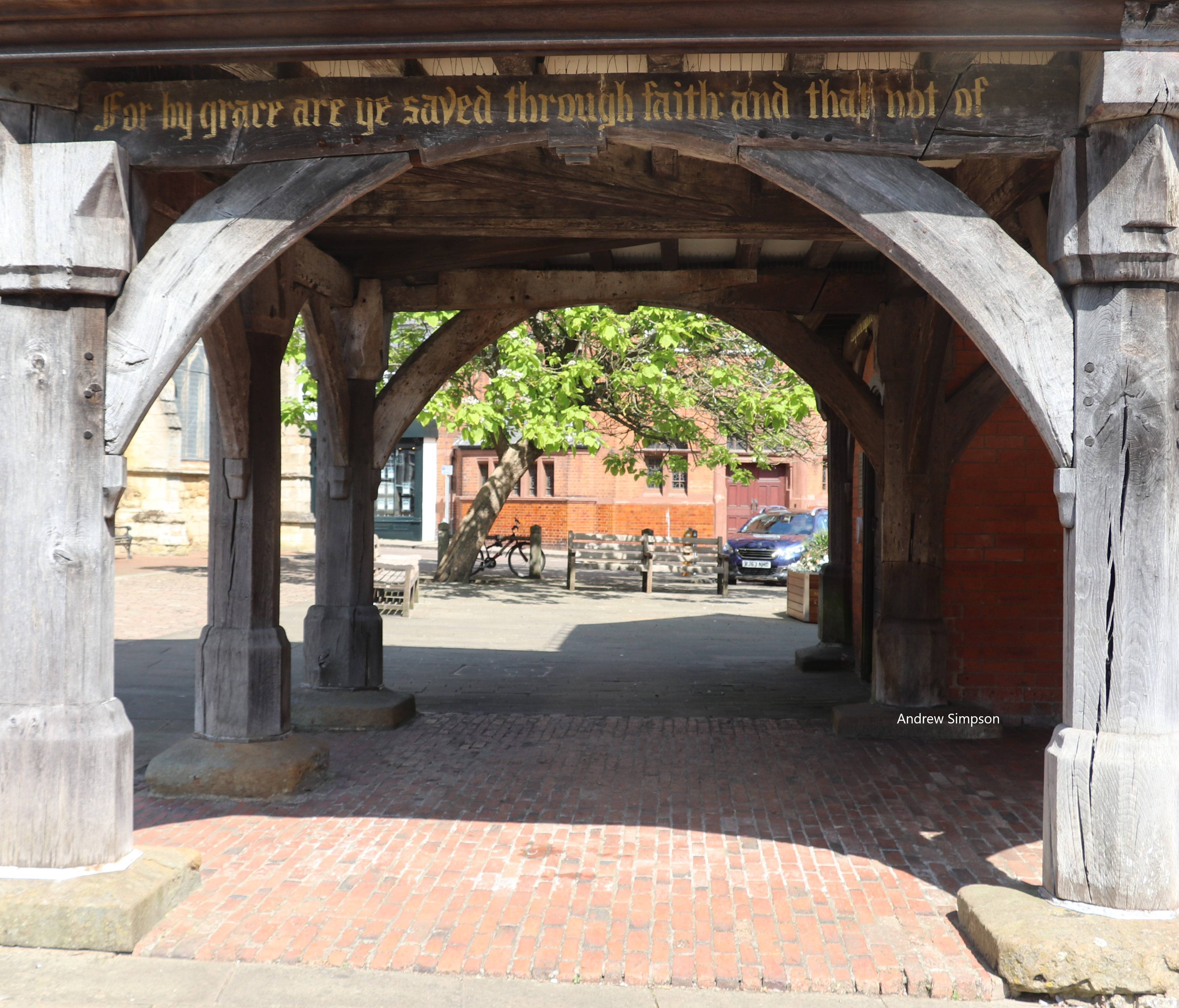
From the Grammar School, 2024
Just when that was is unclear, but like many such places it come into history after the Normans arrived, gaining a market in 1204 an extension to its church a century later and a grammar school in the early 17th century which stands on wooden posts which allowed the space below to be used as a market.

In the same century it was chosen as the headquarters by the Royalist army during the Civil War as the base for which to confront the Parliamentarian forces camped nearby at Naseby.  This turned out to be not so good, as during the Battle of Naseby the Royalists were defeated and the chapel in the town was used to house Royalist prisoners.

People watching in the square, 2024

None of which I knew as we sat in the town square, part of which was given over to a Turkish restaurant.

The sun shone, we ate under a leafy tree and I people watched.

The memorial, 2024
I now know heaps more about its history including the war memorial, and that “in 1950 the canal basin was the venue for a week-long National Festival of Boats, the first such festival organised by the Inland Waterways Association and marking the beginning of the revival of the canal network for leisure use”.*

There is plenty more, but I leave that to you to discover.


Location; Market Harborough

Pictures; Market Harborough, 2024, from the collection of Andrew Simpson

*Market Harborough,  https://en.wikipedia.org/wiki/Market_Harborough


Wednesday, 28 January 2026

Adventures in Middle England ……… from Leicestershire into the Cotswolds …no. 1 the village

When you were born in a city and at the age of 19 exchanged one for another wandering our rural villages can be fascinating.

St Michael's parish church from Eastgate, 2024

It was last week when on a hot sunny day we left the hamlet of Kibworth Harcourt and drove the small twisty lanes with no clear purpose, other than to see what was there.

And that is how just eight miles out from Kibworth Harcourt we arrived in Hallaton which has all you might expect of a village in the heart of the English countryside.

The War Memorial, 2024
These included the war memorial, the church, a school and even a museum which to be fair was only open at weekends.

My Wikipedia tells me that, “The parish church is dedicated to St Michael and is mainly of the 13th century: the aisles were added a century later. 

The church is sited on rising ground and has a dignified tower with a fine broach spire (one of the best in the county); the nave and chancel and aisles have nobility and beauty. 

The sculptured stonework of the north aisle contrasts with the plain battlemented south aisle. A former rector is commemorated by a handsome monument attached to one of the corners.

The village has a famous bottle kicking ritual and "Hare Pie Scramble", which take place usually on Easter Monday. There is a small village museum, offering history of the area. 

Flowers, green stuff and a thatched cottage, 2024
The Hallaton Treasure, a late Iron Age hoard of more than 5,000 silver and gold coins was found at a site near Hallaton in 2000”.*

Alas the pub opposite the war memorial was closed but then it was only 10.30 in the morning.

And at that time little was stirring, apart from a Waitrose grocery van, two teenage girls, and the stone mason working at repairing a wall of the church.

But then there are only 594 people and given it was the summer holidays I guess we shouldn’t have been surprised.  

Through an entrance, 2024

A century and half ago I suspect many of the adults would have been engaged in the fields along with some of the children and others would have been about chores in their homes, making an equally quiet place.

Alternative horizons, 2024
And quiet it was all of which added to the magic of the place, but then I wasn’t a local in my teens wondering how to pass the long days a full sixteen miles away from Leicester.

But I wont end on a down note, because My Wkipedia also tells me that "Hallaton Hall and its lands were owned by Calverley and Amelia Jane Bewicke in 1845. 

Their daughter was the writer and campaigner Alicia Little

As the site of two markets Hallaton was despite its size regarded as a town, even if one of little significance".

The church yard, 2024

And so I should perhaps correct my description of the place as a village and  reinstate it as a town, along with saying "Alicia Little or Mrs Archibald Little (1845 – 31 July 1926) was a British writer and a campaigner for women's rights and later against foot binding in China".**

Not bad for a place of just 594 people.

Location; Hallaton

Pictures; Hallaton, 2024, from the collection of Andrew Simpson

*Hallaton, https://en.wikipedia.org/wiki/Hallaton

**Alicia Little, https://en.wikipedia.org/wiki/Alicia_Little


Monday, 26 January 2026

Heaps of history ….. and the Market Harborough challenge

 I must confess I had never come across that 17th century timber building in Market Harborough which once served as the towns grammar school and covered in market.

2024
According to one source “the former Grammar School of 1614  is a small scale timber framed building with an open ground floor designed to "keepe the market people drye in tyme of fowle weather" and having above it the former school room. This building represents the close of the timber framed tradition of buildings in the area”.*

It is in the heart of a conservation area which includes the former sheep market. 

"The middle section of the original market space now comprises the lower High Street, Church Street, Church Square and Adam & Eve Street. This is the traditional retail hub of the town. It is an area of small-scale buildings of varying ages. ….. 

2024
The centre of this area is Church Square dominated by three buildings, the first two on island sites rising from the pavement. First is the great Church of St. Dionysius with its soaring spire of white limestone. The Church rises directly from the pavement without a churchyard, as it was until 1901 a chapel of the Parish Church at Great Bowden 2 miles away. Secondly, alongside the church is the former Grammar School of 1614,  [and] the third building overlooking the Church and Square is the Council offices, Library and Museum. It is a 4-storeyed former corset factory of 1889”.

We washed up there on a hot day on the way to the small village of Kibworth Harcourt. And as you do we stopped to explore and find somewhere to eat.

The restaurant turned out a good choice, more so because the tables spilled out across the square under the shade of a tree.

2024

And from there we watched as the townspeople went about their business or like us enjoyed a drink, and a meal.

After which we sauntered across the square and while the others  “did the shops” I did the conservation area, but despite all my best attempts I couldn’t get a decent picture of the  grammar school and was left with falling back on a 1905 picture postcard from the company of Tuck and Sons.

1905
To be fair when our commercial photographer did his picture the space in front of the hall would have been less busy and I doubt he would have to have dodged the traffic and snapped away before the traffic lights turned colour.

So that's the challenge .... better the 1905 image.

Location Market Harborough

Pictures; The grammar school, 2024 from the collection of Andrew Simpson and in 1905 from Tuck and Sons, courtesy of Tuck DB, https://tuckdbpostcards.org/ 

*Conservation Areas in Harborough district - Market Harborough Conservation Area, Market Harborough District Council, https://www.harborough.gov.uk/directory_record/1276/market_harborough_conservation_area

Thursday, 1 January 2026

Adventures in Middle England …... no. 5 looking for ghosts

I say looking for ghosts but when we washed up in the village of Hallaton it was less ghosts and more just people that were absent.

The wall, 2024
The village is 17 miles from Leicester, has a fine church, a pub, a museum and a war memorial which shares the spot with the old market cross.

In 2011 it boasted a population of 594, and according to my Wikipedia is famous for the discovery of a hoard of Iron Age coins, runs a bottle kicking event and a "Hare Pie Scramble", which takes place usually on Easter Monday.*

And for those that sneer at the use of Wikipedia, I can testify that Lewis Samuel’s A Topographical description of England published in 1840 reports that “Hallaton is distinguished by a singular annual custom [when] on every Easter Monday the inhabitants meet on a piece of ground which was bequeathed to the use and benefit of the rector who then provides two hare pies a quantity of ale and two dozen of penny loaves to be scrambled for.”**

The house, 2024
And by all accounts it’s a brutal affair and once ended with a riot.  

Now after a bit of a rough and tumble the event finishes in the pub.

There is more but for that you will have to look up the details leaving me to reflect that back in 1840 the population was 664 when some might say its best days were behind it.  

It had been granted permission to have a market in 1224 but this lapsed in the late 17th century, and despite attempts to revive it in 1767  according to Mr. Lewis this “proved abortive owing in great measure to the badness of the roads, which were then nearly impassable in winter”.

Still the market cross or Butter Cross remains as a marker for busier times.  

I have to confess I had never seen one before and couldn’t quite work out its purpose.

But a trawl of Historic England revealed that “A standing cross is a free standing upright structure, usually of stone, mostly erected during the medieval period (mid 10th to mid 16th centuries AD”, and were used for a variety of purposes. *** 


The Butter Cross, 2024

That said the entry is somewhat confusing in that it describes it as a “a good example of a medieval or post-medieval Butter Cross”, but also asserts that the cross is thought to date from the 17th century, with modern repairs and refacing, and marks the location of the weekly village market”.***

The church, 2024
So, you “pays your money and takes your choice” and had we been in Hallaton at the weekend we could have also chosen to do the Museum, but we couldn’t because it was closed.

And that was a shame given that the museum’s site records that “Hallaton Museum was the inspiration of Mrs Honoria Whigham who wanted to record, for future generations, a way of life in a small village community which was rapidly changing.

To this end a great variety of artefacts were gathered to form the nucleus of an historic local collection and a display mounted each year”.****

Still, we wandered through the church yard and had a conversation with a stone mason from Birmingham who was repairing one of the walls.

Alas the pub was also closed, and in all our time in the village we encountered just four inhabitants along with a Waitrose grocery van.  

Walking the graveyard, 2024

But that was enough especially as we discovered a remarkable scheme to honour those from the village who had died in the two world wars.  I could say more but it’s a story I have already written.*****

And by then it was time to move on.

Cottages, 2024
The place remained as quiet at the end of our visit as it had at the beginning and there is nothing wrong in that.

Location; Hallaton

Pictures; walking Hallaton 2024, from the collection of Andrew Simpson

*Hallaton, https://en.wikipedia.org/wiki/Hallaton

**A Topographical description of England 4 vols, Lewis Samuel 1830-40

***Butter Cross, Historic England, https://historicengland.org.uk/listing/the-list/list-entry/1017498?section=official-list-entry

****Hallaton Museum https://www.hallaton-museum.co.uk/

*****Adventures in Middle England ……… from Leicestershire into the Cotswolds …no. 1 the village, https://chorltonhistory.blogspot.com/2024/08/adventures-in-middle-england-from.html

Thursday, 8 August 2024

Adventures in Middle England ……… from Leicestershire into the Cotswolds … No. 2 ..... a mutiny

 This is St John The Baptist in Burford, and it was here that three soldiers of the New Model Army were executed in 1649, following a mutiny over pay and political demands.

Burford Church, 2024

The issue of back pay was resolved, but the political demands went back to the Putney Debates which occurred two years earlier when in the middle of a bitter Civil War in which one in four died the army of Parliament sat down to discuss the future of England after the war with the King.

An Agreement of the People, 1647
Reading the discussions there is something very modern about the position of Colonel Rainsborough who argued that “... the poorest he that is in England hath a life to live, as the greatest he; and therefore truly, Sir, I think it's clear, that every man that is to live under a government ought first by his own consent to put himself under that government; and I do think that the poorest man in England is not bound in a strict sense to that government that he hath not had a voice to put himself under...”

And this in turn reminded me of the Forces Parliaments which took place in the British Army in India and Egypt during the Second World War.  The Cairo Forces Parliament met in February 1944 and voted for the nationalization of the banks, land, mines and transport.

In their way it replicated those debates three hundred years earlier where the men who were fighting debated the future they wanted.

Now the Putney Debates and much more of the visions of the men who fought for Parliament was never taught to me.  

Part of the reason may well have been that the records of the discussions were lost until the beginning of the 20th century but I suspect the absence of this story may also be down to content.

Inside the church, 2024

In an age when history was still taught from top down the idea that there should be an alternative history where ordinary people wanted a share in how their country was run and believed that they had as much a right to that say as the rich and powerful was indeed a challenging one.

And in the case of the three soldiers who were executed it ran against the opinions and interests of the leading members of the army.

The mutineers were Levellers who had argued at Putney for a radical vision of the future including  popular sovereignty, extended suffrage, equality before the law and religious tolerance.

Private John Church, Corporal Perkins, and Cornet James Thompson, 2024
Dissatisfied with the opposition from the leading members of the army known as the Grandees, 400 troopers under the command of Captain William Thompson who were sympathetic to the Levellers set off from Banbury, where they were billeted, to speak with other regiments at Salisbury about their political demands.

The unit was engaged by loyalist forces, defeated, imprisoned in Burford Church where three of the the leaders were shot:

These were  Private John Church, Corporal Perkins, and Cornet James Thompson on  May  17th 1649.

According to the church web site “during their imprisonment,[ some of the the imprisoned  prisoners] left evidence of their time there, in particular a carving by Anthony Sedley in the lead on the font, which is dated 1649. There is also a "nine men's morris" board carved into one of the tombs in the Bartholomew Aisle”.

Walking into the church, 2024
It was by chance that as we headed through the Cotswolds last week we realized we would pass close to Burford, and so chose to break the journey, and after a fine meal at the Angel Inn headed on to the church and the rest is a collection of pictures and sense of walking through a bit of our radical history.

And ever since 1975 people gather each year to remember the Levellers, the Putney Debates and  Private John Church, Corporal Perkins, and Cornet James Thompson.** 

Location; Burford

Pictures; An Agreement of the People, 1647, and the church at Burford, 2024, from the collection of Andrew Simpson

*The Levellers, Burford Church, https://www.burfordchurch.org/the-levellers