Showing posts with label London. Show all posts

Monday, 29 June 2026

A film star, a fish market and a bit of speedway, Britannia of Billingsgate … 1933

Now we can all have slow days, which is how I came to roam the database of old postcards hosted by Tuck DB.*


And having viewed their selection from Italy, I idly typed in film stars, and was rewarded with a rich collection from the 1930s.

Most I had never heard of and so on a whim I went for Kay Hammond, who was born in 1909 and made a series of films through the 1930s as well as appearing on the stage.  

She played  Elvira Condomine, in Blythe Spirit and acted in her last film in 1961, and featured in 24 films in her career of which 19 were made between 1933 and 1936, and of these the one that caught my eye was Britannia of Billingsgate.


If like me you are both a Londoner and someone who grew up in the 1950s and early 60s, Billingsgate Fish Market will be a special place.  It was located by the Thames, close to the Tower of London and the Monument and I passed it regularly on my way to the Tower.

Even at 10’o clock in the morning, long after the market had all but closed the smell of fish lingered in the air along with the odd remnants of discarded fish parts which had yet to be cleared away from gutters.

So I had no option but to look up Britannia of Billingsgate which was released in 1933, and as you do steal the sleave notes from the BFI’s introduction to the film.

“A star is born (or at least found) in a fish and chip shop, in this effervescent musical comedy that jaunts between the cloth caps of Billingsgate Fish Market and the top hats and heady glamour of the film world. Things have never looked so good for Billingsgate chippy owner Bessie Bolton (Violet Loraine) after she is presented with the opportunity of becoming the singing sensation of the silver screen - Shepherd's Bush style.


Violet Loraine had been a music hall star since the early 1900s, but was here returning to showbiz after a break of more than a decade. The film also features an early role for John Mills. The studio where Bessie gets her big break is the Shepherd's Bush Studios belonging to the production company, the Gaumont-British Picture Corporation. The cinema where Bessie's film is premiered is the Gaumont Palace in Hammersmith - now the concert venue the Hammersmith Apollo”.*


It is a mix of “glamour”, some iffy scenes of working class life, but is still a wonderful watch and is free to see on the BFI web site.

Location; London, 1933

Pictures; Kay Hammond, Violet Lorraine, Gordon Harker, and John Mills, marketed by Tuck and Son in the series A GAUMONT-BRITISH PICTURE, STAR, PLAYER or FILM (scenes from movie), cards numbered 150-199, courtesy of Tuck DB, https://tuckdbpostcards.org/ 

*Tuck DB, https://tuckdbpostcards.org/ 

**Britannia of Billingsgate, BFIPlayer, https://player.bfi.org.uk/free/film/watch-britannia-of-billingsgate-1933-online

Sunday, 28 June 2026

Another of those vanished scenes ........... the Thames and Tower Bridge

Now you will have to be the wrong side of 40 to be able to recall this scene.

The date on the card is 1936 but the scene with cargo ships discharging all manner of things from around the world was still pretty much the same two decades and bit later.

I remember crossing London Bridge as a youngster looking across to Tower Bridge with the wharves and cranes on the south side and the old fish market on the left.

Location; London

Picture; the River Thames and Tower Bridge, 1936 from the series London by Tuck & Sons, courtesy of Tuck DB, http://tuckdb.org/

Saturday, 27 June 2026

This Is London ........ a unique guide to the London of 1959

Now I have no idea why I never got a copy of This Is London.*

Cover of This is London
I guess that there are only so many books that you can get for Christmas, and with the Eagle Annual and the odd history book that was enough.

Not that I think I would fully have appreciated it back then when I was only ten all of which is so different now.

It is a witty, informative guide to the London I knew as a child and is full of marvellous images in the style of the period and these alone take me back nearly sixty years.

But it is also the humour which shines through and marks it as something original.

It starts with a page of brown sludge with the occasional splash of yellow accompanied with “Well, this is London. 

 But don’t worry, it is hidden in fog like this only a few times a year in winter. Most of the time it looks- like this!”

And that is the start of a wonderful series of bright colourful and exciting paintings of London with a text to match.

All of which is a riveting read and one that has now become a history book in itself.

So much so that the new edition which was published in 2004** has updated some of the entries,  pointing out for instance that “Today the Billingsgate fish market is located in the Docklands, a rejuvenated section of the London Docks.  It moved there in 1982.”

Now that move passed me by and while I have no doubt it was for the best I have vivid memories of the market, the over powering smell and the debris left on the streets on a Saturday morning only hours after the traders and the fish had left for shops across the city.

Three million passengers are carried daily in Underground trains
It is just one of the moments which bounced out of the past along with those electric milk floats, old Routemasters and a river which was still a working river full of ships from every corner of the world unloading their cargoes under the shadows of tall cranes and massive warehouses.

All of which I remember and for those like my own lads who never knew that London, Mr Sasek’s book has it all.

And so as you would expect I have gone looking for other editions in the same series which included, Paris, Rome, New York, and San Francisco.

In time I might order up the reprints of New York, and San Francisco, but at present I am content to wait for the arrival of This is Rome which was originally published in 1960 and reprinted in 2007.

Like This is London it has an page of updates which will be fun to match with the original text and my own memories of a city we regularly return to.

Now ever one to respect copyright I held off posting and substitute the same story but with images drawn from the collection.

However after contacting the publisher it appears at present no one knows who owns the copyright to the illustrations, so as the blog is no commercial and this is about encouraging everyone to buy read and share the booksof Mr Miroslav I can't think anyone will object, but if they do I shall revert to the original.

And for those intrigued by the books there is a site dedicated to the author and his books.

Picture; cover from This Is London, and Underground train page 42 courtesy of Universe Publishing

*This Is London, Miroslav Sasek, 1959

**Universe Publishing, a Division of  Rizzoli International Publications, New York, www.rizzoliusa.com

***This is M Sasek, http://www.miroslavsasek.com/index.html

Friday, 26 June 2026

Dancing across London …. and on in to Bermondsey ….1965

I like musicals, and so when I saw a trailer for a 1965 film about London and especially Bermondsey, I was hooked and sent off for the DVD.

My River, 1968
For what ever reasons I never saw the film at the time, which might be because it never quite made it to the Well Hall Odeon or the ABC in the High Street

But more probably because back then I didn’t fancy watching Joe Brown, Una Stubbs, Sophie Hardy and Sid James, sing and dance their way around London to an implausible plot, which involved them trying to steal, a bowler hat, Guardsman’s bearskin, and a police helmet.*

But fifty-five years on, having exchanged south east London for Manchester I decided it was worth the £6.

Well I rather think the jury is out on value for money.

I have lots of  time for Joe Brown, Sid James and Una Stubbs, all of whom are superb in their own fields, added to which, the support cast were good, and the backdrops were of a London, long gone.

As for the film, its plot and the quality of the songs, I rather think the writers and producer might have been better employed staying at home.

But a bit of me always wants to be generous to anyone who creates something, and it is easy to be critical.

Looking out from Occupation Lane, 2019
So, forget the story line, along with the songs and some dodgy acting, and instead focus on the bigger canvas, which is that London I grew up with and fondly remember.

The River is still flanked by a forest of cranes, the skyline has yet to be dwarfed by tall nondescript buildings, and there is a mix of touristy London with the sort of places I grew up in.

All of which makes it a piece of history well worth watching, not only for the sights but also for a type of “kids” musical where a group of working-class youngsters make fun and come out OK.

Not that I can empathise with the last bit.  I certainly had fun, but my growing up was more mundane, and ordinary.

Added to which I rather think that Cliff Richard did that style of movie a bit better.

Still, the notes on the back under special features holds out the promise of something good from the image gallery.

We shall see.

Location; London, 1964-5

Picture; The River as I remember it, 1968, and Looking out from Occupation Lane, 2019  from the collection of John King

*Three hats for Lisa, 1965

Saturday, 20 June 2026

Of Waterloo sunsets, Peckham Rye and the Pleasuance at Well Hall

Now it is just one of those things that you miss where you grew up.

Coming home, 2013
It is such an obvious statement but is none the less true.

I left south east London in 1969 for Manchester unsure what was ahead of me but convinced that I would be back, but like most plans it never happened.

Manchester is where I ended up, got married bought a house and brought up four kids.

In my twenties I can’t say I missed London and I guess it wasn’t until quite recently, long after I qualified for a concessionary bus pass and reached an age to be rewarded with the being offered a seat on the tram that I began to think of home.

Well Hall, 2011
And home really only begins when the ferry docks or the  train pulls across the river into Waterloo and then I know I am back.

Another 20 or so minutes later and after the train has taken that curve I have arrived home in Eltham.

But then because we moved around, the train could quite easily have taken me to Queens Road or New Cross and because for a long time our Elizabeth lived in Plumstead and Woolwich there was that other set of railway stations.

My kids always know which special song to play for me and ever since I first heard Waterloo Sunset it has been my tune, with a special meaning given that Kay and I would meet every Friday night under that clock.

Ten years earlier Waterloo Station would be one of the destinations along with London Bridge which would be the start of an adventure.

Woolwich, 2015
For with 2/6d pocket money and aged just ten there were lots of places you could go for a modest return fare and still have change for a variety of sweets.

Sometimes you struck gold and on other occasions you ended up in a dreary back street beside a canal with grim tall buildings all around you.

But that didn’t matter because the fun was in the expectation of where you might go and once there roaming across the city in search of anything that looked interesting.

And there were the bombsites which were still pretty much in evidence all around us.  Most of the time there wasn’t much to discover, but once we found a gas mask still in its box with the green paint and black rubber looking brand new.

Woolwich, circa 1940s
And then there was the old bombed church of St Mary’s which was a place where with a shared candle  a group of you could wander through the crypt anticipating all sorts of horrors and finding only a damp and smelly mattress.

Some adventures turned out not so well, like the time me, Jimmy O’Donnel and John Cox having walked from Lausanne Road to Greenwich, took the wrong turning by the entrance to the foot tunnel and instead of standing on the sand in front of the Naval College we turned left walked amongst the barges and sank up to our ankles in oily Thames mud.

To this day I remain ashamed that I blamed the other two when mother interrogated me on arriving home.

Worse than the interrogation was the bath that followed which seemed to take hours and involved much scrubbing to remove the dried mud from me and even longer to make my shoes half decent.

Today those trips are less perilous but no less fun and often involve a brief visit to an old haunt like the Pleasaunce at Well Hall which is only a few minute’s walk from our old house.

Cambden Church, 1904
Of course I am well aware that the places of my youth have changed and as in the case of Woolwich pretty dramatically but I don’t subscribe to that throw away judgement that places I knew are “now rubbish”, they are just different and no doubt there would be those catapulted into the 21st century from 1900 who would mourn the passing of the “smoke hole” at Woolwich and wish there were two lanes of traffic forcing their way down Powis Street.

I suppose for those of us who leave it is always a bit odd to be confronted with the disappearance of all our childhood memories.

That said I never tire of Waterloo Sunset or arriving south over the river.

Location; south of the river

Pictures from the collection of Andrew Simpson, Scott MacDonald and Elizabeth and Collin Fitzpatrick and Steve Bardrick, Camden Church Peckham Road, circa 1904, Albert Flint Photographer and Publisher, 68 Church Street, Camberwell in the series Camberwell, marked by Tuck and Sons, and reproduced courtesy of Tuck DB, https://tuckdb.org/

Friday, 19 June 2026

A bit of the “other side” of London life in 1851 ................. stories from Henry Mayhew

"Of the thousand millions of human beings that are said to constitute  the population of the entire globe, there are – socially, morally, and perhaps even physically considered – two distinct and broadly marked races  viz., the wanders and the settlers-the vagabonds and the citizen – the nomadic and the civilized tribes.”*

Detail of a Costermonger
And with that Henry Mayhew plunges you in to the London of 1851.

The original accounts appeared first as articles in the London daily press, were then published under the title London Labour & the London Poor in 1851.

And just over a century later my edition of Mayhew’s London was issued, bought by mum and long ago passed to me.

Here are descriptions of what he called the “Street Folk” ranging from the “life of a Coster-lad," "the Dredgers or “River Finders” and the “Bird Catchers.”

Along the way there are detailed descriptions of the area like the London Street Markets, the language of the Coster mongers and much else.

So armed with Mr Mayhew’s guide I would happily have been able to know that “Flatch” was a halfpenny “Cool the esclop” meant “Look at the police” and if I was told the beer house was “Kenneteeno” it would have been stinking while the chap in the corner who was “Flach Kanurd” would have been drunk.

The Kitchen Fox Court Gray's Inn-Lane
What makes the book just that bit more fascinating is that it came out in the year 1851 which means that it is possible to crawl over the detailed census records matching his descriptions with the streets, courts and “dark places” that made up this bit of London.

If I am honest I have neglected Mr Mayhew over the years, spending my time on the equally unforgiving streets of Little Ireland, Deansgate and Angel Meadow in Manchester.

But with long summer days ahead, I rather think I shall leave the computer and sit in the garden with this slice of mid 19th century life form the city where I was born.

That said my edition according to the editors “has been designed for the convenience of the general reading public [and much] interesting material including all the longer passages has been sacrificed.”  
And that has meant the “contents of the entire fourth volume on prostitutes, thieves, swindlers and beggars have been omitted in entirety.”

Ah well you can’t have everything. Although just last week that has been sorted as our Saul has got me the full edition.

Location, London 1851

Pictures; the Kitchen Fox Court Gray’s-Inn- Lane and the London Costermonger, from London Labour & the London Poor 1851

*Henry Mayhew, Introduction, London Labour & the London Poor 1851,

Monday, 15 June 2026

A bit more of the “other side” of London life in 1851

"The first rats I caught was when I was about nine years of age. I ketched them an Mr Strickland’s a large cow keeper, in Little Albany –street, in Regent’s park.”  

Now if you wanted a pretty colourful way of being invited into the life of a nine year old on the streets of London this is as good as you can get.

It comes from observations of Henry Mayhew whose descriptions of London life appeared first as articles in the London daily press, and were then published under the title London Labour & the London Poor in 1851.*

And the rat catcher Jack Black was just one of hundreds Mr Mayhew interviewed.

Just over a century later my edition of Mayhew’s London was issued, bought by mum and long ago passed to me, and for Christmas our Saul bought me a new edition.

All of which I like because of that sense of continuity.

And like so many books which reported on the conditions of the working classes in the 19th century it has a direct relevance to BHC because although the scheme began almost a full twenty years after Mayhew began publishing his accounts, many of those who walked across his pages will have had children and some of those might have been migrated.

Now that is not to suggest for one minute that most of the people he wrote about were feckless or bad parents merely that his stories show those Londoners on the very margin and by extension could represent the urban poor in any one of a dozen British towns.

And that makes his book compelling reading because there is no doubt that a full two or three decades after its publication a lot of the descriptions in London life could be replicated.

I have no idea what happened to Jack Black who went on to tell Henry Mayhew “at that time Little Albany –street, in Regent’s park was all fields and meaders in them parts  and I recollect there was a big orchard on one side of the sheds I was only doing it for a game ........... When a rat bite touches the bone, it makes you faint .... in a minute and it bleeds dreadful.”

What is interesting is that amongst all the gruesome details of rat catching Mr Black revealed that at the age of 15 he had got interested in birds and during his conversation he gave a series of renditions  of different bird songs.

On one level we shouldn’t be surprised but it does challenge that picture that many have of the urban poor in the middle of the 19th century.

And that is all I am going to say, other than that it is a fascinating read.

And one I shall return to ... again and again.**

Location; London

Picture; the Boys Crossing-sweepers,  from London Labour & the London Poor 1851

*Henry Mayhew, Introduction, London Labour & the London Poor 1851

**A bit of the “other side” of London life in 1851 ................. stories from Henry Mayhew, 
https://chorltonhistory.blogspot.com/2020/05/a-bit-of-other-side-of-london-life-in.html

Sunday, 14 June 2026

The skip ……. a man with a van …… and tales of recycling ….. with a nod to the dustman, shore man and sewer hunters

 There is a lot to be said for the recycling man with his van.


I say man, but there is more than one, and as like as not it will be a woman.

Some come quietly in the early morning while others will announce their presence with a loudspeaker alternating between bursts of music and the cry, “fridges, old boilers, pipes and assorted scrap”.


For those like me who were born in the first half of the last century, it brings back memories of the Rag and Bone Man who travelled the streets with a horse and cart and called for “any old iron” or whatever took his fancy.

Then like now it was a one-way trade in which you disposed of the goods, which he accepted and later would sort out and sell on.

As a form of recycling, it worked and does so again.

So early yesterday morning the man with the van stopped outside Sidney the skip, rooted round, picking out a sink and a couple of kitchen cupboards.

Being a discerning sort of chap, there were items he discarded having first pulled them out, inspected them before throwing them back.

Nor will he have been alone.  One skip close to us was visited three times one morning, with a different team calling the following day, when the skip was again almost full.

Now none of this is new, and a quick flick through the past will reveal the extent to which people of the mid-19th century made an even more precarious living from other people’s rubbish.

They were on the margins of poverty and garnered an income from sifting through the left behinds.

So, my Mayhew* written in the first half of the 19th century picked over occupations like the dustman, shore man and sewer hunters, all of whom found value in the valueless.

Shore workers worked the sewers, in “gangs of three and four for the sake of company, and in order to better defend themselves from the rats …… [finding] great quantities of money – of copper money especially; sometimes they dive their arm down to the elbow in the mud and filth and bring up shillings, sixpences, half crowns and sovereigns. **

Even more central to London life were the dustmen who carted away the dust and ash from the capital’s homes.  

Mayhew estimated that the consumption of coal in the metropolis was, 3,500,000 tons per annum which in turn created a vast mountain of ash and cinders, and as ever where there was muck there was money. 

Like everywhere that money was made by a handful of contractors while the dirty work fell to those they employed.

These men carried the ash to the dust yards where an army of labourer’s sifted through the rubbish which threw up oyster shells, old bricks, old boots and shoes, old ten kettles, as well as old rags and bones.  None of which could be recycled into brick making but ended up as hard core for new buildings or new roads.

While old shoes were sold to London shoemakers who used them to stuff between the in-sole and the outer one, leaving the rags and bones to be disposed of at the marine-store shops. ***

It is a story which is worth a deeper study, but for now I think I will just reflect that the passage of 170 or so years has left our man with his van marginally better off.

We shall see.

Location; London 1851, Chorlton, 2021

Pictures; The London Dustman, and View of a Dust Yard, London, 1851, and skips I have known giving up their treasures, Chorlton, 2021, from the collection of Andrew Simpson

*Henry Mayhew, London Labour & the London Poor 1851London Labour & the London Poor 1851

** Mayhew page 330

*** ibid Mayhew page 350

Saturday, 13 June 2026

Of the street sellers of Ices and Ice Cream .... and the day in 1851 when Mr. Mayhew got it very wrong

Now when I want to fall back into the London of the 1850s, there is no better source than the observations of Henry Mayhew whose descriptions of London life appeared first as articles in the London daily press, and were then published under the title London Labour & the London Poor in 1851.*


They are a fascinating insight into how the poor lived and worked, and chief amongst these were the street sellers, and these I have already written about.**

And so as I have become interested again in the manufacture and sale of ice cream in the 19th century I turned to Mr. Mayhew, who for once didn’t quite get it right. 


"I have already treated of the street luxury of pine-apples, and have now to deal with the greater street rarity of ice creams.

A quick-witted street seller – but, not in the provision’ line- conversing with me upon this subject, and said: ‘Ices in the streets! Aye, and there will be jellies next and then mock turtle, and the real ticket, sir.  I don’t know nothing of the difference between the real thing and the mock, but I once had some cheap mock in an eating house, and it tasted like stewed tripe with a little glue.

You’ll keep your eyes open sir, at the Great Exhibition; and you’ll see a new move or two in the streets, take my word for it.  Penny glasses of champagne, I shouldn’t wonder.

Not withstanding the sanguine anticipation of my street friend, the sale of ices in the streets has not been such as to offer any great encouragement to a preservation of the traffic”.

Alas Mr. Mayhew didn’t include pictures of the ice cream sellers, so I have fallen back on The Baked Potato Man, and the London Coffee Stall.

Location; London in 1851

Pictures; The Baked Potato Man, and the London Coffee Stall, 1851 from  London Labour & the London Poor 

*Henry Mayhew, Introduction, London Labour & the London Poor 1851

*London Labour and the London Poor, https://chorltonhistory.blogspot.com/search/label/London%20Labour%20and%20the%20the%20London%20Poor


Friday, 12 June 2026

On being 10 in the summer of 1961 with a Red Rover and a city to explore

Now if you are of a certain age this Red Rover will be your passport to many happy memories.

Andy's ticket to roam, 1965
It offered unlimited travel for a day across London and  I can think of no better thing to do than travel anywhere those old red double deckers would take you.

In 1960 we were still living on Lausanne Road and I think we would have collected the ticket from the New Cross Garage, which begs the question of where I might have picked one up in Eltham.

I am pretty sure you couldn’t buy them on the bus but I guess someone with put me right on that.

Andy sent me this one just a few minutes ago adding, “as a bus spotting nerd I used to use these lot. This one was purchased 2 days after I was 12 3/4 years old. 

I would plan my journey taking in various bus garages, leave about 7 in the morning armed with salad cream sandwiches and arrive home about 10 hours later, all on my lonesome!”

Sadly I never had the forethought to plan in advance, going off on the spur of the moment when the sun shone and the pocket money was burning a hole in my pocket.

Needless to say some at least of my adventures ended in the most disappointing places.

The White Tower in the Tower of London, 2014
It remains one of those cast iron certainties that just because a place sounds interesting and the bus goes there it doesn’t always mean that the destination will prove memorable.

Even now I shudder at the thought of the run down canal beside some sad looking buildings which proved not to be the highlight of one trip.

But then the beauty of the Red Rover was that you could just wait for the next bus and travel on to pastures new.

And all the time there were things to see from out of the window.

 So even if the front seats on the top deck were taken there was always that seat behind the driver which not only offered up the same view that he could see, but with a bit of imagination allowed to imagine you were driving the 161 down to Woolwich or the 36b across town.

In my case it would start and sometimes end at the Tower of London, but that as they is another story.

Instead I shall just reflect that having reached that magic age which qualifies me for a concessionary bus pass I can and do roam across the city making full use of both the trams and the trains.

So there you have it, one Red Rover a shed load of memories and not once did I throw in that title of a Beatles song.

Location; pretty much anywhere in London

Picture; a Red Rover, 1965 from the collection of Andy Robertson, and the Tower of London, 2014 from the collection of Ryan Ginn


Thursday, 11 June 2026

That food factory ……. the River ……. and a conversation

Just when I spent my dinner times gazing out over the River talking about music, the chance of over time and pretty much everything is lost.

I think it will be the summer of 1970 and the location was Glenville’s the food factory down by the Blackwall Tunnel.

It could have been the year before or the year after.

Glenville’s made a variety of things from custard powder, and sachets of flavoured water you left in the freezer, to their specialty which was turning powdered milk into granules.

Of all the jobs this was the most unpleasant given that I was tasked with filling large bags of the milk granules as they shot out of a pipe.

It didn’t help that the regulating tap didn’t work very well so you used your hand to stem the flow just long enough to get a bag underneath, and that it came out very hot from being blown through a set of stainless-steel tubes.

Added to which the sweet-smelling stuff stuck to your overalls and worse still your face which on very hot days was prone to mix with your perspiration to form rivulets of milky sweat.

Nor was that all because while we were paid a basic wage there was a bonus for the amount that was produced, and there was the flaw, because on wet and damp days the granulated milk clogged the tubes and production ceased.

At other times I worked in the dispatch area on the ground floor at the end of a long conveyor belt which disappeared into the roof and on to another few floors.

Loading the boxes of assorted “stuff” was never the problem only that they came down at a ferocious pace, and if not unloaded quickly enough would cause a long jam, which the pressure of more from on high meant that sometimes the boxes burst open showering us in clouds of custard or blancmange powder.

All of which meant that breaks and dinner times took on a special place in the day.

And it will have been on one of those that I met up with a South African.

He was the first South African I had met, and I was fascinated by him.  He was a few years older than me, and he had already traveled thousands of miles across two continents, while I had just got the bus from Eltham.

Over half a century later I can’t remember what we talked about other than that song America by Simon and Garfunkel, which chronicles the journey across the US by two young lovers.

We shared the magic of their journey and each of us in our different ways conjured the trip from Saginaw, in Michigan via Pittsburgh to New Jersey.

And now all those years later I have no idea what he looked like or our other companions, and our dinner time conversations are lost.

But listening to America brings back my time in Glenville’s from the smell of the various products being made, along with that of the River to that carefree and optimistic take on life which at 20 I shared with Kathy and her lover.

I still have that optimistic take but long ago lost Glenville's, and despite frequent visits to the area its exact location remains elusive.

So I await a photo, an address or a memory from someone who like me passed a batch of his early 20s at the food factory by the River.

Location; Glenville’s, Greenwich

Pictures; by the River, 1970s, from the collection of Andrew Simpson

Friday, 30 January 2026

Memories of that other Thames ……

 I don’t know if cargo ships still berth along my bit of the River at Greenwich.


But someone will know, and I hope will tell me.

I left London in 1969 and while I still came home for holidays my visits to this bit of where I grew up became less and less.

But back in the late 1970s I did wander the water with a camera and recorded what I saw.

To some they will be dismal, and grimy but they were my part of London.

What strikes me about the berthed ship is how deep the inside compared to the men.

It’s a silly observation given that the hold had to store heaps of things, but it reminds me of just how different the Thames at Greenwich was five decades ago.

The image is one that sat as a collection of negatives in our cellar for 40 odd years, and only recently has come out of the shadows as I digitalize those pictures.


And Peter from Greenwich added "Good evening Andrew, I always enjoy your pictures of the grimy industrial part of my hometown. 

The coaster on the mud at Lovells was one of the first of a type designed with elevating wheelhouses and masts ets to work upstream on the Rhine and other European rivers. The depth of the hold would have probably been around 4 metres".

Location; The River Thames

Pictures; waiting to load, the Thames, 1979, from the collection of Andrew Simpson


Tuesday, 6 January 2026

As others see us ......... Well Hall in the summer of 1966 by Ian Nairn

The thing about guide books is that they date so quickly.  

But that can be what makes them so intriguing and that pretty much sums up Nairn’s London.*

It was published in 1966 and I picked up my copy over 20 years later from Bryan the Book.

And that is a tale in itself given that Bryan’s bookshop on Beech Road in Chorlton-cum-Hardy is 214 miles from Well Hall where I grew up.

Nor is that all for the original cover price was eight shillings and sixpence and I bought it for 40p.

The publisher warned that “some of the entries are already disappearing; so go and see the rest quickly.”

That said it is reassuring that the places in Well Hall and Eltham visited by Mr Nairn are still there, although not all are described in that fulsome and respective manner of most guide books

So in writing about Eltham Lodge he comments, “nothing great, but worth at least a sentimental journey to see this grandfather of all Georgian brick Boxes.”

But I am pleased my own estate fared not only better but also was described with a little affection.

“Well Hall Estate, Eltham Sir Frank Baines and others, 1916

This extraordinary place was designed in seven days as a rush job to house war-workers for Woolwich Arsenal.  It seems an odd recipe for one of the best housing estates near London.  

Perhaps the architects imply did not have time to air their preconceptions, and the local officials their disastrous application of bye-laws.  


Comfortable, cottagey design, slate and stucco, taken out of the rarified atmosphere of the garden cities, always trying to see streets as entities rather than collections of units.  

The best part is Ross Way, running from Well Hall Road at the junction of Rochester Way.  

This curves round a gentle slope with a raised footpath and uses every possible trick of gables and end walls.  

Half way along, footpaths run off under archways as part of a fairy-tale composition which by an irony is more like a German village than anything else.”***

It is a long time since I have looked through the book but with a wet weekend ahead I think I shall spend a few hours crossing London courtesy of Mr Nairn.

And as the publisher promised the book is the first of a series with one planned for the Industrial North, which sadly was never written which is a shame because  having said some nice things  about where I grew up I wondered if he would do the same for where I now live.

Well we shall see.

Picture; cover from Nairn’s London, 1966

*Nairn’s London, Ian Nairn, 1966

**ibid page 207


***ibid page 208

Monday, 5 January 2026

Standing outside Charing Cross Railway Station in 1904 .......the one with the hotel

 This is one of those places instantly recognizable to anyone who lives south of the river.


And despite the fact that the image and the picture postcard were made at the beginning of the last century there is much that is still the same.

Of course, I am well aware that on the platform side there has been a huge transformation, but as I have never seen the new Embankment Place which sits above the platforms, and my memories of walking through the redesigned concourse are vague, I cannot comment.

But as an old duffer, I was saddened to read that most of the 1906 iron and glass roof above the platforms has gone, but looking at pictures of the concourse it seems cleaner than I remember it.

And it is nice to see the large clock beside the exit is still there, leaving me to hope someone will post pictures of the station as it is today.


The station dates from 1864, and the hotel from a year later.  

At its opening the hotel had 250 rooms spread out over 7 floors, and was so popular that an extension with 90 rooms was a added thirteen years later.

It is a place I have never visited, and a bit of me wishes I had.

The postcard was marketed by Tuck and Sons, with the note that it was from their Christmas and New Year catalogue of 1904/05 under the series titles of London Town and City and London View.

And yes I am well aware that many railway stations had a hotel.

Location; London

Picture; Charing Cross Railway Station, circa 1905, marketed by Tuck and Sons,, courtesy of Tuck DB, https://tuckdbpostcards.org/about


Saturday, 11 October 2025

Looking deeper into the people who supported a children’s charity ........ Miss Malvey and social reform

Now as I dig deeper into the story of the Manchester children’s charity I have become fascinated by the people who toiled tirelessly to improve the lives of the young people they encountered.*

And in particular have been struck by what motivated them to give up their time and money which in many cases stretched over decades.

The conventional assumption is that for most it was either down to strong religious beliefs or that vague term humanitarian concerns”.

Neither on their own is very satisfactory as an explanation, and obscures the subtle differences in why people supported the charity.

In most cases it started with that most basic concern that in what many called the second city of the Empire where conspicuous wealth and great commercial success were everywhere to be seen, just yards away children were hawking goods for a pittance and some were sleeping rough while others were in families which had toppled over into real and abject poverty.

The response as ever was mixed but for those who didn’t cross the road the challenge was not just the short term one of “rescue” but the longer and more positive one of offering care and vocational training to enable young people to lift themselves towards a better life.

Of course even the most respectable and hard working were at the mercy of unforeseen events ranging from a trade depression and unemployment to sickness or the death of the breadwinner which could pitch a family into the workhouse.

For some like Olive Christian Malvey that understanding of the reality of working class life appears to be what brought her to the Manchester and Salford Boys’ and Girls’ Refuges.

Until recently she was just a name on one of the charity’s annual reports and a face on a page from one of their publications. **

But I was intrigued by the reference to her as the author of Soul Market “who, in such an intensely practical way has done much for the homeless girl and woman in London.  

The first shelter she provided for this class of needy ones was opened by Her Royal Highness the Duchess of Albany.  Those who have read that striking book ‘The Soul Market’ will know that [she] speaks on the subject from personal experience.”***

The book was one of a number Miss Malvey wrote in the early years of the 20th century and arose from a series of articles she wrote for Pearson’s Magazine about the lives of working class women in one of the poorer parts of London.

Soul Market was published in 1907 and was followed by Baby Toilers, and White Slavery.

All in their way deal with the issues of poverty, and appalling work practices.

Soul Market consisted of twenty chapters ranging from ‘Up and down the Social Ladder – From a Society Crush to the Spike,’ ‘Gliding the Gutter’, ‘In the Sweating Dens of West and East London’, and ‘Women who Work and Babes who Weep.’

There are a number of useful biographies about Miss Malvey of which Olive Christian Malvey: journalist, ‘lecturer, reciter, and social worker’, by Sarah Jackson is particularly informative.****

And for anyone interested in the migration of young people by the charities Miss Malvey struck an interesting position.

During the annual meeting of the Manchester and Salford Boy’s and Girl’s Refuges, she said “She was sorry that so many had to be sent away to Canada.  It would be better if they could have homes and parents in England, but since they had not it was a good thing that that could be sent to such a beautiful wide land as Canada.”****

Some might jib at what still seems an abrogation on the part of a British social reformer to criticise the policy but it fits well with that general view held by some that the migration of young people to Canada was wrong, and when I have delved deeper into her writings we may find confirmation that that was so.

In the meantime, Soul Market, Baby Toilers, and White Slavery are all available as down loads.

Location; Manchester & London


Pictures; Miss Malvey and other scenes from her book Soul Market, 1907 and Miss Malvey in 1912, from the Children’s Haven page 14

*A new book on the Together Trust, https://chorltonhistory.blogspot.co.uk/search/label/A%20new%20book%20on%20the%20Together%20Trust

**The Children’s Haven, April 1912

*** The Children’s Haven, April 1912, page 13

****Olive Christian Malvey: journalist, ‘lecturer, reciter, and social worker’, by Sarah Jackson in particularly informative, http://eastendwomensmuseum.org/olive-christian-malvery-journalist/

**** Saving the Children, Work of the Boys ‘and Girls’ Refuges, Manchester Guardian, April 12 1912

Monday, 4 August 2025

Living that "low dishonest decade," an autobiography of London life in the 1930s

Cover of What Happened to Tom Mix? 1969
Now it is not often that you get to read an autobiography of someone you knew.

And when I say knew I mean just that.  Ted Willis was a writer and politician and for just over a year I went out with his daughter.

I was welcomed into the family and even went on holiday with them which was pretty much something given that it was a cruise around the Mediterranean
 on the Canberra.

It was around the time of that holiday that he told me about Tom Mix and his autobiography which I rather think he wrote during that cruise.

Whatever Happened to Tom Mix? covers the first thirty years of his life and is a vivid account of growing up in a poor part of London.

Here are the stories of children’s games including clay marbles, box carts and “knock down ginger” of cheap sweets which were still on offer when I was growing up and of harsh as well as inspiring teachers who offered an exciting window into another world.

It is of course a book of its time and just thirty years later while I was growing up in a similar part of London much had changed to make my childhood less of a struggle.

The post war years were dominated by the Welfare State, full employment and a growing level of prosperity.

That said I grew up with the stories of the Hunger Marches, the Means Test, and the long years of unemployment which dominated the decades between the end of the Great War and the start of that war against Hitler.

They were still bit deep into my mother’s mind, including being sacked at the end of her apprenticeship at the local silk factory along with all the others because to retain them on the pay roll would have been to pay them a full wage.

And also the accounts of my grandfather walking the five miles out of the town because he had heard that a local firm were taking on men only to find a hundred were already at the factory gates.

All of these were here in the autobiography and like my mother’s memories were overlaid with a clear political message of where the blame lay for the social injustice of the period.


Advance, 1938
It is just a clear well written account of one young man’s growing political activity ranging from his first years in the Labour League of Youth to confronting the Black Shirts and above all in organising food supplies for Republican Spain during the Civil War.

And it is this part of the book which fascinates me most for here is a vivid account of the political struggles and his own experiences of Spain which he visited three times during the war.

Even now I do have to sit back and reflect that the first time Ted made his way to Madrid by a long and torturous route he was just 19 the same age as I was when I came to Manchester, but while I had done a series of temporary jobs after school spoke a lot about the injustices of the world he had organised the massive job of coordinating food and medical supplies from a warehouse in London and visited Spain three times.

But he would have been the first to point out that everyone’s contribution is different and mine was to come later, although even now I cannot claim it ranks with his.

So the final words are his

“We did not accept the world as it was, and we put what strength we had to the task of changing it for the better.”

Now you can’t say more than that.  Along the way I was introduced to  London which was familiar but still different, of child hood games I also played and of a world alternating between great hardship and hope.

And as for Tom Mix, well you have to be of a certain generation to know of him.  In my case it was Ted who introduced me.

Picture; from the cover of Whatever Happened to Tom Mix? and Advance, paper of the Labour League of Youth edited by Ted Willis, 1938, courtesy of hayes peoples history, http://ourhistory-hayes.blogspot.co.uk/2008_09_01_archive.html


Friday, 20 June 2025

Sweet Thames Flow Softly*


The Thames Flows Down is another of those wonderful children's books written in the 1950s.

It was the companion to  A Valley Grows Up by Edward Osmond.*

The Thames Flows Down was  written by Laurie Osmond and  illustrated by Edmund and tells  the story of the River Thames from its small beginnings to the point when it flowed into the sea.

It is a  mix of history and geography, with the added bonus that it was written in the 1950s and perfectly captures the river and London at a point in time now long gone.

This is my river, that working waterway, when there were still warehouses on the south side facing the Tower of London, and when the docks still provided serious work for many families.

As a child I remember it all and even in the 1960s have memories of barges gently banging together on the tide beside the Cutty Sark pub on long summer evenings.

All of which may seem romantic tosh but it is about the Thames and its impact on those who lived along its banks and relied on it for work long before it became a mere backdrop for luxury flats and flash office blocks.

So I will close with the final words taken from Laurie’s book which pretty much sums up the flow of that river beside which I was born at Lambeth on the south side of the river  which was home for my  first 19 years.

“Back in the quiet reaches of the Upper Valley the Thames still pours steadily seaward through tranquil meadows, where owls are screeching and night jars churr in the trees.  Otters hunt and play, vixen steals for her cubs.


Over the pulsing heart of London an orange glow stains the sky.  The dark, running water is bright with reflections from the City’s embankments, yellow lamplight from bridges pierces the blackness of the tide-race round the piers.  

A police patrol boat slides silently upstream.  A light over Westminster tells that Parliament is still sitting, and along the wharves cranes still work for ships that must make the punctual tides.”


Back in the 1980s I wrote to Mrs Osmond seeking permission to use some of the illustrations from the books in history lessons and she kindly granted permission.

Sadly both books are out of print but maybe one day the O.U.P., will republish both books.  I hope so.

Pictures; from The Thames Flows Down, Laurie Osmond

The Thames Flows Down, Laurie Osmond, O.U.P., 1957

*Sweet Thames Flow Softly* by Ewan Mccoll, https://www.youtube.com/watch?v=zmn5pOxb2iM

**A Valley Grows Up http://chorltonhistory.blogspot.co.uk/search/label/A%20Valley%20Grows%20Up

Pictures; from The Thames Flows Down, Laurie Osmond

Friday, 13 June 2025

The story of one house in Peckham number 5 ............ an adventure out beyond Deptford

The story of one house in Peckham over a century and a half, and of one family who lived there in the 1950s.*

The river, 1977
It is just one of those things that when I look back to the Peckham of my child hood the sun always shone and there were plenty of days when it was so hot that the tar at the side of the roads would go sticky.

And on such days like that with breakfast eaten, the day stretched out and adventures beckoned.

When I was older we would go down to Queens Road Station and take a train to where ever two shillings return would take us.

Sometimes we struck gold and explored new places refreshed by Tizer and a packet of fruit salads and on other less successful jaunts the journey ended by a dismal canal with the threat of rain and a feeling of supreme disappointment.

But in the summer of 1959 trains were for the future, instead Jimmy O’ Donnell, me and John Cox set off down Queens Road and on to Deptford with no clear idea of where we were going other than a vague plan to  reach Greenwich Park where Jimmy said there was and a bit of sandy beach by the river.

And still the memory of that walk has stayed with me along with the discovery of Blackheath all of which became even better as we walked through the park to stand beside that statute of Wolfe with the Thames and all London laid out before us.

Walking to the foot tunnel, 1977
It could all have been even better, had we made the right choice at the Cutty Sark, and found that bit of sandy beach.

Instead at the foot tunnel we made the wrong decision.

Having reached the entrance to the foot tunnel we took the steps down to the waterside and on a whim turned upriver and wandered beside the beached barges only to sink into ozzy oil soaked mud.

None of us sank deeper than our ankles but we were terrified and had to be rescued which added to the shame but was nothing compared with the long walk home and the knowledge that explaining how we came to be covered in a mix of Thames mud and oil would require a fair bit of imagination.

To my lasting shame I blamed Jimmy and John.  It was a lie I have carried with me a full 55 years only owning up to Jimmy recently.

Looking back of course it could have been worse but I rather think not very much worse.

And of course that was pretty much how it was back then.

You knew the bits of Peckham to avoid which still left vast areas to be explored from the Rye back across to our own park on Telegraph Hill and down into edgy Deptford.**

In between there were more parks, plenty of bombsites and Nunhead Cemetery a place best visited in the late afternoon when the officials were busy but a place to be out of before dusk.

Pictures; looking down Greenwich, and out across the Thames at Woolwich, 1977 from the collection of Jean Gammons

*The story of one house in Peckham, http://chorltonhistory.blogspot.co.uk/search/label/The%20story%20of%20one%20house%20in%20Peckham

**Peckham, http://chorltonhistory.blogspot.co.uk/search/label/Peckham


Saturday, 10 May 2025

An adventure, a fish market and the promise of some gruesome stories ..... Saturdays at the Tower of London part 1

Now the thing about adventures is that they are best done with friends.

It lessens the risks and more importantly offers up plenty of opportunities to relive the events which with the retelling become more exaggerated and all the more memorable.

That said there was always one place I did on my own and that was the Tower of London.

I may well have done the odd trip with Jimmy but I was best pleased when I did it alone which allowed me to explore the place for as long as I wanted, following  which ever guide took my fancy and above all just letting the walls, the stories and the exhibits work on my imagination.

And on a Saturday it was free to anyone under the age of 16 which meant that after buying the return ticket to London Bridge what was left of my pocket money could be spent on a packet of toffees and a couple of postcards of the Tower.

But as powerful an attraction as the place was it was just part of the day which began with the wait at Queens Road Station standing on the platform in the sky looking down between the gaps in the wooden floorboards at the ground below.

Once on the train there was the journey which got more exciting as the railway lines grew on either side offering up a shedload of other trains to stare at and making the arrival at London Bridge a pretty spectacular affair.

And there were all those flats, warehouses and factories to take in including the old Peak Frean biscuit plant which announced its presence by that thick sweet smell which lingered in the compartment long after the place had been passed.

But for me in anticipation of the Tower there was the walk across the old London Bridge with the warehouses fronting the south side of the river, each with their cranes and more often a ship lying alongside which was followed by the descent down a flight of dark steps to the Lower Road and the fish market

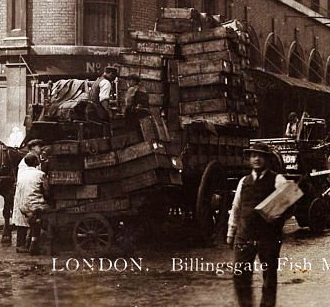
I usually got there around 10 on a Saturday by which time all the fish had been sold and apart from the odd porter there were just the men sweeping up.

That said there were still the odd bits of ice and discarded fish in the gutters and of course that all pervading smell.

A few hours earlier and the place would haven teeming with activity but even given the emptiness of the Lower Road there were those promising smaller roads including the one that led to the Monument which at the time had one of the best views across the City from its observational platform. And cost from memory 6d.

Not that I over dawdled around here for the prize was the Tower.

Pictures; The Tower of London , 2015 from the collection of Ryan Ginn and Billingsgate Fish Market, 1927, courtesy of MARK FLYNN POSTCARDS, http://www.markfynn.com/index.html