Showing posts with label New Cross in the 1900s. Show all posts

Wednesday, 7 July 2021

The search for the Book of Remembrance in Edmund Waller School

I am no nearer discovering the fate of the Book of Remembrance of the students who fought in the Great War.

The Sentry, 1921
It was housed in a glass cabinet, high up on the wall beside the entrance to the classroom of 3b, and every day of the school year during 1959-60 I passed it as I went and left the room.

Now when you are nine going on ten the book had little meaning.

I remember it stood open at a page and the names were recorded in black and red ink.

I have no idea if the pages were turned regularly and as far as I can remember it was never referred to, and I never asked.

Back then the Great War had ended just 41 years earlier, and despite the horrific nature of that war, it had already been eclipsed by the more recent conflict.

But many of those who had taken part would only have been coming up to retirement and may yet not even have had grandchildren.

Most would still be fit and have years more ahead of them and the memories of what they endured would be fresh, even if they preferred not to talk about it.

And for those who lived around the school and had attended, the names in red of their fellow students who never returned would be something else that they hadn’t forgotten.

Now I never forgot the book, although the last 59 years have been so crammed with just living that I didn’t give it much of thought, until that is I was asked to write a book about Manchester and the Great War, and then as you do in researching the men, women and children who took part, I came again to the that Remembrance Book.*

I assumed it would no longer still be on the wall and more than likely have been donated to the Imperial War Museum or the Local Studies Centre.

On two separate occasions I contacted the school left my details and waited for a reply.

Sadly I am still waiting, despite follow up emails.

Of course schools are very busy places and the children always take priority so in the absence of a reply from the school I am pondering my options.

I guess an approach to the Local Studies Centre will be the first step and then either the Imperial War Museum or the National Archives at Kew.

Edmund Waller, School, 2007
And in the meantime I wonder if anyone else remembers it or can shed  light on what happened to it.

Location; Edmund Waller School, Waller Road, London SE 14

Picture; The Sentry, 1921, commemorating employees of S & J Watts & Co, Manchester, from a picture postcard issued by Tuck and Sons, courtesy of Tuck db, https://tuckdb.org/ and Edmund Waller School, 2007 from the collection of Liz and Colin Fitzpatrick
*Manchester Remembering 1914-18, Andrew Simpson, The History Press, 2017

Monday, 7 June 2021

Stories from the Great War ............ the Shaw family and their loss of five sons ..... no. 2 the Western Front

Even from the distance of a century the impact of the Great War continues to reverberate through most families.

The five brothers
Few I suspect cannot account for one family member who either joined the Colours or was engaged on essential war work.  In our case we can count seven from our immediate family and in the course of the book I wrote many of those I interviewed had stories of grandfathers and great grandfather’s who had fought on all the battle fronts, including the Italian one, and of grandmothers who had done their bit in the munitions factories, as Red Cross nurses, or working on the land and on the trams.*

In the case of Pam it was her five great uncles.  She told me, “We grew up with their memories as part of our lives. “

And she also passed over an account written by one of her relatives of the five men, all of whom died during the conflict.

The article written by the son of Thomas Shaw is undated and there is no clue where it was published, but it must post date 1986 because there is a reference to the Queen’s birthday of that year.

Thomas Shaw
The piece is short but details the fate of all five. Two had left for Australia before 1914 and they both enlisted in the Australian army.

Of these Jessie died at Gallipoli in 1915 and his brother John who was a Lieutenant in the 20th Battalion, 9th Brigade of the Australian Force was on May 3 1917.**

On the same, day, the eldest son, Rifleman Thomas Samuel Shaw, aged 32 of the 8th King’s Royal Rifles was killed during an attack on German positions in a wood.

His body was never recovered.

Thomas was the father of the author of the article, who added, “With Uncle Jessie at Gallipoli, three brothers were killed on May 3; Private James Friend Shaw was to be the third brother to be killed in 1917, overstating his age to enlist.  

He was with the 20th Battalion London Regiment which was in Ypres area.  Uncle James was killed in action on August 3 1917 aged 20.”

Jessie Shaw
In the previous year Lance Corporal Henry James Shaw was killed during the Battle of the Somme.  He was 29.

By any measure the loss of five sons must have been very difficult and it underlines the sacrifice that was made by so many.

Their father lived in New Cross.

In time I will devote some time to researching the five men, their families and the life of their father, mother and sister.

All of whom will have stories that should be told.

Location; London, Gallipoli and the Western Front

Pictures; from an article written by the son of Thomas Shaw, and kindly supplied by Pam White Prosser

*Manchester Remembering 1914-18, https://chorltonhistory.blogspot.co.uk/2017/02/today-new-book-on-manchester-and-great.html

**The Shaw family and the Great War, https://chorltonhistory.blogspot.co.uk/2017/07/stories-from-great-war-shaw-family-and.html

Sunday, 11 November 2018

For Miss Florence Brown ........ an invitation to a Christmas Tea and Entertainment .... January 8 1919 at Laurie Grove

Now less than half a century will separate Miss Florence Brown’s presence in the Borough Hall on Laurie Grove and my own visits.

She was attending a Christmas Tea and Entertainment for “the Children of Deptford Men who have fallen in the War".

I went looking for young Miss Florence and while I cam e up with a number of candidates, I can’t be sure which was her.

An invitation, 1919
I won’t leave it there and in the fullness of time I will trawl the official records and the local media for a report of her father’s death and of the event at Laurie Grove.

And I will go looking for some of those who were connected with the Deptford War Hospital Supply Depot, which included Elsie E Morton, the secretary and Mrs R.G.White of BroomfieldHouse Evelyn Street.

The War Hospital Supply Depots were as their name suggests a voluntary organisation involved with producing everything from bandages to surgical equipment along with nightshirts and bed jackets for wounded soldiers recovering in hospitals.

There were more than 2,700 of these work parties and War Hospital Supply Depots.*

Here in Manchester there was large depot which was supported by women and school children.

Looking down the list for south east London there were contact names for pretty much everywhere with Eltham having six contact names, Blackheath four, Greenwich two and Woolwich one.

A medal, circa 1916
Location Deptford


Picture; Miss Florence Brown’s invitation, 1919, and Dover House Supply medal circa 1916, from the collection of David Harrop, 

* War Hospital Supply Depot, http://www.scarletfinders.co.uk/178.html

**The Red Cross Medal and the lost Dover House on Oxford Road ................ stories behind the book part 1,  https://chorltonhistory.blogspot.co.uk/2017/10/the-red-cross-medal-and-lost-dover.html

Tuesday, 18 July 2017

Stories from the Great War ............ the Shaw family and their loss of five sons ..... no. 1. Gallopli

Now I always count it a prviledge when I get to share the stories of other people’s families and so I was very pleased that Pam chose to share hers with me.

The article
Just yesterday she contacted me through social media.

“I found your blogs regarding WW1 extremely interesting and I thought you may find this article interesting.  

These five brothers were my Nans brothers.  

We grew up with their memories as part of our lives.  

My grandmother was the loveliest lady and I have so much regard for her as she lived a hard life, she was actually raising her own 8 children when WW1 broke out.  

The youngest my father being born in 1912.  

As mentioned in the article her Mother passed away in 1910, so she was also helping her father with her young brothers.  


From the Kentish Mercury, May 2, 1919
The other interesting fact was that three of the brothers were in the British army and two were Anzacs.   

My Nan bought her family up in Collins Street, Blackheath, along side the rail line, she lived next door to the widow and son of the eldest of the five brothers.   Hope you find the article of interest. Also the significance of 3rd May.   

They also had a younger brother John, too young for service .He lost his only son in WW2, he was a fighter pilot.  Uncle John and his wife Alice had their home bombed in London and were buried under rubble for 3 days.  Aunt Alice lost her sight, Uncle John lost his hearing.  I realise there are so many stories like these.   

The loss in WW1 was unbelievable.  Hope you don't mind me sending this. Regards,  Pam"

Well of course I was over the moon at receiving it and very happy that it could be included in the blog along with extracts from an  article  and the page from the Kentish Times, dated May 2 1919.

Private Jessie Shaw 1915
The article was written by the son of the eldest of the five brothers.

At present his identity and the date the article was written is unknown, but perhaps reprinting this short extract might stir the pot and someone will come forward with a name.

So for now here is that extract. “My grandfather, Thomas Shaw was born T 9 Upper Grange Walk Bermondsey on November 20, 1847 ..... and was married at St John’s Walworth in 1877 to Harriet Bray of 30 East Street.  

She died 1910; mercifully, it can be said with hindsight.

By 1914, of the five sons who were to go on active service, two had emigrated to Australia, a springboard in 1915 for an Australian Expeditionary Force to land on Gallipoli.  

The landing was made on April 25 1915, and Private Jesse Shaw, aged 23 was one of the 13th Battalion of the 4th Brigade who landed .  His grave at Lone Pine Memorial, Gallipoli 39 MR 6 reads that Private Jesse Shaw died of wounds at sea on May 3, 1915."


Next; the story of four more brothers and the full significance of May 3

Location, London Gallipoli

Pictures; from the collection of Pam White Prosser

Sunday, 16 August 2015

My Peckham .............. nu 4 New Cross Library

A short series of places I grew up with.  

Some have already appeared and others will be familiar because as iconic buildings they are well known.

Now this was what our library looked like in 1911, and just over forty and bit years later it looked very different

Pictures; New Cross Library, July 1911, courtesy of the Music Room London.

*Music Room London, http://www.musicroomlondon.com/

Saturday, 15 August 2015

Growing up in New Cross nu 10 ............. that Roll of Honour in Edmund Waller school and George Carly of Lausanne Road

Growing up in Lausanne Road in the 1950s was to be untouched by the Great War.

Replica Cenotaph circa 1920
Of course the evidence of the Second World War was still all around us.

Many of the bomb sites had yet to be redeveloped and there were those signs announcing EWS and Shelters.*

Added to which there were plenty of gable ends  which had been cemented over and told of the house next door which had been blown away.

But the Great War was different.  It was rarely a topic of conversation which given the more recent conflict was understandable.

And yet those who had participated in it either as combatants or on the Home Front would still be in their late 50s or early 60s, would yet to have retired and some were not yet grandparents.

But I can think of only one moment when it impinged on me and that was at school at Edmund Waller.

In the upstairs hall on a ledge in a glass case was the Roll of Honour, opened at a particular page with those who had survived recorded in black ink and those who had died in red.

I have often wondered if the pages were turned regularly and more recently whether it still exists in the school and is on display.

Joseph Thomas circa 1914-15
Today that conflict is remembered in a way that was not the case when I was growing up.

Rightly so we have come again to recognise the sacrifice of that generation but I think all too often we see them as either young men staring back at us in their ill fitting uniforms or as frail individuals with faltering voices in wheel chairs and forget that when that war was over they settled down to productive lives, raising families with decades ahead of them.

And I was reminded of this when I met with Nicola whose great uncle had fought in the war and died aged just 23 on the Western Front in 1917.

He had been one of those young me who had enlisted in the first few months of the outbreak of war and was in the 2nd City Battalion of the Manchester’s which formed the second Manchester Pals Battalion.

Early in 1915 young Joseph Thomas sent a picture postcard to his brother announcing he was coming home on leave.

The card like many of the time carried an image of a group of young soldiers and after posting the story Nicola got in touch and identified her great uncle.

In the family collection was this replica of the Cenotaph made by Kingsway Art China of London.*


Replica Cenotaph circa 1920
Once these must have been manufactured in their thousands but I doubt that many still exist and those that do will be in collections whose owners have little knowledge of its personal history.
This one however retains that link with the Thomas family and that young man.

And by extension I wonder how many other very personal memorabilia exist in Peckham and which contain a story.

Yesterday I reflected on the story of young George Carly who had lived in our house.

He was  born in 1894 and died on the Western Front at the Battle of the Somme on September 18 1916 and I rather hope that I will uncover something of his.

Pictures; replica of the Cenotaph, circa 1920s courtesy of Nicola O'Neil and Joseph Thomas circa 1914-15 from a picture postcard, 1915 from the collection of David Harrop

Friday, 14 August 2015

Growing up in New Cross nu 9 George Carly ...........a soldier of the Great War

Unknown group of soldiers, 1916
George Carly and I were neighbours separated by just 40 years and sharing the same house.

Of course I didn’t know him and only discovered his existence yesterday when I began to explore the history of where I had lived in the 1950s.

The family appear on the 1911 census and were still there three years later when the Great War began.

That in its self has drawn me to them fired also by a curiosity over their names.  Mr Carly’s middle name was Garibaldi and his wife’s was Zilpah.

Not that their birth places were unusual.  Mr Carly had been born in Sussex in 1865 and Mrs Carly in Greenwich

Unknown group of soldiers, 1916
I suspect given his birth year his father may have admired the Italian nationalist Garibaldi and in time I will I hope discover more about Lucy Zilpah Carly.

But for now it is enough to know that in the April 1911 the Carly’s had been married for 18 years and had six children ranging in age from George who was 17 down to Ivy who was three.

And knowing the house so well it is easy to begin to fit them into the different rooms wonder who slept where and which jobs around the place each was given to do.

My dad always talked about how his was the job of cleaning the fire places and bringing up the coal in his home in Gateshead and I suspect the same would have been true of the Carly’s particularly as they did not employ a servant.

At which point it is easy to slip into speculation about the family.

Mr Clark and his son George described themselves as “catering clerks.”
 George Carly of Lausanne Road, born in 1894 and died at the Somme in 1916

The remaining children with the exception of Ivy were listed as “student” or at “school” and so I wonder if Edmund Waller was where they went which is the school me and my sisters attended.

The school dates from the 1887 with an extension added in 1899 so it is possible that at least some of them might have attended.

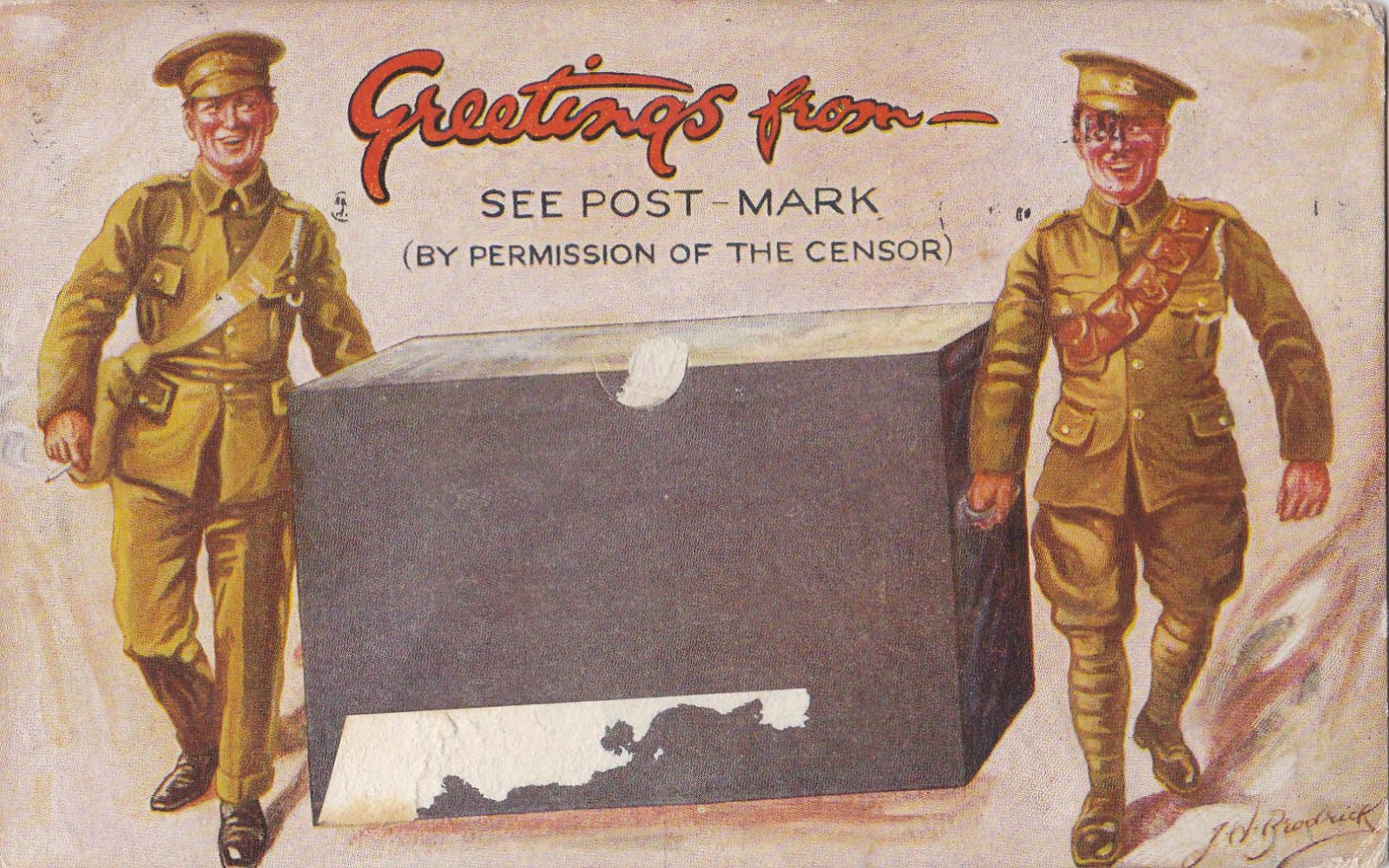
Greetings ............ circa 1918
And I will go looking for school registers and admission books but in the meantime it is George who occupies my thoughts.

At his death he was serving in B Company of the First Battalion Queen’s Westminster Rifles and was killed on September 18 1916 at the Battle of the Somme.

Now if I have got this right the Queens’ Westminster Rifles had been formed in the August of 1914 at 58 Buckingham Gate and had been a Territorial Force and left for France in the November.

Sadly like so many of the men who served in the Great War George’s military records were destroyed which at present leaves us very little other than a reference on the Thieupal Memorial.

Not that this will stop me.

Now I know we inhabited the same house I feel the need to find out more.

Pictures; Daily Mail War Postcards, 1916, and others courtesy of David Harrop


*The London Regiment, The Long, Long Trail, http://www.1914-1918.net/london.htm