Showing posts with label Post Office History. Show all posts

Sunday, 24 May 2026

The Letter Box graveyeard and other posty stories

In The Woolwich Drill Hall circa 1965
Now one of the places I wish I had visited back in 1965 was the old Woolwich Drill Hall in the company of my friend Jean because there I would have seen a pretty impressive collection of old Victorian pillar boxes.

I suppose we take the pillar box like the telephone kiosk for granted and only really begin noticing them as they disappear from our streets.

And as you would expect here there is a rich and fascinating history, which is best told by Jean.

Victorian Letter Box
“In 1963 the Post Office began to replace all the single-aperture posting boxes in Central London with double-aperture ones.  

Concerned about the loss of so many Victorian examples, which were now being sold for their scrap metal value, I persuaded the manager of the SE London Postal District to send all those he recovered to the former Drill Hall in Woolwich, where I could try to identify the rarest examples and find them a Good Home.   

This he did, and I spent many Saturdays there in the task selecting boxes of all types for donation to a suitable museum. 

As I was in the early stages of researching the history of the many different kinds of Victorian letter boxes (which was to lead to my book The Letter Box, published in 1969), this gave me a unique opportunity to examine at close quarters and in one place the great variety in size and design. 

One of these recovered boxes was donated to The Eltham Society, which then (in 1965) had hopes of opening a small museum of local history in the Orangery. 


The first of many, 1952 Whitehall
Today, I am still looking after this 'Penfold' pillar box (named after its designer, J W Penfold, and dating from the 1860s) in my garden.

One of the replaced pillar boxes (of which all trace was sadly lost ) was England's first pillar box of the present Queen’s reign - erected in Whitehall, near the Horseguards' Parade in November 1952. 

Scotland's first pillar box of the present reign was unveiled at the Inch Housing Estate, Edinburgh, on 28 November. 

Within 36 hours it had been daubed with tar and, after a few more such incidents, it was blown-up by a home-made bomb.  Why?  

This was because it bore not only the legend Post Office and the crown of St Edward but also the E11R cypher, which was offensive to Scots as there had been no previous Scottish monarch of that name and, even worse, England's Elizabeth 1 was responsible for the execution of Mary, Queen of Scotland. 


A little bit of Scotland in Yorkshire
Early in 1953, the Secretary of State for Scotland proposed that future posting boxes and mail vans intended for use in Scotland should bear no cypher at all. 

His suggestion was taken up by the Post Office and, henceforth, these bore only the legend Post Office and the Scottish Crown. 

One of these Scottish post boxes was inadvertently sent to Keighley in Yorkshire- but this went unnoticed by the locals!

Many years later Royal Mail, in order to meet the demand for period letter boxes in special locations, commissioned facsimile 'Penfolds' for places such as Chislehurst in Kent.”


Story and research by Jean Gammons, November 2013

Source; The Letter Box – a history of Post Office Pillar and Wall boxes by Jean Young Farrugia-(Centaur Press 1969).  Further information can be obtained from the Letter Box Study Group www.lbsg.org

Pictures from the collection of Jean Gammons

Wednesday, 5 July 2023

A pint …… four stamps ……… and an option on a telegram please

There are many ways of saving a redundant public building.


Now I don’t share the politics of the owner of Wetherspoons, but I must acknowledge the company has saved more than a few iconic buildings which otherwise would have been demolished for a heap of town houses, or apartments.

But it has survived.

The blue plaque which sits beside the main entrance, tells me that it was designed by H.M. Office of Works in 1914 and is a listed Grade ll building.
 
I have yet to find out when it closed, but I know that before it was built the Post Office was on the opposite  side of Witton Street.

I do know that it was "A timber-framed building designed to be lifted up in the event of subsidence. It has recessed plaster panels, and a tiled roof. The building is in three storeys plus an attic. Its architectural style is Elizabethan with ornate decoration. Above the entrance is an oriel window"*

To which I can add that "It was built between 1914-19, as the town’s main post office.  Although the building was finished in 1915 it was not opened and used because of the First World War taking place.  Instead it was left closed until 1919, after the end of the war, when it was finally opened.  It was the town’s ‘largest liftable building’.  It became a public house in the 1990s and takes its name from the world’s first-ever adhesive postage stamp".**


**Northwich Townscape Heritage Progect, Listed Buildings, https://www.northwich-th.co.uk/buildings/listed-buildings/

 
Location; Northwich

Pictures; the former Post Office, Witton Street, Northwich, 2023, from the collection of Andrew Simpson

Monday, 6 March 2023

What you find in your cellar …………

 Never throw anything away is by and large a lifestyle choice I have followed for my entire life.

It allows me to rediscover odd ephemera, which have lain for decades in “safe places”, so safe I had forgotten they were there.

And so, it is with the Newsletter of The British Postal Museum and Archive, from February 2014. 

Just why I had signed up for the publication is now lost in time, nor do I have other copies and this one has sat in the cellar for I guess nine years, along with a heap of books, and lots of photocopied sheets of newspapers, and archive material.

I had gone looking for my collection of school history textbooks, which proved elusive, but I turned up this solitary newsletter, and what a good read it was.

Included in the sixteen pages were articles about the Museum, lists of up-and-coming talks, stories from the history of the Post Office and dips into the archive.

So all in all a good find, but one which perhaps needs a new home, and so I will offer it up to my “posty” friend, David Harrop, whose collection of Postal History memorabilia must rank as one of the largest and interesting in the country.


And that is that other than to say the article by Emma Harper who was the curator back in 2014 on a truncheon issued to GPO staff in 1848, is a gem.

Location; our cellar

Pictures; Interior of Travelling Post Office, 1935, framed artwork for a poster. Artist Charlton, George, Post Office 109/375, and Mt Favourite Object, Emma, Harper, from Newsletter of The British Postal Museum and Archive, from February 2014

*The British Postal Museum and Archive, https://www.postalmuseum.org/

Tuesday, 5 April 2022

A Lifeboat procession ......... a collection of postal workers ...... and something new

So, I wonder what these men of the Post Office thought about dressing up in the summer of 1907 for the procession to mark Lifeboat Saturday. *


Or just who got to choose who dressed up as a Post Mistress through the ages.

The chap imitating a post box seems happy enough but the onerous task of pretending to be the Postmaster General seems too much for his colleague who looks into the far distance.  He may well have felt the part with the embroidered lettering PMG and walking stick, but there is a hint that he is either very uncomfortable playing the part or such a role is below his dignity.

Of course, we will never know but together the team seem a bit abashed at their contribution which celebrates the history of the Postal Service.

And so they should, because my old friend David Harrop, he of all things postal, informs me that behind them is one of the first mechanised postal vans, marking that transition from horse to petrol.

To this I can add from my Grace’s Guide to British Industrial History, "that around 1904 the Royal mail introduced their Rapid Transit Mail Delivery using a motorised tricycle and in 1907,  the first motor vehicle entered Royal Mail service - this was a 2.5 tonne lorry called the Maudslay Stores Number 1 (the first vehicles were stores vehicles rather than mail vehicles). The vehicle was in service for 18 years during which it covered over 300,000 miles”.

All of which means that this picture postcard is quite a find.

And that is all I have to say, except that the first Lifeboat collection happened here in Manchester in 1891, following a disaster when five years earlier, 27 men from Southport and St Anne’s died while trying to rescue sailors from the stricken vessel the Mexico.**


Location; Ipswich, 1907


Picture; Lifeboat Saturday, Ipswich, 1907, from the collection of David Harrop

*1891 First Street Collection, RNLI, https://rnli.org/about-us/our-history/timeline/1891-first-street-collection

** Royal Mail Graces Guide to British Industrial History https://www.gracesguide.co.uk/Royal_Mail#:~:text=1907%20The%20first%20motor%20vehicle,it%20covered%20over%20300%2C000%20miles


Thursday, 14 October 2021

A little bit of Post Office history on New Bridge Street …… and a question

Now this is the former Parcel Post Office which straddled New Bridge Street, Moreton Street and the river.


It is one of those buildings you pass, wonder what it might have been and pass on with a note to find out its origins, but never do.

According to one source, it was opened for business in 1894 and its close “proximity to Victoria and Exchange Stations enabled easy transfer of parcels from the trains. It was closed as a parcel sorting centre in the 1930s when it was replaced by a larger building in Newton Street”.*

It is a Grade II listed building and has been converted into residential use.

The initials VR are still there to see high up on the New Bridge Street side, and was constructed by H M Office of Works to a design by William Thomas Oldreive, who had  spent time in Hamburg, Berlin, Vienna and Paris, in 1886, where he made “a particular study of post office buildings, notably Guadet's new Hotel des Postes in Paris and the General Post Office in Hamburg. As a result of his study he was later appointed architect for provincial post offices in England and Wales. Works included Post Offices at Hyde, 1899-1900”.*


Now I am fascinated by the later history of the building, because despite having been closed in 1930 it still appears as such on the 1952 OS map of Manchester and Salford, and so begs the question of what happened to it during the later part of the last century.

Added to which other sources suggest Newton Street opened in 1908, and Posty David thinks it was doing the business by the 1920s.

So more research.

But some will know and offer up information on the "missing years", leaving me just to observe that Moreton Street is now just a shadow of its former self and renamed Mirabel Street.

Location, Salford

Pictures; the former Parcel Post Office, 2021, from the collection of Andy Robertson

*Parcel Post Office Mirabel Street and New Bridge Street, Architects of Greater Manchester 1800-1940, https://manchestervictorianarchitects.org.uk/buildings/parcel-post-office-mirabel-street-and-new-bridge-street-manchester

Thursday, 2 April 2020

On the occasion of the golden wedding anniversary of Mr and Mrs Wareing of Buxton Avenue ......... a greetings telegram from 1942

Now I am back with the telegram.

For 189 years they were the quickest way of sending a message and the arrival of the Telegram Boy might herald all sorts of news.

Nana received one in 1942 informing her that my uncle was missing, another a little later with the news that he was a Prisoner of War, and the most dreaded of all telegrams which broke the news of his death on the other side of the world.

So for me the telegram is always associated with grim news, but of course there were plenty of happy ones and my friend Ann sent me two.

Both were sent in the August of 1942 congratulating Mr and Mrs Wareing of Buxton Avenue on their Golden Wedding anniversary.

Of the two this is my favourite from Barbara and Margaret Preen with the delightful image to accompany the message.

They were married in 1892 and had lived in Buxton Avenue since 1911.  Mr Wareing described himself as a road surveyor and at present that is all I know, but I guess Ann will have them and in the fullness of time more will be revealed.

For now it is a nice reminder that telegrams were for all occasions and all seasons.

Picture; greeting telegram, 1942, from the collection of Ann Love


Thursday, 17 May 2018

That red box on a wall at Edge Lane ...... the correction

Now yesterday I ran a story on a post box on Edge Lane, which featured the pictures of Robert Williamson and how it came to be restored to working order with the help of David Harrop.

The box is on a wall on the corner of Edge Lane and Hampton Road.

I was pleased with the story and with the response, particularly as people nominated their own one which were all relatively close by.

But I misled you, and Ian has corrected me with, “technically the box at Edge Lane is not a pillar box, but a wall box, designed to be inserted in a wall. 

Pillar boxes are the tall round ones or the 6-sided Victorian ones known as "Penfolds" [after their designer]. 

Readers may be interested in the work of the Letter Box Study Group, the world’s leading experts on post boxes. 


Their website is at: www.LBSG.org.

All of which is as it should be, and a thank you to Ian.

Locations Chorlton

Picture; the Post Office Wall Box, 2014 from the collection of Robert Williamson

*The story of that Victorian pillar box on Edge Lane, https://chorltonhistory.blogspot.co.uk/2018/05/the-story-of-that-victorian-pillar-box.html#comment-form

Wednesday, 16 May 2018

The story of that Victorian pillar box on Edge Lane

Now I like these two pictures of that post-box on the corner of Edge Lane and Hampton Road.

They were taken by Robert Williamson a few years ago, who asked if it was the oldest pillar box in Chorlton and I rather think it is.

My old friend David Harrop thinks so suggesting that it dates from the 1870s and he should know given that he has a large collection of memorabilia from both world wars and more particularly from the history of the Post Office.

Nor is that quite all, because David has a special connection with this pillar box.

Back in the 1990s he was working in the Facilities Branch of the Post Office which was responsible for the siting and maintenance of post boxes in Greater Manchester.

By then our Victorian box had become redundant replaced by a new one attached to a lamp post nearby. 

And to add insult to injury it had lost its door.

On discovering the sad plight of Queen Victoria’s best he instigated a search and the door was found in a garden restored to its rightful place which in turn led to the reinstatement of the said oldest pillar box in Chorlton.

He tells me that people are very sensitive about the position of their local pillar boxes and when the branch moved the one from outside Salford Fire Station it caused quite a storm despite only being moved 30 or so yards.

All of which leaves me to say that ours was made by Smith and Hawkes of Birmingham and given David’s interest in all things posty you won’t be surprised to know that in his collection he has a door from a Victorian pillar box.

Now that door isn’t on display in his permanent exhibition in the Remembrance Lodge at Southern Cemetery but there are lots of interesting things to see from post cards and medals from the Great War to a pillar box salvaged after the Coventry Blitz.

David was insistent I should go down to Edge Lane and take a picture but Robert has kindly let me use his.

So a winner all round, and for those wanting a bit more local history our box will have arrived on Edge Lane sometime in the 1870s reflecting that suburban creep which had seen fine new villas constructed by the well to do spreading up from the station at Stretford.

But that is another story.
Bit in the meantime I received a correction to the story, Ian has pointed out that, "technically the box at Edge Lane is not a pillar box, but a wall box, designed to be inserted in a wall. 

Pillar boxes are the tall round ones or the 6-sided Victorian ones known as "Penfolds" [after their designer]. 

Readers may be interested in the work of the Letter Box Study Group, the worlds leading experts on post boxes. Their website is at: www.LBSG.org".

Thank you Ian


Pictures the Edge Lane pillar box, 2014 from the collection of Robert Williamson


Friday, 22 July 2016

Buying your postage stamps on Todd Lane before catching the 16. 30 from Victoria

Now Corporation Street is one of the more fascinating streets in the city.

It started at Market Street crossed Cannon Street and ran on to the junction with Fennel Street and Withy Grove at what was called Hydes Cross.

Later it was extended to Ducie Bridge where it joined Cheetham Hill Road and continued on as a much narrower street to Ashley Lane.

And along its route it rubbed up against Hanging Ditch, Long Millgate and a shedload of small alleys and courts with names like Cockpit Hill, Hodson’s Square, McDonalsd’s Lane and Piggot’s Court, which in turn gave access to Back Tipping Lane, and Cromford Court.

All of which is an introduction to this Post Office sign which was located in Victoria Railway Station on top of a pillar box and pointed to the sub post-post office on Todd Street.

The building is still there although the Post Office has gone.

So now all we have is the sign which comes from David Harrop’s big collection of all things post office of which more I shall say another time.

Location Manchester

Picture; Post Office sign circa 1980, from the collection of David Harrop

Tuesday, 29 September 2015

Saying farewell to the Post Office bike .......... a little bit of Chorlton's vanished history

One ex Royal Mail post bike, 2015
Now a little bit of postal history slipped past me last year.

For many it will seem a tad trivial but after 120 years the Royal Mail finished off the Post Office bike.

Since 1895 it has been one of those small bits of our daily life which is so commonplace it has gone unnoticed and now it has gone.

This I know because my old friend David Harrop recently bought one from a chap here in Chorlton and was so pleased with the deal that he rode it back to Heaton Moor.

Nor will he have been alone in picking up a surplus bike.

According to the Guardian the Royal Mail had got rid of 14,000 between 2010 and 2014  which left just 4,000 to be disposed of last year.*

Lots of Post Office bikes, circa 1914-18
And of course behind the decision lurks a whole lot of history.

There had been some bizarre and fanciful attempts at inventing and marketing push bikes stretching back into the 19th century but by the 1890s what we would recognise was zipping along our streets and country lanes.

They offered a cheap alternative to public transport, could go almost anywhere and quickly became a craze with the establishment of hundreds of cycle clubs.

And when you added all of that with politics you got the Clarion Clubs, the first of which was started in Birmingham in 1890 by a group of young socialists who combined the bike, friendship and the desire to advance the message.

Barnet Post women circa 1914-18
But more than all of these the bike was the way you got to work.  Look at any picture or news film from the mid 20th century showing people leaving Trafford Park and what strikes you is the sheer number of men and women on bikes.

So it was just sensible for the Post Office to equip its workforce with a means to make delivering our mail a little easier and lot quicker particularly as rounds were very long and as a consequence the load postman carried was very heavy

The standard bike I don’t think changed much over that century and a bit but the details I will leave to David who has a fine collection of Post Office memorabilia some of which can be seen in the Remembrance Lodge at Southern Cemetery along with exhibitions telling the story of those who lived through the two world wars.

Picture; David’s post office bike and Barnet Post women circa 1914-18, courtesy of David Harrop

*Royal Mail to phase out post bikes completely in 2014, Laura Laker, The Guardian, December 9 2013,
http://www.theguardian.com/environment/bike-blog/2013/dec/09/royal-mail-post-bikes?commentpage=2

**The Clarion Cyclist Club, http://chorltonhistory.blogspot.co.uk/search/label/The%20Clarion%20Cyclist%20Club

Monday, 20 April 2015

On rediscovering that the Postal Order still exists and pondering on the telegram, the trunk call and the big red telephone box

Three in a row, 2012, Knaresborough
I am always fascinated at the little bits of my past which have long since vanished.

And yesterday I was reminded of a shedful that have gone out with the tide.

It began with a phone call from our Joshua asking about Postal Orders.

Now I had to confess that I thought that they had long since ceased to exist.

In an age of PayPal, and card transactions with the persistent rumours that the cheque will soon go I just expected that the Postal Order had had its day.

When I was growing up and fewer people had bank accounts it was the most effective way of buying things through the post.

Postal Order, 1939
You bought it over the counter for the amount you needed, sent it by through the  mail and it was cashed at another post office.

And according to the Post Office it remains a simple way to send money, which can be used wherever you are to pay bills, and shop by mail order and offers peace of mind because there is no personal data required.*

What’s more it costs as little as 50p.

Not so the telegram which was a way of sending and receiving messages relatively cheaply and quickly but which died in stages after 139 years.

In the 1930s the Post Office was delivering on average 65 million telegrams per year.  But by the 1960s this had fallen to 10 million and by 1976 to just 844.*

Telegram, 1914
The decision to abolish the service was taken in 1977 and although the service lingered for a bit longer it was stopped in 1982.

That said I do not ever remember receiving one but then we had a telephone quite early in my childhood and that I suspect replaced the need for people to send us telegrams, although thinking about it I doubt that anything much exciting ever necessitated us getting one.

Not for that matter can I remember the telephone ever being used that much.  It was one of those solid black Bakelite affairs with a little tray which pulled out to reveal a space for telephone numbers.

And while I cannot remember our Co-op divi number or pretty much any subsequent telephone numbers, NEW 6251 leaps out of my memory.

Postal Dinky toys, pre 1939
But it is a measure of how far we have travelled with technology that back in the 1950s we had to share the line with another customer, and if on the rare occasion they were using the party line you could if you so chose listen into the conversation.

That simple incontinence became of course a superb device on the part of film makers and authors to advance a plot be it a sinister overheard threat or in the case of Doris Day and Rock Hudson an invitation to a sting of absurd story lines.***

Of course the party line is for most of us as remote as the delightful “trunk call” which resurfaced today in a blog by my friend Lois. ****

Toy postal Van, 1914
In those early years of telephones the only way a customer could call someone listed on another exchange was by asking the operator to connect them and this was a “truck call.”

In its way it was as much a special event as making the “long distance call” and today both sound old fashioned a tad quaint.

Much as I suspect is the red telephone box  which while it does still exist is now fast disappearing.

They first appeared in 1920 mushroomed in the telephone war of the 1980s and are now fading like snow in the winter sun.

But they are for another time.

Pictures; three red telephone boxes, 2012, Knaresborough from the collection of Andrew Simpson, telegram, 1914, Postal Order, 1939 and pre war Dinky Toys and mail van, circa 1914 courtesy of David Harrop

*Postal Order, the Post Office, http://www.postoffice.co.uk/postal-orders

**Telegram messenger, http://en.wikipedia.org/wiki/Telegram_messenger,

***Pillow Talk, 1959


****Trunk Call, http://loiselden.com/2015/04/19/trunk-call/


Saturday, 22 November 2014

The British Postal Museum and Archive

Now you don’t have to be mad keen on the history of the Postal Service to sign up to the newsletter of the British Postal Museum and Archive.

Both the online version and the hard copy are full of interesting stuff on a range of stories some of which are only loosely connected to letters postcards and telegrams.

And this month’s newsletter being a First World War Centenary edition covers everything from the Post Office at War, the role played by the Post Office Rifles as well information on their archives and an article by Alan Johnson MP.

And it is free.

Picture; cover from the November newsletter

* British Postal Museum and Archive, www.postalheritage.org.uk


Thursday, 8 May 2014

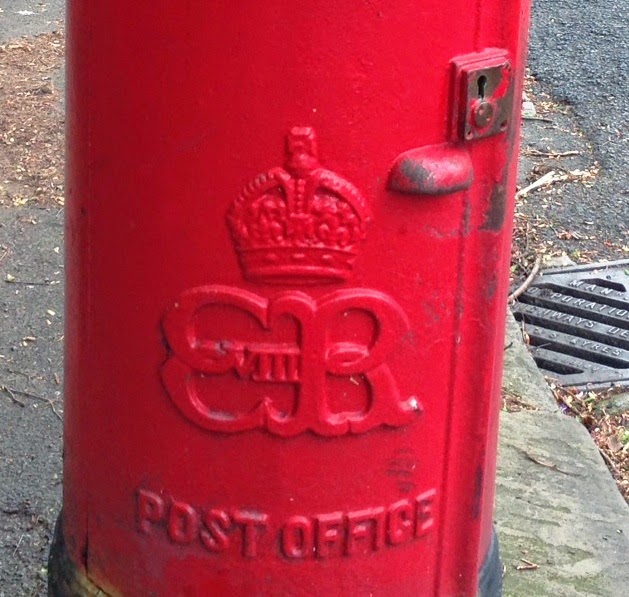
In Sale with Edward VIII

Now this is one you don’t see everyday.

My friend Lawrence came across it recently, and promised to send me this picture.

He tells me that it is an “Edward VIII post-box. It's on Framingham Road near the corner of Wood Road in Brooklands, Sale. Picture taken on a May Bank holiday Monday but the next collection was indicated for Wednesday.”

It is unusual in that there can’t be that many of them.

Edward VIII was the King we never had or to be more accurate the one who was not crowned. 

He was christened Edward Albert Christian George Andrew Patrick David and succeeded his father King George V in January 1936.

But then romance and Mrs Simpson intervened and  given the opposition from elements of the ruling class he chose her and not the crown and abdicated in December of the same year.

Meanwhile everyday life went on and post boxes were replaced and new one sited and in the way of things this one got to see the light of day on Wood Road sometime during 1936.

So it always pays to have a camera and to look out for the unusual and having spotted the  unusual  make sure it has been recorded.

After all you never know when you may be called upon to provide that all important pub quiz answer.

Picture; courtesy of Lawrence Beadle

Sunday, 16 March 2014

Finding the history of the Post Office on Facebook and an exhibition at Southern Cemetery

It is a constant pleasure to come across new web sites increase my knowledge of our past.

And by sheer chance I happened on this one on Manchester’s postal history.

Manchester Postal Museum Postal Memorabilia Displays is a facebook site and has a fascinating collection of material ranging from picture postcards from the Great War, to smutty seaside ones and a delightful Italian Christmas card.

David tells me that he has “probably the largest private collection of postal memorabilia/history around! I am setting up my permanent display at the moment in Stockport.”

 In the meantime he already has a display in Southern Cemetery which I am minded to visit.

But for now I will leave you with two of the postcards from the many on the site.  It was a hard choice, but in the end I decided to go with one from the Great War,dated 1915 and sent to Private Joseph Platt from his wife in Oldham and that all too necessary seaside card which evey collection should contain.

We have all sent them, and looking back into the history of the naughty post card it is remarkable how far back they go.

Pictures; from the collection of David Harrop


*Manchester Postal Museum Postal Memorabilia Displays
https://www.facebook.com/pages/Manchester-Postal-Museum-Postal-Memorabilia-Displays/194111227317115

Friday, 23 December 2011

The Postal Workers Strike of 1890 and an excellent Radio 4 series

There was a time when there could be as many as six postal deliveries and collections in a day. A service which allowed people to post a card in the morning and arrange to meet that afternoon or for day trippers at the sea side to alert the family for when they would be at home.
But of course there was a human dimension to such a service. A Commission of Inquiry heard evidence in 1896 of the extraordinary conditions some postmen endured. The work was heavy, their walks were long, and the hours were longer. Some had been known to walk 26 miles in a single day. Others worked split duties beginning at 6am and ending at 10pm, meaning they rarely saw their families. Some of the city offices were cold and damp in winter, where the staff had few amenities and only the most rudimentary toilet arrangements. Of course these were the worst-case scenarios, but there were other, more widely shared grievances such as low pay, stifling uniforms, minimal leave and a severe disciplinary code that included the awarding of the contentious and often divisive "good conduct stripes".*
Six years earlier these intolerable conditions led to the Postal Workers Strike of 1890 which can be read about at http://postalheritage.wordpress.com/2011/12/16/split-duties-in-the-1890s/
And appeared in the BBC Radio 4 series The People's Post: A Narrative History of the Post Office - 10. The Postal Worker's Strike, http://www.bbc.co.uk/iplayer/episode/b0184vhd/The_Peoples_Post_A_Narrative_History_of_the_Post_Office_The_Postal_Workers_Strike/
*The Postal Workers Strike, from The British Postal Museum & Archive http://www.postalheritage.org.uk/page/peoplespost-strike
Picture, http://www.postalheritage.org.uk/page/peoplespost-strik