Showing posts with label Manchester in the 1970s. Show all posts

Thursday, 30 July 2026

Lost in memories in Albert Square …..

How easy it is to find and post images of Manchester before now.


But how much better to post an image you took and share it along with the memories of the place at the time.

We are in Albert Square when public lavatories were still a feature of the main island sandwiched between the statues of the great and the good and parking meters ringed this public space.

I think it is 1979 but could be any year up to 1984.  

A clue might well be the construction work on the western side of the square which now houses offices and a restaurant.

Over the years I have sat in the colonnaded space looking out at Prince Albert and the Town Hall beyond and pondered on just when the Victorian urinals vanished under a previous makeover of the Square.

They were not remarkable but were still fine examples of Municipal provision and a century or so after they were laid out as part of the memorial to Prince Albert I remember using them, marvelling at the mix of tiles and polished metal.

Location; Albert Square

Picture; Albert Square, 1979, from the collection of Andrew Simpson


Wednesday, 29 July 2026

In Albert Square with the unusual ..........

Now for anyone born before 1970 there will be nothing odd about a bus stop in Albert Square, or the parked up black cabs.

Equally the presence of two underground public lavatories either side of Albert will be no surprise.

That was just what the square was like, pretty much from its construction to sometime in the 1980s or '90s, when the public lavatories, the taxi rank and the bus stops disappeared.

And like so much modern history I can’t remember exactly when it all happened.

Of course the serious side of me knows that I should go off and find out but I bet someone will know and come back with chapter and verse which is always more fun.

Added to which they, or some else, will also be able to explain what happened to the two public lavatories.

Were the fittings carefully and lovingly taken out, and perhaps placed elsewhere or was the void just back filled?

And if it is the latter that raises fascinating thoughts about the discoveries and theories put forward in future archaeological papers on the “Role and significance of underground public services”.

Still for now, I can’t say I miss the bus stops and take pleasure in just sitting in the square, admiring the Town Hall, and pondering on the plight of those underground public lavatories.

Leaving me only to admit that there is still a taxi rank in the Square and the buses still stop but not not directly outside the Town Hall.

Location; Manchester

Pictures; Albert Square, 1978, from the collection of Andrew Simpson

Monday, 27 July 2026

"I had forgotten how black the town hall was" .......... pictures from Linda

The thing about old picture postcards is that there is usually a story which goes with them.

Albert Square, circa 1960s
Often that story is the message on the back, or the recipient which if you are lucky will lead to more stories.

Most of the ones in the collection have been picked up over the years with no extra information about the person who chose it in preference to another, or anything about them.

So it is a rare treat to be handed two picture postcards, by someone I know and who offered up a bit of back story.

These two are instantly recognizable, and will bring back plenty of memories, with some looking closely at the detail to compare with the same scene today.

Usually I would throw in my own observations, but where would the fun be in that?  Far better that I leave that to you.

Piccadilly Gardens, circa 1960s
Instead I shall close with Linda’s own comments on the postcards.

“As I couldn’t make my monthly trip to Holmfirth yesterday I sorted out some paperwork and came across these two postcards.

The one of Albert square is a Bamforth card with a deckle edge.

Their building near the bus station was sadly derelict for years but has recently been converted into flats and looks so much better.

I had forgotten how black the town hall was. Used to park in the square twice a year when I took my children into town to buy their shoes”.

Location; Manchester

Pictures, Albert Square, and Piccadilly Gardens, circa 1960s/1970s, from the collection of Linda Rigby

Monday, 22 June 2026

Two pictures….. one canal …. and 47 years …. walking the Rochdale Canal

It was sometime back in 1979 when armed with just a couple of cameras and heaps of curiosity I wandered down the Rochdale Canal from Princess Street to the Castlefield Basin.


That journey and the eighteen or so pictures I took became a series of stories chronicling that day and subsequent trips.*

In the course of those 47 years the canal has undergone a transformation from a run down, slightly edgy place, littered with sunken boats covered in tall grass and invasive undergrowth which had all but taken over the towpath.

1979
But nothing daunted I returned with family and even groups of students when risk assessment hardy existed.

All of which was a sad lament on what had once been a busy waterway which cut through the centre of the city.

Back then there were plenty of reminders of its former glory fallen on hard times,  from the decaying warehouses lining the route to a complex set of pipes which carried steam from the nearby power stations to surrounding buildings.

Now the overgrown vegetation has been tamed, the warehouses converted into swish apartments or demolished for swish new apartments and those pipes which leached steam have gone to the scrap yard.

And as I was standing on Oxford Road this morning, I was drawn back to snap a few new pictures.

I checked the back catalogue but couldn’t replicate the scene from 1979 and instead fell back on an image looking towards Oxford Road.

At this point I could go into detail on the history of the canal and that space which was once the hospital, but I won’t.

They are all in the blog.**

Still its close enough. 

Location; The Rochdale Canal

Pictures; The Rochdale Canal from Oxford Road, 2026, and looking back towards Oxford Road, 1979, from the collection of Andrew Simpson

*One Canal 18 pictures …….. https://chorltonhistory.blogspot.com/search/label/One%20canal%2018%20pictures

**The Rochdale Canal, https://chorltonhistory.blogspot.com/search/label/The%20Rochdale%20Canal


Wednesday, 25 March 2026

A little bit of timeless history in St Ann’s Square ...... selling flowers

Now the historian in me knows I should go off and look for the first reference to a flower seller in the square by the church.


In 1979 I did the thing, and took a series of pictures of that flower stall.

At the time and for a long time since I thought there was nothing remarkable about the scene.

And then recently I came across a picture post postcard from 1904 showing a flower stall in the identical spot, added to which someone else came up with an earlier image from 1898.

So that rather begs the question of how long there has been a business on this location and for that matter just how many images there are of flower sellers in St Ann’s Square.

I suspect we shall find out.

And quick as a flash, Jennifer added a comment to the blog which deserved to be added in,
"Hello, hope this information my help your research.  From the late 60s to the mid 70s I worked for the Halifax BS on Deansgate. 

They had an account with the flower stall in St Ann's square. 

The couple who ran it then where brother and sister John & Sally. I think the name on the invoice was Fitzgerald. 

They told me the stall had been in their family for many years. I think the stall was taken over by John's son Roger? and then by his son. John and Sally were lovely 5. 

They advised which flowers were good for the displays and how to arrange them".

Location; Manchester

Pictures; St Ann’s Church, 1978-9 from the collection of Andrew Simpson, and from the series Manchester, marketed by Tuck & Sons, 1904, courtesy of Tuck DB, http://tuckdb.org/


It’s the history …. not the quality

I am on Camp Street looking across the Rochdale Canal.


The quality of the images is not wonderful but then they were taken with a cheap camera in 1978, and the negatives have sat in the cellar for 40 odd years.

The original prints were lost a long time ago, but today I digitized those negatives, and they reveal a bit of Manchester now vanished.

Back then the area was waiting for something to happen, so while the Courts were just up the road doing the business of dealing with lawbreakers, and the College of Commerce was still introducing students to the wonders of accountancy, the law, and even a mix of Arts degrees Camp Street was a pretty forlorn spot.

For three years at the start of the 1970s I had wandered down it, exploring this part of the city instead of going to the library in the Aytoun College of Knowledge.

Back then there was an old-fashioned transport café, and those line of parking meters, while the skyline was dominated by buildings most of which have long gone or been turned into other uses.

And that really is that.

Location; Canal Street

Pictures; the Rochdale Canal, 1979 from the collection of Andrew Simpson

Tuesday, 17 March 2026

Till & Kennedy's on Cavendish Street ........... or if you prefer Mr Righton's Drapery Emporium and the Student's Union

Now this is one or those buildings which will mean many things to many people.

Righton's Buildings in 2015
For some it will be the old show rooms and for me and some of my generation Manchester Polytechnic’s first proper Student Union.

Before then the three colleges pretty much did their own thing with their own bars.

The College of Commerce on Aytoun Street where I went was known for some pretty spectacular Saturday nights with big bands, the Art College may have done the same but I doubt that much happened down at John Dalton

Detail including Mr Righton's name, 2015
All of which is outrageously  biased but fits with someone who wasn’t even aware of the other two sites until sometime in late 1970 almost a year after I begun at the “college of knowledge.”

Nor can I be fully sure when the Till Kennedy Building opened for pints, bands and much more.

One source has it throwing back its doors in 1969, before which it had been Till & Kennedy’s the ironmongers.

Righton's in 1958
It was built in 1905 for William Righton whose name appears above the main entrance.

He was a draper and the building offers up plenty of clues to its origins as a drapers shop.

The spacious ground floor was perfect for accommodating a vast range of fabrics while the large windows allowed the maximum amount of daylight into the building, a feature complimented by the top-lit gallery with the cutaway floor providing extra light to penetrate down into the main shop.

Now this had always puzzled me as had the benching around the gallery and only now have I discovered that these benches were where “the cloth was measured.”*

Righton's in 2015
It had a short life as a student’s union and has been used by various faculties of the Poly and the MMU.

I remember visiting it to look at the collection of taped memories of life in Manchester in the first half of the last century but as much as I tried my mind wandered to disco nights and of a particularly magic evening with Osibisa.

Added to which there were those endless student general meetings where our own version of politics was played, all of which was I suspect a long way from Mr Righton’s bolt of blue cloth or Till and Kennedy’s taps and assorted iron ware.

Pictures; the Righton Building, 2015, from the collection of Andy Robertson and in 1958, H.W.Beaumont, m19060, courtesy of Manchester Libraries, Information and Archives, Manchester City Council, http://images.manchester.gov.uk/index.php?session=pass

*Manchester An architectural history, John K Parkinson-Bailey, 2000, Page 317


Monday, 9 February 2026

The lost canal ….Bert’s CafĂ© …. and the Coach and Horses ….. views across Minishull Street fifty years ago

This was one of my familiar views of the Manchester I knew in the 1970s.

Looking towards Minishull Street, 1979

To my left was the tower block of the College of Commerce which some of us affectionately called The College of Knowledge but which had just joined the Art School and John Dalton to become Manchester Polytechnic.

Over to the right was the Fire Station and Police Station on Whitworth Street West. Leaving just the tall buildings of the British Rail office block and the swirling S bend pile which was more glass than wall.

Lost view of Minishull Street, 1979
And for those really in the know hidden behind the hoardings in the first picture was Bert’s cafĂ© and Placemate that night club which had once been home to the Twisted Wheel.

To which there was the Coach and Horses on London Road which my Pubs of Manchester Past and Present tells me "was originally an artisan's house with a workshop on the top floor.  It ended its life as a Tetley house at the bottom of Piccadilly Approach on the corner of Upton Street".*

We would sometimes cross the car park from the college and spend an evening in there, ostensibly discussing the next essay but quicky ending up on the football machine drinking from those old-fashioned straight glasses.

Go back to 1850, and the spot from which the pictures were taken and this was Coal Yard of the Bridgewater Canal Company, supplied by an arm of the Rochdale Canal.  The canal still exits running beside Canal Street and running  eventually in one direction to the Dale Street Basin and  Castlefield in the other.

That canal arm, 1850

But the arm which also nudged Little Davis Street has long gone.  It was still there in 1950 and may well have been filled in when the College of Knowledge was built in the 1960s.

Leaving me just to reflect that for a while the Poly occupied the warehouse which once abutted the arm of the canal while I have written about Little David Street and some of the people who lived there.*

The Rochdale Canal with the vanished arm to the right, 1980
I could again explore that history from the 1850s but instead will settle on Bert’s CafĂ© which remains with me over 50 years after we frequented the place, eating Bert’s sausage sandwiches and swapping stories of the night before.

Given that it was just a few minutes’ walk from the College and we were the archetype students, we would put a morning breakfast over the first lecture of the day. 

The place consisted of just one room with a serving hatch from which Bert delivered the orders which mainly consisted of chips with egg, or bacon or sausage with a variation of these in sandwiches.  The bread was white, the spread marg and the coffee was hot milk with a hint of the brown stuff.

In the winter the windows were always steamed up and in the summer the door was permanently open but had those plastic-coloured strips which rustled in the wind and were a concession to privacy.

The view, 2025

Location Minishull Street

Pictures, looking towards Minishull Street, 1979 from the collection of Andrew Simpson and the arm of the Rochdale Canal,  1851 from Adshead’s map of Manchester 1851 courtesy of Digital Archives Association, http://digitalarchives.co.uk/ and the view in 2025, courtesy of Google Maps

*Pubs of Manchester Past and Present, http://pubs-of-manchester.blogspot.com/2010/01/coach-horses-london-road.html

** Little David Street, https://chorltonhistory.blogspot.com/search?q=Little+David+


Sunday, 8 February 2026

When your life comes packaged in just eight pages…….

 It’s a silly title really but it sprang to mind after seeing Michael Kay’s post featuring the brochure for Manchester Polytechnic.

It is dated 1970 and must have been produced just a few months after I washed up in the city to do an Arts degree at the College of Knowledge on Aytoun Street.*

I had arrived in the September of the previous year, with a suitcase, an address for a bed sit and no idea what was ahead of me.

Indeed, as a lad from southeast London Manchester was only the second city I had ever experienced.

And pretty much soon after I arrived, I embraced the place spending the hours when I should have been in the library wandering the city centre, which gave me a fascination for the buildings, and the history. 

Along the way I made some lasting friendships and many more which have dropped away over the years.

As for the degree, well I learned a few things, but like others not as much as I had done during A levels.

But the three years also introduced me to the other two faculties that made up the Poly, and while I did visit John Dalton the science place, it was the Art College, All Saints and the old Till Kennedy Building which were a second home.

The three faculties of Art, Commerce and Science had been separate educational institutions and mine betrayed its origin with the title of Commerce which offered many vocational courses, making it an odd mix of students.

Till Kennedy, Student's Union, 2015
Over the years I have written about the famous Saturday nights which hosted a pile of groups which straddled the late 60s and early 70s, along with equally memorable times at the Students Union which to many of us will always just be the Till Kennedy Building.*

It was built in 1905 for William Righton whose name appears above the main entrance.

He was a draper and the building offers up plenty of clues to its origins as a drapers shop.

The spacious ground floor was perfect for accommodating a vast range of fabrics while the large windows allowed the maximum amount of daylight into the building, a feature complimented by the top-lit gallery with the cutaway floor providing extra light to penetrate down into the main shop.

The Art College, 2024

Now this had always puzzled me as had the benching around the gallery and only now have I discovered that these benches were where “the cloth was measured.”***

The College of Knowledge, 1969
Over the years I have explored the history not only of the College of Commerce but also the Art College with its links to many of the artist I admire, as well as Mr. Dalton.

Much of which came flooding back with the brochure with its images of the city and its optimistic take on Manchester in the 1970s.

And what is remarkable is that a full fifty-six years after it was published many of the buildings and places it featured are still there.

Sadly, my own College was found wanting and now is at the centre of a residential complex, while On the Eight Day has moved slightly further up Oxford Road and now inhabits a new build, while Manchester Piccadilly Railway Station was transformed by a make over at the start of this century.

Still the eight pages make for an interesting read, but not a nostalgic one, after all I never left the city and so took the changes in my stride.

That said I do remember that two years after the Poly came into existence, its entire collection of student accommodation comprised six flats for six married couples in the former Fireman’s block of the Mill Street Police Station off Grey Mare Lane.

We had married in the December of 1972 and moved in a few months later as one of the first six couples.  

For all of us living in east Manchester was a tad different from the south of the city but perfectly fitted with how we saw ourselves.

Leaving me just to thank for posting and giving me permission to use the pictures.

Location; Manchester in 1970

Pictures; Manchester Poly brochure, courtesy of Michael Kay, The College of Commerce, 1969, Butterworth Street, Luft M 1991, m55776, courtesy of Manchester Libraries, Information and Archives, Manchester City Council, http://images.manchester.gov.uk/index.php?session=pass, The Art College, 2024, and the former College of Commerce, 2024, from the collection of Andrew Simpson and the former Till Kennedy Building, 2015 courtesy of Andy Robertson

The College of knowledge in 2023

*The College of Commerce.

The entire student accomodation in 1972

**Manchester Polytechnic, https://chorltonhistory.blogspot.com/search/label/Manchester%20Polytechnic


****Manchester An architectural history, John K Parkinson-Bailey, 2000, Page 317


Saturday, 7 February 2026

A park bench, a Radio Station and a reggae singer ............. Piccadilly Gardens sometime in the 1970s

Now as soon as you post a picture of Piccadilly Gardens you can be confident there will be a deluge of comments.

Most favour the old layout and I have to say I am one of them.  In my case it is a mix of nostalgia and a preference for a more formal set of displays.

All of which I know in these cash strapped times is hard to maintain but the present expanse of grass flanked by the concrete slab does little for me.

We will all our own vivid memories.

One of my most vivid ones is walking through the gardens on a summer’s morning.

A few people had taken up a bench but they were there for just a few minutes before going on to work.  The air was still fresh, and the cool morning air had the promise of a hot day to follow.

Fast forward a few hours and the place would have been full of lunchtime visitors, grabbing an hour in the sun with a set of sandwiches and catching up on the gossip with friends.

All of that is old hat so instead I shall finish with the message on the back which was sent to John Dees at Piccadilly Radio.

It was one of two that he received from our sender who left no name but again was writing about John Holt the reggae singer.

Now I know from an earlier picture postcard that he was her favourite artist.

There is no date or postmark on the reverse of the car, but I think it will have been taken earlier perhaps in the 1960s.

Location; Piccadilly Gardens


Picture; Piccadilly Gardens, circa 1960s, from the collection of David Harrop


Friday, 6 February 2026

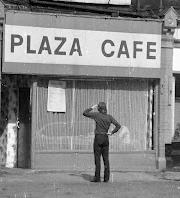
Chicken bryani in the Plaza on Upper Brook Street on Saturdays in the 70s

For those who were born around the mid 20th century who queued to see the film Spartacus, remembered with profound sadness the death of Ottis Reading and raged at the Vietnam War it is more than likely that if you were in Manchester during the late 60s into the 80s you will have eaten at the Plaza on Upper Brook Street.

I had almost forgotten my beery nights out which always seemed to end at the Plaza until a post about breakfast on my friend’s Lois’s blog brought it all back.*

I have yet to meet anyone who ate there who does not have fond memories of the place, and has their own story. Mine are many.

 I remember the night of the Milk Snatcher’s Ball at UMIST** when we fell into the cafe with our baby doll nightdresses which we had borrowed from two flatmates securely hidden under our jeans and tee shirt or the night of the vivid conversation between a man with a broken hand and his girl friend about the relative merits of an A &E unit in down town Berlin.

I am sure there were many things on the menu but I can only ever remember eating the chicken or meat bryani, half of which cost 3/6d in 1970 and was more than enough for two.

The chicken arrived on a pile of yellow rice and raw onion with a small pot of the curry sauce and after vast quantities of cheap student union beer it went down well.

Now our friend Mike had never taken to curry and so at 3 in the morning on Upper Brook Street he would ask for a roast dinner which he got, with everything including the roast potatoes, chicken, gravy and just possibly Yorkshire puddings too. It was as my friend Lois said that "everything was possible at the Plaza."

Sometime around 1972 I stopped going. I suppose it was a mix of things really. My girlfriend of the time wasn’t over keen and by the end of that year we were living off Grey Mare Lane and soon after that out in Ashton, which meant that Upper Brook Street was a serious trek.

I suspect we were also playing at being grown up and grownups eat sensibly at places like the Bella Napoli off Albert Square and on Sundays in China Town. Looking back it was my loss.

And then it had gone. When exactly I don’t know, although I have friends who still went there in the early 80s for Sunday dinner.

Now I know that with age comes a rosy nostalgia about the past, and no doubt my sons can talk of their own food dives and late night experiences but for my generation the Plaza was special, even if it was hard to remember much of the night the following day.

Picture by kh1234567890 posted on flicker photostream

*http://loiselsden.wordpress.com/2012/04/14/breakfast/

**My friend Marc always referred to it as the Tech but he went there while I and my friends Jack, Greevz, Mike, Lois and John slummed it across the road at the Poly which we always called the College of Commerce which had been its pre amalgamation name. There were other things we called it of which the College of Knowledge was one, but mercifully never Colcom which really put you out with the nerds in the dustbins.

Friday, 23 January 2026

Heaps of cars … missing trains ….. and Central Railway Station in colour

I missed the end of Central Railway Station by just a couple of months, and it was not for another decade that I stumbled across the place.

By then it had become a car park which I suppose was a bit of an insult although I guess most of those who parked up there thought it was a convenient use for that former grand terminus.

I can still remember marvelling at how impressive it still was with that giant wall of glass where the platforms almost ended.

Back then I mostly did black and white pictures and rarely did colour which is why most of my photographs of Central Railway Station are monochrome.


But occasionally I did venture into colour slides and recently began converting them into digital images.

Alas many suffered from over four decades in our cellar and the quality of them is iffy.

But there is enough to bring back to life that time in 1979 when armed with two cameras I wandered along the platforms, looking down on the parked cars and the slowly deteriorating remnants of station offices and other railway furniture.

Now there are plenty of pictures of Central after the trains left, but these are mine.


I have to confess that those I took in black and white are better, but here are some of the lost colour ones.
But  then as you do I decided to throw in some of the others and that really is it.

Location; Manchester Central Railway Station

Pictures; after the trains left, Manchester Central, 1979, from the collection of Andrew Simpson


Fish and chips on Richmond Street

This is Richmond Street forty-seven years ago.


Back then I still used it as a cut through from Minshull Street down to Chorlton Street and for a decade was a place I knew well.

I had washed up in the College of Commerce a decade earlier doing an arts degree along side trainee lawyers, accountants and heaps of night school courses. The place had just become part of newly created Manchester Polytechnic, although it still felt like a separate entity miles from the other two colleges.

And that may have increased our sense of isolation or independence which led to its irreverent nickname of the College of Knowledge.

Sadly those not in the know called it ColCom.


That said in the late 1960s and 70s the students Union had hosted some memorable groups which added to our sense of feeling a tad special.

I don’t remember the fish and chip shop, but I will have fallen across the cafĂ© on Chorlton Street, which was never as popular as Bert’s its close rival on Whitworth Street.

The Minshull Street Courts are still there, although they closed briefly just a decade after I took the picture.

But all those untrendy, traditional little outlets like the transport cafés have gone, and with it a bit of my youth.

Location, Richmond and Canal Street

Pictures; Richmond and Canal Street, 1979, from the collection of Andrew Simpson  


Monday, 12 January 2026

A camera ..... a day in 1979 ..... and a lost destination

 I think l was was on one of the roads running parallel to Portland Street, and l thought the building was the former Bank of England close to Piccadilly.


But now l can't be sure.

Alternatively l could be looking towards King Street with what was that other tall black tower which was another bank.

On balance l favour King Street.

Location; Manchester

Picture; the lost location, 1979, from the collection of Andrew Simpson

Sunday, 11 January 2026

The train now arriving is the 13.20 from 1979

I am well aware it isn’t the most original of titles but it pretty much sums up where we are.

At the back of the 1970s I bought a new camera and later added a dark room.

The pictures were all a bit hit and miss because I was a tad lazy with timings for both the developing and printing.

So while some might stand against anyone’s, others are hazy, lack definition and can either be too light or too dark.

That said they are a record of just what things were like as the 1970s pulled to a close.

And so here I was on Piccadilly Railway Station watching a rain arrive.

I have no idea what type of locomotive it is or even where the train had come from.

During the early part of the decade I had regularly travelled south with British Rail but by 1979 this was less frequent.

More recently I was back on the station and was transfixed by the smooth looking locos of today, so in celebration of what we had and what we've got now, here is one I took over 30 years after the first.

Same station, possibly same platform just separated by the decades.

And thirteen years on from that picture of two Virgin trains ...... taking  the strain from Manchester to London it is now as much a part of the past as the train from 1979.

Location; Piccadilly Railway Station

Pictures; Piccadilly Railway Station, 1979, 2013, from the collection of Andrew Simpson

Saturday, 10 January 2026

Who laments the passing of the old milk machine?


It is as much a piece of history as the Penny Farthing bike or the old fashioned tram.  

I am trying to remember when I would have used one.  I suppose it would have been after the pub in those years when I was a student and living in a bed sit in Withington.

There used to be a milk machine by the Scala Cinema which in turn was beside the White Lion. And I guess it would have been that bit of forward thinking about milk for breakfast which would have got me using it.

But then without a fridge and with most shops having closed by nine in the evening buying your emergency milk from a machine made sense.

Of course getting the cartoon open was another matter.

All of which  got me thinking about the age of the vending machine which I assumed came along in the 19th century.

And there I was wrong, there is a reference to one in the first century when Hero of Alexandria came up with a machine to dispense holy water.*

The first modern one was introduced onto a London street in the early 1880s and sold post cards.  For me the first I really remember were the Five Boys Chocolate bars usually on railway stations and which could be guaranteed to deliver slightly dry flaking chocolate which had gone white at the edges. There were also the polo mint machines and the chewing gum ones.

Along with the cigarette machines they were just one of those bits of street furniture you took for granted.  I don’t really remember when they began to disappear to be replaced by the giant all glass fronted multipurpose dispenser.

As for the milk vending machine I rather think they began to vanish in the 1970s, possibly in the wake of the supermarket revolution along with cheap fridges.  For who would want to stand at what was often a shabby and knocked about machine, fumbling for the sixpence only to discover the coin had got stuck, the machine refused to accept it or worst still there were no cartoons left?

This one was on on Shude Hill and was photographed in the March of 1960 which may have been at the height of their popularity.

I suppose they fitted into that new high tech way of life that was the late 1950s and 60s, and I have to say that thinking back to the period it does look ultra modern and there was something novel about getting your milk this way instead of from a milkman.

Not of course that the milkman visits many houses anymore and I hear today that one more newspaper is about to turn itself over to an electronic version.

As someone who grew up in the 50s thinking that milk delivered to the door step along with a daily newspaper was the hall mark of civilized life this all seems a little sad.

And if  I don’t stop I am in danger of sounding like my uncle who still could not bring himself to accept the fall of Constantinople.

Pictures; vending machine on Shude Hill taken by L Kaye, March 1960, courtesy of Manchester Libraries, Information and Archives, Manchester City Council, m59879, m59878, m5987, http://images.manchester.gov.uk/index.php?session=pass


Friday, 9 January 2026

The way we were ............. just 56 years ago

Now it is easy to forget that well within the living memory of most of us the City was still full of tiny workshops which wouldn’t have been out of place in the mid 19th century.

When we first moved to east Manchester in the early 1970s, the pit head gear of Bradford Colliery was still there, as were countless little iron works, steel manufactures and other businesses, employing a handful of local people.

They nestled beside the giants like Clayton Aniline, and the big engineering factories on the Old Road.

The images of the United Steel Works on Ashton Old Road are fascinating, partly because I would have passed the place and because of the detail they reveal.

In particular it is the belt driven machinery which is essentially no different from that which you could have seen in a factory in the 1850s or even the later 18th century.

Back then they would have been driven by steam power but otherwise there is very little difference.

Nor would the actual buildings themselves have changed much over two centuries. They were made of brick to a simple design with wooden beams and cast iron pillars supporting the roof.

Most will have had a varied industrial use over the years and were an essential part of the community.

Picture; inside the United Steet Works, Ashton Old Road, 1970, courtesy of Manchester Libraries, Information and Archives, Manchester City Council, http://images.manchester.gov.uk/index.php?session=pass