Showing posts sorted by relevance for query Little David. Sort by date Show all posts

Monday, 5 January 2026

Lost and forgotten streets of Manchester .... nu 64 Little David Street, a lost canal a cafe and a plan

Now I doubt that anyone takes a picture of Little David Street.

Little David Street, 2016
It's off Chorlton Street, is very narrow and is closed off by a big gate.

It doesn't seem to have excited any interest and I have yet to find anyone who took a picture so in there interest s of history I did.

Little David Street runs besides that building on the extreme right with the very impressive arch way which around 1972 into 1973 was the library for the old College of Commerce and as such was a place I knew well.

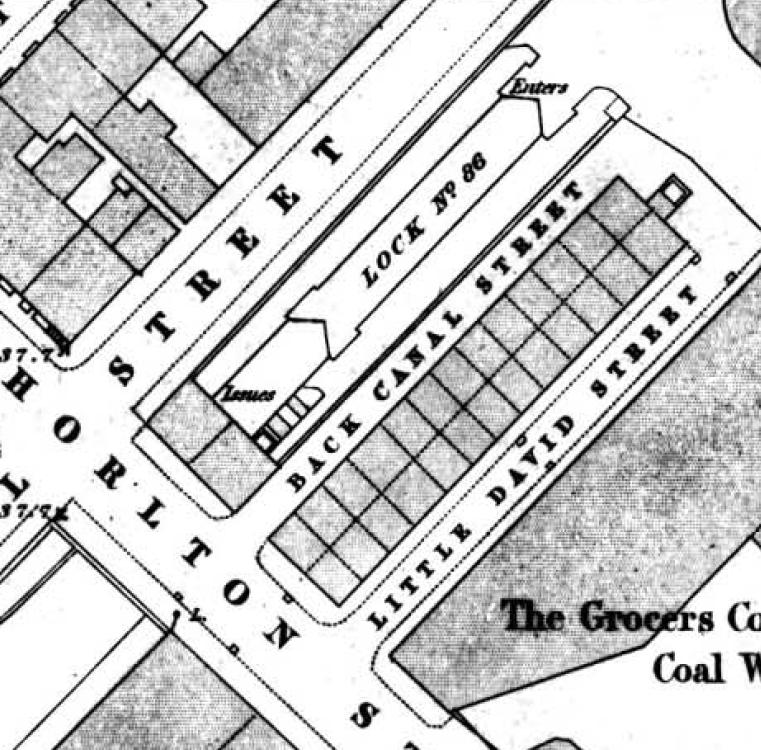
Little David Street, 1849
A century and half before that Little David Street was fronted on its east side by a row of fourteen back to back houses and ran parallel with Back Canal Street.

And both gave access from Chorlton Street to a branch of the Rochdale Canal which stretched from the main canal almost down to what is now Whitworth Street.

The route of this arm of the canal is now underneath the car park and tower block of the Aytoun Street Building and explains why the back of the Minton & Turner warehouse and the one next door open out onto nothing more than an open space.

The canal with the arm off to the left 1955
I can’t say that during my three years in the Aytoun Street Building or as it was then the College of Commerce I knew that under me was that lost bit of canal.

I was there from 1969 to 72 and while some called it Colcom we were happier with the College of Knowledge.  The irony is that part of what I was studying was both Manchester and the Industrial Revolution but that fact that a bit of sat on my doorstep passed me by.

Looking back we could perhaps have been a bit critical of the course which failed to point any of that out but
I suppose back then the landscape was still dominated by so much from the Industrial Revolution it was all just taken for granted.

In time I will go looking for the inhabitants of Little David Street.  They won’t feature on any street directory but they will be on the census returns, and the key will be the landlord of the Mechanics Arms which is there in the first picture and was offering up pints in the 1850s.

The Mechanics Arms and Cafe, Chorlton Street, 1959
So identify him and with a bit of trawling we will find the people of Little David Street.

In the meantime I can’t leave without reflecting on some of the other changes since I was in the College of Knowledge over 34 years ago.

Back then Canal Street was just a street linking Minishull Street with Princess Street, and it was a drab little road made only interesting if you liked canals.

Of course now it is the heart of the Village and part of its space is occupied by tChurchill's.

I remember that corner as the cafe.  I never went into it, pretty much took it for granted and had completely forgotten its existence until now.

And as I posted, Antony sent me this from the MEN, Developers'plans to transform 'Hidden city' city centre into new £150 m district.*


And a full six years later the plans to revamp our little street have come to fruition, hence the re-run of the story ..... proving that all stories are worth revisiting.**

 Location; Manchester

Pictures; Little David Street, 2016 from the collection of Andrew Simpson, British Waterways narrow boats, proceeding to Hassall's Warehouse, Ducie Street, leaving Chorlton Street Lock, 1955, m54248  Mechanic’s Arms, Chorlton Street, H W Beaumont, 1959,m49952, courtesy of Manchester Libraries, Information and Archives, Manchester City Council, http://images.manchester.gov.uk/index.php?session=pass and Little David Street, 1851 from Adshead’s map of Manchester 1851 courtesy of Digital Archives Association, http://digitalarchives.co.uk/

Tomorrow; Living in Little David Street

*Developers'plans to transform 'Hidden city' city centre into new £150 m district, MEN, Katie Butler, April 30, 2015  http://www.manchestereveningnews.co.uk/news/greater-manchester-news/manchester-city-centre-kampus-development-9149071 

**The secret cobbled street in the city centre brought back to life, Louisa Gregson, September 19th, Manchester Evening News, https://www.manchestereveningnews.co.uk/news/greater-manchester-news/secret-cobbled-street-city-centre-21595202


Sunday, 19 July 2026

Lost and forgotten streets of Manchester ..... nu 65 the vanished 22 houses and 81 people

I can’t think anyone would mourn the disappearance of Back Canal Street and Little David Street.

In the space where two streets existed, Chorlton Street, 2016
In 1841 81 people lived in 22 of the 28 back to back properties which had been built as one up one downs at the beginning of the 19th century.

Here lived a mix of families who earned their living as labourers, textile workers with the odd craftsmen.

So few back to backs have survived that it is difficult sometimes to realize how small these properties were and how overcrowded they must have been.

Suffice to say that the width of this stone fronted building on Chorlton Street took in the combined width of Little Canal Street and the back to back houses.

The two streets in 1849
And I think we can be even more precise and calculate that the width of the street would be the distance from the edge of the brick building to right side of the doorway and what was left would be the width of the houses.

Looking at the census records for the June of 1841 reveals that some of the houses were occupied by just one person while others contained four to five people and one had nine individuals crammed in to its two rooms.*

But those with single occupants were in the minority and the general picture is one of overcrowding made worse by what appears to be the provision of only one lavatory.

The sound of young voices in Little David Street, 1841
The largest single age group were the young with 18 out of 52 in Back Camp Street under the age of 10, and 11 out of 29 in Little David Street.

All of which must have been a constant worry for parents with the canal and an arm of the canal surrounding the properties on two sides.

And it may well have been the canal which did for our 28 houses.  Maps from the 1890s show they no longer existed and the 1863 directory lists a warehouse on the site which may even have been there by the 1850s.

So a short life for those two streets.

Location; Manchester

*Census, Little David and Back Camp Streets, Enu 10, 7-8, London Road, Manchester, 1841

Pictures; the site of Little Canal and Little David Streets, 2016, from the collection of Andrew Simpson and streets in 1849, from the OS map of Manchester & Salford 1844-49 courtesy of Digital Archives Association,  http://digitalarchives.co.uk/

Tuesday, 30 September 2025

The canal, some lost buildings and a moment from 1978

 This is Canal Street in 1978, and for me and those friends who went to the old College of Commerce it is  familiar scene.

Canal Street and the Rochdale Canal, 1978

Now the blog doesn’t do nostalgia, it is a pernicious and deceptive trick, where the sun always shone, Wagon Wheels were always big, and people left the doors unlocked.

The fact is that there was never  a perfect golden time, and if people did leave their doors unlocked it was simply because there was nothing in the house worth stealing.

The canal, 1955

That said, the picture does conjure up nostalgic memories.  By 1978, my student days at the College were six years in the past, I was gainfully employed, and still finding lots of time to wander the streets of the city, with a camera and heaps of historical curiosity.

But perhaps because I walked Canal Street so many times I don’t think I ever photographed the canal from this angle.

David Ward-naden did, and it is a perfect piece of history.  Beyond the bridge and to the right the buildings which fronted London Road and have long gone, as has the cark park of the college which was behind that white wall.

David reminded me that this has once been an arm of the Rochdale Canal which serviced a series of warehouses, one of which in the early 1970s was converted into the library of the college.

And that in turn led me back to a series of stories I did of that spot, and in particular of Back Canal Street and Little David Street which ran parallel to Camp Street.  

Only Little David Street still exists and it is now just an alley which at present id fenced off.  Back in the early 19th century the two streets which ran off Chorlton Street terminated at the edge of the canal arm.*

In 1841, 81 people lived in 22 of the 28 back to back properties which had been built as one up one downs at the beginning of the 19th century.

The area, 1955

Here lived a mix of families who earned their living as labourers, textile workers with the odd craftsmen.

The properties were swept away and replaced by a new commercial building, but as late as the 1950s, the canal arm was still in use, and the site was not cleared until the middle of the next decade when the College of Commerce was built.

That too has now gone, with the old tower block redeveloped for residential purposes, and a new block standing on the site of the old car park.

Such is the passage of time over 40 or so years.

Location; Manchester

Pictures; Canal Street and the Rochdale Calana, 1978, from the collection of David Ward-naden British Waterways narrow boats, proceeding to Hassall's Warehouse, Ducie Street, leaving Chorlton Street Lock, 1955, m54248, courtesy of Manchester Libraries, Information and Archives, Manchester City Council, http://images.manchester.gov.uk/index.php?session=pass

*Lost and forgotten streets of Manchester .... nu 64 Little David Street, a lost canal a cafe and a plan, https://chorltonhistory.blogspot.com/search?q=Little+David+Street


Friday, 20 March 2026

Lost and forgotten streets of Manchester ...... nu 66 Back Canal Street and Mr Thomas Griffiths

Now there are no photographs of Mr Griffiths and there is nothing surprising about that.

Home of Mr Griffiths marked in red on Little Canal Street, 1849
He was born in 1806 worked as a labourer and lived in Back Canal Street, which was a row of one up one down back to back houses facing on to the Rochdale Canal.

So unremarkable or perhaps so dire were the houses that they were swept away sometime in the 1860s to make way for a warehouse.

That said the warehouse still exists and is on Chorlton Street as is Little David Street which ran parallel to Back Canal Street.

History has been no kinder to Little David Street which is now gated off but given that it was the same width as its neighbour it will offer up an idea of what Little Canal Street was like.

Sadly so far the historical record has revealed little more about Mr Griffiths who was living at number 17 Back Canal Street with his five children who ranged in age from fifteen down too four.*

He was a widow and while I can’t yet find a reference to his marriage or the death of his wife, I am guessing that he may have been married sometime around 1826 and she might have died in childbirth giving us a date of 1837.

It’s all very vague and making a second guess of basing her name on that of either of her two daughters has proved a dead end.

Still I know that in 1841 when the Griffiths family were in Back Canal Street they were paying 9d in rent and that they were still there in 1842.  Now trying to make anything of wage rates and the cost of living is fraught with difficulties. But a labourer might be on a £1, a textile worker on a little more and rural workers on a lot less.**

Little Back Canal Street occupied half the same of the warehouse
But after that we lose them and the hunt is made more difficult by the large number of men with the name Thomas Griffiths.

That said there is a Thomas Griffiths who was living nearby in Silver Street in 1839 and another in Major Street a year later and both of these are very close to Back Canal Street.

Added to which the rents are pretty much the same so I think it would be sensible to say this is our man.

So far I can’t find him after 1842 but the census of 1851 reveals a Richard Griffiths who might have been his son.  He was the right age, used the same names for his children as Thomas's dad done and shared the family house with two of his siblings.***

Both siblings carried the same names as children at 17 Little Canal Street and were born at the same time as Thoma's children.

It might all be a little too far fetched but if historical research has taught me anything it is that such clues usually lead to the right conclusion.

Well we shall see.

Location; Manchester

*Census, Enu 10 8, London Road, Manchester 1841

**The History of Chorlton-cum-Hardy, Andrew Simpson, 2012

**Census Enu 1k, 46, Ancoats, Manchester 1851

Pictures; the site of Little Canal and Little David Streets, 2016, from the collection of Andrew Simpson and streets in 1849, from the OS map of Manchester & Salford 1844-49 courtesy of Digital Archives Association,  http://digitalarchives.co.uk/

Monday, 16 June 2014

“I think we will have a little to say when all this is over” ..... letters from the Great War

Firing a heavy howitzer in France
“I think we will have a little to say when all this is over.”

It is one of those powerful understatements which so often come from men and women swept up in great events.

In this case it is contained in a letter written by George Armstrong to his brother in March 1915.

George was on the Western Front with the First Battalion of the Welsh Fusiliers and he was writing to Ted serving on HMS Orion.

And in the exchange of letters we learn that their youngest brother Charlie “is expected in London about May the 6 [and that] I should like to see him as its now been close on three years since we met and it seems quite a long time since I was home too.”

"Dad and Uncle Charlie," date unknown
In just those four lines these two men pretty well sum up the experiences of millions who were found themselves far from home on foreign battlefields with little control in what was happening around them.

They were “the little people living out their lives in a big century” and the letters are preoccupied by the ordinary things around them.

George reflects on the weather which “is still cold and proper brittle at night in the trenches” while Ted complains of being “fed up and wanting something to break the spell, of the same old thing day in and day out with tons of coal too often.”

Both share news of family and of friends who were also destined to go into uniform and there was agreement that their mother should apply for the extra money.

They are fascinating glimpses in the conflict now a century behind us but nothing quite prepares you for what is coming.

George sent his letter to Ted on March 7th and Ted replied on the 16th which  just as it should be for even in war people write regularly, in fact George chides his brother for not writing more often and Ted asks where a recent postcard has gone which he sent.

But the sting in the tail is that on March 15th George died of wounds he had received.  The envelope with his brother’s letter was marked in an unknown hand “Deceased” and accompanied by the printed message “NEXT OF KIN NOTIFIED.”

That envelope
It will be the sort of thing that was replicated over and over again during the war but there is something very moving in holding the two letters now a century old and reflecting that on the turn of a week such ordinary letters were given a tragic outcome.

It is a privilege to be able to read them and also to look at the others in the collection which David Harrop* has allowed me to use for the new book on Manchester and the Great War.**

What makes his collection so valuable is that all of the material comes from those little lives and are about how they coped with it all.

Some of his collection can be seen at two exhibitions during the summer.****

All of which just leaves me to try and track George's brothers along with his sisters and on the way possibly identify the men in this picture of "Dad and Uncle Charlie."

Now I have found the family in 1910 and again in 1911 and with more research should find out more.

Pictures; from the collection of David Harrop

*David Harrop, http://chorltonhistory.blogspot.co.uk/search/label/David%20Harrop

**Manchester, Remembering 1914-18 from the series, Great War Britain, The History Press, http://www.thehistorypress.co.uk/index.php/catalogsearch/result/?order=relevance&dir=desc&q=the+story+of+chorlton

* ****The Atkinson, Lord Street, Southport from July 28 and Oldham Archives, Union Street, Oldham, from August 4

Monday, 9 February 2026

The lost canal ….Bert’s Café …. and the Coach and Horses ….. views across Minishull Street fifty years ago

This was one of my familiar views of the Manchester I knew in the 1970s.

Looking towards Minishull Street, 1979

To my left was the tower block of the College of Commerce which some of us affectionately called The College of Knowledge but which had just joined the Art School and John Dalton to become Manchester Polytechnic.

Over to the right was the Fire Station and Police Station on Whitworth Street West. Leaving just the tall buildings of the British Rail office block and the swirling S bend pile which was more glass than wall.

Lost view of Minishull Street, 1979
And for those really in the know hidden behind the hoardings in the first picture was Bert’s café and Placemate that night club which had once been home to the Twisted Wheel.

To which there was the Coach and Horses on London Road which my Pubs of Manchester Past and Present tells me "was originally an artisan's house with a workshop on the top floor.  It ended its life as a Tetley house at the bottom of Piccadilly Approach on the corner of Upton Street".*

We would sometimes cross the car park from the college and spend an evening in there, ostensibly discussing the next essay but quicky ending up on the football machine drinking from those old-fashioned straight glasses.

Go back to 1850, and the spot from which the pictures were taken and this was Coal Yard of the Bridgewater Canal Company, supplied by an arm of the Rochdale Canal.  The canal still exits running beside Canal Street and running  eventually in one direction to the Dale Street Basin and  Castlefield in the other.

That canal arm, 1850

But the arm which also nudged Little Davis Street has long gone.  It was still there in 1950 and may well have been filled in when the College of Knowledge was built in the 1960s.

Leaving me just to reflect that for a while the Poly occupied the warehouse which once abutted the arm of the canal while I have written about Little David Street and some of the people who lived there.*

The Rochdale Canal with the vanished arm to the right, 1980
I could again explore that history from the 1850s but instead will settle on Bert’s Café which remains with me over 50 years after we frequented the place, eating Bert’s sausage sandwiches and swapping stories of the night before.

Given that it was just a few minutes’ walk from the College and we were the archetype students, we would put a morning breakfast over the first lecture of the day. 

The place consisted of just one room with a serving hatch from which Bert delivered the orders which mainly consisted of chips with egg, or bacon or sausage with a variation of these in sandwiches.  The bread was white, the spread marg and the coffee was hot milk with a hint of the brown stuff.

In the winter the windows were always steamed up and in the summer the door was permanently open but had those plastic-coloured strips which rustled in the wind and were a concession to privacy.

The view, 2025

Location Minishull Street

Pictures, looking towards Minishull Street, 1979 from the collection of Andrew Simpson and the arm of the Rochdale Canal,  1851 from Adshead’s map of Manchester 1851 courtesy of Digital Archives Association, http://digitalarchives.co.uk/ and the view in 2025, courtesy of Google Maps

*Pubs of Manchester Past and Present, http://pubs-of-manchester.blogspot.com/2010/01/coach-horses-london-road.html

** Little David Street, https://chorltonhistory.blogspot.com/search?q=Little+David+


Tuesday, 31 May 2016

In Southern Cemetery .......... uncovering a little more of Leading Seaman Ernest Thistlewood who fought at Jutland

Long Service medal
This is the long standing medal awarded to Ernest Robert Thistlewood who served with the Royal Navy from 1896-1919.

Like so much research his story turns on just a day, because only yesterday I had to admit I knew little about him other than that he was on HMS Royal Oak at the Battle of Jutland on May 31 1916.*

And even that assertion was based only on the presence of a sweet heart badge with the name Royal Oak which was amongst his medals.

A day later and another trawl of the records turned up his Royal Navy service record and with that he has stepped out of the shadows.

He was born in Birmingham in 1878 and at the age of 18 he gave up his job as a “shop boy" for a life at sea.

During the course of which he served on 21 ships and naval stations and on May 1 1916 joined the crew of HMS Royal Oak on the day it was commissioned.

On May 30 she sailed out of Scapa Flow joined the British Grand Fleet and participated in the Battle of Jutland.

Sweet Heart Badge
And Ernest was there at the battle, and continued on HMS Royal Oak till he was demobbed in 1919.

The record shows that he had re-enlisted in 1910 for a further five years was promoted to Leading Seamen and throughout his career was described a “very good” sailor.

Now no pictures of him have surfaced but his military records show he was just over 5 feet in height had light brown hair, brown eyes and a “fresh sallow” complexion.

And there the trail gets just a little confused because there appears to be another Ernest Robert born in Birmingham who married Ada Mary Carl at the Holy Trinity Church in Mile End in 1908.

The collection of medals
All the bits fit except that he gave his occupation as a Fireman and was based at the Fire Station in Great Marlborough Street.

Now this could still be him, and I may have miss read the naval record which may suggest a break in service.

If this is him then they had two children born in 1910 and 1911 and he died in 1963 in Ruislip with Ada surviving him by seven years.

Of course any one who has done any family research will not be surprised at this turn of events and there are still clues which may help firm up the story.

Some of the display at Southern Cemetery
But for now I am pleased that a little bit more of the detail behind those medals has come to light, and I will pass on the information to David Harrop who maintains the exhibition at the Remembrance Lodge in Southern Cemetery.

David has just finished a new display to mark the centenary of the Battle of the Somme which began in July 1916.**

Some of the exhibits are not only related to that battle but are from men who are either buried or commemorated in Southern Cemetery.

Location; Southern Cemetery

Pictures; medals of Leading Seamam E R Thistlewood, 1896-119, from the collection of David Harrop

**In Southern Cemetery with a little bit of the Battle of Jutland ........ and a story still to be revealed, https://chorltonhistory.blogspot.co.uk/2016/05/in-southern-cemetery-with-little-bit-of.html


** Coming Soon ......... an exhibition in Southern Cemetery ........... remembering the Battle of the Somme, https://chorltonhistory.blogspot.co.uk/2016/04/coming-soon-exhibition-in-southern.html

Tuesday, 10 June 2014

Looking for William on "active service" in France in October 1916

This is the second of the Great War picture postcards from the collection of David Harrop.

Over the last few years I have been looking at the stories of those who lived through the Great War both the men who marched away and those who stayed on the Home Front.*

David has a vast collection of postcards, letters, and other memorabilia and has kindly shared some of them with me.**

And in return I will be featuring ten from that collection covering letters and cards from men at the Front, to the medals and official communications down to the souvenirs which sat on a mantelpiece of sideboard.

It will be impossible to draw a strict line between Manchester, and Salford, Stockport and the nearby towns of Ashton and Oldham and Rochdale, if only because some of those in the collection came from one lived in another and worked across another municipal border.

Some have come from even further afield like this one from Thomas to A H Hosking.

Thomas was on “active service” in France and the post card is dated October 1916 which would place Thomas on the Western Front during the last month of the Battle of the Somme.

This had begun in the July of 1916 and dragged on till November by which time both sides had sustained heavy casualties.

Now so far I have not been able to discover anymore about Thomas or Mr A H Hosking who received the card.  The address is still there and it is one of what were once very impressive solid houses on St James’s Road in Croydon

The message gives little away focusing on the positive and comments on the letter and newspaper sent out to France and promises a letter later in return.

With a bit of research I should be able to identify Army Post Office S 18 which may help.

All of which at present just leaves us with the image on the front of the card which came from a series produced by the Daily Mail Official War Pictures.  This was number 11 from series two and carries the title,
“Before battle, in battle, and after battle our "Tommies" are ready for a "fag." These men are lighting up after a scrap.”

And with a little careful research and help from Epsom and Ewell History Explorer I discovered that “during the Great War the Daily Mail produced a number of sets of postcards each showing an Official War Photograph. We believe there were 22 sets each with 8 images. 


The total number of postcards is therefore 176 but some images were used twice, once in colour and once in monochrome. 

All the images had been cleared by the censor and the cards were part of the official British propaganda effort so it is possible that some of the photographs had been posed.”*** 

I will go back into the records and try and find both Thomas and A H Hosking.

If as I expect Thomas’s surname was Hosking then there are a few clues both in the military records and official documents either side of the Great War.

It would be nice to follow up the two individuals and put lives behind the post card.

And that is what David has been able to do with many of his collections.

Only yesterday as I looked through the material he has lent me I came across stories of young fighting men and their families from enlistment to the conclusion of hostilities.

Some of these will be available to see at two exhibitions David will be mounting later in the year.****

Picture; from the collection of David Harrop

 *The Great War, http://chorltonhistory.blogspot.co.uk/search/label/The%20Great%20War

**David Harrop, http://chorltonhistory.blogspot.co.uk/search/label/David%20Harrop

***World War 1 Postcards, Epsom and Ewell History Explorer, 
http://www.epsomandewellhistoryexplorer.org.uk/WW1Postcards.html

****The Atkinson, Lord Street, Southport from July 28 and Oldham Archives, Union Street, Oldham, from August 4

Monday, 4 August 2014

A little bit of the Great War in Oldham from August 4

Now today was the day just a century ago that Britain declared on Germany.

Most believed it would be “over by Christmas” a “brief cleansing war” which for some would settle old scores, restore the balance of power in Europe or create a new world order.

Some saw it coming arguing that the imperial tensions between the great powers and the arms race which had existed from the start of the century made war if not inevitable then certainly a darned near certainty.

Sarajevo might have been a spark but the logic of an arms race is that one side will at some point decide that their advantage in weapons and men can’t last and a pre-emptive strike is the best option.

And of course the set of alliances that the Great Powers locked themselves into left little room for manoeuvre which was not helped by the deadly routine of train timetables which meant if troops had to be mobilized it had to be done to a set plan but which alerted your enemies to your intentions.

The causes will continue to be debated and now as we enter the centenary of the outbreak of war there will be the opportunity to see its impact on the ordinary men and women who were caught up and carried along by it.

There will be the big set exhibitions but I for one will be going to see the second of David Harrop’s presentations from his extensive collection.

The first opened in Southport on July 28 and the second will be opening today at the Oldham Archives, Union Street, Oldham.

The strength of David’s material is that much of it is the ephemera of war, including porcelain tanks meant for the mantelpiece, letters and postcards from the men and women at the Front and the medals and official communications from the War Office.

All of which gives a sense of how people coped, like Mrs Davidson of Hulme whose husband was killed in the last few months of the war and whose collection of letters cards and much more David has carefully looked after.

*David Harrop, http://chorltonhistory.blogspot.co.uk/search/label/David%20Harrop

**The Atkinson, Lord Street, Southport from July 28 and Oldham Archives, Union Street, Oldham, from August 4

Pictures and memorabilia; from the collection of David Harrop


Tuesday, 29 September 2015

Saying farewell to the Post Office bike .......... a little bit of Chorlton's vanished history

One ex Royal Mail post bike, 2015
Now a little bit of postal history slipped past me last year.

For many it will seem a tad trivial but after 120 years the Royal Mail finished off the Post Office bike.

Since 1895 it has been one of those small bits of our daily life which is so commonplace it has gone unnoticed and now it has gone.

This I know because my old friend David Harrop recently bought one from a chap here in Chorlton and was so pleased with the deal that he rode it back to Heaton Moor.

Nor will he have been alone in picking up a surplus bike.

According to the Guardian the Royal Mail had got rid of 14,000 between 2010 and 2014  which left just 4,000 to be disposed of last year.*

Lots of Post Office bikes, circa 1914-18
And of course behind the decision lurks a whole lot of history.

There had been some bizarre and fanciful attempts at inventing and marketing push bikes stretching back into the 19th century but by the 1890s what we would recognise was zipping along our streets and country lanes.

They offered a cheap alternative to public transport, could go almost anywhere and quickly became a craze with the establishment of hundreds of cycle clubs.

And when you added all of that with politics you got the Clarion Clubs, the first of which was started in Birmingham in 1890 by a group of young socialists who combined the bike, friendship and the desire to advance the message.

Barnet Post women circa 1914-18
But more than all of these the bike was the way you got to work.  Look at any picture or news film from the mid 20th century showing people leaving Trafford Park and what strikes you is the sheer number of men and women on bikes.

So it was just sensible for the Post Office to equip its workforce with a means to make delivering our mail a little easier and lot quicker particularly as rounds were very long and as a consequence the load postman carried was very heavy

The standard bike I don’t think changed much over that century and a bit but the details I will leave to David who has a fine collection of Post Office memorabilia some of which can be seen in the Remembrance Lodge at Southern Cemetery along with exhibitions telling the story of those who lived through the two world wars.

Picture; David’s post office bike and Barnet Post women circa 1914-18, courtesy of David Harrop

*Royal Mail to phase out post bikes completely in 2014, Laura Laker, The Guardian, December 9 2013,
http://www.theguardian.com/environment/bike-blog/2013/dec/09/royal-mail-post-bikes?commentpage=2

**The Clarion Cyclist Club, http://chorltonhistory.blogspot.co.uk/search/label/The%20Clarion%20Cyclist%20Club

Friday, 23 August 2019

A little mystery down in Heaton Mersey

The Wardle bell, 2015
Now here in lies a mystery.

The bell in the picture was discovered by David Harrop on one of his recent walks exploring the industrial archaeology of Heaton Moor.

The trip took him  from Didsbury Road down the side of the Crown Hotel along Vale Close to the cottages of Park Row and Park View.

It is a picturesque spot which belies its past, for here just to the north of those cottages was the Upper Bleach Works.

The works were in full swing by 1844 and I guess with a bit of digging I should be able to discover when they were opened and when they finally closed.


Park Row, the Bleach Works in Heaton Mersey, 1844
But for the meantime it’s that bell which according to David sits on its own along the footpath with no explanation for why it is there.

David assumes it may have come from the Bleach Works.

The name on bell is “Wardle Manchester” which is not much to go on but in 1911 there was an “Ernest Wardle & Co, Iron and Church Roof builders" who operated from the Derby Street Works in Cheetham.

It doesn’t appear to be a big concern and of course the date may all be wrong added to which it may have no
Park Row and Park Place, 2015
connection with the bleach works and instead just be one of those random objects that turns up for no apparent reason other than sheer chance.

That said the hunt for the bell led me to a wonderful site on “Walking from Stockport to Sale” along with more of David’s pictures.

And it precedes earlier  that trips taken by Andy Robertson highlight how little I knew about Heaton Moor and how much more there to discover.


Looking across to the site of the Bleach Works, 2015


Pictures; Wardle’s Bell & Park Row, 2015 courtesy of David Harrop, and detail of Heaton Mersey from the OS for Lancashire, 1844, courtesy of Digital Archives Associationhttp://www.digitalarchives.co.uk/

* Walking the Mersey: from Stockport to Sale, August 15, 2012, https://gerryco23.wordpress.com/2012/08/15/walking-the-mersey-from-stockport-to-sale/


Monday, 2 November 2020

Discovering a little bit more on a soldier buried in Southern Cemetery ............. Private William Ernest Edwards 1891-1918

Now I am fairly confident that there are no old pictures of Cottenham Street which once ran from Upper Brook Street to Mansfield Street.

Part of it still exists but sadly the houses which once flanked it and in particular number 55 have gone.

And that is a shame because they would be one of the only physical links I have to William Ernest Edwards.

He was born in 1891 and died in the Princess Street Hospital on November 22 1918.

I know that just before he enlisted he described his occupation as a “cashier,” that he was in the 16th Battalion of the Manchester’s and is buried in Southern Cemetery.

Other than that all we have are a few biographical details that have come from the census record.

He lived at Cottenham Street in Chorlton on Medlock from 1891 till at least 1911.  His father was a policeman who died sometime between 1901 and 1911 and on his death Mrs Edwards turned part of the family home over to a boarding house, renting out one of the five rooms to three lodgers.

And that is about it.  His elder brother had followed their father into the police force but according to David Harrop was drowned at sea.

And it is David who I have to thank for introducing me to Private Edwards after acquiring one of William’s war medals.

This was the British War medal issued to all men who fought in the Great War and it will form part of a new display in David’s permanent exhibition in the Remembrance Lodge at Southern Cemetery.

The collection includes memorabilia from both world wars and many of the items have a direct connection with Southern Cemetery.

And that connection extends beyond Private Edwards and includes his mother Hannah who was buried there in 1917 in the Non Conformist section of the cemetery.

That said I can’t exactly be sure at present of the date because there is another Hannah Edwards who was buried there in 1930.

But 1917 seems to fit given that Mrs Edwards and her some were both Non Conformists.
It is not much I know to stand for one man’s life but with more research and a dollop of luck more will come to light.

So a search of the directories for 1918 will confirm if she was still at 55 Cottenham Street and if not providing she hadn’t moved address this might anchor her death for 1917.

And a little has come to light about William’s father and brother. His father was born in 1863 and joined the City Police in 1885 and David his brother followed his father and joined in 1909.

Picture; headstone and British war medal  of Private Ernest Edwards 2015 from the collection of David Harrop

Friday, 27 January 2017

The amazing David Harrop collection is on its travels ............ be the first to display an item

Now anyone who knows David Harrop, will know about his collection which spans two world wars and the history of the Postal Service.

Many of the items from that collection have appeared over the years as stories on the blog and most of the material featured in my book Manchester Remembering 1914-18 was sourced by him.*

The items range from rare photographs and picture postcards, to letters, theatre posters and a lots of everyday ephemera, much of which would usually be thrown away or destroyed.

And amongst the vast cornucopia of “old and historic things” are the big ones, which include pillar boxes, a “posty” bike, a Victorian mail cart and my own favourite which is the RAF clock.

David tells me they have out grown his current storage units and he is looking for somewhere to store some of them for a short period.

And so here is the appeal ............. if you have a spare garage, large secure shed he would be happy to hear from you.

But more than that David is keen for these items from the collection to be seen which leads me to that second appeal to schools, offices or work places who would like a little bit of history to adorn their space to also get in touch with him.

Presently some of his collection is on permanent display in the Remembrance Lodge in Southern Cemetery while in recent years other items have been seen in towns around the North West.

David has various facebook sites where he can be reached or leave a comment on the blog and David will pick it up and be in touch.

Location, pretty much anywhere


Manchester Remembering 1914-18 by Andrew Simpson is published by the History Press on February 2 2017


Order now from the History Press, http://www.thehistorypress.co.uk/publication/great-war-britain-manchester-remembering-1914-18/9780750978965/ or Chorlton Book Shop, info@chorltonbookshop.co.uk 0161 881 6374

*A new book on Manchester and the Great War http://chorltonhistory.blogspot.co.uk/search/label/A%20new%20book%20on%20Manchester%20and%20the%20Great%20War

Pictures; from the collection of David Harrop

Tuesday, 18 August 2015

Memories of New Cross in south east London in the 1950s


I like reading other people’s memories of their childhood, especially when they are about the same part of south east London that I grew up.

So here are the memories of David Easton who I first met recently at the Furness History Society.  David runs two very interesting blog sites, http://brickcourse.blogspot.co.uk/  and http://furnesshistory.blogspot.co.uk/ which are well worth visiting.

David has written a vivid account his part of New Cross.

Throughout my childhood, a fortnightly visit to New Cross in South East was obligatory. My grandmother lived at 105 Woodpecker Road, a house that she shared with my aunt and uncle and their children. 

My grandfather had died in 1944. The year of my birth. My Nan was a dour Victorian woman, the sort who gained her only pleasure from constantly grumbling. Auntie Dolly was cheerful and always gave a warm welcome. 

Oppoiste; David's grandparents at 105 Woodpecker Road

Her husband Vic was jolly too, although I always had trouble understanding his strong London accent. This was a large house in a terrace. Two reception rooms, a dining room, a kitchen and three bedrooms. The bathroom was only added in the 1960's. 
The small back yard had a toilet and a coal shed. The tin bath hung on the wall. It was always a gloomy home, even in bright daylight. Come evening, the 40 watt bulbs would be grudgingly illuminated when it was almost too dark to find the light switch. 

There was just one more street between Woodpecker Road and the railway sidings so the clanking of wagons and coaches being shunted was a common sound. Of a Saturday afternoon, the air would be filled with the roar of the crowd at Millwall football ground which was just across the railway.

The woman next door but one was known to be eccentric. She lived alone with Tibbles and when her feline friend failed to come home one day, she went out in search. Around the corner in Chipley Street, a tabby cat lay in the gutter. Carrying the body home, she was sure that a little warmth was all that was needed to bring about a revival.  It was only when the real Tibbles came through the door a couple of hours later that she realised that the dead cat that was still roasting in the gas oven was an imposter.

The highlight of these visits was the journey across London. In the early years, we would sometimes take a tram from Victoria. This waited at its' terminus in the middle of Vauxhall Bridge Road. I think this was route 36 and took us along Old Kent Road into New Cross. 

As a young child, I was always thrilled to sit on the top deck of the swaying and rattling old car. This was one of the last tram services in London, replaced by buses in 1952, the latter offering little excitement.  

Another route involved an ancient relic of the Underground. Changing trains at Whitechapel we would descend the stairs to the platforms of the East London line. The railway would soon pass under the Thames and it was clear from the stations that not all was watertight. The ancient train, of only 3 or 4 coaches, had sliding doors - passenger operated. One had to heave on a shiny brass handle and remember to close it behind you. 

We travelled only 2 or 3 stations to Surrey Docks where we would wait for a single deck bus. I never saw a ship but sensed that masts and funnels were hidden behind the high dock walls. The bus wound its way through the south London streets crossing the Surrey Canal where a Thames lighter  or two, laden with sawn timber,  would always be seen moored at a wood yard. The canal is sadly filled in and turned into roadways. Nearby was Folkestone Gardens, now a small park but then forbidding tenement buildings known as "mansions".

As I grew older and bored with family chatter, I would go out exploring the neighbouring streets. This was near to dockland and had suffered wartime bombing. There were a number of cleared sites where houses once stood. 

Some of these served as used car lots, others were occupied by pre-fabs. My aunt worked at Pecry Haberdashers in Deptford High Street. I seem to remember an open fronted shop, wooden floors and a pneumatic payment system. Each counter was connected to a system of pipes and payments would be sealed into a container which would be propelled by air pressure to the office upstairs. She worked in the office upstairs and would receive the cash, prepare the receipt and send it back to the counter with any change.  

On New Cross Road, the Matcham designed Empire Theatre had not yet been demolished. The last curtain had fallen but the house opened again for a record attempt by a pianist. There was no entry charge but people out of curiosity were looking in to see this man who had already suffered two sleepless nights and who by this time had bandaged fingers. 

Wandering another day, I went in the opposite direction and found that the strangely named Coldblow Lane dived under the railway line through a narrow tunnel. The other side was an abandoned level crossing and diminutive signal box. The tracks led into what appeared to have been a wagon works. The large sheds and yards were open to anyone who cared to wander in. There was no vandalism, no graffiti; they stood as they had on the day that the last worker had left.

My visits to New Cross eventually became less frequent. My Grandmother died, my cousins married, Aunt and Uncle moved to Lewisham and Woodpecker Road was demolished to make way for a new estate.

David

Picture; from the collection of David Easton

Tuesday, 11 July 2023

So good the story wrote itself all over again ……..

Now if you are going to run a successful railway company and indeed brand yourself “The Premier Railway” there should be no half measures.

SS Anglia, circa 1899-1914
And that pretty much was how the London and North Western Railway went about its business.

Its routes traversed the country from the west country, through London and into the northwest and out across the Pennines into Yorkshire, and as befitting such a grand enterprise it ran its own steam ships to Ireland from Bristol, Holyhead, Liverpool and Glasgow.

And when it merged in 1923 to form one of the “super four” it retained that air of superiority by becoming part of the grand sounding London Midland and Scottish Railway, thereby trumping its three rivals whose names announced them as seemingly just regional English railways. *

But as the LNWR our railway could boast that it was once the largest joint stock company in the world.

Just what the company did
So, no surprises that it also marketed the business in a huge range of picture postcards of which SS Anglia was but one of many which included their railway locomotives, trains and stations.

There had been three ships with the name of Anglia working for the LNWR and its LMS successor, from the first built in 1847, the second launched in 1899 and the last which came into service in 1923, was damaged a year later and was scrapped in 1935.

Ours is the second and my Wikipedia tells me was “requisitioned for use as a hospital ship during the First World War. On 17 November 1915 she hit a mine laid by the German U-boat, UC-5. n 17 ."

HMHS Anglia, 1914-18
HMHS Anglia “was returning from Calais to Dover, carrying 390 injured officers and soldiers. At around 12:30 pm, 1 nautical mile (1.9 km) east of Folkestone Gate, HMHS Anglia struck a mine and sank in fifteen minutes. 

The nearby torpedo gunboat HMS Hazard helped evacuate the passengers and crew. Despite the assistance of the nearby collier Lusitania, 134 people died in the sinking." 

I don’t suppose I would have gone looking for story of the SS Anglia, or its troop ship reincarnation had it not been for a neat little piece of porcelain made during the Great War and sold as a souvenir.

The Manchester version, 1914-18
Such pieces were common enough and accompanied porcelain tanks, battleships, and ambulances in the catalogues of porcelain manufacturers.

Both the picture postcard and the porcelain piece are owned by David Harrop who had a huge collection of wartime memorabilia some of which are on display in the Remembrance lodge in Southern Cemetery.

An account of HMHS Anglia appeared recently on the blog and when David also offered up the picture postcard the story just wrote itself.

Pictures; the SS Anglia circa 1899-1914, and the porcelain figure of HMHS Anglia, circa 1914-1918 courtesy of David Harrop.

*The Great Western Railway, The London North Eastern Railway and the Southern Railway.  To be fair the LNER also ran routes into Scotland as far as Aberdeen and owned its own docks in 20 locations across England and Scotland as well as heaps of canals.

**HMHS Anglia, https://en.wikipedia.org/wiki/HMHS_Anglia

***The little reminder of the Great War, https://chorltonhistory.blogspot.com/2023/07/the-little-reminders-of-great-war.html