Showing posts with label Housing conditions in the 20th century. Show all posts

Wednesday, 7 July 2021

One hundred years of one house in Chorlton …. part 122 ....... Totò Looks For A House

The continuing story of the house Joe and Mary Ann Scott lived in for over 50 years and the families that have lived here since. *


Now I doubt that Joe and Mary Ann watched Italian films, but yesterday was Totò night in the house.

Rosa had arrived over from Milan on Friday, and we had bought in several films by Totò, who like Rosa was from Naples.

He is someone I have written about before, and over the years I have become quite a fan.**

Last night we chose Totò Cerca Casa, or Totò Looks For A House, which was made in 1949 and was the second most popular film of the year.

The sets were pretty basic, the humour fairly slapstick and some at least of the actors might have been better enrolling in acting school, but given all of that it was funny.

And while the plot was at best fairly implausible it did hold some truths.

Like most of post war Europe there was a severe housing shortage and Totò and his family end up in a number of different properties, each more unsuitable than the one before, including a school, a cemetery caretaker's house, the studio of an artist, a large luxury apartment and even the Colosseum before ending up in a psychiatric hospital.


Each location offers up comic possibilities, from a student rebellion led by Totò, to an apparent ghost at the cemetery, and the discovery that the luxury apartment has also been rented out to another family at the same time. 

Behind the humour of course is the very real hardship of people with no where to live.  

Naples was already a hard city to live in and the war made it harder.

Here in Britain there was the same lack of properties, which in turn led to the squatter movement was a direct response tin part to the shortage of accommodation because of war damage but also because some properties had been deliberately left unoccupied by their owners.

The campaign was nationwide and in London was coordinated by the Communist Party.

Here in Manchester the first successful squat was at the gun site near Alexandra Park which housed one family at 8 p.m., but by the following day contained a community of over 20 families and all available huts were occupied. It is a fascinating story and ended with the Corporation accepting the squatters as tenants.*** 


Joe and Mary Ann will I suspect have known about the Alexandra Park squat, and taken a keen interest given that they built decent and affordable houses across Chorlton.
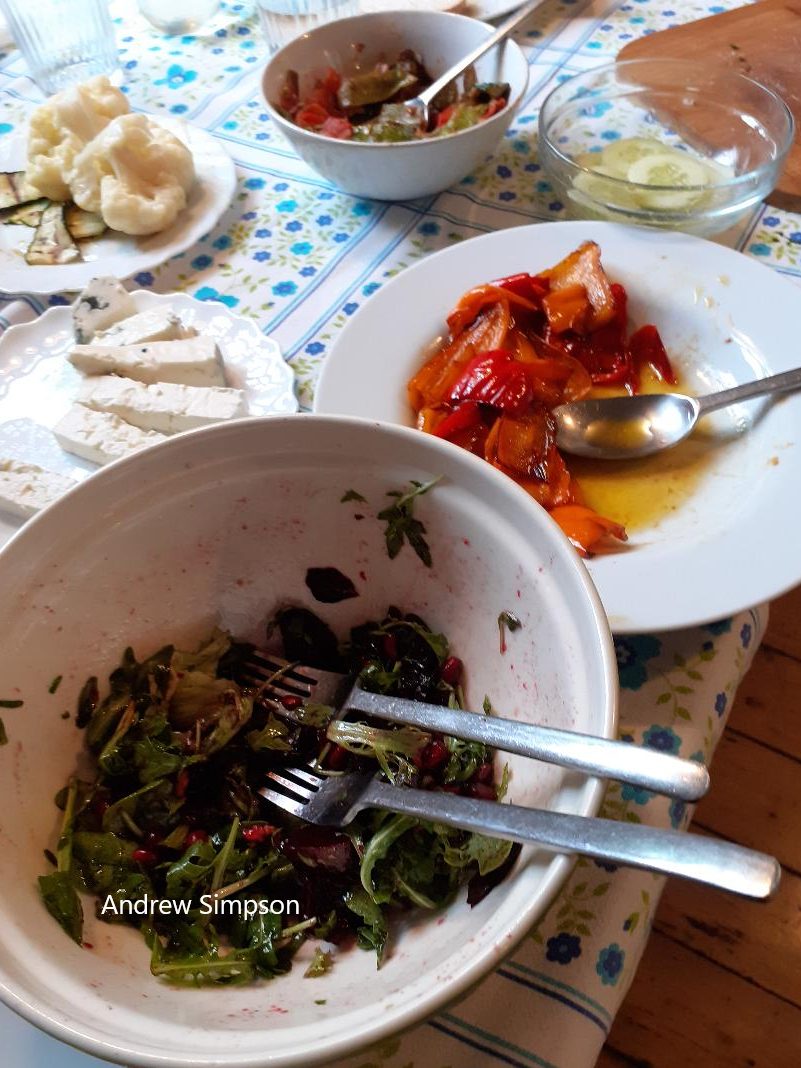

But I have no idea whether they would have enjoyed Totò Cerca Casa or the selection of foods Rosa cooked up that evening, which included peppers, a selection of greens in olive oil and may favourite, a salad made from oranges and dressed with garlic, olive l and chillies.

 Pictures, Totò Cerca Casa, 1949 and a selection of Neapolitan dishes.

*The story of a house, https://chorltonhistory.blogspot.co.uk/search/label/The%20story%20of%20a%20house

Walking the streets of Naples with a comic genius ........ Totò, https://chorltonhistory.blogspot.com/2020/01/walking-streets-of-naples-with-comic.html

Totò 

***The forgotten story ………. a little bit of squatter history in Alexandra Park, https://chorltonhistory.blogspot.com/2020/07/the-forgotten-story-little-bit-of.html


Thursday, 28 June 2018

Living in a two up two down house any time from the 1890s

Behind the houses, 1979
The two up two down terraced house remains a feature of most of our towns and cities.  

Most were built in the mid 19th century onwards, some were adapted from older two roomed back to backs and some were altered to add another room, or the addition of an extension.

But across the country, particularly in the north and the midlands they were and still are a major part of the housing stock.

And many of us will have close connections to them. My mother and grandparents lived in one in Derby, and the first house I bought was a two up two down mid terrace in Ashton -Under- Lyne.

Now this is no romantic descent into some warm cosy nostalgic commentary on two up two downs.  They are fine for those starting out together when there is just the two of you with an option on a baby but cannot have been fun for a large family.

After all where do you put everybody?  Not that this was ever a new problem.  Overcrowding both in the towns and cities as well as the countryside has always been the lot of many working families.

12 Hope Street, Derby, circa 1930s
Back in rural areas in the 19th century parents fell on a range of strategies.

Where possible some of the children stayed with relatives or deals were struck with neighbours who involved families with boys and girls sharing out the children and setting up single sex bedrooms in each other’s houses.

And if none of that was possible it was down to the blanket across the room dividing the area in two.*

All of which brings me back to the house in Ashton -Under -Lyne.  It was the usual model.  You walked in off the street into the front room and directly facing you was the door to the back room.  In our case the stairs ran from the very back of the second room up to a small landing and the two upstairs rooms, one of which had been divided to take a bath room.

Almost all the original features had gone and so it was impossible to know what the downstairs fireplaces had been like, the design of the range or even the doors, for all of them including the front door had that 1950s makeover which involved a sheet of hardboard which was nailed on.

Outside at the rear we had a yard with the lavatory and beside it the gate to the alley.

12 Hope Street, Derby, 1926
Back in 1911, our house with its four rooms had been home to James and Catherine Porter, their four children and James’s sister.

And here really is what must have been a problem, for the Porter’s had a ten year old daughter, two sons aged 3 and 2 and a baby and then there was Elizabeth Porter the 39 year old sister.

Now I cannot be sure but I suspect the problem had only recently become more complicated, because Elizabeth had been living with her father who had died the year before and we can only guess how they all fitted in.

And there we pretty much have to leave the family.  Elizabeth was working as a cotton winder in a local mill and so may have found alternative accommodation or maybe they all adapted and made the best they could.

The house is still there and while many of these two up two downs have been cleared away, plenty more are still doing the business.

Ours dated from sometime at the end of the 19th or the very beginning of the 20th century and like so many it was built within sight of the local mill and what had been a colliery.

Just across from the house along Whiteacre Road, there were three coal pits and two reservoirs all gone now although when we were there the site was still just a landscaped hill.

Picture; Behind the houses, 1979, back yard of 12 Hope Street, circa 1930 and 1926, from the collection of Andrew Simpson

* Reports of the Special Assistant Poor Law Commissioners on the Employment of Women & Children in Agriculture in England, HMSO, 1843