Showing posts with label Elections. Show all posts

Friday, 10 July 2026

As many Prime Ministers as you can count ……

It has become one of those throw away comments much loved by the media that since 2016 we do seem to have had a lot of Prime Ministers, which is often accompanied with a comparison to some of our European neighbours who change theirs with monotonous regularity.*

1979

And it is true that in that decade we have had five, with one lasting just 44 days which occasioned the “Liz Truss lettuce”.

1923
Now none of this is contested but does hide the uncomfortable history that during the last century some governments were almost as short lived.  

The second post war Labour Government which won the 1950 General Election survived with a majority of just five from February 1950 till the October of 1951.  

All the more remarkable when the first post war Labour Government came to power with a huge majority and established the National Health Service. 

Just over twenty years later in 1974 there were two elections in the February and October, while the Conservative Prime Minister, Sir Alexander Douglas- Home who succeeded Harold Macmillan in the October of 1963 lasted just a year.

Of course, there are sound political reasons why those changes of power occurred and once you delve into the history the sleek and shallow observations are just that ….. sleek but shallow.

And if you wanted to go back to almost the beginning of the 20th century that history can offer up a similar set of Prime Ministers who held office for just a short period.

1929
David Lloyd George, Coalition, lasted from 1918 till he was ousted by a Tory Party coup in October 1922.  His successor Andrew Bonar Law, Conservative was replaced by Stanley Baldwin, Conservative in May 1923.

But Baldwin lost the 1924 General Election to the first Labour Government led by Ramsey MacDonald whose administration lasted for just eleven months. 

Baldwin was returned to power and managed a creditable five years before he was defeated in the 1929 General Election by Labour who were derailed by the financial crisis of 1929.  Unable to secure the budget cuts he wanted and in the face of a Labour Party split he formed a National Government winning the 1931 General Election.

All of which means that by my reckoning in the seven years that spanned most of the 1920s we managed to clock up six changes of Prime Minister, starting with the Lloyd George Coalition Government and ending with the Coalition Government of Ramsay MacDonald.

Pictures, Election Posters from 1924-1979

*Theresa May, 2016-2019, Boris Johnson, 2019-2022, Liz Truss, 2022-2022, Rishi Sunak, 2022-2024, Keir Starmer, 2024-2026


Sunday, 29 March 2026

When Chorlton was in Moss Side

The year is 1978 and the Labour Party is defending its Moss Side seat in a byelection which was occasioned by the death of Frank Hatton who had won the seat for Labour  in February 1974.

George Morton and "team" in Chorlton, 1978
The Labour candidate was George Morton, who had served on both Manchester City Council and the Greater Manchester Council and lived locally.

There were four other candidates, drawn from the Conservative Party, the Liberal Party, and the National Front and the Workers Revolutionary Party, and the election was fought against a backdrop of growing industrial conflict, which has come to be remembered as the “the winter of discontent”.

Added to which the Labour Government had lost its slim majority of three in 1976 and entered a pact with the Liberal Party the following year, which lasted until September 1978.

Here in Moss Side and indeed in Chorlton, George was well received and the outcome of the election was a Labour victory, with George increasing his majority and share of the vote in the General Election which followed in 1979.

And for those who are pondering on the significance of a Moss Side story, that is because Chorlton was in the Moss Side Constituency.

The seat had been created in 1918 and was abolished in 1983 when changes to the Parliamentary boundaries moved Chorlton into Manchester Withington.

For most of its existence it returned a Tory MP, with the Liberals briefly winning the seat in the 1923 General Election only for the Conservatives to win it back a year later.

Campaigning in Moss Side, 1978
By 1929 the Labour Party had over taken the Liberals as the main contender to the Tories and across the next three General Elections achieved between 32% and 41% of the votes cast.

The seat was finally won by Labour in the landslide victory of 1945, when William Griffiths took the seat for Labour with 49% of the vote.

Sadly in Chorlton, Labour had to wait until 1986 for its first election victory, which was followed  a year later when Keith Bradly won Manchester Withington, giving Labour voters the double.

Location; Moss Side and Chorlton

Picture; George Morton campaigning in the by-election in Chorlton and Moss Side in 1978, with fellow MPs, the local organizer and volunteers, from the Lloyd Collection


Wednesday, 25 March 2026

When all eyes were on Chorlton, the local elections of 1928


Now I know that local elections do not fascinate everyone, but the 1928 election here in Chorlton had got the lot. 

It was fought out against a backdrop of worsening unemployment figures and an expectation that 1928 might be the year that the Labour Party became the largest group on the City Council.

Across the city the Manchester Guardian did not rate the chances of the Conservatives too highly and speculated that of the sixteen seats they were defending they might only hold eight.

The Liberals who were defending just five were reckoned to be safe in four of the five but it was Labour “with fewer seats to defend and a greater number of more vunerable positions [to] attack,” who were making an “audacious bid to secure a clear majority .... and although the attempt is hardly likely to succeed on the present occasion it is by no means a forlorn one.  The Labour representation has been steadily increasing and the at the moment only requires nine additional seats to give it the preponderance it desires”*

So attention focused here, where the Guardian told its readers the Conservatives were defending a slim majority and one that looked all the more under threat because the year before the Liberals had won the seat with a huge majority of nearly 2,500 votes, but as the Guardian went on to warn “it must be borne in mind that at the present occasion Mr Wicks, the Liberal candidate, is opposed by a serious Labour candidate in addition to the retiring Conservative.”

Sadly any campaign literature is unobtainable at present and we are forced back on the newspapers.  The Labour candidate was Alice McIlwrick who had stood the year before in Didsbury and gained  10% of the vote.

I wish I knew more about her.  She lived in various parts of south Manchester, had married at the age of 20 and was confident enough to issue a challenge to her Liberal candidate to “speak for a quarter of an hour in response to a challenge.”  

Moreover she was indeed seen by the Labour Party as a serious Labour candidate as they sent the Labour M.P., R J Davies and the Councillor Wright Robinson to speak on the same platform.

The result was not I suspect what many had expected.  The Conservatives retained the seat with 4, 788 votes to 3, 955 for the Liberals and a very creditable vote of 1,457 for Labour and 14% of the vote.  It was the first time the Labour Party had contested the seat and it would be another four years before they improved on that share of the vote.

What makes the election even more interesting was that it was rerun a month later.  The Tory councillor had died suddenly and the election was held just five days before Christmas.  Again the Manchester Guardian weighed in with the observation that “there are few wards in which Conservative and Liberal opinion is so nicely balanced.  Of the eight elections that have been fought in Chorlton since 1920 four have been won by the Conservatives and four by the Liberals.”

And in an echo of a more recent Lib Dem assertion that the “Conservatives can’t win here” the Liberals pointed out that the Tory candidate‘s majority the month before was just 253 above what he had polled in 1925 while the Liberals had won the year before with a “record majority of 2,329 votes.”

None the less they were equally quick to point out that Labour “cannot possibly hope to win the seat and  suggest that a number of moderate Labour votes go to Mrs Pilling [the Liberal] who is a strong candidate.”

But in the event the Labour vote held with Alice McIlwrick obtaining 12% of the vote, the Liberals dropping three per cent and the Tories gaining an extra six per cent.

Now this may well have been simply because of the lower turn out by the electorate.  In the November election this had been 52% but a month later it had fallen to 28%.

And in part it may also have had something to do with the intervention of the Salford Diocesan Catholic Federation who had reported that “the questions addressed to the candidates on the education question have been answered satisfactorily by Mr Somervile the Conservative candidate; unsatisfactorily by Mrs Pilling the Liberal candidate, and that Mrs McIlwrick, the Labour candidate, has not replied to them.”**

The right of Roman Catholics to establish parochial day schools for children up to fourteen had become an important issue.  The Salford Diocesan Catholic Federation had held five meetings where candidates in the election were "invited to outline their attitude towards this educational problem.  In addition five test questions have been sent to each municipal candidate, and the answers to these will be published during the weekend. The views of each candidate will determine whether he shall have the support of local Catholics."***
The issue had arisen after a dispute in Levenshulme when the Education Committee had refused to approve plans for a parochial school.

Well I suspect the jury will be out until we can find some more first hand accounts of the election but like all these things I am confident they will turn up.

Picture; The Conservative Club and party headquarters, and the result of the election in November 1928.

* Manchester Guardian October 1st 1928
** Manchester Guardian December 18th 1928
***Manchester Guardian October 27th 1928

Wednesday, 3 December 2025

Hard won elections ……. and disappointing results ….. Manchester …. 1894-98

It is of course an obvious observation that political fortunes wax and wane, and the mould breaking gains of one year become the pit of electoral despair the following year.

ILP logo, 1893-1975

And so it was with the Independent Labour Party, which shortly after its formation won two seats in the 1894 elections to Manchester City Council.  The real significance of which was that they were the first two Labour councillors.

In what were fiercely fought contests in which the Conservative were not above using scare tactics, the ILP won the Bradford and Openshaw wards.  In Bradford John Edward Sutton took 54% of the vote, and in Openshaw Jessie Butler gained a narrow majority with 50% of the total vote.

Across the city the ILP had put up candidates in eleven of the fifteen seats and in total  got just over 10,000 votes, coming a decent second in Harpurhey, racking up an impressive 1,261 in New Cross and four figure results in another six wards, with only St John’s falling below the trend with just 83 votes.


ILP share of the vote, 1895

But anyone who follows local elections  will know that there can be wide variations from one year to the next, and the fortunes of the ILP  prove testimony to the rule.

In 1895, they contested just five of the 15 seats, gained none and returned shares of the total vote ranging from 37% in Harpurhey down to 11% in Miles Platting, while in Bradford they sank to just 21% and in Openshaw got a marginally better 26%.

And while they contested more seats in the following  year, achieving four figure results in five of the seven wards, it would not be until 1897 that ILP candidates were returned.


ILP & SDF results, 1897

In Bradford, John Edward Sutton was reelected, and was joined by another ILP candidate in Harpurhey, and a member of Social Democratic Federation in St George’s Ward.

Of course, what is missing from these elections results is the politics behind them, and to judge the significance of what happened you have to fall back on the national as well as the local scene to provide a context.

And that I have yet to do.

But the victories in 1894 were in part a response to the way the ILP had organized in the working-class areas in the city and in particular to the bitter coal strike in 1893 which commentators at the time thought was decisive in the ILP gaining Bradford and Openshaw, many of whose electors worked at Bradford Colliery, and who also identified with Mr. Sutton and Mr. Butler who were miners.

John Edward Sutton, date unknown

Equally we know that in 1878 which saw the election of the two ILP and one SDF councilor, local factors came into play.  In the case of Bradford, John Edward Sutton was a respected councillor who was defending his seat, and was reelected but with a reduced share of the vote.

In Harpurhey the ILP had achieved consistent good results over the previous two years, and in Openshaw Jessie Butler who failed to regain his seat lost because the Labour vote was split.

Mr. Butler according to the Manchester Guardian “came out this time simply on Labour lines, having severed his connection with the Independent Labour Party for various reason, and had to meet the opposition of many of his old supporters and the solid body of Conservatives”.*

And while the ILP did not put up a candidate, he achieved just 40% of the vote.

I wish there were more local detail but that will have to wait till Iam next in Central Ref  and I can look through the local media, which  I am confident will provide the background to what was happening in the city between 1894 and 1897 and is also a nudge to me to delve deeper into the national political scene.

For now, that is it.

Pictures; logo of the ILP, 1893-1975, John Edward Sutton date unknown, election results from the Manchester Guardian, 1894-98

*The Municipal Elections, The Manchester Guardian, November 2nd, 1897

Monday, 1 September 2025

That bye-election and a defeat for the Government, ....... Farnworth January 1938

Rally for George Tomlinson on the day of the election on Bridgewater Street
Here is another from the Bolton series which for various reasons I am re-posting.

They are  a wonderful collection of images of life in Bolton in the 1930s.

Secondly I have found my copy of the photographs that Humphrey Spender took* and finally because they feed my own interest in all things to do with elections.

The entire collection can be viewed at BOLTON WORKTOWN, PHOTOGRAPHY AND ARCHIVES FROM MASS OBSERVATION  http://boltonworktown.co.uk/ and range from people on trams, out shopping and relaxing in pubs to children paying in the park and just images of street life.

For me though it is those pictures which cover the Farnworth by-election which I find fascinating.  They include photographs of the election posters, the public meetings as well as campaigning on the streets and voting day.

It was an industrial seat dominated by coal mining, textiles and the railway works and from 1922 with the exception of 1931 had returned Labour MPs.

The sudden death of Guy Rowson who had represented Farnworth since 1935 occasioned the by-election.**

It was a contest between George Tomlinson for Labour and Herbert Ryan standing as a National Government candidate.

Mr Tomlinson had started work at the age of 11 as a half-timer in a weaving shed, and “when he stood for election his job was selling home brewed beer.  He used to go round Farnworth with a cart and everybody loved him.  He wasn’t a very well-educated fellow, but crikey, when he spoke he was the best speaker I heard of all the lot.”

The issues ranged from the economy to the prospects for peace and the threat of another European war, so while posters for the National Government emphasised the low levels of unemployment in Farnworth, Labour ran the slogan LABOUR AND PEACE which echoed its General Election poster of three years earlier.

In the event, George Tomlinson defeated the National Government candidate, Herbert Ryan by 24,298 votes to 16,835.

This was an old fashioned election campaign with well attended public meetings, Heath Robinson style posters on horse drawn carts, and legions of children dressed out with hand held banners and paper hats processing around the constituency.

And at the heart of it all were Humphrey Spender’s photographs.

At a National Government election meeting at the Co-op Hall
Some capture the intense concentration of the audience listening to the political points being made at meetings, the gaggle of children following the novelty of the speaker car or the election conversation over the garden gate between party activist and voter.

All of them are vivid and immediate and have a directness which belies the fact that this election was held eighty-one years ago and the style of electioneering he recorded has all but vanished.

So I recommend the election photographs at the Bolton site

*Worktown People, Humphrey Spender, Falling Wall Press, 1982

**Local Elections Archive, 2012.proboards.com/thread/1363/farnworth-election-1938

Election cart on Mount Street on the day of the election
***Harry Gordon, quoted from Worktown People.  Before his election George Tomlinson had been a local councillor and went on to be Minister of Education in the Labour Government after the war.

Pictures; courtesy of Bolton Library Museum Services, from the collections 1993.83.26.27, 1993.83.16.31, 1993.83.29.17, and poster from the 1935 General Election, from Labour Party Archives

Wednesday, 27 August 2025

In Queens Park Bolton in September 1937 during the National Apprentices’ Strike

You might be forgiven for passing over the picture of these policemen standing in Queens Park Bolton in the September of 1937.

And yet there is a story here and its one that connects my mother who had been working in Derby with the young men and women in Bolton.

The caption with the image provides part of the answer for this was the “Apprentices’ Strike meeting in Queen’s Park. 

The national strike by apprentices was to demand fair wages, the right to union representation and an end to victimisation. 

Apprentices’ wages were extremely low, despite them often been asked to do jobs for which adult workers were paid danger money.  

It was also standard practice for companies to sack them when they became fully qualified and replace them with new apprentices who were much cheaper. 


The apprentices’ slogan was `All out together, all back together’ and they were successful in gaining union representation and fairer wages.”

My mother always spoke with some bitterness at the practice in the silk mill in Derby where she worked which as in Bolton took on young people as apprentices, on low wages only to finish them when they qualified.

Apprentices were 'bound' to their employers for several years by indentures, which strictly forbade any indiscipline, including strike action.

By the mid-1930s, young workers in engineering and shipbuilding were complaining at the lack of adequate structured training and the low wages. Under the slogan 'all for one and one for all', a strike started on Clydeside, Scotland in spring 1937 and by April, there were 3700 apprentices out.

The strike was ended after national negotiations started between the unions and employers, only to break out again in Salford in September, when talks were seen to be non-productive. The strikes spread to Yorkshire, the Midlands and London and only ended in October, when the Amalgamated Engineering Union secured the right to negotiate on behalf of all apprentices. Many local agreements gave boys large increases, and their wage rates were tied into advances won by adult skilled men.”

The photograph was part of a Mass observation “project founded in the late 1930s by a group of young writers and intellectuals, led by Tom Harrisson. They believed that British society was deeply divided, with very little understanding or consideration given to the lives and opinions of ordinary people.

The first focused study carried out by Mass Observation began in 1937 in Bolton, which they called Worktown.

Bolton was chosen as a ‘typical’ northern working class town, and Harrisson recruited a team of men and women who tried to capture a vast range of information about the local population using observation techniques."*

They remain a wonderful and powerful record of life in the industrial north during the late 1930s.

*BOLTON WORKTOWN, PHOTOGRAPHY AND ARCHIVES FROM MASS OBSERVATION,
http://boltonworktown.co.uk/photo-collection/

Pictures; courtesy of Bolton Library Museum Services, from the collections, Apprentices’ Strike meeting in Queen’s Park, September 21st 1937, 1993.83.25.37


Wednesday, 6 November 2024

At the factory gates in Bolton in 1937

Outside the Flash Mill Street compound in 1937
I am back with that wonderful collection of images from Worktown.

And today I have been drawn to these two pictures of Bolton at work in 1937.  It is a world that has all but gone, but one that says much about how we made our wealth from the early 19th century through to the 1960s.

They are of course iconic pictures which are what many people associate with the North and of course this was how it was.

When we first moved to east Manchester in the early 70s there was still much heavy industry most of which disappeared during the following decade.

Cycling home
For most of us looking at the picture, the first thing that you notice are the bikes, and in other pictures particularly of Trafford Park what amazes you is the number of people leaving work on a bicycle.

And then I suppose it is the preponderance of woman workers and lastly the tram lines.

The photographs were part of a Mass observation “project founded in the late 1930s by a group of young writers and intellectuals, led by Tom Harrisson. They believed that British society was deeply divided, with very little understanding or consideration given to the lives and opinions of ordinary people.

Unknown Bolton Mill, 1937
The first focused study carried out by Mass Observation began in 1937 in Bolton, which they called Worktown.

Bolton was chosen as a ‘typical’ northern working class town, and Harrisson recruited a team of men and women who tried to capture a vast range of information about the local population using observation techniques."*

They remain a wonderful and powerful record of life in the industrial north during the late 1930s.

*BOLTON WORKTOWN, PHOTOGRAPHY AND ARCHIVES FROM MASS OBSERVATION
http://boltonworktown.co.uk/photo-collection/

Pictures; courtesy of Bolton Library Museum Services, from the collections, Workers leaving the Flash Street Mills compound, 1937, image ref 1998.83.12.15 and a Bolton Mill, image ref, 1993.83.0120

Thursday, 4 July 2024

One General Election …. a heap of strategies to pull off an all nighter….. and a new definition in growing old.

 I have voted in 14 General Elections and countless local ones along with some referendums.

Keith Bradley and some of the election team. June, 1987
And tonight, I am pondering on whether to accept the challenge and stay up to see the election end “by the dawn's early light”.

Actually, if my memory serves me right, almost half were seen out in a club booked for the purpose and open till there was no one left to buy a drink.

And in that memorable night when Labour first won the Manchester Withington seat in 1987 we followed the milkman home.

But the nights of euphoric victories were matched with those dismal ones when as the seats were declared you knew you had lost. 

Labour Party Poster, 1945

To these can be added those BBC exit polls which on the stroke of 10 declared a fail, leaving the assembled party to stare at each other leave their drinks and stumble into the night looking for a taxi and the oblivion of sleep.

And so it has been with the last three, when with the confirmation that it ain’t gone well  I haven’t even bothered to watch a moment of election news.

To this can be added that obvious reflection that staying up late at 74 is a challenge.

Polling Station, St Clements Road, Chorlton, 2022
But maybe tonight will be different, for even while I remain a tad hesitant at the plethora of opinion polls predicting a Labour victory there does seem something in the air.

Well we shall see.

But I will read the piece on BBC News “How to pull off an election all-nighter” as my guide if I should take up the challenge.*

After all anyone interested in the past should show a keen interest in watching a possible change which will go down in history.

Location; our setee

Picture; Keith Bradley and some of the election team. June, 1987, from the Manchester Evening News, Labour party Poster, 1945, Polling Station, St Clements Road, Chorlton, 2022

*How to pull off an election all-nighter, BBC News, https://www.bbc.co.uk/news/articles/c047gr9mgxxo


Saturday, 22 June 2024

Visions of a better world .......... nu 3 the political poster

Labour 1945
Now I have been thinking of election posters.

And it is easy to stick with those issued by the Party of preference.

But that would be to ignore a great chunk of history.

In 1945 the war in Europe had ended in May and the wartime Government announced a General Election for July 5th.

It was the first in ten years and given the popularity of Winston Churchill many assumed the Conservative Party he led would be victorious.

Conservative 1929
But while the war time leader was popular there was a mood for change and one that the Conservatives were not seen to be able to deliver. For many they were associated with the grim years of the 1930s dominated by mass unemployment, the Means Test and appeasement.

Some with longer memories reflected on the failure of the 1918 Conservative dominated government of Lloyd George and succeeding Tory governments to make Britain a land fit for heroes after the Great War.

This was in direct contrast to the policies of the Labour Party who were committed to social reform, ranging from a national health service, a new housing policy and an expansion of state funding for education.

Their slogan And Now Win the Peace offered a bright new future which reflected the aspirations of those who had fought in the Peoples’ War.

Liberal Party early 20th century
And for those who want to follow up on the remaining two posters with their visions of a better Britain the stories can also be read on the blog.*

Picture; Labour Party Campaign poster 1945, Labour Party, and reaming posters from Politics: Exploring the Political Poster in Britain which was on display at the People's History Museum, Manchester, in 2012, http://www.phm.org.uk/whatson/picturing-politics-exploring-the-political-poster-in-britain/

* Posters of the 20th century, http://chorltonhistory.blogspot.co.uk/search/label/Posters%20from%20the%2020th%20century

Friday, 21 June 2024

A photograph, and an election campaign in the summer of 1945


A photograph is not much without the story that goes behind it.

This one was supplied to me by my old friend Andrew Simcock who of course also supplied the story.

It is 1945 and we are in Stone in Staffordshire and the event is one of those unrehearsed shots during the General Election of that year.

The war in Europe had ended in May and the wartime Government announced a General Election for July 5th.

It was the first in ten years and given the popularity of Winston Churchill many assumed the Conservative Party he led would be victorious.

But while the war time leader was popular there was a mood for change and one that the Conservatives were not seen to be able to deliver. For many they were associated with the grim years of the 1930s dominated by mass unemployment, the Means Test and appeasement.

Some with longer memories reflected on the failure of the 1918 Conservative dominated government of Lloyd George* and succeeding Tory governments to make Britain a land fit for heroes after the Great War.

This was in direct contrast to the policies of the Labour Party who were committed to social reform, ranging from a national health service, a new housing policy and an expansion of state funding for education.

Their slogan And Now Win the Peace offered a bright new future which reflected the aspirations of those who had fought in the Peoples’ War.

And so to the campaign and our picture.

At the centre is Andrew’s grandfather “William Simcock who was a Labour Councillor in Stoke on Trent in the twenties and stood for parliament three times in the rock solid Tory seat of Stone, Staffordshire.

In 1931, in Labour's darkest hour, he came bottom of the poll behind the Conservative Sir J Lamb and the Liberal candidate with just 5,993 votes. The Tory secured 20,327.

In 1935 Sir J Lamb again won with 20,498 votes but my grandfather's vote moved up to 13,099 - a majority of 7,399.

In 1945 Hugh Fraser won the seat with 20,279 votes to my grandfather's 18,173 - a majority of 2,106.

"The photo shows my grandfather on his bike, cigarette in hand, and my father, newly demobbed from the army and a team of canvassers.

My father told me how many of the Labour meetings took place in the open air. 

On one occasion he thought the turn out at the meeting was low until he looked behind a wall and saw a line of farm labourers listening to the speeches but not wanting to be seen - the power of the landed aristocracy in the area might have led to repercussions had they been spotted.”**

Like all good photographs it is the detail that also makes this such a fascinating image.

In an age of sound bites, high profile advertising and the all important need to “keep on message” there is something refreshing about seeing the candidate on a bike, and a campaign still reliant on people knocking on doors and making direct contact with the electorate.

It is something we used to do here as well as in Stone.  As later as the 1960s election meetings were held on Chorlton green as well as in the Public hall on Wilbraham Road and in school halls.

And all of those elections depended on an army of local party workers.  Some dleivered the leaflets while others called on houses to find out how people were going to vote, and then on the day going back to the promises  to ask if they had voted yet or might need a lift to the polling stations.

All of which is something that Andrew himself has done.  He has lived in south Manchester for 30 years, participated in his local community, and is one of the three councillors for Didsbury East.

Picture; campaigning during the 1945 General Election, from the collection of Andrew Simcock & Labour Party Campaign poster 1945

*This was a coalition of 332 “Coalition Conservatives” and 127 “Coalition Liberals” with Lloyd George who had been Prime Minister since 1916.  It won the 1918 General Election but against a backdrop of an economic downturn serious industrial unrest and scandals to do with the sale of honours, the Conservatives ditched the coalition which resulted in a general election.

**All of which has echoes of that 1835 General Election when voter intimidation here in Chorlton and across the Parliamentary seat of South Lancashire organised by Tory grandees led to a Tory victory.


Thursday, 20 June 2024

Pictures with a story …………. Labour gains Manchester Withington, June 11, 1987

Now, I thought I had lost this photograph which was taken on the night Keith Bradley won Manchester Withington for the Labour Party.

And even given the passage of 32 years, I can name all but two of the people in the picture.

The election in Withington was a contest between, Labour, the Conservatives, the Liberals and the Greens.

Labour polled 21, 650, the Conservatives 18,259, the Liberals 9,978 and the Greens 524, giving Mr. Bradley a majority of 3,391.

The election returned the first Labour MP to the constituency and was notable for a campaign video which featured Keith and a selection of supporters.

Location; Manchester

Picture Keith Bradley and some of the election team. June, 1987, from the Manchester Evening News.

Wednesday, 19 June 2024

Forgotten election campaign posters nu 1 .......... 1979

Now the poster has faded with age.

Once, forty five years ago it sat in our window, moved after the election to a wall in the bathroom and finally got put away, only to be rediscovered today.

The message referred to the industrial conflicts which had led to the three day week during the previous Conservative Government under Mr Heath.

The result of the 1979 election was a victory for the Conservatives.

The history of that election, the subsequent three Tory victories and the final election of a Labour Government will be for another time.

Location; Britain

Picture; Labour election poster, 1979, in the collection of Andrew Simpson

Sunday, 14 April 2024

When the tide turns......... politics in Chorlton in the 20th century

The Conservative Club circa 1910
I wonder just what an ardent Conservative or Liberal voter born in the late 19th century in Chorlton would make of the local political scene today.

Their first port of call might be those large political and social clubs which were established within a few years of each other on the edge of New Chorlton.

Both were set up by subscription and those who subscribed were drawn from a wide section of the community.

The Conservative Club opened in 1892 and with its public hall and impressive clock tower seemed to mark the Tories out as a force to contend with which seemed borne out by the fact that during a large part of the 20th century Chorlton returned Tory MPs and councillors. From 1918 to ‘23 and again from 1931 to ‘87 we had a Tory MP.

But the Liberals may well have taken heart that political fortunes can fall as well as rise and so their decision to convert Laurston House into a permanent home for the Liberal Association was a sound one.

It opened in 1897 admidst a fanfare of optimism.  But nationally the years around the opening of the club were not good for the Liberals.  They lost both the 1895 and 1900 general elections and would not be returned to office till 1906.

The ups and downs of Liberal fortunes in the 1920s and 30s
Locally they fared better both on the old Withington District Council and after our incorporation into the city on the Manchester City Council and by the 1920s were so evenly balanced with the Conservatives that the Manchester Guardian reported in 1928 that

“there are few wards in which Conservative and Liberal opinion is so nicely balanced.  

Of the eight elections that have been fought in Chorlton since 1920 four have been won by the Conservatives and four by the Liberals.”*

But by the early 1930s the Liberals were on the defensive increasingly being challenged by the Labour Party.

They won their last seat in 1932, saw their sitting councillor Lady Sheena Simon loose to the Conservatives the following year and after 1935 did not  contest another election until after the war by which time Labour were asserting themselves as the real alternative.

That said it would not be until 1986 that Labour won its first council seat defeating the Conservative candidate by a significant margin. And while they failed to win the following year from 1988 they consolidated their position winning all three seats.

Not that they had it all their own way, for there was a challenge from the Liberal Democrats who at one point won two of the Chorlton seats.

A decade in Chorlton elections
But in the last few years the Lib Dem share of the vote has been falling against that of Labour.

It is a reversal of political fortunes matched across south Manchester leaving a political landscape that our two visitors from the past would not recognise.

The Liberal Club quietly passed away and the building became the Laurston Club.

The Conservative Association lingered on but finally called it a day and their grand building with its Public Hall was sold to a developer.

By then its political fortunes had all but vanished. The last Conservative MP failed to be re-elected in  1987 and in the years since 2006 they have never achieved more than 7% of the total vote.

All of which would seem a grim scenario for both our Conservative and Liberal time traveller.

Pictures; from the Lloyd collection and election data from the Manchester Guardian and Manchester City Council.


*The Chorlton By-Election, Manchester Guardian December 18, 1928


Sunday, 3 March 2024

Drama on election night in Manchester ……………. new Party makes gains and threatens the Establishment ………..

It is the sort of headline the media delights to run, and will follow up with acres of “in depth investigation”, penetrating discussion, and of course soundbites from members of the public.

Solidarity, 1887

Back in 1894, the Manchester Guardian was less dramatic, more measured and a tad dismissive of the election of the first two Labour candidates to the city council.

They were John Edward Sutton and Jessie Butler, both worked in the coal industry, and both were members of the recently formed Independent Labour Party which had been established to campaign for the election of working class candidates at local and Parliamentary elections.

The Manchester Guardian was quick to point out both men were the outsiders.  

Mr. Sutton who was standing in the Bradford Ward was up against a sitting councillor who had been elected unopposed since 1888, “when he defeated Liberals and independent candidates by a majority of considerably more than a thousand.”

In Openshaw which was the other Labour gain the seat had been won by the Liberals the previous year with a majority of over 700 votes.
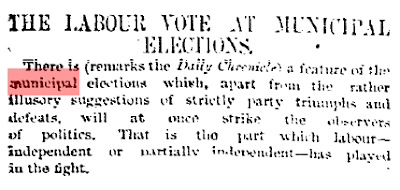
Labour makes gains, 1894

But as ever the devil is in the detail, and the Bradford branch of the ILP had in the words of the Manchester Guardian “practically grown from nothing to its present strength in the course of the past three years”

Moreover, some of the working families in both wards would have owed their livelihood to the Bradford Colliery, and the year before the industry had faced a major national strike following the employer’s decision to cut coal miners wages by one quarter, while the Miner’s Federation demanded a “living wage” for the workforce.

ILP logo, 1893-1975

The industrial conflict grew bitter, troops were dispatched to some of the coalfields, and as tensions grew strikers at Featherstone in Yorkshire were fired on, with sixteen hit and two killed, while in Llanelly, in Wales “police  armed with cutlasses” guarded the colliery after the cavalry had been withdrawn.**

The strike ran through the summer of 1893, and concluded in the November, and it appears to have played a major part in both Mr. Sutton and Mr. Butler becoming involved in politics.  John Edward Sutton joined the ILP during the strike and by its end, was “has been one of the principle leaders at the Bradford branch of the Independent Labour Party”.

While for Mr. Butler who was an assistant to the secretary of the Miner’s Federation , it “was in part the action taken by the Labour Party on behalf of the miners which [led him] to become a member”. 

The ILP arrives, Manchester, 1894

Both contests were hard fought with the Conservatives in the Openshaw ward distributing leaflets which branded the ILP as a vote for “Socialism and Anarchy”, but as the Manchester Guardian observed “It is improbable, however that the working class electors in the ward, who are perfectly familiar with Mr. Butler were in the slightest  degree influenced by an appeal exhibiting such a limited amount of intelligence”.***

And in Bradford Ward, despite the Conservatives  having “for some years occupied a strong position in this ward, holding all three seats ……. A large section of the working men, however, have expressed dissatisfaction with [the Tory candidate] and they gave effect to their feeling by nominating Mr. Sutton and working energetically in his behalf”.

ILP gain, Bradford, Manchester, 1894

A degree of confidence which saw them continue to elect him to the City Council for almost 20 years and followed that up with electing him as the MP in 1910, again in 1922 and from 1923 through to 1931.

But for many on that night of November 1894 the ILP’s entry on to the Manchester electoral scene was something to savour.  

In total they got just over 10,000 votes spread out across the eleven wards they contested, and racked up some very decent three figure results, some of which like at Harpurhey brought them close to being the second party.

John Edward Sutton, date unknown

All of which were promises for the future, while at Bradford and Openshaw the promise had arrived.

John Edward Sutton secured 2072 votes, ahead of his Tory rival who achieved 1,757, which gave the ILP a majority of 335, and 54% share of the vote.

In Openshaw it was a closer contest with Labour winning by 22 votes, but that is not to diminish the result.

Such can be election dramas.

Location; Manchester, 1894

Pictures; Solidarity, Walter Crane, 1887, extract from the Manchester Guardian, November 2nd, 1894, Logo of the ILP, 1893-1975, Manchester election results, November, November 2nd, 1894, and John Edward Sutton, date unknown

*The Municipal Elections, Manchester, the Manchester Guardian, November 2nd, 1894

**The Coal Strike, the Manchester Guardian, September 26, 1893

***Salford Eccles A General survey of the elections, the Manchester Guardian, November 2nd, 1984


Sunday, 11 February 2024

Stories from an election, Chorlton May 1980


It was the first year into a Conservative Government and the 1980 election campaign in Chorlton was fought out on both local issues and national ones.


The Conservative called on the electorate to “Stop The Labour Rot in Chorlton” the Liberals pointed to their growing “revival in the city of Manchester” and Labour reflected on the cost to the electorate after a year of Conservative Government.

So here are extracts from leaflets that the three parties pushed through doors in the May of 1980.

The Conservative candidate was Maureen Vince, the Labour candidate was Harold Brown, and the Liberal candidate was John Commons.

Some wondered about a slogan that called for the electorate to "Stop the Labour Rot in Chorlton," when all three elected councillors were Conservative, but the upshot was a Tory victory, although their vote was well down on previous years.

And in 1986 Labour gained its first council seat here in Chorlton with the election of David Black.

Pictures; from the collection of Andrew Simpson