Showing posts with label Commercial Street. Show all posts

Friday, 24 July 2026

Looking for the lost 32 cottages and 15 cellars, home to 208 people

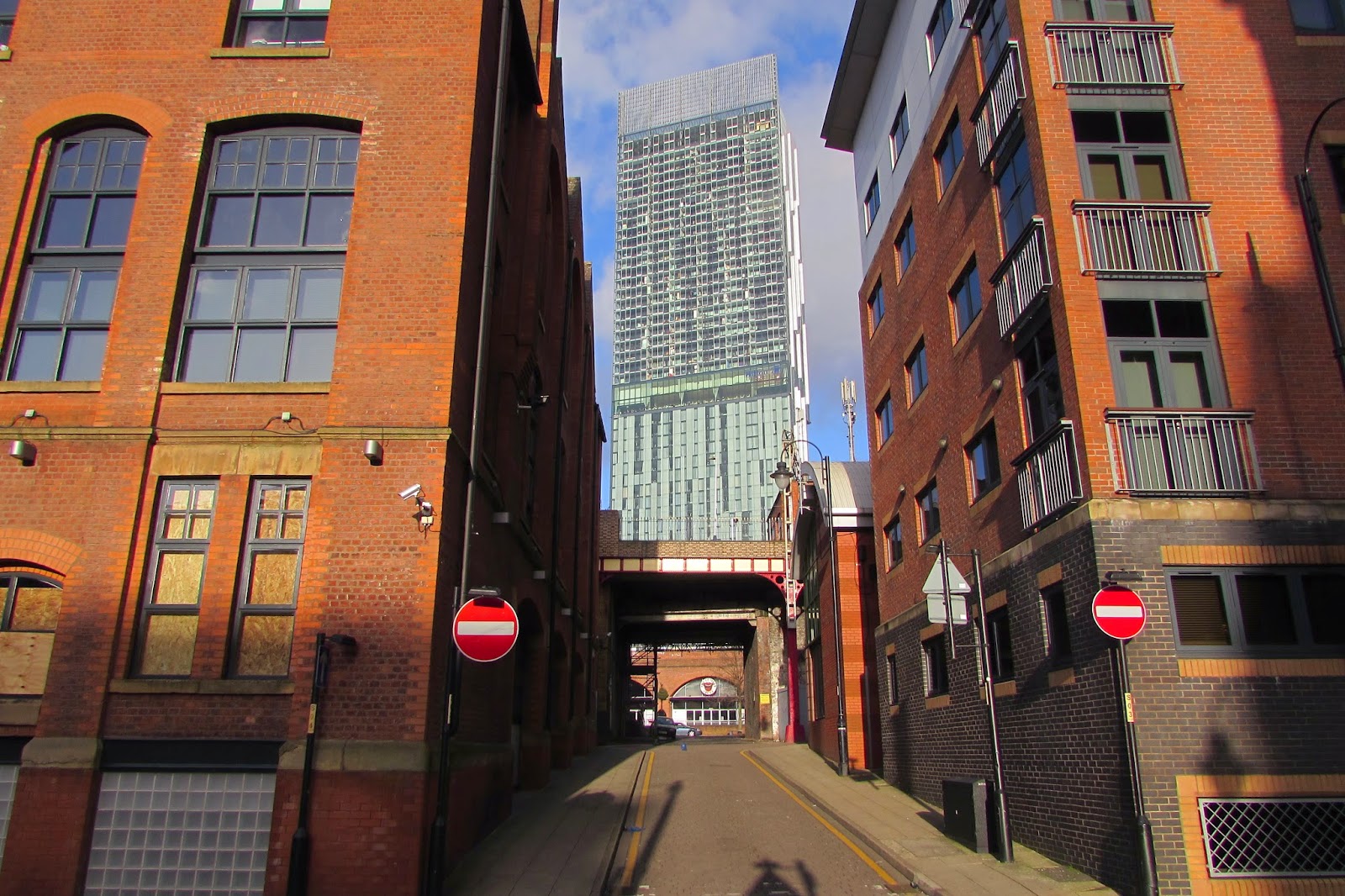
Looking down Commercial Street, 2015
Now I first wandered down Commercial Street sometime in the 1980s looking for Omega Street, and its neighbours Alpha Street and Fogg’s Place.

And I must have missed them by just a few years.

That said I don’t think they would have featured in any glossy guide to comfortable inner city living.

In 1853 they had formed a complex of back to back housing consisting of 32 cottages and fifteen cellars inhabited by 208 people.*

Commercial  Omega Street, 1849
Directly opposite was the Egerton Mill, while behind them there were two more and the surrounding area was dominated by more textile mills, a handful of iron works and the Hulme Brewery.

And I doubt even the most optimistic estate agent could gloss over the noise from the nearby railway or the smell from the river Medlock which flowed in a curve close by.

Back in the 1980s you could still see the outline of the house walls in what at the time was a temporary car park but when I returned some 20 years later these had vanished under new tarmac and there was nothing left to show what had once been there.

Looking across to Omega Street from Commercial Street, 2002
Now another eighteen years on and the surrounding buildings had either been demolished or made genteel and the worst I suspect in the form of pollution comes from the noise of loud music in the flats opposite or the conversation of the office workers making their way home.

And even that car park is now boarded up which may soon mean even space inhabited by those three streets and 32 cottages will be lost for ever.

Location, Manchester

Pictures; Commercial Street, 2014 courtesy of Andy Robertson, Omega Street, 2003 from the collection of Andrew Simpson and area in 1849 from the OS for Manchester & Salford, 1842-49, courtesy of Digital Archives Association, http://www.digitalarchives.co.uk/

* Report of the Manchester and Salford Sanitary Association 1853

Tuesday, 24 March 2026

A blue plaque for Mary Clarke ……….. resident of 8 Alpha Place

Now, I don’t think I will ever find Mary Clarke.

Alpha Street, 2003
In 1853 she was living in the cellar of number 8 Alpha Place, which with Omega Place and Fogg’s Place formed a complex of back to back housing consisting of 32 cottages and fifteen cellars inhabited by 208 people.*

The three streets were bounded by Commercial street to the south and Jordan Street to the east and are just off Deansgate in Knott Mill.

I am not even sure how long she was there. Two years earlier she doesn’t feature on the census return and in 1854 she has gone.

And so far, while there are plenty of Mary Clarke’s living across the city in the 1850s, it is unclear which might be her.

Alpha Street, 1849
Nor am I surprised, because Alpha Place was another of those small streets where “poverty busied itself”.*

In 1853 it attracted the attention of the Manchester and Salford Sanitary Association which drew attention to the poor housing and lack of sanitation.**

I can’t be sure when they were built, but the first entry in the Rate Books for Commercial Street is 1836 and for Jordan Street the following year. 

All 32 properties were back to back and consisted of two rooms with the addition of a cellar.

Mary Clarke paid just 1/6d for her cellar room while the going rate for the houses ranged from 2/5d to 2/8d, which was a substantial chunk of a weekly wage.

For as along as I can remember the area has been a car park and back in the 1980s it was still possible the exposed lines of the brick walls.  On my last visit the car park had been given a make over and the evidence for those walls had vanished under tarmac.***

Alpha Street, 2022
Which is pretty much how I left it.

By the start of the new century the area had been fenced off, gained an odd-looking single-story hut in 2008, which subsequently vanished behind another fence, and since then the fences have slowly deteriorated.

Andy Robertson was down there a few days ago and pondered as he took pictures, that there was “Plenty of room for at least two 95 storey tower blocks”.

But a search of the planning portal has revealed no development plans.

So, for now the site which was home to Mary Clarke, John Fletcher, Ellen Hoole, James Brooks and another 204 people remains and empty space.

Alpha Street, 2022
Of course, I know that there will never be a blue plaque to remember Mary Clarke, but perhaps there should be, if only as a reminder of the thousands of unknown residents across the city, who lived, and worked in the menial jobs, and many of whom lived on the margins of poverty.

They are less the people who history has forgotten and more those who were never even recognized.

Location; Manchester

Pictures; Commercial Street, Omega Street, 2003 from the collection of Andrew Simpson and area in 1849 from the OS for Manchester & Salford, 1842-49, courtesy of Digital Archives Association, http://www.digitalarchives.co.uk/ and in 2022, from the collection of Andy Robertson


*Robert Roberts, The Classic Slum, Salford Life in the First Quarter of the Century, 1971, Pelican edition 1973

** Report of the Manchester and Salford Sanitary Association 1853

***Commercial Street, https://chorltonhistory.blogspot.com/search?q=commercial+street


Thursday, 23 March 2023

Down behind Deansgate Station with the memory of a dark and forbidding period in our history

I think it must be a full decade since I wandered around the small network of streets behind Deansgate railway station.

During the 1980s and into the turn of the last century the area bounded by Commercial Street, Jackson Street and Omega Place was part of a series of guided walks and talks  I did around this part of the city.*

They had started as a study of Liverpool Road Railway station grew to include the pubs, surviving houses in Castlefield along with the canal basin and spread out across Deansgate.

Back in the 1980s much of the area was still a place waiting for something to happen, and now thirty years later this has happened.  The empty and derelect buildings have either been converted into smart office and residential properties or been replaced by tall 21st century glass and steel structures.

But Andy Robertson has managed to capture a little of what I remember and looking at his pictures it is easy to conjure up those walks I made and something of what the area was like back in the mid 19th century.

Over two decades ago I wrote that

“in a small area which still keeps the original place names of Commercial Street, Jordan Street and Omgea Place, the 1853 Sanitary report records two hundred people living there in what is now a small car park.  It was still possible in the mid 1980s to see the levelled walls of the buildings at ground level.

Chorlton-upon-Medlock which also neighbours Castlefield and includes Little Ireland, had a population in 1851 of 35,546 squeezed into 6,951 houses.


The high numbers of people who were buried in the St Johns graveyard can further attest this density of living in the area. 

Between 1848-51 the burial records show 457 deaths, which is matched by an inscription, which reports that 22,000 lie in the park. 

Similar data comes from Angel Meadow where 44,000 people were buried between 1789-1816."  

The 1853 report commented that the houses on Omega Place were by no the worst properties that could be found in the area but still rereading the report is to be transported into a world of overcrowding, poor sanitation and grim prospects.

Which just leaves me to add that this was once Knott Mill Railway Station.

Pictures; Little Peter Street & Commercial Street, 2014, from the collection of Andy Roberston

*Castlefield, http://chorltonhistory.blogspot.co.uk/search/label/Castlefield

**Report on the Sanitary Condition of Certain Parts of Manchester, M126/5/1/13, Manchester Libraries, Information and Archives, Manchester City Council, quoted in Castlefield, Andrew Simpson, 2003


Wednesday, 2 March 2022

Looking for a bit more of the past on Commercial Street

Now I was on Commercial Street yesterday with a collection of Andy’s pictures, and a  map looking for Mary Clarke who briefly lived in a cellar dwelling. 

Commercial Street, 2022
There wasn’t much I could find out about Mary Clarke, other than that briefly in 1853 she rented the cellar of number 8 Alpha Place.

 Her rent was just 1/6d which was almost half what the residents of the house were paying and hints that her accommodation was very basic.

 Alpha Place consisted of 10 back-to-back houses bounded to the south by Commercial Street and Jordan Street to the east, just a few minutes’ walk from Deansgate.

 The house vanished a long time ago and for decades the site was a car park but early in the new century a set of fences went which promised development.

Commercial Street, 1851
That development has yet to materialize as Andy’s pictures shows.

He was there this week wandering Commercial Street which is one of those twisty streets that was once densely populated with a mix of early 19th century houses, small industrial units and textile mills.

 And it was at the point where Commercial Street runs back from Jordan Street where he took this picture.

 It neatly delivers that contrast between the old and the new.

 I can’t be sure when the building in front of us was constructed, but the footprint was occupied by the 1840s, and given that Alpha Place dates from a decade earlier I am guessing that the site had been developed by then.

So far I have yet to find a reference to Commercial Street for the mid-19th century in the directories, but I will go back to the Rate Books and see if I can identify who lived or worked in it.

 The 1876 directory lists business on the street, none of which were located in our building which suggests that it was still in residential use and given the low status of the residents it was not worthy of an inclusion.

But by 1911 it was used by a Thomas Nuttal who was a fancy box maker.

 So a tad more research, which I might just get done before those fences come down.

Location; Manchester

Picture; Commercial Street, 2022, from the collection of Andy Robertson, and in 1851 from Adshead's Manchester of Manchester, 1851, courtesy of Digital Archives Association, http://www.digitalarchives.co.uk

 *Commercial Street,  https://chorltonhistory.blogspot.com/search/label/Commercial%20Street