Showing posts with label Naples. Show all posts

Saturday, 4 October 2025

Of Naples in 1961 and Little Italy in Ancoats in 1901


Rosa in Naples 1961
This is one of my favourite pictures of Rosa.

It was taken in Naples when she was just 21 during the summer of 1961 just after she had collected her passport.

Later that year she left Italy with Simone her husband and moved to Cambridge.*

They were two of those economic migrants much derided by some who sought a new life in a new country.

In the same way and just sixty years earlier my father’s parents crossed the border from Scotland and settled in Gateshead while just a little later my maternal grandfather  came home to Derby with his German war bride.

And it carried on.  Dad and mum finally made their way to London where I was born and over the course of twenty years moved around south east London, and just under a decade later I left for Manchester.

All of which reinforces that simple idea that people move around, make new homes in new places and along the way add to the communities they have joined.

Nor is it all one way.  My great uncle left for Canada in 1914 followed by his sister eleven years later. One of my uncles carved out a career in India and east Africa before settling down in South Africa and to close the Italian connection Rosa and Simone finally left Cambridge for Italy returning not to Naples but Varese in the north.  Only for one of their daughters to return to Cambridge, relocate to Manchester and in the fullness of time to set up home with me.

13-15 Blossom Street, 1903
All of which is an introduction to the many who found a home here in Manchester in the 19th and 20th centuries.

Ours was the shock city of the Industrial Revolution and the mills, engineering plants, chemical works and collieries drew in the rural poor from the surrounding countryside, which were added to by those fleeing the famine in Ireland and later still those escaping the persecution in eastern Europe and the grinding poverty of southern Europe.

For some this was the eventual destination while for others it was the half way stage before crossing the Atlantic.

And their presence can still be found in the synagogues and Torah School of the Jewish community of Strangeways and Redbank and in names like Little Ireland and Little Italy.

Most have had their historians who have recorded their presence, ** which is all to the good because these communities have by and large vanished.  Little Ireland which had become one of our worst slums fell victim not to the sweep of town planners but to the railway, which cut through the area.

Not for the first time did a  railway company act as a means for slum clearance.  Much the same happened to sections of Angel Meadow in the north of the city and to parts of London’s slums.

In the case of the Jewish communities of Strangways and Redbank it was that other familiar social development which saw the better off moving out along Cheetham Hill Road to leafy more pleasant places.

Jersey Street, 2011
And so finally to Little Italy in Ancoats which became home to those from Italy who were seeking a better life.

They came from the great cities of the north like Milan, Turin and Genoa from the rural hinterland as well Naples, Sorrento, and Palermo.

It was a small close knit community inhabiting the area behind Great Ancoats Street and primarily located around Jersey Street, Blossom Street, and Henry Street.


Jersey Street, 1908, with No 2 Jackson Court to the left
Now as I often maintain if someone has done the research I have no intention of stealing their thunder, so for those who want to know more about Little Italy there is not only Anthony Rea’s book Little Italy, which was first published in 1988 but his equally fine site where you can find a wealth of information, stories and pictures.***

Added to this there are links to a whole range of other sites which give a comprehensive picture of he life they left and the contribution they made to their adopted city.

Pictures; Rosa in Naples, 1961 from the collection of the Balzano family, 13-15 Blossom Street,  A, Bradburn, 1903, m11033, and Jersey Street, 1908 m10153, courtesy of Manchester Libraries, Information and Archives, Manchester City Council, http://images.manchester.gov.uk/index.php?session=pass and Blossom Street from Great Ancoats Street with Gun Street and Henry Street beyond, 2010 from the collection of Andrew Simpson


*Messy history .......... Part One Migration, http://chorltonhistory.blogspot.co.uk/2011/12/messy-history-part-one-migration.html


** Bill Williams, The Making of Manchester Jewry, Manchester University Press 1976, Jewish Manchester: An Illustrated History, DB Publishing, 2008, and a new book on Manchester’s Pre Black History 1750-1926, Anthony Rea, Little Italy, Neil Richardson, 1988, and of course Little Ireland in Conditions of the Working Classes in England , Friedrich Engels, 1844

***Manchester's Ancoats, Little Italy, http://www.ancoatslittleitaly.com/index.html


Wednesday, 10 September 2025

Stories from the back streets of Naples ……. and a Neapolitan cookbook

There are many different categories of poverty, from not having the means to heat the home, provide food for the family or secure a decent education for your children.

Down a Neapolitan street, 2018

And up there with them is the absence of running water, which at the very least can mean a tedious frequent trip up and down stairs to the neighbourhood tap and at worst a long walk to a communal pump. 

With buildings that reach to the sky, 2019

Today, we take fresh and clean running water for granted.  It is one of those key steps forward in the provision of public health during the late 19th and early 20th century.

In my own family I would have to go back to my great grandmother and the 1870s and 80s, to be able to record stories of the communal water tap in the shared courtyard, and to my grandparents in the 1920s who shared an outside lavatory.  

But progress was in the air and by the time I regularly visited them three decades later, the lavatory had become their personal one, even if it was still located outside at the bottom of their yard.

And then in a casual conversation with Rosa who was born in Naples in 1940 I was reminded that drawing water from a tap in her home was as alien to her as it had been for great grandmother.

We had just had pasta for dinner, and as I went to start washing up, Rosa pointed to the huge saucepan of “pasta water” and suggested I use it to wash the pots and plates.

It struck me as odd, but it was still warm, and more to the point had I been back in Naples in 1940, I wouldn’t have entertained wasting water ….. not if it meant going down and coming back 4 flights of stairs with a fresh supply.

A Napoli Si Mangia cosi

From there the talk drifted to one of the cook books which has sat in our house for over 20 years.  It was published in 1986 and is entitled A Napoli Si Mangia cosi', which means In Naples you eat like this.

It was one of the things Rosa gave Tina when she left home to come to Britain a full 35 years ago.

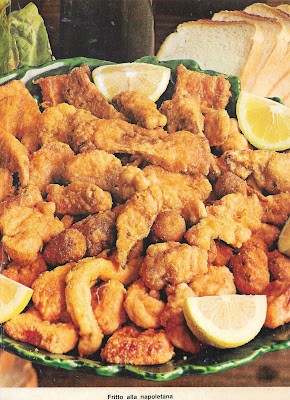
Fritto alla napoletana
It is much used, held together in part by sellotape and a book I occasionally flip through.

Now, I can’t speak or read Italian, despite many embarrassing attempts, and so having looked at the pictures I would put the book back.

What I didn’t know was that it is not written in Italian, but in Neapolitan which for some Italians can be as incomprehensible as any foreign language.

And even now she will often say to me this is the Italian for something, but in Naples we would say …….

All of which leaves me to decide if I should give up on Italian and go straight for Neapolitan.

We shall see.

But I now know that Fritto alla napoletana is a selection of vegetables and zucchini flowers dipped in batter and fried.

Pictures; from A Napoli Si Mangia cosi' and Naples Street, 2018-19, from the collection of Saul Simpson and Balzano

Monday, 8 January 2024

Walking the streets of Naples with a comic genius ........ Totò

Now there is no escaping Totò in Naples.

He was born in one of the poorest parts of the city in 1898 and was the illegitimate son of Anna Clemente from Sicily and a Neapolitan nobleman who did not legally recognise him until 1937.

By which time Totò had become a popular entertainer who in that year made the first of 96 films, many of which we still regularly watch on Italian TV.

And he was one of those all round entertainers, performing variously as a comedian, film and stage actor as well as a poet and song writer.

But above all it was his comic genius which delighted generations of Italians and earned him the nickname of the Prince of Laughter.

Yesterday we sat and re watched Totòtruffa 62 in which a poor man supports his daughter’s stay at an expensive boarding school by a series of outrageous money schemes including the sale of the Trevi Fountain to a foolish businessman.

And such was his popularity that at his death there were three funeral services.

So I am not surprised at how a full half century after he died he is to be found everywhere in Naples.

We sat beside him at a small cafe where his life sized model advertised Caprese, which is a salad made from tomatoes, mozzarella and basil.

There was an exhibition devoted to him; the shops were full of Totò souvenirs, from key rings to painted plates and masks.

And in that small street devoted to all manner of nativity figures more than a few were of the man himself.

Location; Naples


Pictures; Totò in Naples, 2017 from the collection of Andrew Simpson

Monday, 20 November 2023

Down on the Corso Garibaldi in Naples waiting for the tram

Now, if you know where to look you can find a tram in Naples.  

On the Corso Garibaldi, 2006
This one runs to the Corso Garibaldi and is one of the  three services which are routes 1, 2 and 4.

I have no idea what happened to route 3, but given that this is Naples there can be any one of a number of explanations.

The most likely is that it was lost once when the tram network was more extensive.

The good news is that trams are on the increase again in the city and that has to be good.

They first began running a service in 1875 which was two years before Rome and at present there are 11.8 km of track.

I wish we could have caught one last month when were there but next time I shall.

Near the Porta Maggiore 2010
And in the same way when we return to Rome I will board one of their green ones.

My preferred choice would be one of  these older ones, but I am guessing it will have been replaced by the new sleeker models.

Well, we shall see.

Location; Naples & Rome

Pictures; Napoli, line of trams in Corso Garibaldi. At the head of the line is Peter Witt-type tram no. 975, ©grahamec, permission is granted to copy, distribute and/or modify this document under the terms of the GNU Free Documentation License, Version 1.2 and Roma, Older tram near Porta Maggiore 2010, © Luca F, who as the copyright holder (Luca F.) of this file allows anyone to use it for any purpose, provided that the copyright holder is properly attributed.

Sunday, 19 November 2023

Naples .... squeezing cars, people and lots more on to those narrow streets

Now you can never get enough of pictures of Naples and of these it is the ones showing the narrow streets where everything squeezes in every available space.


Location; Naples

Picture; Naples in 2017 from the collection of Saul Simpson 

Sunday, 1 October 2023

Stories from Naples in the spring of 1944


I am reading Naples '44* and it is one of those delightful moments when history and my fascination for Italy collide.

It’s 1944 and Norman Lewis is a British intelligence officer with the allied armies in Italy.

He landed at Salerno in September 1943 with the American 5th Army and the book chronicles a year of his life in the city of Naples.

It is a closely observed description of life after the war has moved on leaving an aftermath of broken buildings, a desperate lack of food and a breakdown of the usual conventions of morality.

So on a journey to Afragola he saw “hundreds if not thousands of Italians mostly women and children in the fields all along the roadside driven by their hunger to search for edible plants ... they had left their homes in Naples at daybreak, and had to walk for between two and three hours to reach the spot where I found them.”

But there are those vivid little pictures of Neapolitan life which I suspect had been lived out before and after his visit including the family who lived opposite his office and who “carried out a table and stood it in the street close to their doorway.  This was briskly covered with a green cloth with tassels.  Chairs were placed round it in an exact distance and on it were placed photographs, a vase of artificial flowers, a small cage containing a gold finch, several ornate little glasses, which were polished from time to time as the day passed by to remove the dust.”

And around that table they carried on the daily routines of life, from domestic chores to grooming the children, washing and eating.  There were other tables out further along the street and people called out to each other, while a man with “tiny twisted legs was carried out by his friends and propped up in a comfortable position against the wall.”

It is a scene of street life which my parents in law knew well.  Simone and Rosa were born in Naples just before Italy entered the war in 1940 and grew up in the harsh years of that war and the equally hard years afterwards.

Not that this is any rosy nostalgic account of a simple but good way of life.  For many in Naples life was a struggle lived out against a backdrop of poverty which the war made that bit more difficult and led many down darker and more brutal ways of survival.

All of this along with the horror and confusion of the fighting falls out of this book.

But so often it is the carefully observed little scenes that that draw you in, like the “two lean, hip swinging American soldiers, sharing a bottle of wine [who] passed down the street, and the two girls at the table [who] looked up and followed them with their eyes until they turned the corner and disappeared from sight.”

Location; Naples, Italy

*Naples '44, An Intelligence Officer in the Italian Labyrinth, Norman Lewis, 2002, Eland Publishing Ltd, http://www.travelbooks.co.uk/

Picture; from the front cover, designed by Robert Dalrymple 

Saturday, 30 September 2023

In Naples trying to choose between the figure of a saint or the green frog with a hat

I never tire of the contrasts that confront you in Naples.

For any one wanting a souvenir, sooner or later you end up in the street that specializes in a mountain of such objects.

It remains one of those places we always go back to, for here there is everything you could ever want to remind you of a stay in the city.

Tina always looks out for the figures associated with the Nativity, because her mum collects them, and until recently would always display the full collection at Christmas.

These jostle with more risqué figures of impossibly fat men and slim women who crowd the glass cabinets and spill out on to rickety tables.

And for those with a more serious side, there are the religious ones, which range from saints painted on slim wooden panels, to porcelain giants, complete with wings and halo, which share a shelf with Jesus, Joseph and Mary.

While next door the shop is full of silly plastic animals, cartoon characters and the odd toadstool.

But what they all have in common is that they are bright, outrageous and made of plastic.

More than once I have wondered how long these impulse buys stay with the purchaser.

Some no doubt make it home, but most will be lost in transit, left in the hotel or become a victim to the need to lighten the weight of the suitcase at the airport.

Most of what is on sale, is tack, …………. garish, poor quality, over priced and ugly, but there is no getting away from that simple fact that they are fun, and that for me is Naples.

Location; Naples

Pictures; a  little bit of Naples for sale, 2019, from the collection of Balzano


Tuesday, 19 September 2023

At home in Torre Annunziata in the Gulf of Naples

Now according to one travel authority the top ten things to do in Torre Annunziata range from 21 sights and landmarks, six outdoor activities, nine night spots and a handful of shops, spars, and parks.

Baba and zeppole
But after the short flight from Milan down to Naples and the 30-minute taxi ride from the airport, the remainder of the first day’s stay should really be taken gently.

This usually consist of a stroll to the local supermarket for a few essentials, including a selection of pastries, one of which must be a  zeppole and my favourite which is baba.

Then after a rest, a more serious wander to the nearby piazza where they sell fried potato croquettes.

These are called panzerotto but differ from the usual ones which look small calzone and use mashed potato instead of bread dough.

Looking for the piazza
By which time there is not that much left of the day, and the most sensible thing is to head back to the apartment, and settle down for the night, so as to be  ready for the morning’s adventures.

Torre Annunziata is a small place, and it is where Rosa was born.

The plan is to visit some of the old places and take in a few more from where Simone grew up, which is close by.

Today the town is a suburb of Naples, with a population of just over 42,000 but has its own distinct dialect which is a variation of Neapolitan.

It never occurred to me before that this will be what Simone and Rosa would have used at home and it will be what Tina and her brothers and sisters heard in the family home as they were growing up.

But Rosa and Simone left in 1960, and while they have been back, I wonder just how much it still looks like the place they knew.

The Encyclopedia Britannica described the town as "a seaport of Campania, Italy, in the province of Naples, on the east of the Bay of Naples, and at the south foot of Mt Vesuvius, 14 m. S.E. of Naples by rail. Pop. (1901), 2S,070 (town); 28,084 (commune). It is on the main line to Battipaglia, at the point of junction of a branch line from Cancello round the east of Vesuvius, and of the branch to Castellammare di Stabia and Gragnano. 

It has a royal arms factory established by Charles IV., and other ironworks, considerable manufacture of macaroni, paper, breeding of silkworms, and some fishing and shipping. 

The harbour is protected by moles. Remains attributed to the Roman post-station of Oplontis were discovered in making the railway between Torre del Greco and Torre Annunziata, a little west of the latter, in 1842”.

Down a street
But that was in 1911, and today my guide book tells me that it still has industries based around the navy, armaments and pharmaceuticals.

Just leaving me to ponder on the current exhibition of “sculptures and objects from Roman villas” at the Palazzo Criscuolo.

It will cost us just € 3.00, and not for the first time I ask Tina if they might offer concessions for OAPs but reflect that my concessionary bus pass might not pass muster as identification of my senior age.

So instead I will use the virtual guide to see what I am missing, which can be accessed from the town’s municipal web site.*

Who said you can’t live in the fast lane in Torre Annunziata?

Location; Torre Annunziata

Pictures; Torre Annunziata, 2019, from the collection of T. Balzano

*Comune Di Torre Annunziata http://www.comune.torreannunziata.na.it/hh/index.php


Saturday, 19 August 2023

Sunday in Naples with Sophia Loren …….

This Sunday we sat down to watch Yesterday Today Tomorrow.*

My Wikipedia tells me that,“it is a 1963 comedy anthology film by Italian director Vittorio De Sica.

It stars Sophia Loren and Marcello Mastroianni. 

The film consists of three short stories about couples in different parts of Italy.” 

Now for Rosa the film was a hit, not least because the first story shot in Naples was where she was born and grew up, and the scenes were ones she was familiar with.

More so because she left the city just three years before the film was released.

For Tina and me all three stories resonated. Tina grew up just north of Milan and I have always been drawn back to Rome while both of us love Naples.

Moreover Tina and her siblings grew up speaking Neapolitan at home and “official Italian” at school, at work and to their friends.

So we all found something in the three stories.

And of course it underlined that marvel of technology that the three of could sit in our front room and watch an Italian movie beamed from a popular Italian T V station before swapping to the very popular In Sunday which takes over the whole of the afternoon and early evening on Rai 1, before switching late in the evening to BBC.


Location; 1963


Pictures; stills from Yesterday Today Tomorrow

* Ieri, oggi, domani, 1963

**Yesterday, Today and Tomorrow, https://en.wikipedia.org/wiki/Yesterday,_Today_and_Tomorrow

Tuesday, 18 April 2023

A Roman street and Neapolitan pizza from Pizzeria I Decumani........ just perfect

We were in Naples and having chosen not to visit Pompeii and Herculaneum I suppose we felt more than a little guilty.

Walking the Roman street
After all here were those two Roman towns frozen in that moment back in 79 AD when Vesuvius erupted.

But there is only so much you can do in a week.  That said given my love of all things Roman I did feel a little that I had done something wrong.

But Tina knowing how I have felt came up with the Roman remains under the church of San Lorenzo Maggiore.

The church was built at the centre of the ancient Greek Roman city where today the via San Gregorio Armeno crosses the via dei Tribunali and underneath there is about half of an original Roman market which has been excavated over the last 25 years.

Just as at Pompeii you can walk down the main street past a collection of shops including a bakery, winery and laundry, step over the grooves used to drain the basins of dye and bleach and call at the offices of the tax collector.

A little further down the street are seven interconnected rooms with barrel vaults pierced by skylights designed to draw in the air and sunlight.

And in some of these rooms are the shop counters and wall niches along with at least one iron grill which would have protected the windows along the street and a selection of mosaic floors.

Now I grant you it lacks the size of Pompeii and today is deep beneath the streets of Naples but it still is a powerfully evocative place with the added bonus that you are almost on your own walking the 3 metre wide street which runs off for 54 metres offering you a slice of Roman life.

Pizzeria I Decumani
Now that did for me, particularly as it was only minutes away from the Pizzeria I Decumani.*

And of course if you want a pizza there is no where better than Naples.
The two most popular ones were packed out with long lines of hungry tourists waiting patiently outside but we had asked the local fruit seller on the corner of Via dei Tribunali who suggested Pizzeria I Decumani which he reckoned was not only the best but was where he ate.

Now it was midday and the place was full but we gave our name and sat outside in the small area opposite the shops and within the space of  five minutes were inside and ordering.

An as it happens the pizza I ordered
What came was a pretty spectacular pizza and one that cost just €3.50 compared to the €12 we had paid the day before in Sorrento.

So all in all a good day made even better by those narrow Neapolitan Streets with their tall buildings and drying washing hanging from the balconies, which is a story for another time.


*Via dei Tribunali, 58 80138 Napoli Italy‎ +39 081 557 1309

Picture; of the Roman street, "Scavi san lorenzo maggiore01"  and the rest  from the Pizzeria I Decumani

Wednesday, 8 February 2023

A bit of history on a wall ………….

Now there are plenty of very narrow streets in Torre Annunziata, which sits in the Gulf of Naples.

I am not sure that you would choose it as your tourist destination of choice.

It is after all a busy no-nonsense place, which once made its money from making armaments, pasta, paper and breeding silkworms, along with a bit of fishing and shipping.

And today that is pretty much still the case with the addition of pharmaceuticals.

I like the fact that despite having a population of just over 42,000 it retains its own distinct dialect which is a variation of Neapolitan and is town that is pretty proud of itself.

Which is just how it should be, given that it is in the process of revealing a fine old Roman villa, has fine views across the Bay and offers plenty of those little twisty streets, which end in a piazza and reveal some interesting bits of Torre Annunziata’s past.

Like the sign on a wall which tells the story of making pasta, from unloading the grain in the town’s harbour, to the various processes, which end with a young woman, a glass of wine and a plate of pasta, set against a panoramic view of the Gulf.

It is a unique account of one family business.

And yes, look closely, and there are those classic pictures of the pasta hanging out to dry on street corners accompanied by groups of workers staring back at the camera.

It is a fascinating little bit of history, which of course led us on to thinking about food, and one of the town’s speciality street foods, called panzerotto, which differ from the usual ones, and instead of bread dough, are made from mashed potato and are deep fried.

Leaving me just to reflect that there were plenty of other things on offer, but a couple panzerotto were a good start.

Location; Torre Annunziata


Pictures; Torre Annunziata, 2019, Balzano

Tuesday, 7 February 2023

Of coffee cups, sugar and a Neapolitan song of love ............. À tazza è cafè

Now I like the way that in Naples you can find a song about pretty much everything, and the one about the sugar in the bottom of the coffee cup is one of my favourites. 

Like many Neapolitan songs, its jaunty music comes with a set of humorous but cynical lyrics, comparing a young woman’s disdain for an admirer with the bitter taste of coffee.

But as ever with unrequited love, the admirer hopes that she will eventually warm to him and that transformation will be like tasting the sugar at the bottom of the coffee cup.

And so in the words of the song,

"I'd really like to know why every time you see me
you always look so annoyed 
but you, the more you try to look ugly,
the more you look beautiful to my eyes.

Now, I don't know if you've noticed that.

But with these manners, oh brigida
you seem a cup of coffee
there's sugar at the bottom
and above you are bitter.

But I am determined to stir
and stir so much
that the sugar at the bottom of the cup
will finally be tasted in my mouth".

It was also a favourite of Simone and Rosa who are from Naples, and is one that they often sing, along with many which are more romantic.

This one was written by Roberto Murolo, who was born in 1912 and had a long career as a musician, sportsman, and actor as well as a songwriter.

Alongside his own songs he released LP’s of traditional Neapolitan songs dating back to the 12th century and performed at concerts in to his 80’s.

But for me it is "À tazza è cafè" which always brings a smile to my face and takes me back to Naples, reminding of other wonderful bitter sweet Neapolitan songs

Of these my favourite is "Tu vuò fà l'americano" or “You Want to Be American".

It was written in 1956, and savages those young Italians who wanted all things American, from Rock an Roll to whisky and soda, baseball and Camel cigarettes but relied on their Italian parents to fund their adopted lifestyle.

It is a joyful, fast moving song with the same cynical take on things as À tazza è cafè and Tina and her dad sing it with gusto smiling as they reach the line asking who pays for it all ....... "Chi te li da? La borsetta di mamma'" which translates, "Who gives you them? Mamma's handbag”.

And that is it.

Location; Naples

Pictures; from the collection of Andrew Simpson

Monday, 4 July 2022

Caputo …….the secret of the cupboard ………and a choice

Now, in our house I take pizza as it comes, although that said I prefer a thin base.

And that has taken me to the store cupboard, where we have a shelf devoted to a range of different flour from plain white to strong white, several bags of self-raising, along with gluten free.

But prominent amongst the lot are  Caputo Red and Caputo Blue, which we use for pizza.

The red is ideal for thinner crust pizza.

It has more gluten and protein in it than the blue flour, and provides a little more elasticity to the dough and is ideal for slow rises.

So, there you have it, I come across a red bag and a blue bag and I have instantly discovered some of the science behind making a pizza dough.

Added to which I know that Caputo is reckoned to be the finest Italian flour for making pizza, and that ‘00’ on the bags refers to how finely the wheat flour has been ground, and the overall texture, with the roughest graded at ‘1’.

Of course, this will not be new to foodies or those who spend hours inside the pages of cookbooks, but for me it was a revelation.

And set me off looking for the Caputo company, which began in 1924 and is the last mill, in Naples.*

Its site offers up little on its history, other than a  fascinating picture of the family and staff, sometime long before now.

As you would expect there is plenty there on their products, and an interesting link to Granonostrum, which is, “the first agricultural chain of soft wheat in Italy …… and provides for the traceability of all agricultural practices starting from the search for raw materials through the sowing of wheat, scrupulously monitoring every single production process up to the collection and storage, up to the final processing of the product.

The entire production process will use only two varieties to be cultivated according to the climatic and soil peculiarities and above all the products that the pasta masters must make, obtaining a wheat and a final product qualified as superior”.**

And here I confess that I had no idea that those two bags of flour would lead me off on a trip around southern Italy.

But that is what you do when you go looking for the  things we store away.

All of which leads me back to those two bags of Caputo flour, and the pizza choices we make.  

Leaving aside this the choice between thick vs thin, there is that debate on what constitutes an acceptable topping.   
Everyone is of course entitled to place what food they fancy as a topping. 

For the Italian side of the family along with Italian friends the only authentic pizza has been cheese and tomato.

That said everyone knows my fondness for mushrooms, but like the family I draw the line at pineapple.

Location; Chorlton, and Naples

Pictures; Blue and Red Caputo, 2020, from the collection of Andrew Simpson and finished pizza, from the collection of Balzano, 2020

*Caputo Mill,  info@molinocaputo.it  Corso San Giovanni a Teduccio, 55
80146 Naples, Italy

**Grano Nostrum, https://www.granonostrum.it/

Sunday, 3 July 2022

On the Via Cesario Console with the monument to a forgotten war

Now the translation is not the best but the memorial on the Via Cesario Console is dedicated “To the Soldiers of the Earth, Sea and Land Falling In the Arrows Of Africa Advancing Domestic Terms Resolved To The World Mission” which I grant you is a bit of a mouthful.

And I am more than happy to concede that there is someone out there who can give a better version of the original, “Al soldati Della Terra Del Mare E Del Cielo Che Caddero Nelle Gverre D'Africa Avanzando I Termini Della Patria Risorta Alla Missione Mondiale.”

But essentially this is I think a memorial to those Italian soldiers who died fighting to establish a colonial empire in Africa.

Unlike Britain, France and some of the other European countries Italy came late to creating an overseas empire but nevertheless by a mix of diplomacy and naked aggression managed to acquire  bits of North Africa, Somaliland, and China, but met with a humiliating defeat in its attempt to take part of Ethiopia.

So I rather think the memorial is about those African wars, and that raises that sticky question that not all war memorials will be judged in the same way.

In the case of those dedicated to Europe’s colonial wars they always omit any reference to the suffering of the peoples of  Africa and Asia who were killed during invasion of their countries and subsequently by the exploitation of their natural resources.

Location; Naples

Picture; war memorial on the Via Cesario Console, 2017 from the collection of Andrew Simpson

Saturday, 2 July 2022

Dodging the unexpected in Naples on a July day

We were lucky to be on the other side of the road when the woman threw the contents of a bucket of water down from her balcony.

She lived on the top floor of one of those tall properties which rise six stories from the street.

Her shout of warning was followed only seconds later by the sound of the water hitting the pavement.

Now I hope it was only water because there was no time for anyone to have heeded her shout and dodged for cover.

Luckily no one was hit and within seconds the spreading stain joined the other bits of street rubbish which littered the pavement.

These included a box of assorted rotting fruit, a pile of old newspapers and a broken chair.

Of course a few years ago the piles of rubbish were everywhere and we were treated to daily horror stories on the TV news but not now.

And that I suppose is one of the things you take in your stride about Naples.

There are the stories of crime, along with the frenetic activity on the streets and the sheer shabbiness of some of the city all of which will be true but not of the Naples we saw.

Yes it was noisy and we had to jump out of the way of the cars whizzing their way through the narrow streets but then everyone we met was extremely helpful, no one sought to exploit us and we had fun.

And judging by pictures from the late 19th century not a lot had changed.

Picture; "Via Toledo1". Licensed under Public domain via Wikimedia Commons - http://commons.wikimedia.org/wiki/File:Via_Toledo1.jpg#mediaviewer/File:Via_Toledo1.jpg and Naples circa 1890 from Napoli coom’era, 2013, courtesy of the publishers, Intra Moenia


Wednesday, 18 May 2022

When we are all migrants ………

It's an obvious observation but one that needs revisiting, and it is this .... dig deep and most of us can count a migrant in our family history.  

Ontario
And it has to be revisited because all too many think that migrants and migration belong to someone else.

In our family that migration began so far back that the details of the story are lost.  

But it began in the east Highlands perhaps at the start of the 19th century and is not over yet.  

For perhaps a century and more  we were on the move travelling south across Scotland, stopping for a generation, in a town or village, but always south, finally crossing the border around  1900.  

To Canada and the USA, 1871

And then in different stories fanning out across England with father settling in London in 1932. 

His brothers made homes in Birmingham, Ipswich,Penzance, and Surrey while one chose far flung places in different parts of the old Empire.

Nor has it finished.

l left London for Manchester, one of our sons for Warsaw and  a nephew for Australia.  

A testimonial, 1925
At the heart of each move by all of us has been work and a belief that the move would improve our lives.  

So, we are all economic migrants.  

And to these I can add the Italian side of the family who left the grinding poverty of Naples for Cambridge in the 1960s before moving back to Italy near the northern city of Milan.

Now as far as l know we were not fleeing from political oppression, or the fear of imprisonment, and the choices were free ones. 

That said one of my great uncles was migrated to Canada by The Derby Union which administered the Poor Law in Derby.  

To what extent he had a choice is now lost, but many young people who were sent to Canada and other parts of the old British Empire and some may have had only a tenuous role in the decision.  

They were and are the British Home Children and about 10% of Canadians can claim to be descended from a BHC. 

In the course of our search for him l have made many close friends in Canada, and have an extensive Canadian family descended from his sister who followed him out looking for work.  

Rosa, Naples, 1960
Our story isn't unusual and like many we also share the knowledge that our great-grandmother Eliza spent time in the workhouse as well as having her last child born in its infirmary.  Added to which all her surviving children spent time in the care of the same workhouse.

So we may not like it, but most of us come from poor families who  were agricultural labourers, domestic servants, factory hands, or itinerant traders, soldiers and sailors.

Our ancestors arrival in these islands may date from the Windrush or the 1970s, or stretch back through the Normans, Vikings, Saxons and Romans, to those Neolithic boat people and perhaps even further back to the Paleolithic.

Which brings me back to that opening observation, that it is easy to think that history is not messy, and that we can all track our roots back to an indigenous ancestor, which is as silly as thinking that we all once lived in a castle, or can count Lloyd George as a family member.

Pictures; Ontario 2015, courtesy of Saul Simpson, poster from the report of Cow Cross Mission, 1871, testimonial for Laura Boot, 1925 and Rosa, in Naples the day before she left for Britain, 1960, from the Simpson family collection.


Saturday, 14 May 2022

Naples ........ the woman and a fading poster

Now sometimes a picture has a fascination way beyond your first impression.

This for me is just such a picture.

The woman sits on a battered old chair and off to her right is one of those narrow Neapolitan side streets with buildings that climb cliff like in to the sky and seem to be constantly in gloom.

Someone on the Italian side of the family will be able to identify the footballer on the poster and for all I know he may have played for Napoli which for over 70 years has been Simone’s team.

And even now having lived in the north for decades he still watches every match and can remember all the great games.

This summer we were back in Naples following in the footsteps of our Saul and Emilka.  I had hoped we might have encountered that old woman but we never did.

As for the footballer I am still none the wiser

We shall see.

Location; Naples

Picture; Naples in 2017 from the collection of Saul Simpson and Emilka Cholewicka

Thursday, 12 May 2022

Beware stories of Naples

Via Dei Tribunali
Now you are never quite prepared for Naples.

Tina’s mum who was born here and regularly returns warned us to be careful with a set of safety instructions which would have been a disappointment for anyone intent on robbing us of all we possessed.

We left the cameras behind, stowed the cash in the most obscure places and kept an ever vigilant eye and all for no reason.

Everyone we met as we plunged deeper into the heart of the city and wandered further from the beaten track was helpful and went out of their way to put us on the right track.

One shop keeper actually suggested that the Crocchette di patate he sold was far inferior to the one just a few metres away.

And when it came to the pizzeria the best was not the one with the long lines of tourists but the one recommended by the fruit seller on the corner of VIA DEI TRIBUNALI.

True you still had to wait but only for a few minutes, and it was well worth it.

The basic pizza in the city of its birth was big, the best I have tasted and cost just €3 compared to the one in Sorrento which was 4 times the price.

Napoli Spaccanapoli
Added to this the pizzeria was comfortable and the staff welcoming and efficient.

And if you wanted more confirmation that we had indeed walked into the right place it was that we were surrounded by locals taking a break from shopping or grabbing a leisurely meal form work.

The final touch was in a way the best for as Tina left the tip the boss shouted “a bonus for the lads” where upon the waiters all shouted a thank you.

So all was well and the warnings proved unnecessary.
That said the area around the main station might well have  lived up to Rosa’s fears but then most big railway termini offer up that edgy atmosphere where shady characters appear out of nowhere offering all sorts of dodgy deals.

In our case it was the usual range of DVDs and CD’s with that man selling IPads.  To be fair once their offers had been declined they retreated into the corners of the street by the bars selling tired looking food and watered down soft drinks.

But the station with its crowded rush hour trains was for later, for us there was more of the less well known to encounter.

Not that we set out to search for it, instead it came our way as we left the VIA DEI TRIBUNALI with its mix of pizzerias and food shops and ended up in those narrow side streets where the buildings soar six storeys and every other balcony  has its set of washing hanging down.

And from these streets led off even narrower ones often fronted by a tiny piazza with a fountain the odd shop and a few rickety chairs.

Here were fish mongers bakers and all manner of tradesmen from the watch repairer to the cobbler and much more.

The Church of San Lorenzo Maggiore 
And just as for centuries the street and this ting piazza were where you lived great chunks of the day which given that in the past there was no air conditioning and rooms were small and overcrowded the outside was a preferable place to be.

Look back at old photographs from the late 19th century and read the stories from the traveller writer Norman Lewis and there are the poor sitting on those rickety chairs, carrying out all the everyday routines in the open on the streets.

And that I think will be another story as today I bought a book of photographs of old Naples and with those images will come more stories.

Alas as I took Rosa’s warning to heart and left my camera I have fallen back on the pictures of others.

Pictures; Via Dei Tribunali, Mattia Luigi Nappi and Napoli Spaccanapoli, and the Church of San Lorenzo Maggiore
MM


* Stories from Naples in the spring of 1944, https://chorltonhistory.blogspot.co.uk/2016/01/stories-from-naples-in-spring-of-1944.html


Wednesday, 16 March 2022

Looking for that street in Naples …………….

Now, when we are in Naples there is always one street we go back to.

It doesn’t matter much that what is sold in the small shops that stretch along both sides, are a mix of bad taste and questionable quality, we always return.

And we return because it is just a fun place, full of figures of all sizes and subjects.

Many have a religious flavor while others play to the superstitious side of many Neapolitans and include those little red chilies which are believed to protect your car and house from all sorts of nasty things.

Now ideally, they should be fresh, but that can be a faff and so the street specializes in little wooden and plastic ones.

Simone and Rosa who are from Naples have a collection of them in their house in Varese, while Tina carries one pair on her key ring and another bunch in the car.

But on our street these jostles with large figures of the saints, smaller ones of footballers, and film stars and nestle beside rows of politicians including one of President Trump.

All these crowd in next to cabinets of nativity figures and wooden painted panels, ranging from scenes of Naples to risqué ones of fat men and slim young women.

And while I never tire of the shops I am always drawn to those other shops, the ones that sell a bewildering variety of cakes, and biscuits with fillings that cover the full sweep of tastes and look as good as they taste.

Having navigated that street, the challenge becomes one of getting back to the station.

And that very quickly means plunging down those narrow streets where the buildings soar to the sky and seem to challenge the law of gravity.


And just when you think the street can’t get any narrower, it does.  If you are lucky it will eventually open out into a small piazza or lead onto a main road, but not always.

Added to this, some of residents do throw their dirty water off the balcony, but do at least offer up a warning shout, which in my experience comes moments after the water is in free fall.

To be fair it only happened to us once, and it was no more sinister than a bowl of water left over from washing the pots.

I don’t suppose it is that common, given that many people still spend great chunks of the day on the street, and in the very warm weather might set up a table, prepare vegetables, eat a meal or just get on with “doing things” while snatching conversations with neighbours and passerby in a seamless continuity of street life that goes back generations.

Look at the old photographs from the early 20th century, and the same pattern is there, with women working at a rickety wooden table, to children having their hair cut and od men fiercely debating the issues of the day.

And that is the city I have come to love.

Location; Naples

Pictures; street scenes, Naples, 2019 from the collection of Balzano

Tuesday, 1 March 2022

A bit of history and a lot of food ....... Stanley Tucci: Searching for Italy

Now I have long admired the work of Stanley Tucci in a host of films, and recently I listened to him read from his book "Taste: My Life Through Food"  on the wireless.

Naples, 2018
All of which means I watched his television programme, "Stanley Tucci: Searching for Italy".

"Academy Award nominee Stanley Tucci travels across Italy to discover the secrets and delights of the country’s regional cuisines. 

Tucci comes prepared with a bottomless appetite for it all, showing us how the diversity of Italian cooking offers a gateway through which you can glimpse Italy’s history and culture. 

Naples is the third-largest city in Italy, but its history and beauty has been tainted with underdog status from close association with Vesuvius – the world’s most dangerous volcano, the Camorra – a notorious branch of the local mafia - and poverty. 

In the historic Spanish quarter, Stanley meets professor Elisabetta Moro, who takes him to the last authentic fried pizza maker, Fernanda’s. Stanley embarks on a whirlwind tour to find the freshest mozzarella and the best San Marzano tomatoes with Enzo Coccia, the proud king of Neapolitan pizza, to learn the secret art of arguably the world’s best pizza. 

The local Roma population have joined forces with the Neapolitans, and Stanley samples their mouth-watering culinary fusions before continuing his journey to the island of Ischia and the beautiful Amalfi Coast to revisit some spectacular regional dishes. 

Neapolitans have survived volcanoes, earthquakes, pandemics, war and poverty. In defiant life-affirming responses, they have given the world incredible dishes to be shared and enjoyed by billions. 

A RAW Production for CNN Original Series"*

And it was all it promised to be.

Location; Italy

Picture; Naples from the collection of Saul Simpson, 2018

*Stanley Tucci: Searching for Italy, https://www.bbc.co.uk/iplayer/episode/p0bncnd5/stanley-tucci-searching-for-italy-series-1-1-naples-and-the-amalfi-coast