Showing posts with label Attic History. Show all posts

Thursday, 28 January 2021

Stories from the attic ...... part 6 ........ travelling across Europe with my dad

To be accurate it was our cellar rather than the attic, but the principle remains the same, which is that all sorts of stories can be conjured up from the bits and pieces we carefully store away and then forget.

Glenton Tours circa 1956
In our case, it was two leather suitcases, which had accompanied dad on his travels across the Continent, during his drive as a coach driver, transporting happy passengers on sightseeing tours from Antwerp to Paris, to the Swiss and Italian Lakes and the French and Italian Rivera.

Along the way he picked up lots of luggage labels, form hotels.

Dad being dad, chose instead to collect them, storing them carefully in envelopes, which is how we inherited them.

Over the years I have plundered the collection to write about places as varied as Venice, Paris, Nancy, and Brussels.*

But until yesterday I had missed a group of six identical one’s advertising Glenton Tours, which was the tour company he worked for, for over 40 years.

Venice, cicra 1950s
The firm had begun in the 1920s when an estate agent settled a debt with a customer by accepting a coach and that started “Glenton Motor Coach Holiday Tours.”

Dad worked for them from the very beginning and finally retired in 1987 having driven their coaches around Britain and Europe from the early 1930s.

The tours were all inclusive, offering “first class accommodation” and the “Chauffeur-Couriers have been chosen after exacting tests of their reliability and skill and give every attention to travellers.”***

 The tours lasted for anything between 7 and 15 days.

For £45 Tour C7 in 1965 offered nine days to the Swiss and Italian Lakes, leaving London on the Saturday, staying in Brussels on the Sunday night and travelling on to Lake Lucerne on the Monday, then later in the week to Lake Maggiore and then in to Switzerland and back via Burgundy to London.

Dad and Elizabeth, circa 1959
Of course it is easy today to sneer at an experience where everything was provided and if you failed to look out of the window you might miss a country, but in an age before the internet with television still in its infancy this was a relatively cheap way to see places which would otherwise just be a picture in a book.

And this was value for money given that the national average wage in 1965 was £26.

There are still plenty of travel companies offering this sort of holiday but back in the late 1940’s and ‘50s this was an experience just opening up for thousands who were beginning to enjoy the first taste of consumer prosperity.

St Anton, date unknown
They are as much an indication of that new Britain as the washing machine, television and motor car.

And given the stories that will tumble from these treasures, Peter and I have embarked on the next project which will be to use those objects left in cellars, attics and garages for the new book, which we have called The Lost Stories of Chorlton-cum-Hardy In Our Attics, Cellars, Garages and Sheds.

We are confident that there will be plenty of people with their own treasures and stories which they would like to be included.

Leaving me just to make the appeal for objects.

You can contact us by leaving a comment on the blog or through Facebook, telling us just what you have and its importance to you and your family.

Location; across Europe

Pictures; Luggage labels, 1950-1968, from the collection of Andrew Simpson, and the box of treasures from the book cover, courtesy of Linda Rigby


*Hotel labels, https://chorltonhistory.blogspot.com/search?q=hotel+labels&max-results=20&by-date=true


**Glenton Tours, http://chorltonhistory.blogspot.co.uk/search/label/Glenton%20Tours

***Glenton Tours Brochures, 1951-1968


Wednesday, 27 January 2021

Stories from the cellar ...... part 8 ........ getting around the capital in 1965

It’s odd what you come across while looking for that thing you put away, because you knew that one day it would come in handy.


Of course, I never found the thing, but instead uncovered another folder full of family memories.

This one I guess belonged to dad, after all he was a coach driver, but it might equally have been me.

Although as I was only 14, I doubt I would have been using it for its intended purpose as a road map.

But despite the passage of half a century and more I remember it vividly, not least because of those old red London Transport buses, and the Bank of England in the background,  which was one of those places I would stumble across on a Saturday, when I had taken myself off for a wander around the City.

So, having done the nostalgia bit, I looked more carefully at the map, and marveled at the small number of traffic  signs displayed on the back of the map, and just to what extent the road network is still as it was back in 1965.

As treasures go it still  wouldn’t bring a fortune if I ever wanted to put it for sale.

But it remains a nice piece of history, complete with the old Underground map, and the “Theatres, Concert and Exhibition Halls and Cinemas outside the Area of the West End”.

Not bad for a rummage in the cellar on another lockdown day.

Location; London


Picture; Road Map London, Section 1, Esso, 1966

Saturday, 27 June 2020

A detachable collar, a travelling shaving kit ........ and stories of Mr. Stevens ...... the Chorlton undertaker

I doubt anyone born later than 1930 ever wore a detachable collar, other than the clergy and a few people engaged in ceremonial events.

They were once very popular, allowing you to change the collar which could be washed, starched and ironed separately from the shirt.

The added bonus of course was that while the collar might have become quite grubby, the shirt could be worn for another day, and because a starched collar is stiff and can be uncomfortable, once away from work you could take it off and just wear the shirt.

There are plenty of family photographs of grandfather and his brothers staring back at me minus their collars.

And here I have to admit that back in 1964 at the tender age of 14 I began to wear them for school.

The shirts carried a feint red and grey striped pattern, and the detachable collars were white, which at the time I thought was quite a fashion statement.

Of course fastening the collar to the stud at the back of the shirt was a faff, and on very hot days undoing the top button was not possible.

But we have all suffered for our desire to strike out and be different.

In my case the alternative were those bri-nylon shirts, which required no ironing and could be hung up to dry after a quick passage through the washing machine.

The downside was that they were uncomfortable to wear in very hot weather and seemed to stain under the arm pits.

All of which is an introduction to another attic story, which this time comes from my old friend Ann Love, who burrowed deep into her family collection and came up with a wonderful set of items from the early decades of the last century.


Ann’s father was an undertaker and they lived at 523 Barlow Moor Road in Chorlton.

The house was part home, but also the office.  The coffins were made in the garage at the back and the deceased were laid out in a room in the house.

And as was the practice in the first half of the twentieth century, staff attending a funeral wore formal dress which included not only a detachable collar, but the winged variety.

Ann found a collection of the collars  "which were the wing collars, still in their box. I'd never looked at them closely before, but apart from two which were from Lewis's, the others seem to come from Ireland.

I also found photos of my father and grandfather wearing wing collars, all dressed up for their job, as undertakers”.

There is lots more, including trade cards, “a travelling shaving set, which I believe was my grandfathers, obviously not used much.

A strop, for sharpening blades, and two boxes of shaving equipment. I love the boxes, particularly the 'Rolls Razor' which is nicely decorated and fits together very cleverly".

Added to all these Ann has over the years shared with me a selection of her drawings of the house and surrounding area made while she was studying art.

All together they make a fascinating record of how one family lived in Chorlton.

At which point there is a danger that I will fill the story with bits of Ann’s finds, but for those you will have to read new the book which is “The Lost Stories  of Chorlton-cum-Hardy …. In Our Attics, Cellars, Garages and Sheds”.

The book is predicated on that simple idea that we all have “treasures” stored away which tell our own personal story as well as casting light on the history of the last two centuries.

Peter and I are working on it as I write, but would welcome contributions.

You can contact us by leaving a comment on the blog or through Facebook, telling us just what you have and its importance to you and your family.

Location; Chorlton

Pictures; what Ann found, 2020, from the collection of Ann Love.


Tuesday, 21 April 2020

Manchester’s Industrial Past.... another story by Tony Goulding

Manchester’s industrial past was, as is well documented, centred on the production of textiles specifically cotton leading to the city being given the by-name “Cottonopolis”.

However these three artefacts reveal that although the area’s industry was predominantly textile based it was not exclusively so...
 
The ruler is marked “Sutcliffe and Bingham Ltd Manchester with two of their products “KKOVAH PLUM PUDDING” at one end and “KKOVAH MINCEMEAT” at the other.

The small pewter tankard is stamped underneath, “Morgan Crossley & Co. Ltd. They claimed to be the largest manufacturers of lamp and candle wicks in the world.
   
This remaining item is a curiosity embossed “Blair & Sumner Ltd, Bolton”.

The only one of the three objects associated with a firm directly involved in the textile trade its more substantial nature perhaps reflecting that industries importance.

Blair & Sumner were a firm of bleachers with premises at Mill Hill Bleach Works, Little Bolton, Bolton, Lancashire. They had an office in Manchester at 6, Back Pool Fold Chambers, Chapel Walks. Cross Street.


Blair & Sumner's Office, 1944
This firm dates from at least 1844 as an article of “The Bolton Chronicle” reported on  14th December of that year on the closing of a subscription list for a testimonial  honouring the work of Rowland Hill in instigating the penny postage scheme. 

The report published the list which included a donation of £2 -2s -0d from Blair and Sumner. A devastating fire caused £70,000 (a huge sum at that time) worth of damage to part of their premises that they shared with Hodgkinson & Gillibrand, a hosiery manufacturer, on 13th July, 1928. 

Despite this setback the firm was still in existence after more than a century of trading in 1954 when it had entries in Kelly’s Directory of Lancashire, Manchester, Salford and Stretford.
Sutcliffe and Bingham’s factory, Kkovah Works, was located on Ogden Street in the Cornbrook area of Manchester and dates from 1892 when Arthur Sutcliffe and George William Bingham left the employ of  Mr. John Bury a produce merchant of Corporation Street, Manchester  and started their own business originally at Milton Street, Hulme, Manchester.

The partner’s joint enterprise thrived by the year 1899 when on 18th March the “Nursing Record and Hospital World” carried this glowing endorsement for their “KKOVAH JELLIES”  “--- can fairly be described as delicious and their flavour seems to confirm the claim made for them that they are flavoured with the actual and unadulterated fruits --- and are most palatable --- but as they are also most nutritious they form a valuable addition to the dietry (sic) of the sick.”

Another product of Sutcliffe and Bingham was “Laitova Lemon Cheese” which in the 1920’s was promoted as “building sturdy boys and bonnie girls” a legend which was proudly displayed on their packaging.

Morgan Crossley & Co. has a much longer history, the company of that name only dates from 1905 with the amalgamation of three previous companies Joseph Morgan, James Crossley and Hewitt, Bunting.

Both James Crossley and Joseph Morgan started business in the early 19th century (Morgan in 1829, Crossley two years later, in 1831) The firm of  Hewitt Bunting has even longer history, being established in1770.
 

The new company continued to use the existing factory sites Morgan’s at Ducie Mills, Miles Platting, Manchester,
PICTURE
 5

M29911 Ducie Mills Hulme Hall Lane – 1924

 Crossley’s at Ripley Mills, Ripley, Derbyshire and Hewitt Bunting’s at Furnace Hill Works, Chesterfield. They also had an office in London at 121, Newgate Street, E.C.1
   

The amalgamated companies soon faced a decline in demand for their main products, wicks for candles and oil lamps, brought about by the widespread adoption of electric power for lighting.

Fortunately for them the fast developing motor car making industry provided another opportunity and the company switched to manufacturing brake linings under the trade name “TENOID”.

They also began fabricating sponge cloths, blind cords, stair treads and woven matting. These new products enabled the company to remain in business until the late 1970’s


m29920 F. Hotchin 1962 Morgan Crossley & Co.
“TENOID” factory Hulme Hall Lane

Tony Goulding © 2020

Location; Manchester

Pictures; Blair & Sumner’s Office, M78943City Engineers Dept. 1944, M78943, Ducie Mills Hulme Hall Lane – 1924, M29911, Morgan Crossley & Co., F. Hotchin, m29920, courtesy of Manchester Libraries, Information and Archives, Manchester City Council, http://images.manchester.gov.uk/index.php?session=pass 
remaining pictures from the collection of Tony Goulding

Sunday, 19 April 2020

MY FAMILY AT WAR and post war service .......another story from Tony Goulding

It has been said many times that a picture paints a thousand words and so it is with these few which eloquently detail the lives of my parents both during the 2nd World War and its immediate post war period. 

Mother
They also reveal how their lives converged due to their service to the country.

 My father served in the Royal Navy mostly in minesweepers and here are his mother’s “next of kin” card and the amulet he wore during his war time service including his participation in the D-Day landings in June 1944.

 My mother spent her war years in the centre of Chorlton close to several sites of the fatal bombing incidents of the Christmas Blitz of 1940 and of later raids.

 In 1947 my mother, who at the time was working as a shorthand typist for a textile company in Manchester, answered the call for women to join the Land Army to make up the agricultural workforce depleted by casualties of war and continuing military service.


Dad
She was sent to a farm near Preston, Lancashire were she was to meet my father who had, by then, been “de-mobbed” and was working for the soon to be nationalised British Railways.(1)


At this time the rail network was an essential service to the country as it battled to rebuild its economy.

This was particularly true at the time my parents first met as the winter of 1946/7 had been a particularly severe one.

© Tony Goulding, 2020


Pictures; from the collection of Tony Goulding


Mother's ration card


Land Army certificates


Casualty Card


Dad's amulet


Dad's railway picture
NOTES

1) The rail network comprising the 4 major companies London Midland (L.M.R.), London North Eastern (L.N.E.R.),   Great Western (G.W.R.), and Southern (S.R.), together with several minor railways were nationalised on 1st January, 1948

Saturday, 18 April 2020

Stories from the attic ...... part 9 ........ of trolley buses, funny tummies and cuts and grazes….. Em’s story

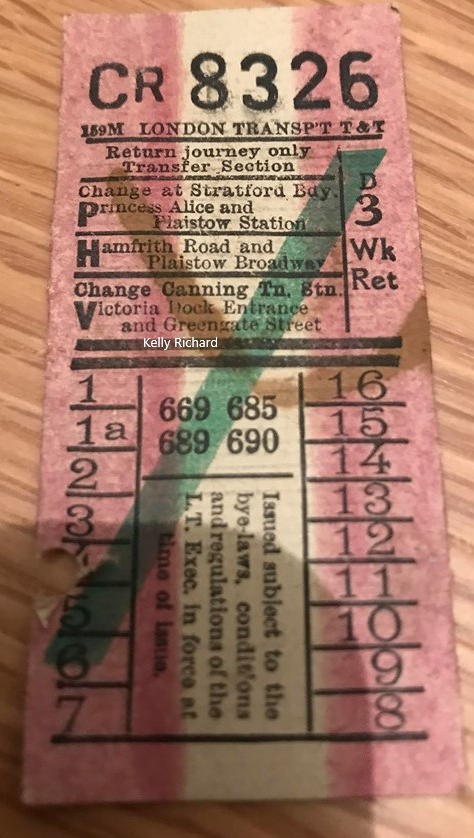
Now I say Em’s story but strictly speaking it is her friend Kelly who came across a collection of “bits belonging to her Nana”, and Emily sent then north to me.

They consist of a trolley bus ticket, two small tins and a set of instructions.

And here I feel my age, because when I told Em that I thought the ticket was a trolley bus ticket, she relied by asking “what was a trolley bus?”

But to be fair Emily was born in 1980, a good two decades after trolley buses were beginning to disappear from our streets.

I have to say I wasn’t a fan of them. I don’t know whether it was the smell of the leather seats, the constant accelerating and decelerating or just that the inside always seemed so hot, but I always ended up feeling travel sick.

They had a short life with London Transport.  The first batch of 60 entered service in 1931 and the last were replaced by motor buses in 1962.*

I tracked the ticket down to east London, via a fascinating map of “Trolleybus and Tram Routes, 1947” and while I think our ticket will date from the late 1950s or early 60s, at least one of the routes on the ticket shows up on the map .*

At which point I could get a tad nostalgic, if that is I was fond of trolley buses, but as I am not I shall finish with the two tins, one of which was designed to “Relieve, Indigestion, Heartburn, Flatulence,  Acidity, [by taking] One or two Tablets sucked after meals will give you complete STOMACH COMFORT”. 

It was made by Meggeson who had been established in 1796 and in the 1950s and 60s were based in Bermondsey.

So far I haven’t been able to find out any more, although I do know that according to the National Archive, “the 1957-1966: minute book of directors and general meetings (previously Beckdale Laboratories Ltd) are held privately".

I can’t recall that we ever had a tin of Meggeson’s in the house, referring Andrew’s Liver Salts.

But we did like most homes have at least one tin or packet of Elastopast, which back in those days was still made with a fabric coat, which quickly went soggy when you washed or went swimming.

And for those unfamiliar with how to use the product, the tin came with a set of helpful instructions, for which you paid one shilling.

So, that is all I have to say, other than the objects might make their way into the new book, on Lost Stories …of Chorlton-cum-Hardy, in our Attics, Cellars, Garages and Sheds***

Of course they will have to be in a special chapter about things from around the world, given that all four come from south east London.

If I move quickly and deftly I doubt Peter will notice,

Alternatively I could just own up and suggest he comes up with something from Preston, where he was born.

We shall see.


Location; south east London


Pictures; family objects, circa 1950-60, from the collection of Kelly Richards

*Trolleybuses in London, https://en.wikipedia.org/wiki/Trolleybuses_in_London

**“Trolleybus and Tram Routes, 1947”, Mapping London, https://mappinglondon.co.uk/2018/trolleybus-tram-routes-1947/

***A new book on the Lost Stories; https://chorltonhistory.blogspot.com/search/label/A%20new%20book%20on%20The%20Lost%20Stories

Wednesday, 11 December 2019

Stories from the attic ...... part 7 ........ a mystery, a typewriter, and a shared family story

Now, I had completely forgotten the big brass decoration which had always been a feature in the house as long as I could remember.

And because familiarity often creates  a sense of complacency, I never wondered where it came from, or how it first came into our possession.

The realist in me thinks that it might well have been something mum picked up in a secondhand shop.

But the design shouts out the Far East, and like many families we had connections with the sub-continent and Africa, through one of our uncles who spent his adult life working in India, Siri Lanka, and Kenya, before settling in South Africa.

And so, I think it is entirely possible it was one of his presents to my parents, along with a collection of African elephants carved out of wood and other “exotic things”.

Uncle Charles was the adventurous one of dad’s brothers, and in his early 20s went out to the Empire, not as civil servant but as an administrator in a succession of companies, which I guess dealt in export and import, although exactly just what they and he did I never asked, and are now lost.

But he was one of thousands of young men and women,  who went East to service Empire and Britain’s vast commercial and trading business.

But I do remember that when he retired in the early 1960s, he and a “pal”, drove from Cairo to the Cape, and having reached South Africa, and apart from brief trips home, that is where he stayed.

Mother was never quite reconciled to the suitcase he left with us on one visit, which included tins of butter, which then and now, still exercise my imagination.

Just what happened to them I have long forgotten, but the “treasures from the Far East” were shared out between me and my sisters when dad died.

And that is why I had all but forgotten that big brass plate, because it went with Elizabeth who sent over a couple of pictures of it, along with some of a typewriter which belonged to Colin’s mum.

The typewriter is one of those sturdy black numbers which were an essential part of offices around the world and in its way is as much a comment on how we all used to live as the brass plate.

I still marvel out how people used them, relying on erasers  and later Typex to gloss correct mistakes, while remembering to buy into new ribbons.

Today, they are as much a bit of our past as the technology of producing newspapers with printing presses.

Of course there are still writers who use typewriters, and mother wrote plays, short stories and a novel on an Olivetti, which was a sleek portable version of Colin and Liz’s model.

And I am in awe, given that with a computer, corrections are just a click away, while the process of copy and paste revolutionizes the stuff of expressing ideas and feelings.

So that is it ……….. one brass plate taking me back to our uncle and Empire, and the typewriter offering up a very different way of expressing yourself.

Location; Kent

Pictures; from the collection of Liz and Colin Fitzpatrick

Tuesday, 26 November 2019

The Lost Stories of Chorlton-cum-Hardy ....... the new book ….. coming soon

Like all good stories, it started with a discovery and a conversation.

The discovery was a hoard of treasures stored carefully in Peter’s attic for over 30 years and brought out into the daylight last week.

Those treasures ranged from an old cigarette packet, and tea carton dating from the 1930s, through to a selection of electronic consuls, and games from three decades ago, and in between were dozens of military cap badges, bottle openers and badges.

Having found them and knowing I would be interested, Peter sent over some pictures of the hoard, and from there we had the conversation, which roamed over the excitement of rediscovering the bits in the attic, to just what they said about how we lived.

And as they do the blog stories followed, which in turn inspired friends  to offer up their treasures, which then led to more blogs, and by degree to the book, which we have called The Lost Stories of Chorlton-cum-Hardy In Our Attics, Cellars, Garages and Sheds.

It is as they say a work in progress, which at present has clocked up some wonderful items, all of which with a bit of research and memories from the owners, has taken me to the Great War, a textile factory outside Hebden Bridge, and an unforgettable night in a Yates Wine Lodge in Preston.

But this is just the start, because out of that conversation came a parallel one where we discussed just how to involve groups of people coming together with their attic finds and sharing the stories behind each one.

And here we have been joined by Jolene Sheehan, whose very successful community writing project culminated in the recently published book, The Stories of Our Lives.*

Just how this exciting part of the project develops is still in the planning stage, but it holds the promise of being fun, and rewarding.

So that is it, ………. just leaving me to make the appeal for more treasures, from your attics, cellars, garages and sheds.

You can contact us by leaving a comment on the blog or through Facebook.

Location; Chorlton-cum-Hardy

Pictures; cover of The Lost Stories of Chorlton-cum-Hardy in Our Attics, Cellars, Garages and Sheds, featuring Linda Rigby's box of treasures, and selection of attic hoards from Peter and me.

* The Stories of Our Lives was a community writing project in Chorlton cum-Hardy which involved 50 local people coming together over four Saturdays in August to share their memories, which in turn were transcribed by a group of volunteers and became the book.

Friday, 22 November 2019

Stories from the attic ...... part 5 ........ the family mystery

Now this metal notebook holder has been in the family for as long as I can remember.

It is small but quite heavy and  I am ashamed to say has suffered from being in the cellar.

Its metal exterior has been attacked by rust and I am looking at how best to restore it.

It carries the German Imperial Cross with the letter W and the date 1914, and given that my grandmother was German I assumed it belonged to one of her family.

But now I am not so sure.

The name inscribed on the front is not one I recognise.

Of course that doesn’t prove it is not one of our family but allows for some doubt.

Alternatively it could have been picked up on the Western Front by either my grandfather or great uncle Jack.

Both served in the British Army and both were in France.

Whatever its origins I do know that it passed to my uncle who served in the RAF and whose name, serial number and the words RAF were inscribed inside.

Uncle Roger enlisted in 1938 aged 16 and saw action in Greece, and Iraq before being captured by the Japanese in 1942 and died in a prisoner of war camp the following year aged just 21.

And that offers up a second mystery because it remained in our possession.  I very much doubt that had it headed out to the Far East with him it would have returned.

I am of course totally prepared to accept the commonsense explanation that he just left it behind for anyone of a number of reasons.

The German side of our family is the one that we have not explored and when we do we might find the answer to its original owner.

Sadly there is no one left to ask and had we not decided to clear out the middle cellar I suspect it would have been many more years before I came across it.

All of which is a lesson in how to look after family objects.  All too often because we have grown up with them we take the item for granted, and that can lead to neglect and eventually to the loss of the object.

So that is it.  The search has begun.  Leaving me only to reflect on the irony of the fact that it passed to my uncle who was in the RAF but like my mother had been born in Cologne.

Picture; metal notebook holder, circa 1914, from the collection of Andrew Simpson, 2019

Wednesday, 20 November 2019

Stories from the attic ….. part 4 ..... the camera

Now, just a few days ago, I ran some stories on the forgotten treasures that lay lurking in attics, cellars, and garages.

Peter Topping’s hoard was first off the starting line, and that led me to make the appeal for others to go rummaging, and that is exactly what Andy Robertson did.

And here is his little bit of the past …..an Olympus Trip, which he tells me, “my mother had one when we lived in London.  

When I moved to Manchester and was earning a wage, I bought mine probably 1975. A good servant!”

According to one source,"The Trip 35 is a 35mm compact camera, manufactured by Olympus. 

It was introduced in 1967 and discontinued, after a lengthy production run, in 1984. The Trip name was a reference to its intended market – people who wanted a compact, functional camera for holidays. 

During the 1970s, it was the subject of an advertising campaign that featured popular British photographer David Bailey. Over ten million units were sold”.*

So, there you have it a wonderful find that offers up a glimpse of popular photography in the late 20th century.

Location; Andy’s attic

Picture; an Olympus Trip 35, 2019 from the collection of Andy Robertson


*Olympus Trip 35, https://en.wikipedia.org/wiki/Olympus_Trip_35


Sunday, 17 November 2019

Who knows the secrets of the little room at the top of the stairs? …………

So, I know you will have to be of a certain age to link the title with that TV advert for Black Magic Chocolates, but then if you can, you may well be the person we are interested in, because it is of the forgotten gems,  carefully put away in the box room or the attic which could be the subject of our new book.*

It started when Peter brought down box loads of stuff which had been stored in the attic, gathering dust and almost sliding out of recorded memory.

There was a collection of military cap badges, from both world wars, assorted old computers, and electronic games, along with a packet of Edwardian tea, and an empty carton of Player's Weights.

Nothing you might think as valuable, but each offered up clues to how we used to live during the last century.

Having got hold of some of the treasures I wrote the story with a promise of more to come, and then Peter came up with the idea of asking to look into other people’s attics, spare rooms and garages.**

Now I  know that the idea is not new and one TV channel specialized in programmes rummaging around in the attics of celebrities, but what makes Peter’s idea a tad different is that we will be looking into the homes of people from across south Manchester and ignoring “celebs”.

And having been given permission to unearth the boxes of promise, we intend to tell stories of what those boxes contain, with the firm expectation that the bits and pieces will offer up a slice of our collective past.

Looking again at Peter’s cornucopia of forgotten interests, I fastened on all those old 1980s computers and the games which went with them, remembering the hours our kids spent playng on Sim City, Tetris, Dungeon Master and Prince of Persis.

At which I could explore the power of this new form of entertainment and its impact on how we did leisure, but instead that’s for the book.

For now, here is the challenge which “ should you choose to accept”, is to  go rummaging amongst your old and neglected store of half-forgotten objects and get in touch with us.  We will come around, take the pictures and in consultation with you choose some which tell a story.

Unlike Mission Impossible this story and your stories will not “auto destruct in 5 seconds” but will linger long enough for lots of people to become inspired by the project.

And in the fullness of time become another book which Peter Topping and I offer up to the world.

Leaving you to leave comment on the blog or contact us through social media.

Location; your attic, garage, or spare room,

Pictures; things that have sat in Peter’s attic for decades, courtesy of Peter and Linda Topping

*Who knows The Secret of The Black Magic Box? was an TV advertising  campaign from the 1970s

**The time capsule that is Peter’s attic …….. part 1, https://chorltonhistory.blogspot.com/2019/11/the-time-capsule-that-is-peters-attic.html

Thursday, 14 November 2019

The time capsule that is Peter’s attic …….. part 1

Now when Peter ventured into his loft and brought down the accumulation of 40 years of stored stuff, I doubt he was quite prepared for just what had been “ carefully put away”.

But that is just what most of us do when faced with the need to clear the backroom but unwilling to part with treasures.

In some cases, they will be the product of a collecting enthusiasm, or just that assumption that one day they will become useful again.

That said I challenge him to explain how in the 21st century he will use the contents of the box of “Players’ Weights, Made from PURE VIRGINIA TOBACCO”, or for that matter the packet of blended tea sold  by “Yates Brothers, Wine Lodges Ltd”.

But I suppose that is less relevant than just what so many of his treasures tell us about the last century.

So, I was intrigued by that Yates’s tea, and had no idea they sold it.

I remember the lodges as big smoky rooms, filled with people of a certain age, drinking in a place that hadn’t much changed since Victorian times.

And that brings me back to the tea, and that simple question of whether it was sold in  the bars, alongside their “Blob”, their wines and their white rum?*

I do remember reading somewhere that they also sold beef, so perhaps an expert will wade in with chapter and verse.

In the meantime, I am equally intrigued by the box of military cap badges, the metal bottle openers, and those testaments to late 20th century gaming, which includes a Nintendo 64, a Commodore Amiga, and the CD Rom of NODDY The Magic of Toytown.

Nor is that all, but some like Peter’s time as a snake keeper and his time with Chorlton Breakers are best left in the shadows.

But I am drawn to the cap badges, partly because of book I wrote on Manchester and the Great War, and partly because each will have a story to tell, and after all stories are what it is all about.**

So, I will be beating a path to Peter’s house to borrow the box and continue the stories.

And when they are done, I shall follow up on the time of the Nintendo 64, Commodore Amiga, The Kodak bellows camera, and the posh leather wallet and newspaper clipping.

Location; Peter’s attic

Pictures; assorted attic history, 2019, from the collection of Peter Topping

Next; Stories from cap badges


*Blob was a mix of sweet Australian wine, and brandy, to which was added hot water, sugar and lemon.  The company began in 1884 when they opened their first lodge, and within 20 years had nearly 20 lodges across Lancashire

**Manchester Remembering 1914-18, Andrew Simpson, 2017, https://chorltonhistory.blogspot.com/search/label/A%20new%20book%20on%20Manchester%20and%20the%20Great%20War