Showing posts with label Manchester in the 1890s. Show all posts

Friday, 24 July 2026

When fast food predated the 20th century …..instant meals for the workers on our Victorian streets

We take for granted that breakfast was and still is for many something you have at home but this has not always been the case.  

Throughout history people and it does tend to be the poor have eaten out, often from fast food vendors and not I suspect always out of choice.

You can pick any one of a number of reasons, which usually come down to the early start of their day or the simple fact that the means to cook much in a shared room was limited.

Street food was available in Pompeii before it vanished under the ash of Vesuvius, and similar shops and stalls can be found across the Roman Empire, while Henry Mayhew in his London Labour and the London Poor, published in 1851 devoted eighty-eight pages to the purveyors of almost every imaginable fast food, from fruit, fried fish, coffee and “green stuff”.”*

And tomorrow I will explore those London street sellers courtesy of Mr. Mayhew, but today I am revisiting The Victorian City, Everyday Life in Dickens’ London by Judith Flanders. **

I came across it back in 2012 and it is a prefect companion to that older survey of the capital’s eating habits.

Today eating out can be expensive and a life choice, but back in the early 19th century it was pretty much of a necessity.  Most of the working-class lived-in rooms of shared houses with just a fire place for rudimentary cooking extending to boiling a kettle or a pot of something, and anyway lighting a fire was a costly affair which would then continue to burn long after everyone had left for work.  

Added to which Likewise water was not always readily available and might only be obtained from a street pump and then not all the time.

By contrast on the way to work there were  coffee stalls which had the added bonus that in cold weather the mugs would warm the hands as well.

Some stalls were just simply a board laid over a pair of sawhorses and a can of coffee kept warm by a charcoal burner and others elaborate tent like structures.  A cup of coffee and “two thin” – two pieces of bread and butter might cost half a penny.

Nor was this way of life restricted to London.  Across Manchester and indeed all our cities and towns could be found similar fast food sellers

Picture;  Hot food on sale on the streets, the pictures date from the 1890s which takes them a little out of the time frame of the book, The Infirmary Corner at the top of Market Street, The Rovers Return, Shudehill, and Angel Meadow, by H.E. Tidmarsh from the book Manchester Old & New, Arthur William Shaw 1894

*Mayhew, Henry, London Labour and the London Poor, 1851

**Flanders, Judith, The Victorian City Everyday Life in Dickens’ 2012


Monday, 11 May 2026

Searching the picture ….. London Road 1895

This is a photograph of London Road where it joins Store Street and we are in 1895.

London Road, 1895

There is nothing very remarkable about the picture and might well be described as eight people, two posters  and one antique shop.

But there is of course more and it is the more that has drawn me in.

Above the brick pillar is the approach to London Road Railway Station and that antique shop is still there.  I remember it as a tobacconist and also as a betting shop and is now empty and boarded up.

London Road, 2019
Just whether it will ever see better days again is debatable.

It is after all on that very busy stretch of London Road which most pedestrians shun and is given over to speeding traffic and passing trams.

All of which means it’s footfall is limited.

But not so back in 1895 when an H Entwhistle captured that group of four boys and four men staring into the camera in front of Mr. William Butterworth Wharton’s shop. He described himself as a “dealer in works of art”, and I can track his presence there from 1888 to 1911.

Earlier he is listed during the late 1870s and early 1880s on Half Street by the Cathedral and was living at Oak Bank Cheetham Hill Road.  Now that begs the question of whether the move to London Road was a step up or a slide down.

He died in 1915 leaving the sum of £1150.

Sadly, so far there is little of him in the official records.  He is missing from the census returns but I know  he married in 1880, that his wife Maria died in 1912 and he had at least two sons. They along with his wife are buried in the same plot in Manchester General Cemetery.

And as they say …. Watch this spot because a Sarah Ellen Makin, a Joseph Shevlin and a Betty Mckeown share the plot.  These last three may have no family connection with the Wharton family but it will be fun to explore the chances that they were.

Our man, 1895
At which point I have to confess our dealer in art was not how I was drawn into the picture, that prize goes to one of the eight staring back at me.  He is the one with the hat and by chance his face is the one most clearly visible.

He leans against the poster stand looking back at the camera with what could be a mix of curiosity, or disdain challenging the photographer to  discover what he is thinking.  

And what ever he is thinking I am convinced that he will never offer up any details of his life or his secrets.  

By contrast the others are a blank canvas and could be any one of the thousands of passers by confronted with the new technology of photograpy.

To their right are two posters advertising an event at Bell Vue featuring the Storming of Port Arthur during the short Russo Japanese War of the year before.

The caption on the picture refers to the “crack in the abutment” which 130 years later is still there.

Leaving me just to ponder on what the man on the left has in that basket and just what the neatly dressed  boy with cap and posh looking overcoat was doing on London Road .


But I doubt we will ever know, as for what our man in the hat was thinking .... that is just utter conjecture which has no place amongst the facts other than as a piece of tosh.

Location; London Road, London Road, 1895, H Entwhistle m63006, courtesy of Manchester Libraries, Information and Archives, Manchester City Council, http://images.manchester.gov.uk/index.php?session=pass and Mr. Wharton’s shop, 2019, courtesy of Google Maps

Saturday, 14 March 2026

Gasholders I have known and loved ........... no 3 inside the Rochdale Gas works

Now I am well aware this is a cheat ............. less a gasholder and more the inside of the Rochale Road Gas works.

But I have included it the series Gasholders.

The picture is entitled Gas Works Drawing Coke Rochdale Road and dates from 1894.

This was the time when “town gas” was manufactured on site and didn’t come down a pipe from the North Sea or in a container ship from somewhere on the other side of the world.

Back in 1894 Henry Tidmarsh recorded this one along with over 300 other  illustrations for the book Manchester Old and New which  was published in 1894 by Cassell with a text by William Arthur Shaw.

In three big volumes it told the history of the city but the real value of the book was in Tidmarsh's vivid depictions of Manchester, with streets and buildings animated with people.

Pictures; Gas Works Drawing Coke Rochdale Road, 1894, Henry Tidmarsh, from Manchester Old and New, William Arthur Shaw, 1894

*Gasholders,https://chorltonhistory.blogspot.co.uk/search/label/Gasholders

Tuesday, 10 March 2026

The sandwich board ............ a century apart

Advertising the Palace Theatre, 1896
Once the man with a sandwich board was a common site on the streets of all our towns and cities.

And then sometime after the last world war they seemed to disappear.

I guess it was part of that more slick way of advertising which relied on TV to get the message over.

But they are back usually advertising fast food and can be seen following the main routes into the city or as in this case at St Mary’s Gate close to St Ann’s Square.

Some firms have gone that step forward and produced a sign which mimics the product.

And like their predecessors a century ago they walk the streets in all weathers, come rain, hail or sun.


Fast food, 2015

Back in 1896 Henry Tidmarsh recorded what he saw on the streets of Manchester.  In all he produced over 300 illustrations for the book Manchester Old and New.

It was published in 1894 by Cassell with a text by William Arthur Shaw and told the history of the city but the real value of the book was in Tidmarsh's vivid depictions of Manchester, with streets and buildings animated with people.

Location; Manchester


Pictures; At St Mary’s Gate, 2015, from the collection of Andrew Simpson, and by St Peter’s Church, 1896, Henry Tidmarsh, from Manchester Old and New, William Arthur Shaw, 1896

Wednesday, 3 December 2025

Hard won elections ……. and disappointing results ….. Manchester …. 1894-98

It is of course an obvious observation that political fortunes wax and wane, and the mould breaking gains of one year become the pit of electoral despair the following year.

ILP logo, 1893-1975

And so it was with the Independent Labour Party, which shortly after its formation won two seats in the 1894 elections to Manchester City Council.  The real significance of which was that they were the first two Labour councillors.

In what were fiercely fought contests in which the Conservative were not above using scare tactics, the ILP won the Bradford and Openshaw wards.  In Bradford John Edward Sutton took 54% of the vote, and in Openshaw Jessie Butler gained a narrow majority with 50% of the total vote.

Across the city the ILP had put up candidates in eleven of the fifteen seats and in total  got just over 10,000 votes, coming a decent second in Harpurhey, racking up an impressive 1,261 in New Cross and four figure results in another six wards, with only St John’s falling below the trend with just 83 votes.


ILP share of the vote, 1895

But anyone who follows local elections  will know that there can be wide variations from one year to the next, and the fortunes of the ILP  prove testimony to the rule.

In 1895, they contested just five of the 15 seats, gained none and returned shares of the total vote ranging from 37% in Harpurhey down to 11% in Miles Platting, while in Bradford they sank to just 21% and in Openshaw got a marginally better 26%.

And while they contested more seats in the following  year, achieving four figure results in five of the seven wards, it would not be until 1897 that ILP candidates were returned.


ILP & SDF results, 1897

In Bradford, John Edward Sutton was reelected, and was joined by another ILP candidate in Harpurhey, and a member of Social Democratic Federation in St George’s Ward.

Of course, what is missing from these elections results is the politics behind them, and to judge the significance of what happened you have to fall back on the national as well as the local scene to provide a context.

And that I have yet to do.

But the victories in 1894 were in part a response to the way the ILP had organized in the working-class areas in the city and in particular to the bitter coal strike in 1893 which commentators at the time thought was decisive in the ILP gaining Bradford and Openshaw, many of whose electors worked at Bradford Colliery, and who also identified with Mr. Sutton and Mr. Butler who were miners.

John Edward Sutton, date unknown

Equally we know that in 1878 which saw the election of the two ILP and one SDF councilor, local factors came into play.  In the case of Bradford, John Edward Sutton was a respected councillor who was defending his seat, and was reelected but with a reduced share of the vote.

In Harpurhey the ILP had achieved consistent good results over the previous two years, and in Openshaw Jessie Butler who failed to regain his seat lost because the Labour vote was split.

Mr. Butler according to the Manchester Guardian “came out this time simply on Labour lines, having severed his connection with the Independent Labour Party for various reason, and had to meet the opposition of many of his old supporters and the solid body of Conservatives”.*

And while the ILP did not put up a candidate, he achieved just 40% of the vote.

I wish there were more local detail but that will have to wait till Iam next in Central Ref  and I can look through the local media, which  I am confident will provide the background to what was happening in the city between 1894 and 1897 and is also a nudge to me to delve deeper into the national political scene.

For now, that is it.

Pictures; logo of the ILP, 1893-1975, John Edward Sutton date unknown, election results from the Manchester Guardian, 1894-98

*The Municipal Elections, The Manchester Guardian, November 2nd, 1897

Tuesday, 29 July 2025

A little bit of Manchester in Holland, and another bit in a garden in Chorlton-cum-Hardy

I am looking at a picture of the Manchester Assize Courts which I have added to the collection.

It was donated by my old friend David Harrop, who is a collector of all things posty.

The Courts were designed by Alfred Waterhouse and finished in 1864.

Sadly, this magnificent building did not last a century and after being hit during the blitz of December 1940 and again in ’41 it was demolished in 1957.

Some of the exterior sculptures were designed by Thomas Woolner who was one of the founding members of the Pre Raphaelite-Brotherhood, and others was the were of the Irish stonemason firm of O’Shea and Whelan.

But more of them in a minute.

For now, it is the postcard itself which interests me, and in particular the message on the back, which is in Dutch and begins, “Congratulations on your birthday We have a pleasant one ………….”

And here I have to credit Google translate, which over the years has allowed me to appear semi proficient in a host of languages.  And what makes the card that bit more interesting is that it appears to have been produced for the Dutch market, given that the printed word postcard is also in Dutch.

Not that I should be surprised at that.  F. Firth, like Raphael Tuck and other companies marketed their postcards across Europe and beyond.

But I like the idea of a little bit  of Manchester somewhere in Holland, and …………. with a smile at the contrived link that follows, I like the fact that for many years one of the stone figures from the Manchester Assize Court adorned a garden in Chorlton-cum-Hardy.

The garden was part of Park Brow Farm at the bottom of Sandy Lane where it joins St Werburghs Road.

My friend Tony Walker maintained that it came from the old Manchester Assize Courts on Great Ducie Street in Strangeways and looking at pictures of the building the figures do look the same.

And it has led me to more than a few stories about the farm, the Assize Courts and just what people put in to their gardens. *

Location; Manchester, Amsterdam, and Chorlton-cum-Hardy

Picture; The Assize Courts, 1898, from the collection of David Harrop, and stone figure in the garden of Park Brow Farm, 1988 from the collection of Tony Walker


*One stone statue ........ late of Park Brow Farm and the Assize Courts .......... makes its way into Cheshire and on “down south”, https://chorltonhistory.blogspot.com/2016/06/one-stone-statue-late-of-park-brow-farm.html

Wednesday, 23 July 2025

A little bit about Samuel L Coulthurst and those amazing pictures of Manchester street life

Rochdale Road and Swan Street 1900
This is another of those images of Manchester street life by Samuel Lawrence Coulthurst.

It was taken in 1900 at the corner of Rochdale Road and Swan Street.

Now at this point I would normally go off and look for a story behind the image but today I am more
interested in Mr Coulthurst.

There are 171 of his photographs in the digital collection of Manchester Libraries, covering everything from those street scenes to buildings and portraits and taken between 1890 and 1920.*

There is also a book of his pictures which sadly is out of print. **

For a long time Mr Coulthurst was just a name I saw in the credit to the photograph I was studying but as more of his images turned up I became interested in him.

He was born in Blackley, described himself variously as a “book buyer” and “stationary buyer" and lived in various parts of Manchester and Salford.   He married Annie Higson in June 1900 and he died in Helsby in 1939.

Samuel Lawrence Coulthurst, 1890
And despite a series of wonderful photographs of the twin cities, I have only been able to turn up a poor quality photograph of the man himself.

But I have high hopes that something better will turn up.

After all he appears to have been well known during the late 19th century, exhibiting at the Royal Photographic Society in 1897 and was a member of the Manchester Amateur Photographic Society which under took the first photographic survey of Manchester and Salford between 1892-1901.

In 1901 232 platinotype prints were handed to the Manchester and Salford Reference Libraries.

A third copy was retained by the Society but over the years a number have gone missing. The photographs are mounted on sheets of card, either singly or groups of 2 or 4 photographs per sheet. Manuscript details are written in ink beneath each image giving a brief description, a number and the photographer’s name. ***

Now there is a lot more I want to know about Mr Coulthurst and I have contacted both Manchester Amateur Photographic Society and the Friends of Salford Museum’s Association.

In the meantime I will leave you with this small piece of his personal life.

In the March of 1922 Samuel and Annie took a cruise to Lisbon, Madeira and the Canary Islands.  I would just love to see any photographs of that trip, but I fear they have been lost forever, which brings me back to those of the digital archive which I will be going back to over the next few months.

Pictures; Rochdale Road and Swan Street, Samuel L Coulthurst, 1900, m41073 and Samuel L Coulthurst, 1890,  m72750, courtesy of Manchester Libraries, Information and Archives, Manchester City Council, http://images.manchester.gov.uk/index.php?session=pass

*Manchester Local Image Collection, http://images.manchester.gov.uk/index.php

**The Samuel L Coulthurst Photographs: Victorian Salford and Manchester, 1995, Friends of Salford Museum’s Association

***National Archives, http://www.nationalarchives.gov.uk/A2A/records.aspx?cat=124-2373&cid=0#0

Thursday, 17 July 2025

On St Johns Street with a story that crosses continents

Now the way a story comes to light can be as fascinating and revealing as the actual story. 

St John Street showing the home of the Painter family, 2008
So it was when Julie picked up on a post about St Johns Street with the comment that “My great grandfather was David Arthur Keneally. I think it was actually 19 he lived at.” 

And that was how it began.

St John Street dates back to the late 18th century and remains a street of elegant houses which by the late 19th century had become the consulting rooms of fashionable doctors, surgeons and eye specialists.

A few were residents but most lived elsewhere.

Their rooms were on the ground floor and the remaining parts of the houses were let out to a mix of tenants who made their living from a range of occupations from service industries to clerical and industrial enterprises and quite a few working for the nearby railway companies.

There was even a blacksmith and a policeman, which is where our story begins.

Police Constable, Kenally, date unknown
This is Mr Keneally.

I don’t have a date for the picture but given that he joined the Manchester Police Force in the October of 1895 and he has two stripes I would have put the date sometime into the early 20th century.

Those service records also show that he was born in Cape Town in 1868 and had been in the Cheshire Regiment.

And that is a good starting point because although I can’t find any reference to him before 1891 I do know that in the April of that year he was in Salford Barracks on Regent Road.

The army seems to have been a natural career choice given that he was born in King William’s Town and that his father was in the 99th Foot Regiment which served in South Africa from 1865 till 1868 and again in 1878.

All of which explains why he appears to be missing from the records.

Looking down St Johns Street, circa 1900
But those records do throw up a few odd hiccups.  So while his birth was registered as 1866 his police records have him born in 1868 and those same police records describe him as single, when he had married the year before.

The marriage took place in St John’s Church on January 24 and the parish record  is a revealing document.

Mr Keneally was living at number 19 St Johns Street and gave his occupation as "musician" and that of his father as a clerk, while his bride was living two doors down the road at number 23.

She was Mary Ann Cross who was from Ireland and her father is given as James Painter and that of course puzzled me.  But according to Julie Mary Ann’s mother had remarried on the death of her father. “Sarah Myles married William Cross (he was in the Kerry Militia) and they had Marianne (Mary Anne / Marion?).  


Mary Ann Painter gets a present, 1885
William Cross died and Sarah married James Painter who was in the British Army and she came back to England with him.”

And that made the connection with St Johns Street because in 1891 Mr Painter was the caretaker in the Royal Eye Hospital which was situated at number 24, and there too was Mary Ann described as "house keeper.”

Mary Ann appears to have adopted her step father's surname by 1885 when she received a gift from her work colleagues, but gave her name at the wedding as Cross.

Now that will help in the search for her story.

In the meantime the romantic in me likes the idea of David and Mary Ann seeing each other regularly on the street and discovering that they were attracted to each other.

After their marriage they stayed on St Johns Street where they still were in 1901 living at number 23.  By then they had a son and employed young Minnie Day as a servant.

A decade later and they had swapped the imposing house on St Johns Street for the more modest 41 Carleton Street in Rusholme which was a a 4 roomed property close to Claremont Road.

Mr and Mrs Painter with John and Percy circa 1907
And what I like is that both homes are still standing.

There will be lots more research to do.

I know that Mr Keneally died in 1921 and Mrs Keneally in 1937 and  both were buried together in Southern Cemetery, but for now that is enough.

And this was pretty much the end of the story but then having discovered that Mr and Mrs Keneally were buried in Southern Cemetery I asked my friend David to visit the rave and take a picture.

Headstone of Mr and Mrs Keanlly
They were interred block U and it is fitting I think to close the story with his picture of their headstone.

Location; Manchester

Additional research Julie Smith


Pictures; St John Street in 2008 from the collection of Andrew Simpson, St John Street circa 1900, m04502, courtesy of Manchester Libraries, Information and Archives, Manchester City Council, http://images.manchester.gov.uk/index.php?session=pass  the headstone of Mr and Mrs Keneally 2016 from the collection of David Harrop, and family images from the collection of Julie Smith

Tuesday, 17 June 2025

On the streets of Manchester, polishing shoes, selling food and offering up fun balloons

It is one of those things about city life that there is always someone who will sell you almost anything.

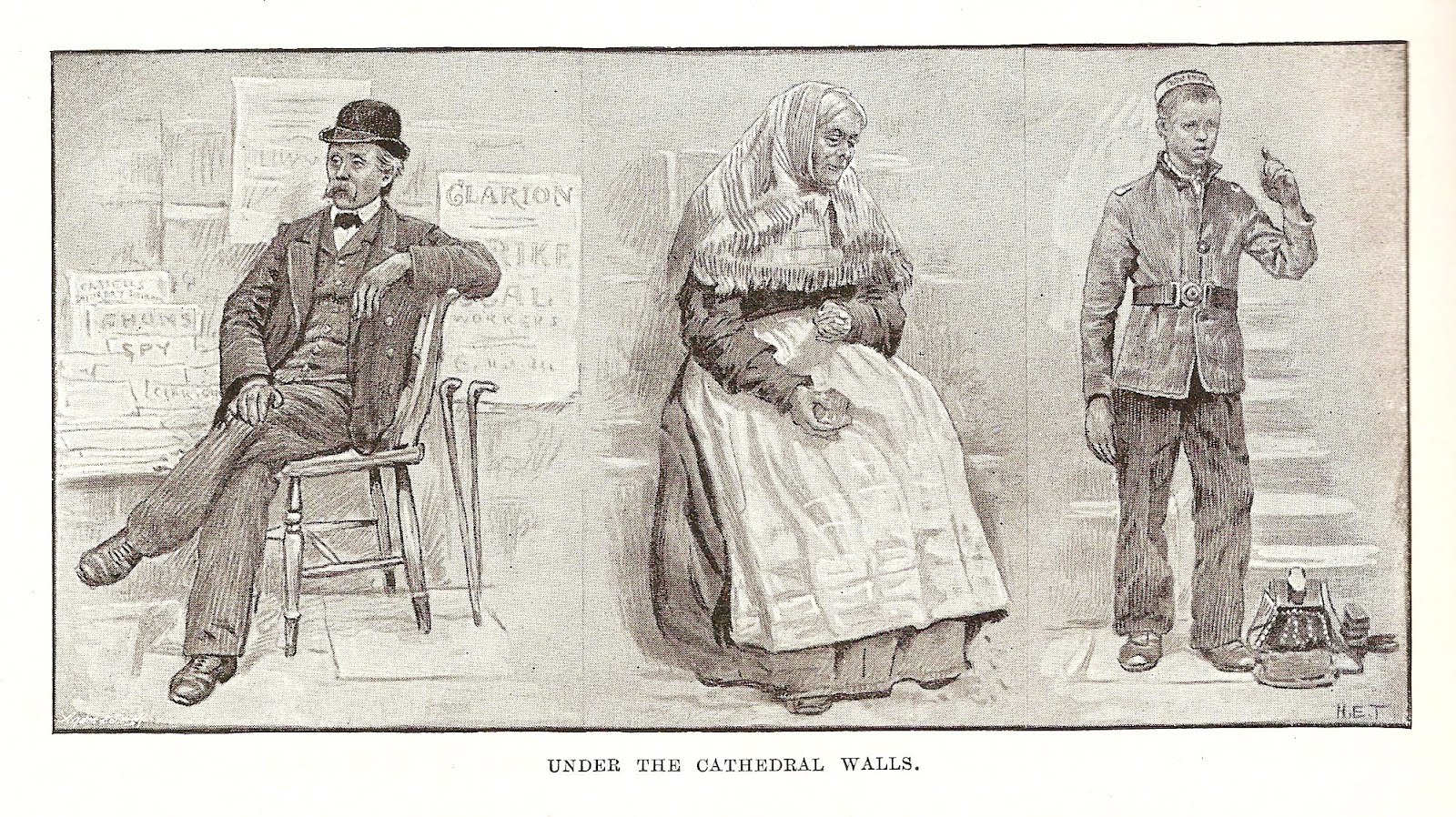
Just over a hundred years ago down by the Cathedral walls, the artist H.Tidmarsh recorded the old man selling newspapers, a woman selling potatoes and a boy polishing shoes, while up by the Infirmary at the top of Market Street he painted another street vendor selling food.

Not far away by Hunts Bank late at night young children plied the streets selling newspapers in the early hours of the morning.

And a century and a bit later, out on Market Street the crowd surged past the burger van, negotiated the balloon man, and stopped to buy a political paper.


Pictures; Manchester street sellers by H.E. Tidmarsh from Manchester Old and New, William Arthur Shaw, 1894 and from the collection of Andrew Simpson, June 2013

And over the next few weeks I shall focus on more of the street vendors who plied the streets of Manchester  in the late 19th century and their counterparts who still do the same business today.


Monday, 16 June 2025

The night watchman............ out on the streets of Manchester in 1896

Once the night watchman would have been a familiar sight sitting beside his hut keeping warm at the brazier and maintaining a solitary vigil over the road works or building site.

They feature in much literature during the last two centuries and only disappeared sometime in the 1960s.

Back in 1896 Henry Tidmarsh recorded this one somewhere in the centre of Manchester.

In all he produced over 300 illustrations for the book Manchester Old and New which  was published in 1894 by Cassell with a text by William Arthur Shaw.

In three big volumes it told the history of the city but the real value of the book was in Tidmarsh's vivid depictions of Manchester, with streets and buildings animated with people.

Pictures; The night watchman, 1896, Henry Tidmarsh, from Manchester Old and New, William Arthur Shaw, 1896

Sunday, 15 June 2025

The Manchester of 1894


I have spent part of the afternoon looking through a wonderful collection of pictures of Manchester from the late 19th century.

They come from a three volume collection published in 1894 under the title Manchester Old and New.  It was written by William Arthur Shaw and the 300 illustrations ranging from small pictures set into the text to full page paintings were by Henry Tidmarsh.

These for me are the real attraction of the books.  True, some might be dismissed as chocolate box illustrations with a romantic hue, but many were of the less prestigious streets and highways while others like the Rochdale coke and gas works vividly bring to life an industrial scene long gone.

Location; Manchester

Pictures; from Manchester Old and New published in three volumes in 1894 by Cassell, text by William Arthur Shaw, illustrations by Henry Tidmarsh

Saturday, 14 June 2025

Lost and forgotten streets of Manchester nu 36 Newgate ..... less a street and more a court

Now I didn’t expect to find Newgate on the directories, even when this picture was taken in the 1890s the inhabitants of this closed court were part of that unseen Manchester.

Newgate, 1890
To get to Newgate you had to turn off Long Millgate and go through an entry in a building which then led off to other smaller courts.

But even here it ranked as an insignificant address for while Pearsons Court which was the neighbouring court got a listing as a direction point in the directories for Long Millage, Newgate didn’t even warrant that.

So to all intents and purposes it might as well not have existed.

But the maps show it there and show at least eleven properties and in time with a bit of digging I will find it on the census and that in turn will offer up the names of the residents, their ages occupations and families.

Newgate, 1849
For now the best that I can offer the curious is to direct them along Corporation Street heading north and just beyond Hanover Street under that very big white building will be Newgate and Pearson’s Court.

Location; Manchester

Picture; Newgates, 1908, m8316, courtesy of Manchester Libraries, Information and Archives, http://images.manchester.gov.uk/index.php?session=pass Manchester City Council, Newgate in 1849, from the OS for Manchester & Salford, 1843-49 courtesy of Digital Archives Association, http://digitalarchives.co.uk/

Monday, 7 April 2025

Living beside the Medlock in the shadow of those tall railway viaducts ……… Victoria Terrace and Coronation Square

 I doubt I would ever have known about a row of terraced houses beside the River Medlock in the heart of the city and certainly would not have begun looking at them in detail if Andy Robertson hadn’t sent over a series of pictures of the Bridge Inn on Fairfield Street.


The pub was doing the business by 1840, and continued into the 20th century, although it is now closed.

But what really caught my interest was Andy’s pictures of the River Medlock which briefly comes out into the daylight as it crosses under Fairfield Street before descending back into a tunnel.

And as you do I went looking for the story of this patch of land between the river and the pub, and was not disappointed.  

In 1848, there were twenty-four properties of which 14 appear to have been back to back houses along with another ten.

Some faced directly onto the river , and the rest were grouped around Coronation Square, which I suspect offers up a possible date for their construction which I am guessing must have been around 1837.  And this I think will be confirmed by the fact that the fourteen back to backs were called Victoria Terrace.


I will  go looking into the Rate Books to see how far back I can trace the houses, but for that I need the names of some of the residents, and sadly back in the middle decades of the 19th century, no one deemed them worth enough to be included in the directories.

And that in turn has made it difficult to unearth the relevant census returns for the period.

However by dint of a tedious trawl of the 1891 census for the Central Enumeration district for 1891 I struck lucky, and found all twenty four.

They were a mix of four, three and two roomed properties, and were home to 71 people.  There was evidence of overcrowding, with the eight members of the Younger family squeezed into four rooms, and Mr. Thomas Nagle sharing his three rooms with his cousin and three lodgers.


Most of the occupants were unskilled workers, ranging from labourers to  street peddlars, although amongst them there were also a tailoress, a shoemaker  an Assistant Mathematical Instrument Maker.

But most were engaged in precarious and heavy work with more than a few heading towards their sixties.  

One of these was Thomas Nagle who at 56, described himself as a Bricklayer’s labourer, although in his case he appears to have left the building trade behind, because in 1895 he is listed as a greengrocer trading from Coronation Square.

There is much more to do, including examining the ages of the residents and working out the balance of adults to children as well as where the 71 came from.


Some at least of the properties were being demolished by the early 20th century and there are two pictures from the Local Image Collection showing some of the houses.

All of which promises to offer up more of the lives of those who lived beside the Medlock in the shadow of those tall railway viaducts, just a step away from Fairfield Street

Location; Manchester

Pictures, detail of Victoria Terrace and Coronation Square, 1851, from Adshead’s map of Manchester, 1851, courtesy of courtesy of Digital Archives Association http://www.digitalarchives.co.uk/ , some of the properties in 1903, A. Bradburn, m11495, and in 1904, m11492, courtesy of Manchester Libraries, Information and Archives, Manchester City Council, http://images.manchester.gov.uk/index.php?session=pass Victoria Terrace and Coronation Square, 2020, from the collection of Andy Robertson

Sunday, 6 April 2025

Selling flowers ........ By St Ann’s Church sometime around 1904

Now I fell on this picture postcard of the flower seller by St Ann’s Square fully intending to write about a century of selling flowers at this spot.

The post card is from a series dated to 1902, so here we seemed to have over a hundred years of continuity.

But by one of those twists of historical research my facebook friend JBS came up with one for 1898 and in the way of these things I bet someone was selling flowers from this pitch even earlier in that century.

That said it is just possible that the painting is earlier than 1902 and might have been made in the last decade of the 19th century, but I would be guessing so I shall just leave you with the observation that it is a nice picture.

And that was the end of the story until John left a comment which just needed to be added to the story, more so because back in the late 1970s, I too took a series of pictures, which I think will include him.


"Lovely to see this picture. It depicts my family's flower stall. My great-great grandfather first started selling flowers on this spot in June 1895. 


It may have been earlier, but this is the first recorded payment of rent for the spot to the church. He sold flowers from boxes at first and the stall arrived a little later. 

The business passed down through my great-grandfather, my grandfather and great aunt, my father and finally myself. I ceased trading in 2008 to follow another path. The business was still viable but not what is t was in the city centre's busier decades from the 60's to the 00's.

I donated the stall to the church for their future rental and it was subsequently leased by others for a while. I'm not sure if it is currently occupied as I rarely visit the city centre nowadays. 

I hope it is, I've a lifetime of memories".

So there you are ...... the story continues.

Picture; St Ann’s Church  from the series Manchester, marketed by Tuck & Sons, 1904, courtesy of Tuck DB, http://tuckdb.org/, and The flower stall, 1979, from the collection of Andrew Simpson

Friday, 4 April 2025

"Shedding an occasional ray of light and cheer upon the dull lives of the slum children" ......... the Cinderella Clubs

Now until recently I had no idea that there was an organisation called the Cinderella Club or of its links to the wider socialist movement and of its work in helping poor working class children.

It is one of those little stories which has faded from view, but is an interesting insight into how we were dealing with child poverty over a century ago.

“The idea of the Cinderella Clubs seems to have originated with Robert Blatchford, a journalist with the Sunday Chronicle. According to the Leeds Mercury of 18 April 1890, the Cinderella Club Movement, which was founded in Manchester, aimed 'to shed an occasional ray of light and cheer upon the dull lives of the slum children.' 

The Chronicle had 'asked for helpers in other towns,' and appears to have had little difficulty in securing these from the middle and working classes as well as patrons from the better classes.  In Leeds, for example, the Cinderella Club could count amongst its patrons the Mayor and Lady Mayoress and at least one local Member of Parliament.”*

In pursuing the story I came across twenty-five photographs of the work of the club taken in 1910.

They cover everything from Christmas visits to parties and the inevitable day out by the sea.

And it clearly there is a story here, both in its own right and as another challenge to those who saw the migration to Canada as the answer to child poverty, destitution and neglect.

Of course the Cinderella Clubs could never do more than be a short term fix to a big problem and there will be those who argued that in the long run a new start away from the grime and awful conditions of our inner cities in the fresh air and open fields of Canada and later Australia was the way forward.

For a few this may have been the case but as the records are beginning to show the migration of thousands of children to Canada brought heart ache, suffering and in some cases a degree of cruelty which exceeded what these young people had experienced here.

It also neatly side stepped the real issues that the prevailing economic and social system was responsible for the conditions endured by the majority of working people which even in good times was circumscribed by the possibilities of ill health unemployment and just bad luck.

Any of which could pitch a family into real poverty and destitution.

So I shall dig deeper in to the Cinderella Club Movement and into the Christian Socialists who seemed to be linked to the clubs.

All of which only leaves me to thank Dee who first published the story on facebook yesterday and in turn led me to the various sites which gave me some insight into their work.

In the meantime I shall just return to the images from the archive and in particular to the four I have featured.  I could have chosen others. But these I think sum up the club.

They all convey that mix of excitement and sheer pleasure that from a  party and a day out.  It is there in the smile on the face of the lone boy and from some of those in the hall.

And then there is the station scene.  It is a destination I do not know but maybe someone will follow the clue of “FURNISH AT WARINGS MANCH’R or recognise the station approach and come up with a place.

It is so representative of an institutional day out.  The children all in the best clothes, with a uniformity in their dress, the adults also decked out in their finest accompanying their own children and beyond them the day to day throng of railway passengers.

But there is also something else which I am not so sure about and sits a little uncomfortably with me.  It starts with that sign announcing “POOR GIRLS AND BOYS”, and going on to explain that the camp is SUPPORTED SOLELY BY VOLUNTARY CONTRIBUTIONS, and that it is "OPEN FOR INSPECTION DAILY.”

This may be a necessary part of any voluntary organisation and good self publicity but  reminds me of those before and after images that the children’s societies of the period went in for as a way of promoting their work of rescuing young people off the streets.

But I suspect that those in our picture were not bothered about the sign, they like the lad with the smile and the present are more content with what had been offered them.

Pictures; Cricket Game with the Cinderella Club, 1910,  m68190 , a party meal, m68191, one happy child, m68208, and setting off, m68209, courtesy of Manchester Libraries, Information and Archives, Manchester City Council

* The Cinderella Club Movement from the blog, Victorian History, http://vichist.blogspot.co.uk/2012/03/cinderella-club-movement.html

**Manchester Local Image Collection, http://images.manchester.gov.uk/ResultsList.php?QueryName=BasicQuery&QueryPage=%2Findex.php%3Fsession%3Dpass&Anywhere=SummaryData%7CAdmWebMetadata&QueryTerms=Cinderella-Club&QueryOption=Anywhere&Submit=Search&StartAt=1

Thursday, 3 April 2025

In search of the sellers of sleep on Angel Street …..

Now yesterday I was on Angel Street exploring the stories behind the doors of the lodging houses, of which there were many in the surrounding area.

44 Angel Street, 1897
Number 44 Angel Street was typical.  It was run by Mr. Patrick Comer.  On the night of March 31st 1901 when the census was taken it was home to thirty two men ranging from William Paxton aged 22 from Wigan who described himself as a street hawker to Thomas Reed from Ireland who at 74 was still working as a labourer.

All of them earned their living from manual work or the slightly more precarious occupation of selling on the streets.

Most were single although a few were widowers and while the largest single group had been born here there were those from the rest of Lancashire, as well as Ireland Scotland and even London.

I doubt their stories will ever be told, and even after combing all the official records for the 32 the results will be fragmentary and much of their lives will remain in the shadows.

And so following up on comments from John Anthony Hewitt and Geoff Ashworth, who were both interested in the owners and managers of these places who were what the French called “sellers of sleep".

Inside 44 Angel Street, 1897

Not that the owner would have been over bothered at the use put to his properties.  In the case of number 44 this was someone listed as Allanson.  He or she first appears in the Rate Books owning numbers 44, 42, and 38, but by 1898 the empire had shrunk to just 44.

On Angel Street, 1900
A search of the records has so far not thrown up any candidates that I can be confident as being the owner.

That said I was a little more successful with the man I take to be the manager.  This was Patrick Comer who may be one of the men staring out at us from the photograph dated 1898.  He seems an interesting character as he is also listed as occupying both numbers 44 and 40.

And yet the census returns for 1901 offer no reference to Mr. Comer.  Of course he had moved on between 1891 when he appears in the Rate Books and 1901 when is absent from the census.

Or perhaps he was still officially the occupier doffing up 7/6d a week for the rent on 44 and 5/- for number 40, and then collecting  a sub rent from those actually living in the two houses.

So more searching and more speculation.

Location; Angel Street

Pictures; Angel Street, 1900, m85543 44 Angel Street, 1897, m08360, 44 Angel Street 1898, m00195, and Angel Street common lodging house, 1897, m08365, S.L.Coulthurst, courtesy of Manchester Libraries, Information and Archives, Manchester City Council, http://images.manchester.gov.uk/index.php?session=pass

*Angel Street, https://chorltonhistory.blogspot.com/search/label/Angel%20Street