Showing posts with label Brooks Bar. Show all posts

Thursday, 26 September 2019

Standing in the road at Brook’s Bar …………. now that is a daft thing to do

Brooks Bar has long been a busy junction, but I am intrigued by the number of people who have stopped in the middle of the road to observe the photographer at work in this picture.
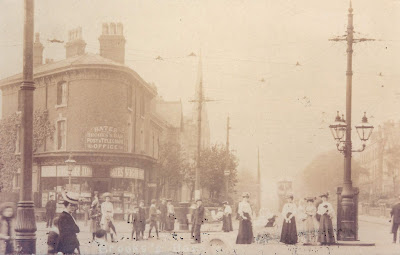
I can’t date it, but there may be a clue in the buildings stretching down Chorlton Road on the left-hand side.

On the corner there is that striking rounded building, which is still the today, and back then was the Post Office.

The name of the proprietor should offer up a time slot, and only requires me to go looking in the directories for the period.

Until then, I suspect it will be down to look very carefully at the other buildings and try and identify the presence of the Imperial Picture Theatre and Café which is now a timber warehouse.

The cinema opened in 1917, could seat 760 people and only closed in 1976.

By then the tall houses on the opposite side had been cleared away and trams no longer ran along Chorlton Road.

There will be someone who knows, leaving me just to ponder on whether this was a Sunday, given the lightness of the traffic and send you my history of the Imperial which has appeared on the blog before. *


And quick as a flash, John Anthony Hewitt, responded with the comment, "the number of full length skirts worn by the ladies, suggests pre-WW1 - post-war cost of materials had risen so much that ladies of the time switched to cheaper (shorter, less full) designs. 

The lady holding the umbrella is wearing a shorter skirt, whilst the boys are wearing knicker-bockers, which suggests Edwardian period. 

Three of the ladies in the road are holding a dog, a baby and long gloves. But, the mother with the pram was standing between the handles, and not behind the handle. 

Researching vintage photographs suggests that style of pram was late-Victorian to Edwardian, circa 1905. GMTS Website records electrification of the tramways as completed by 1903, but that Hulme to Chorlton-cum-Hardy was still served by horse buses in 1905. Princess Road tram depot opened in October 1909, but it is reasonable to assume that depot was built to relieve over-crowding at Hyde Road and Queens Road depots. Taken together, I would suggest a time-slot of between 1906 (earliest) and 1914 (latest)".

All of which just leave me to thank John Anthony.

Location; Brooks Bar

Picture; Books Bar, date unknown, courtesy of Steve.

*The Imperial Cinema, https://chorltonhistory.blogspot.com/search/label/The%20Imperial%20Cinema

Thursday, 5 January 2017

Catching the bus at Brooks's Bar in 1905


I am back at Brooks's Bar in about 1905.  

Now I can’t be exactly sure of the date but this horse drawn bus travelling the route from the Prince of Wales to Chorlton appears in other pictures in the collection where we do have a date.

It is in the livery of Manchester Corporation and soon after this picture was taken Manchester began using motor buses.* Inside sits a solitary passenger.

But what I am more drawn to is the section of Withington Road to the left of the photograph.  Today this section consists of a series of terraced houses set at right angles to the road, but in 1905 they were a stately line of impressive houses.

They were the homes of a tobacconist, greengrocer, photographer and commission agent and in the fullness of time I will track down Mrs Nellie Titley's tobacco shop  the green grocer's of Robert Burns and the address of the photographic business of J Ingham & Sons, all of whom may have taken our bus to work.

What however, really interests me it is  the hand cart up ended by the entrance to one of the houses.  It is not something you would see now and I wonder why it was there.

In 1905,  such hand carts were common.

Workman used them  as did the knife grinder and other tradesmen.  It is perhaps a sobering thought that before such a man could start work he first had to wheel the cart, tools and equipment to where he was working.

Location; Whalley Range, Manchester

*A Short History of Public Transport in Greater Manchester, http://www.gmts.co.uk/explore/history/history.html

Picture; from the Lloyd collection

Saturday, 23 May 2015

Lost images of Whalley Range part 10............ the Imperial at Brooks's Bar

There will be those who mutter darkly that the Imperial was not in Whalley Range, but I bet plenty of people will have crossed over the road and spent time there.

And as the smaller picture houses around Whalley Range closed this was an obvious local choice with that added attraction that if you were old enough there was the Whalley Hotel for afterwards.

Now I have written about the old Imperial Cinema at Brooks Bar a couple of times focusing on its history, its final closure and some fascinating pictures of the interior and given that it was always deemed to be superior to its near neighbour near the old Carriage Works it deserves to be included.

Of course some will have opted for the three picturehouses in Chorlton or made a night of it and headed into town but the local cinema like the local pub had its attractions.


Pictures; the Imperial in 1980, m09229, courtesy of Manchester Libraries, Information and Archives, Manchester City Council, http://images.manchester.gov.uk/index.php?session=pass and today from the collection of Andy Robertson, with a thank you to Imperial Timber 166-172 Chorlton Road Manchester M16 7WW‎ 0161 226 9190

*The Imperial Cinema, http://chorltonhistory.blogspot.co.uk/search/label/The%20Imperial%20Cinema

Tuesday, 9 September 2014

Celebrating Alexandra Park and remembering the Whalley Hotel.

Parks and pubs are pretty much places we take for granted.

I used to pass Alexandra Park regularly on the bus and when I varied the route swapped the trees and flowers for a view of the Whalley Hotel, neither of which sadly I regularly visited.

All of which is a great shame.

The park has been there since 1868 and has just had its makeover which has not been without a bit of controversy.

But back in 1868 there will have been those who muttered at the expense, the encroachment on open countryside and the size of the flowerbeds.

During those 146 years it has been a wonderful resource drawing in generations of people and it has also been the venue for everything from carnivals to demonstrations.

Its closeness to the city centre made it a good choice for protests meetings with marches which began in Manchester and ended in the park.

In 1902 upwards of 20,000 people marched to the park demonstrating against the Education bill, while six years later a large meeting in the park closed a weekend of activities calling for the extension of the vote.

Now I wasn’t around for either of those but I did march in a huge anti racist demonstration through the city sometime in the 1980s from Strangeways to Alex Park.

And at different times the park has also been the destination for Whit Walks, hosted Fun Days and just been somewhere to go on a summer’s day.

For some I suppose that morning stroll in the park might be followed by an afternoon in the Whalley Hotel which is not that far away.

It has for over a century and a bit been another of the landmarks of the area and there will be plenty with fond memories of the place.

From the days of the horse drawn bus to the Corporation tram it was one of those places you saw as you left Brooks Bar for Chorlton.

And in 1951 the departure of Whalley Summer as publican gave the Manchester City News one of those headlines you just don’t ever forget.

“Wally of the Whalley” Says Goodbye appeared in the Manchester City News for November 16th 1951 and featured Mr and Mrs Summer who had run the Whalley Hotel for four years.

Mr Wally Summer and his wife Ethel were leaving Manchester for Anglesey, where they were to take over the Anglesey Arms by the Menai Bridge.

“It's going to be a wrench leaving” he told the City News, “we’ve made hundreds of friends since we came to Brooks’ Bar.  I’ve been amazed at the number of people who have come up to wish us luck.”*

I rather wish I had been around to do the same, but given that I was only two at the time I shall content myself with the thought that there will be plenty of people with pictures and stories of nights in that pub and days in the park which would stand beside the tale  of Mr Wally Summer.

Now I am sure some of these will be covered by the Alexandra Park Heritage group who I am told have some fascinating archive material, and no doubt these will be matched by some equally fascinating material from the Whalley Hotel.

All of which just points to that simple observation that you should never take your park or pub for granted.

Pictures; Alexandra Park, 2013 from the collection of Andrew Simpson, and the Whalley Hotel late 19th century from the Lloyd Collection

*Manchester City News November 16, 1951

Coming next; the Park during its make over courtesy of Andy Robertson