Showing posts with label The GreyHound. Show all posts

Monday, 6 July 2026

A history of Chorlton in just 20 objects number one ...... a bridge across the Mersey 1816

Now this will be a short series featuring objects which tell a story of Chorlton in just a paragraph and is also a challenge for people to suggest some that are personal to their stories.

They are in no particular order, and have been selected purely at random.

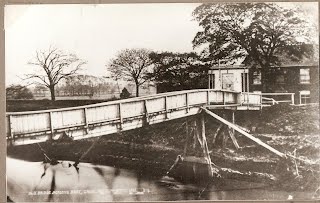
This was the first bridge across the Mersey on the edge of the township.  Samuel Wilton built it in 1816 at a cost of £200, but the ferry and the right to transport passengers across the Mersey were still in place in 1832 when the pub and the surrounding land were put up for sale.

At the time it was the landlord of the pub who benefited from the ferry charges.  The toll of a 1d to cross the bridge was abolished in the 1940s.

Picture; from the Lloyd collection 1865

Wednesday, 11 February 2026

Crossing the Mersey in 1955 to Jackson's Boat


Like many of Derrick A. Lea’s pictures of Chorlton this one was made in the winter.

We are at Jackson’s Boat, that pub across the river and the year is 1955.

Now I have written about Mr Lea already and I keep getting drawn back to his images of Chorlton which were made in the 1950s.

They work for me on a number of different levels.

At its simplest they remind me of the style of pictures I grew up with.

But it is also that you don’t see many drawings, paintings or wood cuts of the township, so these are particularly appealing.

“The pub was built in the 18th century and so might count as the oldest in the township.  It was known variously as the Old Greyhound and the Boat House, before reverting back to the old Greyhound.  Briefly it was called Jackson’s Boat and then the Greyhound from 1834. 

The names may in part be explained by the origins of the site.    At some point a farmer called Jackson farmed the land and kept a boat for ferrying passengers across the river. 

Later still Samuel Wilton built a bridge in 1816 over the river at this point at a cost of £200.  

But the ferry and the right to transport passengers across the Mersey were still in place in 1832 when the pub and the surrounding land were put up for sale. 

The advert throws some light on how the relationship between owner and tenant. The land and pub were owned by John Marsland and tenanted by a George Brownhill who seems to have benefited from the ferry charges.  

The sale in 1832 went to Edmund Howarth who may well have placed Samuel in as tenant.”*

All of which may seem a long way from the picture, but not so.  In 1955 the bridge was free to walk across, but until the late 1940s there had been a toll, which had been there since Sam Wilton’s old bridge in 1816 and was just a continuation of the fee charged to cross the river by the ferry.

The gate was on the south side of the bridge and there are those who can just remember paying the penny to cross over, and one wonderful story of a young girl who chose to chance her luck and crossed by a more dangerous and unconventional way.

She lived in the Block which was a collection of cottages on Hardy Lane, and this seemed a quicker and cheaper alternative to a long walk or the penny payment.

Picture; Derrick A. Lea


Location; Chorlton

*The Story of Chorlton-cum-Hardy, Andrew Simpson 2012, https://chorltonhistory.blogspot.com/search/label/A%20new%20book%20for%20Chorlton

Friday, 2 May 2025

Mrs Cordingley at Jackson’s Boat up in front of the magistrates for “selling beer during prohibited hours” in June 1876

The old bridge and pub, 1881
Now I wonder how Mrs Cordingley felt after the magistrates threw out an alleged breach of the Licensing Act.

It was June 1876 and she had been called up in front of the bench for “selling beer during prohibited hours.”

For any publican this was a serious affair but I suspect a potentially devastating one for  Mrs Cordingley who had been running the pub across the river  with her husband Joseph since at least 1861 and maybe as early as 1857 and with his death would still be pulling pints until she died in 1902.

She had fallen victim to the Sunday Trade out from Manchester.

It was a popular enough event and involved a trip out from the city which on a pleasant summers day was just 3½ miles  out along country lanes with the reward of a pint or two  at the end.

The Manchester Courier, 1872
Some were families escaping for a few hours from those dismal narrow streets and closed courts hedged in by mills timber yards and iron works.

A few like Richard Buxton were out botanizing.**  These were self taught working class men who in the case of Richard Buxton were cataloguing the plant life and would in time produce the definitive book still referred to by many today.

But then there were those less interested in the pleasures of rural Chorlton and more simply for the opportunity to down as pints as possible.

They arrived in ones and twos and sometimes in gangs and could threaten our community with anti social behaviour, vandalism and petty crime.**

So I can understand Mrs Cordingley’s concerns, only a decade and a bit before she settled in the pub large gangs of men were known to assemble in the meadows up by Barlow Farm to watch illegal prize fighting.

The pub, 1881
The attractions were of course the remoteness of the site and this in itself put the Bridge Inn out on a limb which was made worse when Sam Wilton who ran the pub in 1818 built a bridge across the Mersey.

Mrs Cordingley had replaced it in the 1880s and like her predecessor charged a small fee to cross over.

Now the pub dates from the 18th century and for most its history went under the name of the Greyhound or the Bridge Inn.  In the 1840s it was run by Samuel Nixon who described himself as a farmer and whose son ran the Traveller’s Rest on Beech Road.

Old Sam Nixon died in 1857 and this may be when the Cordingley’s took over.

And the story has a happy ending for she was found not guilty and the two chaps who tried to falsely gain a drink were themselves fined 5shillings each.

Strictly speaking neither of them were part of the Sunday Trade, for one was from Chorlton and the other was from Stretford.

Of these James Harris of Chorlton is known to us.  He lived on Beech Road was a painter with a family and more on him later.

Pictures, newspaper account from The Manchester Courier, June 21 1876, courtesy of Brian Robertson, and picture of the pub and bridge  circa 1881 from the Lloyd Collection


*"over the Mersey at Jackson’s Boat and on to Baguley Moor and Hale Moss and after having botanized there ....returned to Manchester at dusk, all pleased with our day’s excursion” Richard Buxton in Chorlton, http://chorltonhistory.blogspot.co.uk/2014/10/over-mersey-at-jacksons-boat-and-on-to.html


**A drunken jolly out from Manchester and stone throwing at Stretford........ petty crime in a rural community
http://chorltonhistory.blogspot.co.uk/search/label/Chorlton%20and%20crime

Sunday, 10 July 2022

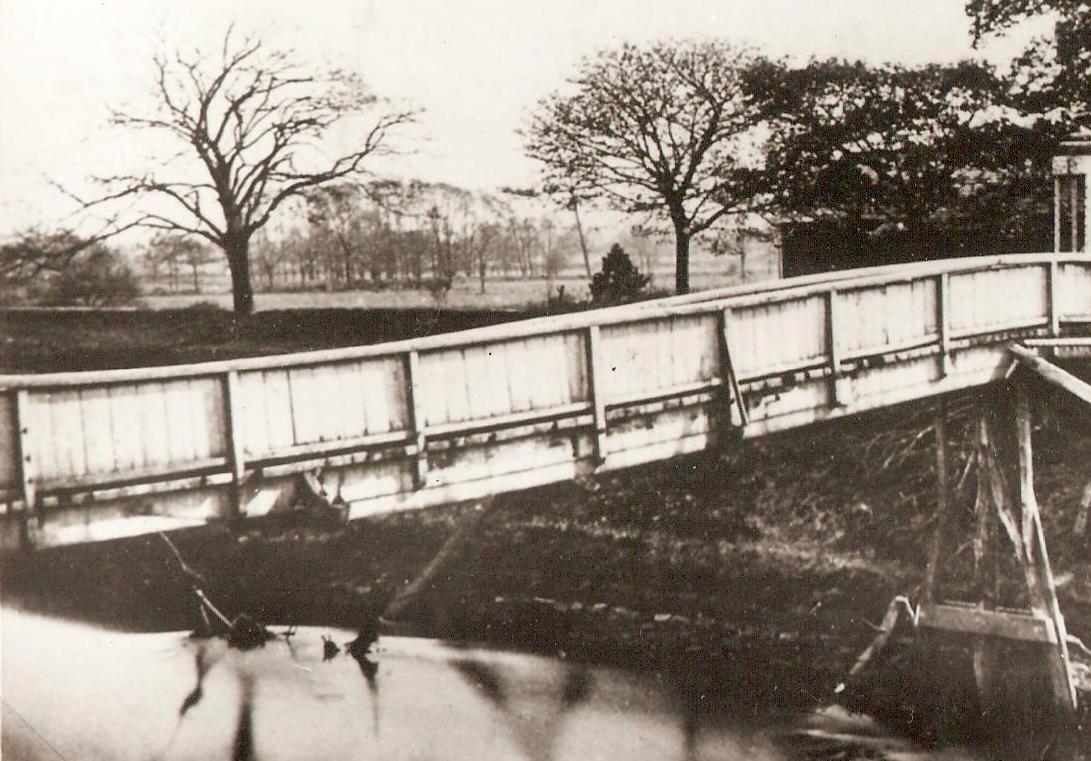
The not so safe bridge over the Mersey circa 1865


The old bridge 1865
This is one of the oldest pictures in the collection and dates from 1865.

We are on the bank of the river Mersey and just beyond the bridge is the pub.

“The pub was built in the 18th century and so might count as the oldest in the township.  It was known variously as the Old Greyhound and the Boat House, before reverting back to the old Greyhound.  Briefly it was called Jackson’s Boat and then the Greyhound from 1834.

The names may in part be explained by the origins of the site.    At some point a farmer called Jackson farmed the land and kept a boat for ferrying passengers across the river.


The pub sometime after 1881
Later still Samuel Wilton built a bridge in 1816 over the river at this point at a cost of £200.  

But the ferry and the right to transport passengers across the Mersey were still in place in 1832 when the pub and the surrounding land were put up for sale.

The advert throws some light on how the relationship between owner and tenant. The land and pub were owned by John Marsland and tenanted by a George Brownhill who seems to have benefited from the ferry charges.  The sale in 1832 went to Edmund Howarth who may well have placed Samuel in as tenant.”*

The old bridge and the missing central support 1865
And so back to the bridge which by 1865 was in a pretty poor state.

The central section had been swept away and judging by the way it slops down in the middle could not have made travellers feel particularly safe.

It did however survive until 1881, although the loss of the support on the Chorlton side a year earlier made a new bridge a necessity.

This was opened on October 14th 1881 which was all to the good given that the old one was washed away a few hours earlier.

But the new one like the old one had a secure door at the southern end which the landlord would open only after having been paid the toll.

Pictures; from the Lloyd collection

*THE STORY OF CHORLTON-CUM-HARDY 

Saturday, 30 March 2013

The pub beyond the river, a ferry and a bridge


Hardy Lane circa 1912
On a warm summer’s evening a walk across the meadows to the Mersey and the pub beyond the river is one of those pleasant things to do.

Although walking back in the dark can be an adventure and one which more than once has left at least one of us down the ditch at the side of the lane.

And I guess it was ever such because the pub has been serving beer from the beginning of the 19th century and most probably before that.

The small community which lived in Hardy and those from the village who fancied a walk out with a drink at the end of it will no doubt have known it well.

But any one drinking there before 1816 would have had to rely on the ferry across the river until Samuel Wilton built his bridge.  Now Sam Wilton was canny and maintained the toll once charged by the ferry man and to ensure he got his money he added a stout door on the southern end hard by the pub.

The old bridge in 1865,  built in 1816
Nor was this charge dropped when the new bridge was erected in 1881 so while the door became an iron gate the toll remained and did so until well in to the late 1940s.

But I suspect the sale of beer was always secondary, and the prime money spinner for the tenant landlord was the land along with the crossing charge.

So Samuel Nixon who was there in the 1840s and 50 described himself as a farmer and according to the tithe schedule of 1845 tended nine acres of orchard and meadow land.

Now nine acres put him amongst the 60% of market gardeners in the township who farmed between one and nine acres of land growing the crops the city wanted to eat.


The old bridge and toll door, 1865
Of course like a handful of others he had diversified into other occupations as well as farming.  In his case this was  the crossing toll and the sale of beer.


I don’t know when Samuel Nixon took over the pub but it may have been when the place was sold in 1832.

He may even have seen the advert which led to Edmund Howarth buying the land, the buildings and of course the right to charge that toll.

It is a fascinating piece of history and well worth reproducing.

“By Mr. Nathaniel Pass, by order of the trustees named by the will of James Marsland, deceased at the house of Mr. George Brownhill, known by the name of Jackson’s Boat in Chorlton-with-Hardy, in the county of Lancaster, on Monday the 5th day of March, 1832, at five o’clock in the evening subject to conditions to be then produced.

The land around Jackson's Bridge 1841-53

The Inheritance in Fee-Simple or and in all that long established  and well accustomed Public-House, known by the name of Jackson’s Boat, aforesaid, with the outbuildings, garden, orchard, and several closes of Land thereto belongings, called the Bank, the Nearer Ford Mouth, Further Ford Mouth, and the Further Field, situto in Chorlton-with-Hardy aforesaid, but lying on the southerly or Cheshire side of the River Mersey, and containing together with the site of the said buildings, by recent admeasurement, 5a.2q. 16p of land, of the Lancashire measurement, or thereabouts.  

Together with the Ferry thereto belonging, and the right and priviledge of carrying passengers over the river Mersey, in the occupation of the said George Brownhill, as tenant.

And also all that Field or Parcel of LAND, called the Boat Field, situate in Sale in the county of Cheshire, containing 3a 0q. 14p. Of land, of the measure aforesaid, or thereabouts, in the occupation of John Marsland, and adjoining the land before mentioned.

The house and land in Chorlton-with-Hardy will be sold subject to an annuity of £26. 13s. 8d., payable during the life of a widow lady, aged 46 in April next.  The buildings are in excellent repair, and the land is of the first rate quality.
The pub circa 1881

The tenant of the public house will shew the premisises; and for further particulars apply to Mr. Marsland, or Mr. Samuel Alderley, of Sale; or to Meesrs. PASS and Shelmerdine, Althrincham.”**

Manchester Guardian February 18, 1832

At the time the pub was called Jackson’s Boat but it had during the early 19th century other names, including the Old Greyhound and the Boat House, before reverting back to the old Greyhound.  Sometime around 1832 it became Jackson’s Boat and then the Greyhound from 1834.

Just another of those wonderful ways history has of surprising you.

*The not so safe bridge over the Mersey circa 1865, http://chorltonhistory.blogspot.co.uk/2013/03/the-not-so-safe-bridge-over-mersey.html


**Manchester Guardian February 18, 1832

Pictures; from the Lloyd Collection and map of the land around Jackson's Bridge, courtesy of Digital Archives, http://www.digitalarchives.co.uk/