Friday, 15 May 2015

Uncovering the records of those in care in the 19th century ........ from the Together Trust

Now many of us tracking down a family member, who went into care or was sent abroad often stumble at the first hurdle.

Even if you can locate the official records it can be difficult to access them and in many cases the file was either destroyed or worse just lost.

All of which makes the latest post from the Together Trust so interesting because it focuses on those very reports and unlike those of my great uncle who was sent over to Canada in 1914 they still exist*.

The blog only published one but it is a revealing document and is far more detailed than the simple one line entry on my great uncle.

I had never seen one of these before and I suspect anyone who also has encountered the problem of discovering why their relative went into care will find the post fascinating.

It records that the father "is a drunken idle scamp, has been prison for neglect of children.” and that there was no one else to care of the child.

"Consequently two children were in Dr. Barnardo’s Homes, four had been adopted by individuals in varying locations and the sixth, a 5 year old girl, had ended up in Tetlow Grove Home, owned by the Manchester Refuges."*

It does make for easy reading but it is an insight into the problems faced my some young people.

And it offers up far more than the one line entry on my great uncle, and his siblings which just simply stated "mother unfit to have control."

Now as painful as that is I wish I had more on my great uncle and hsis brothers and sisters one of whom was grandfather.


The Together Trust was the Manchester and Salford Boys’ and Girls’ Refuges’ began helping young neglected and destitute children in 1870 and their archives are extensive and their archivist most helpful.**

So I shall just leave you with the link.

Picture; courtesy of the Together Trust

*Separation in the nineteenth century, from Getting down and dusty, http://togethertrustarchive.blogspot.co.uk/

Thursday, 14 May 2015

Walking four hundred years of Chorlton's history

Just over four hundred years ago the Mosley family finished their grand new family home at Hough End Hall.

And to celebrate that event along with the launch of  Hough End Hall The Story* which is the first serious book on the hall and the people who lived and worked there you are invited to walk a bit of our history.

In 1596 the Mosley’s could look out west across open land to Barlow Moor Lane and if they were minded ride over to the small chapel by Chorlton Green.

Of course in the four centuries since then the place has changed but until relatively recently much of what was familiar to old Sir Nicholas Mosley was still pretty much the same.

In the summer of 1848 the Brook still meandered on its lazy course out towards the Mersey helping supply the needs of the small community that lived around St Clements church and the majority of the people in the township continued to earn their living from farming.

By then the Hall had become home to the Lomas family who farmed over 200 acres and employed ten agricultural labourers.  Many of these are known to us by name and most lived with the family.

Of the ten living there in 1841 six were 15 or younger, another three were twenty and only Michael Rustage was in his mid 30s.

All of them would have been familiar with the route we shall take which will start at the hall and move on through Chorlton Park and Barlow Moor Road, down Beech Road and then by degree north to Manchester Road, Ash Tree Cottage and the old finger post ending at the Lloyds Hotel.

Along the way we will learn about who lived here what they did above all who in that summer of 1848 we would have to be polite to.

And my old friend David Bishop has agreed to join us.

David is a botanist and he will talk about the plant life we might have encountered back then and will reveal at least one surprise flower which may have once been grown by Sarah Sutton who lived in a wattle and daub cottage on Beech Road in the 1850s.

Having started at the Hall in 1596 we will finish at the Lloyd’s Hotel built in 1870 and a fine place to reflect on those 400 years and to view the exhibition on its history and the campaign to buy the building and transform it into a place for the community to use.

So that is pretty much it.

The events are part of Chorlton Arts Festival and there will be two walks, the first on Sunday May 17 and the second on May 24 and both start at 1pm and both  are free

Nor is that all because for those that want a tad more history you are also invited to the book launch of Hough End Hall The Story which will be at the Lloyds on Saturday May 16 starting at 7.30, where you can meet the authors, buy a signed copy of the book and enjoy a performance of the music and songs familiar to our farm labourers in the 1840s.

Pictures; Chorlton Park in 2009 from the collection of Andrew Simpson, cover of the book, Hough End Hall The Story


*Hough End Hall .......... the book.......... coming soonhttp://chorltonhistory.blogspot.co.uk/2015/01/hough-end-hall-book-coming-soon.html

Wednesday, 13 May 2015

A story coming out of the shadows ........... Looking at the story of the British Home Child from the other side of the Atlantic

Leaving for Canada, on the steps of Manchester Town Hall, 1897
I count myself as one of the new boys on the block when it comes to British Home Children.

These were those children who from the 1870s through into the 20th century were migrated first to Canada and then later to Australia, New Zealand and other parts of the former British Empire.

It is still a subject not well known about in Britain and even less well understood and just getting information about a relative who made that journey can be difficult.

Now as many of these young people were settled in Canada it is there that much of the work has been done, after all one estimate suggests that perhaps 10% of Canadians are descended from a British Home Child.

And it is a subject which I have become very interested in since I discovered my great uncle made the journey in the May of 1914.

His story and much more has been the subject of a large number of posts on the blog over the years.*

Now there were a large number of charities along with some individuals involved in the migration of young people.

My own uncle was sent by the Derby Guardians in the care of the Middlemore Charity and sadly  the official paperwork has all but been lost.

In Canada, 1907
Happily the archives of the Manchester & Salford Boys’ and Girls’ Refuges which began sending young people across the Atlantic in 1870 but stopped at the start of the Great War are intact.**

Today the charity is known as the Together Trust.

It has an archivist who is very helpful and a blog which is a fascinating insight into the care of those in its charge.***

Until 2007 I knew nothing of the programme to send children from Britain to Canada, and the story of the British Home Children  has moved from what was essentially a quest by individuals trying to make sense of their own family history into a serious area of study.

It began with a few lone pioneers inspired by their own experiences, moved up a notch with the formation of self help groups who shared their skills and knowledge, and took a huge leap forward with the use of social media.

At the Post Office, Beaver Rapids, 1907
Today that growing interest is reflected in a host of events across the country, and regular stories in the media.

At the heart of all this are those self help groups many of which are on facebook and others with a dedicated site.  What they have in common is a desire to bring the story out of the shadows.

And as more research is done some of the earlier interpretations are being challenged which can be quite uncomfortable but this now marks BHC out as a serious area of study.

All of which is not bad for a story which until comparatively recently sat in the shadows.

Pictures; courtesy of the Together Trust

*British Home Children, http://chorltonhistory.blogspot.co.uk/search/label/British%20Home%20Children

** Manchester & Salford Boys’ and Girls’ Refuges, http://chorltonhistory.blogspot.co.uk/search/label/Manchester%20and%20Salford%20Boys%20and%20Girls%20Refuges

***Getting down and dusty, http://togethertrustarchive.blogspot.co.uk/


Tuesday, 12 May 2015

One hundred years of one house in Chorlton part 58 ............ waiting for the film crew and thinking of a breakfast cereal

Planning a makeover, 1938
The continuing story of the house Joe and Mary Ann Scott lived in for over 50 years and the families that have lived here since.*

I wonder what Joe and Mary Ann would have made of the letter that fell through the door last week from a film company showing interest in featuring the house in a television drama.

It appeared that “from the exterior your house looks as it may be suitable for one of our characters,” but alas it was not to be.

It would have been the first time the house featured in a film although we came close when a scene from Looking For Eric was shot in the Rec.

Had the actors moved a little further east we could have forever been part of Eric but such are the choices of location editors

Planning a makeover, 1938
Not that I think Joe and Mary Ann would have worried about that loss of fame.

Back then Chorlton  was a pleasant and quiet place which had grown quickly in the last two decades of the 19th century but there after had settled down and was perhaps most famous as the butt of comedians from the south who were always guaranteed a cheap laugh when referring to Chorlton-cum-Hardy in a poor northern accent.

That said there have always been gentler and even affectionate references.

According to my new friend Bevan who was born in 1926 whenever the D’Oyly Carte Opera Company came to Manchester they often contrived to insert Chorlton-cum-Hardy in to the chorus of one of the most popular Gilbert and Sullivan songs.

And in 1967 Flanders and Swann in that elegant and sad comment on the closing of so many passenger railway lines sang “No churns, no porter, no cat on a seat,
At Chorlton-cum-Hardy or Chester-le-Street”**

For those with a keen sense of history there are quite a few other moments when the media have shone their light on Chorlton from cruel murders, to sporting events and of course  the Great Burial Scandal.***

Birds Eye, 1956
But until now Joe and Mary Anne’s house remained off limits leaving them to get on with everyday life.

And so I will conclude with a little bit of our recent history that I am confident they were involved in.

It may not seem much when compared with a TV drama  but the growing reliance on frozen and convenience meals was one that Mary Ann will have embraced and in its way was equally dramatic.

In the 1950s the growing reliance of frozen food would lift some of the drudgery out of preparing food.

Now I still like washing carrots, peeling potatoes and shelling peas but for sheer speed nothing beats opening the packet of frozen peas.

And sixty years ago the adverts for frozen foods focused on that simple message that they were quick to use and because of the way they had been frozen on the day they were harvested were bound to be fresher than the peas and carrots which had made their way from the field via the market to the small greengrocer, whose turn over dictated that the produce might sit for days before it was bought.

Birds Eye, 1956
Of course few people in 1956 had a fridge let along a freezer which was why the bags of frozen vegetables came in small sizes which were bought and used on the same day.

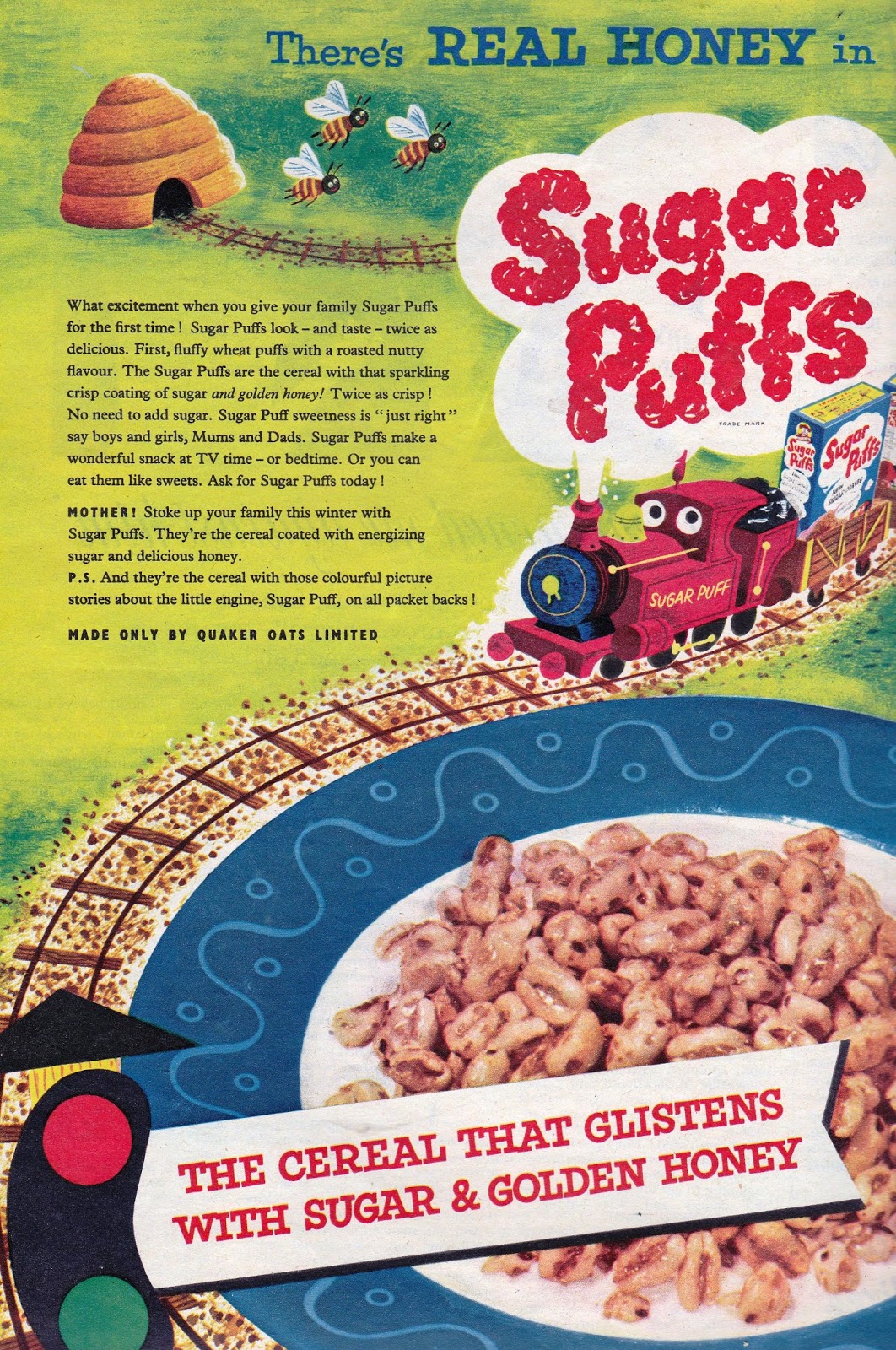
And in much the same way out went the old fashioned breakfast of porridge, eggs, bacon and toast in favour of the breakfast cereal.

Now these had been around since the 1930s, and there are ads in the collection for Corn Flakes and Rice Crispies, but the 50s offered up a new and exciting range, often marketed with a toy or other novelty and clearly aimed at the young.

Sugar Puffs, 1956
Of course I have no way of knowing if Joe and Mary Ann embraced all these changes but some at least will have found their way onto the table and perhaps even onto a tray to be eaten in front of the television awaiting the film of the week.

Mother was quick off the mark to try the "new TV dinners  for one" which came out in the late 50s but equally died a death in our house as too expensive and not that nice.

Instead we reverted to simpler home cooked  food that we ate in front of that television which is where we came in.


Pictures; interior designs, from Ideas From Our Experts, My Home, July 1938, and adverts for Birds Eye Foods and Sugar Puffs, from Woman’s Own, January 12 1956

*The story of a house,
http://chorltonhistory.blogspot.co.uk/search/label/The%20story%20of%20a%20house

**The Slow Train, Flanders and Swann, https://www.youtube.com/watch?v=U6OHD2uCpfU

***The Great Burial Scandal, http://chorltonhistory.blogspot.co.uk/2015/04/the-great-burial-scandal.html

The things they bought in the Great War .............. on display in Southern Cemetery

I am looking at a collection of souvenirs from the Great War, and what makes them fascinating is that they are the everyday objects which would have graced the sideboard or sat on the mantelpiece.

And given that they were made of porcelain it is a wonder that they have survived intact.

A century ago they would have been bought in their thousands, as keepsakes and presents.

But some would have been made to mark a specific event in the course of the war, and so it is with the ship in the picture which is a replica of the Lusitania which was sunk by enemy action on May 7 1915.*

Until recently I had no idea that such things had been made or that people bought them.

They don’t appear in the history books and I can’t remember seeing them in museums.  Of course they will be familiar to some people but not to me.

And they are a powerful connection with that war and the people who lived through it.  For unlike many of the things which have made their way into museums these represent the everyday choices of individuals who expressed their supprt for the war by buying the items.

These particular examples are from the collection of David Harrop and can be seen in the Remembrance Lodge at Southern Cemetery which contain many other very ordinary everyday bits and pieces but which say so much about how people coped with the conflict.

Pictures; porcelain tank, replica of the Lusitania, cup and medal from the collection of David Harrop


*On this day a century ago ........ the sinking of the Lusitania and the dark arts of propaganda, http://chorltonhistory.blogspot.co.uk/2015/05/on-this-day-century-ago-sinking-of.html

Monday, 11 May 2015

Bidding farewell to a clockwork Nokia

The future as seen in 1951
Now I went looking in my collection of Eagle comics today for an image of Dan Dare Pilot of the Future using a hand held communicator which was usually featured as a watch you could talk into.

I could of course have used one of the shots from Star Trek but the franchise quite rightly is very protective about its copyright and any way Dan Dare was a round in the 1950s when the idea of such devices was still reckoned to be either daft or so far into the future as to dismissed.

All of which is a lead into the fact that I have now become the owner of a smart phone.

For years I clung to my old clockwork Nokia and even had a flirtation with the ancient Nokia 3310 but in my heart of hearts I knew the future lay with something bright and new which would connect to the internet, let me wander across social networks and of course let me make a phone call.

To be fair my last Nokia would allow internet access but it seemed more effort to use it and it confused me.

So I stuck with a phone which just bounced if you dropped it, had a battery which lasted all day and played Snake.

A little bit of my future, 2015
But even dinosaur mobiles do not perform well after being through the washing machine on a 45 minute wash.

The bag of rice, and the gentle warm rays of an April day did nothing to bring it back to life and so I have joined Dan Dare, Captain Kirk and pretty much everyone on the planet and can now communicate in several different ways almost at the same time.

That said it remains a painful learning curve and one which continues to impress on me that I may not be that smart to operate a smart phone.

A sad fact illustrated by my discovery that having registered the sim I should turn the phone off and on again to become linked to my provider.  This I discovered only after a day of waiting.

And the point of the story?

Well I suppose it is that simple one that all technologies and message systems have their day.  I no longer listen to the wireless, await news delivered by the telegram and can only just remember a TV which had just two channels which changed by operating a dial on the set and offered no colour.

Pictures; detail from the Red Moon Mystery, Eagle Comic, October 5, 1951, Vol 2 Nu 26, and the Nokia Luminia 635 from the collection of Andrew Simpson

Sunday, 10 May 2015

A fine new history blog

Now I always enjoy reading new blogs and I was pleased to see my friend Debbie has begun writing about the past.*

The first focuses on The Birkenhead Case – Wright Robinson and Conscientious Objectors.**

“The case concerned two trade unionists from Liverpool – Charles Dukes and George Beardsworth – who wanted exemption from conscription because of their strongly held, moral beliefs.

They wanted this to be recognised as grounds for exemption similar to that granted to men who had deeply held religious objections to fighting.”**

And that is I am going to say and suggest you follow the link, read the story and wait for the next one.

Picture; from The Birkenhead Case – Wright Robinson and Conscientious Objectors, Debbie Cameron


**The Birkenhead Case – Wright Robinson and Conscientious Objectors, http://historicalclues.blogspot.co.uk/2015/05/this-is-my-original-research-that-was.html?spref=fb