Thursday, 25 March 2021

In memory of the Four Banks and Bank Corner

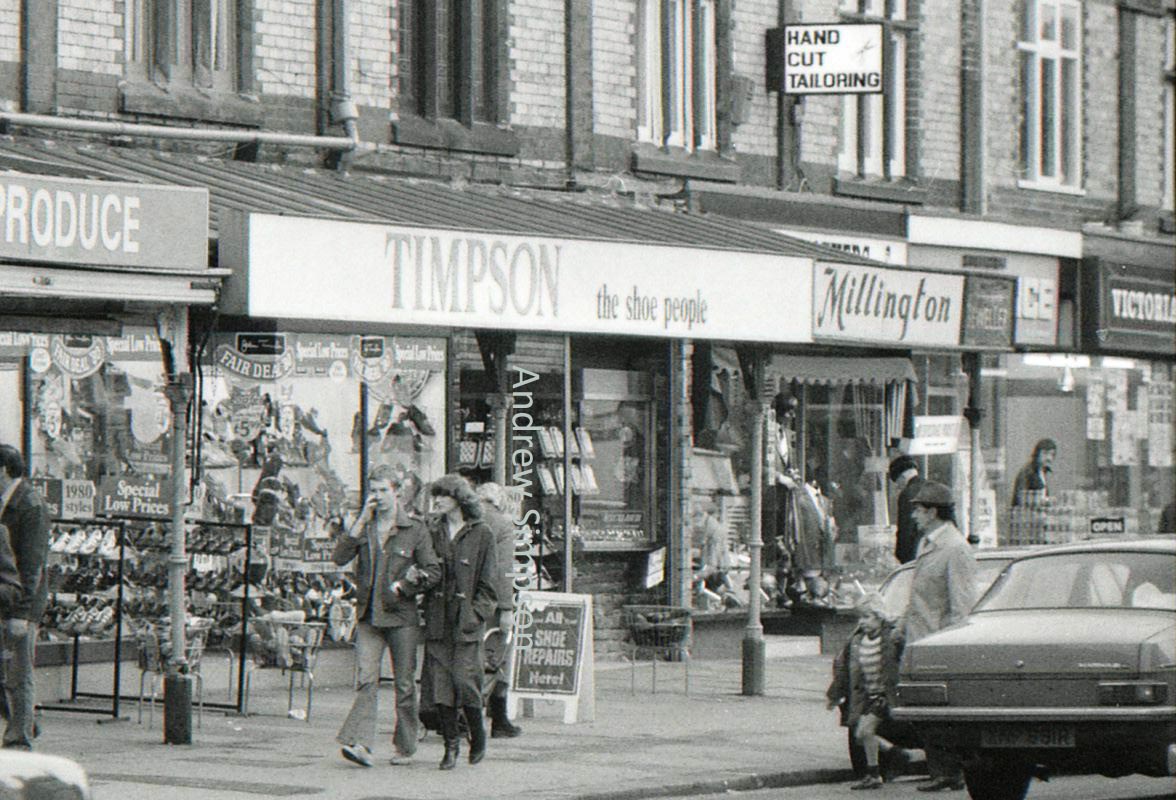
 I can’t be exactly sure of the date of the picture, but I know it must be sometime around the late 1990s.


Now I can be pretty sure of that because what was the National Provincial Building Society with its distinctive yellow lettering on a green background became the Abbey Building Society in 1996 which in turn became part of the Santander Group thirteen years later.


Added to which the Midland Bank which had moved into its present building in 1978, adopted the HSBC logo in 1997, having been acquired by The Hongkong and Shanghai Banking Corporation in 1992.

Those who want will look carefully through the picture and identify other lost shops and offer up stories.

What I like about the image is that in some ways it looks more dated than one of those black and white photographs from the 1900s which we know show a very different Chorlton.

But this one is close enough to us today to look very familiar ……. But just not quite.

And for those about to mutter about the name, Four Banks, our building societies had begun to become banks in 1989, and so by the time this picture was taken there were indeed four banks on each corner, hence the accurate title, which harps back to references from the late 19th century on picture postcards when people referred to the spot as “Bank Square”.

That said, as many will know the corner of Barlow Moor Road and Wilbraham Road, now occupied by the HSBC was popularly known as “Kemps Corner”, after Harry Kemp’s chemist which stood there.

As so often happens, remained the accepted name for the corner well into the 1960s, long after it ceased being a chemist.

All of which points to that simple observation that names for locations arise from popular usage, which I suspect will mean that the official name for the junction which is Chorlton Cross, will never catch on.

Location; Chorlton


Picture; Barlow Moor and Wilbraham Roads, circa 1995, courtesy of Steve

Wednesday, 24 March 2021

TESTIMONIALS ..... HASLAM'S REFERENCE .... another story from Tony Goulding

Inspired by a recent post extolling the merit of old testimonials in historical research I delved into my own family archives – I was not disappointed. 

Miss Mary Clarke, 1947

The above reference was given to my mother in August, 1947. It symbolises, a time when “Cotton was King” in this city all be it an increasingly frail and aged one about to be dethroned. (1)

 Haslams was a firm of cotton spinners and manufacturers with its origins in Bolton, Lancashire based at Halliwell Cotton Works, Lark Hill. 

The company began as a warehouse for local hand loom weavers set up in Bolton by the first John Haslam in 1816 as the cotton industry expanded with the Industrial Revolution so did Haslams. 

The company remained family run for over a century with first John’s son, also called John and then his grandson William becoming its chairman. William died in Bolton, Lancashire in the March quarter of 1917 and shortly after that, in 1920, Haslams was merged with other cotton manufacturers to form The Amalgamated Cotton Mills Trust. 

For a time there remained a connection with the Haslam family as William’s younger brother, Lewis continued as a director until his death on 11th September, 1922. It is also likely that at least one of William’s sons, the youngest William Heywood was a one-time director.

Lewis Haslam, 1911

Lewis Haslam was a very wealthy man. 

He was the holder of various permits both collectively with Cornelious Mashall (for a number of improvements in textile manufacturing processes) and individually (for Aertex, a lightweight cotton fabric used in the production of shirts and under garments).

 In public life he was a J.P. for Lancashire and stood as a candidate for the Liberal Party in a number of constituencies before getting elected in 1906 at Monmouth Boroughs, which he represented until 1918. He then stood in and was returned for Newport, being their M.P. until his death. At his death he was resident at 8, Wilton Crescent, Belgrave Square, London and left an estate of £521, 454-7s -1d. (£30, 302, 000 at today’s value).

As shown by company’s letterhead in 1947 they had also branched out into manufacturing rayon goods, with their head office at 28, Quay Street, Manchester 3. Their address for telegrams, “Squirrels”, is intriguing and for the moment remains a complete mystery.

 My mother left Haslams employ in order to take up a posting with the Womens Land Army (2); a body of women volunteers to work in agriculture to replace male workers serving in the armed forces. The continuing need of this force throughout 1947 and 1948 is indicative of the perilous state of the British economy during the immediate post-war years. 

Despite the end of hostilities, the huge cost of fighting the war meant the government was desperate to maximise home-grown food production as a way of reducing the cost of imports. The severe winter of 1946/7 only served to exacerbate the problems the country faced.

My mother was posted to a farm just outside Preston, Lancashire and remained working as a “Land Girl” until the 23rd October, 1948 when she left to marry my father. Here is a copy of her termination letter.

The Land Army discharge, 1948

 Pictures: Lewis Haslam portrait, 1911 by Sir Benjamin Stone in public domain, http://www.npg.org.uk/collections/search/portraitLarge/mw118735/Lewis-Haslam, others, from the collection of Tony Goulding.

Notes

1) The peak year for the production of cotton in the U.K. mostly, though not exclusively in Lancashire was 1912 when eight billion yards were produced. At that time, it was Lancashire’s proud boast that it clothed Britain before breakfast and the rest of the day was spent clothing the world. The disruption to trade as a result of the Great War provided a catalyst for the rapid growth of the embryonic textile industries of the Far East particularly in Japan which by the mid-1930's had become the world’s leading cotton manufacturing nation. The impact of the boycott of imported cotton in favour of home-spun cloth by the Gandhi inspired Indian independence movement also had a detrimental effect on the Lancashire mills. There was a short-term revival of the industry during World War Two when production was refocused on war materials, especially parachutes only for the industry to further decline in the 1950’s decade.

2) The Womens Land Army was raised in June, 1939 reviving a similar organisation of the final 2 years of the First World War. At its peak, in 1943, 80,000 women were serving as “Land Girls”. As demobilisation progressed, less women were needed to work the land and the service was finally disbanded in 1950.


The lost pubs of Salford ............. 1872

Now one of the things that happen so often in researching old newspapers is you get side tracked.

And so yesterday while continuing to trawl the papers for references to Salford’s children’s charity I happened on this little piece of pub history.*


Now I could begin a search for each but that would draw me away from the work of uncovering the history of the Refuge for the new book, so I won’t.**

Instead I will leave it to others to rummage through their collection of pub books or better still come up with memories of some of those listed in the report.

Location; Salford, 1872


Picture; from the Manchester Weekly Times, January 13 1872


*The Manchester & Salford Boys’ and Girls’ Refuges, https://chorltonhistory.blogspot.co.uk/search/label/Manchester%20and%20Salford%20Boys%20and%20Girls%20Refuges

**In the midst of plenty ........ two children sleeping rough “one under a Salford Railway arch and the other below an old staircase in a Deansgate entryhttps://chorltonhistory.blogspot.co.uk/2017/07/in-midst-of-plenty-two-children.html

The band, a demonstration, and a bit of a mystery

I know the name of the band, and am pretty sure we are in Manchester and the date will be sometime in the late 1970s into the ‘80s.

But more than that I am stumped.

They are the Cri De Coeur and given the Salford sign painted on the side of the flat top it will be a demonstration I was on sometime between 1978 and 84.

Now I can be fairly sure of the dates because that was the brief time I took and developed my own photographs.

That said many of those I took were never turned into prints and have sat almost forgotten in our cellar for forty years.

All of which explains why I am hazy about the venue and the date.

As you do I went searching for the group and turned up a short you tube clip from 1988 with the promising comment that they were a punk based band from Lincoln formed in 1986.

Now that doesn't fit with my time line.

By 1984 I had pretty much given up the darkroom with the birth of our first son swapping evenings with smelly chemicals and an enlarger for Thomas the Tank Engine and Lego.

Nor is the location much of a help.  The brick building is tantalisingly familiar, but all the possible venues for where I might have been just don’t match the picture.

I hoped the strip of negatives might help but they don't.

Long ago they got transposed with others which make it almost impossible to check back.

Still someone will know, either because they recognise the site, followed the band or remember the demonstration.

And quick as a flash some has located the spot.

According to Ted it is the site of the old Mabel Tylecote Building on the corner of Oxford Road and Cavendish Street.

I thought we were down in All Saints, and in the original draft said so, but I couldn’t match my pictures with the site today, but that was because I had placed myself round the corner on Higher Ormond Street.

Location; Manchester

Picture; a band, a demonstration and a mystery, circa 1979, from the collection of Andrew Simpson

“We will always have Paris” ....... Part. 3 .... alone on the Avenue des Champs-Élysées

It must have been a quiet day on the Avenue des Champs-Élysées because apart from a lone cyclist I seem to have had the road to myself.


I can’t now remember why, but I know on a return visit we were just about cleaned out of all our cash after purchasing a coffee and croissant each at a cafe facing the Arc de Triomphe.

Location; Paris

Picture; the Avenue des Champs-Élysées, 1980 from the collection of Andrew Simpson

Tuesday, 23 March 2021

Just how careless are we with Chorlton’s buildings?

I rather think we have become careless with our buildings.

The Lychgate and Bell Tower, 1978

It is a thought prompted by yesterday’s post on the absence of a list of old buildings in Didsbury.*

But it applies equally to Chorlton , and I guess almost everywhere.

We do still have a few examples of buildings dating back to the late 1700s, along with a few more from the early 19th century, and of course there are also Barlow Hall and Hough End Hall.

Although if I wanted to be pedantic, Hough End Hall was actually in Withington, and little that you see either inside or outside is original.

The majority of properties date from no later than the 1860s onwards and many were lost during the last century, these included a slew of fine mansions built for the comfortably off, and a collection of more humble homes dating from the 1820s and 30s, some of which may have been one up one down houses.

In the last decade and a bit we lost two houses on Beech Road which were built when we were still a small rural community, and in both cases we can track the residents back to the early 19th century.

And even the more humble farm houses and labourers cottages have histories which we can discover, even if they have vanished, like Higginbotham’s home on the green or Brownlow’s Cottages on Sandy Lane.

But their existence and their history will be known to the owners and a handful of interested people. 

Beech Road, with Mr. Clarke's smithy, circa 1880

Tracking the age of a house is not difficult, even if there are gaps in the historical narrative, and I have done a few, but the list is small.

In the case of Didsbury, I asked a few people, thought about trying the City Council Planning Department and emailed the Didsbury Civic Society, and then fell back on the two well known history books, which offered up a comprehensive list.

Here in Chorlton, we do have a few historians who have referenced old buildings, and of these Thomas Ellwood’s account written in 1886 is still valuable, not least because he offers up details of the homes of the farmers and labourer’s who occupied them in the early 19th century.

Sutton's Cottage, 1892

So that left me with Historic England, which has a database of “The most important historic places in England",  including “buildings, battlefields, monuments, parks, gardens and more”, and a visit to the site offered up results.**

But if I have this right, the list is of buildings which have been listed, and that requires someone to make an application, which is matched against the criteria, and a judgement is taken.***

At which point I hear people mumbling “so what?  All houses have something about them, and the logic would therefore dictate that every house in Chorlton should be on the list”.

And even if you apply the broad criteria used to consider an application there are problems. So, “to justify special historic interest a building must illustrate important aspects of the nation’s history and / or have closely substantiated historical associations with nationally important individuals, groups or events; and the building itself in its current form will afford a strong connection with the valued aspect of history, which is fine, but what constitutes an “important aspect of the Nation’s history”?***
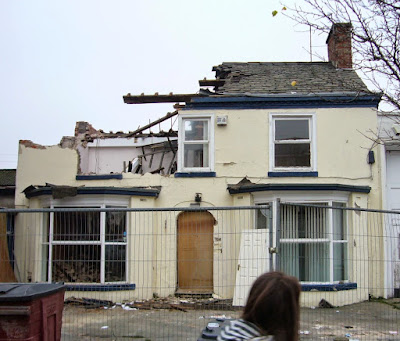
Row House, under demolition after two hundred years, 2008

A decade ago we might have thought a statute to someone involved in the slave trade was distasteful, but reflected part of our history.  

However, the recent continuing revaluation of how we view the slave trade, and who we should single out as worthy of positive recognition has changed.

And in the same way history books, historians and opinion makers have not always seen the importance of recording the contribution made to our collective story by the working class, by women or by ethnic groups.

That list in Historic England includes just six historic Chorlton buildings, so perhaps it’s time to bring more out of the shadows.*****

How of course is another question, but perhaps a database, open to all to contribute, which provides an address, and date, with if possible some more background information.

Who would set it up and how it would be maintained I leave hanging in the air, but it is possible, and would be fun.

Higginbotham's farm buildings, on the green, circa 1880s

And since posting the story Ruth suggested I explore Historic Environment Records, which is part of Historic England, and that is exactly what I have done.*****

The email was sent a few minutes ago and I shall await developments.

Pictures; Lychgate and Bell Tower, 1978, Beech Road, with Mr. Clarke’s smithy, circa 1880, from the Lloyd Collection,    Sutton’s Cottage from the Wesleyan Souvenir Handbook, 1907, courtesy of Philip Lloyd, Row House, Beech Road,  2008 from the collection of Lawrence Beedle & Higginbotham’s farm buildings, Chorlton Green, circa 1880, from the collection of Marjorie Holmes, St Clement's Church 1880 from the collection of Tony Walker

St Clement's Church, circa 1880

*Making that list of Didsbury’s houses ………, https://chorltonhistory.blogspot.com/2021/03/making-that-list-of-didsburys-houses.html

**Historic England, https://historicengland.org.uk/

***Principles of Selection For Listed Buildings, Department for Digital, Culture, Media and Sport, 2018, https://assets.publishing.service.gov.uk/government/uploads/system/uploads/attachment_data/file/757054/Revised_Principles_of_Selection_2018.pdf

****Chorlton War Memorial, Manchester Road, John Holland’s Wood, a picture, circa 1900-1903, Higginbotham’s Farm, Chorlton Green, The Lychgate and Bell Tower, Chorlton Green, the Former Temperance Billiard Hall, Manchester Road, Barlow Hall, St Clement’s Church, Edge Lane, Hough End Hall, The Lloyds Hotel, Wilbraham Road, Listed Buildings, Chorlton, Historic England, https://historicengland.org.uk/sitesearch?searchType=site&search=chorlton

The Priory ........ a campaign to save a row of trees .......... and that new book

Now here is a story with a contemporary ring.

St Peter's Priory 1895, from 7 Maple Avenue
In the April of 1897 more than a few residents of Chorlton were moved to write to the Manchester Guardian in defence of a row of trees which were in danger of being demolished.

One correspondent described the plan to cut them down as an “act of vandalism” while another argued that the loss of “the plantation of well grown trees which now graces the garden adjoining St Peter’s Priory” highlighted a trend where “Chorlton is growing so rapidly that green acres are disappearing almost under the pressure of bricks and mortar, and it seems more than a pity, nay almost a crime, to cut down a single tree unless absolutely imperative.”*

Oakley, 1894
The trees in question ran parallel to Barlow Moor Road in the garden of St Peter’s Priory, which had once been known as Oakley, and even earlier as Oak Bank, and had been built in the early 19th century as the home of William Morton, and later the Cope family.

Oak Bank was a substantial building standing in its own grounds, close to the modern junction of Barlow Moor and Wilbraham roads.

Nothing now exists of the house but the path leading to it is now Needham Avenue. The house was situated in a garden which covered the area running on either side of Needham Avenue as far as Barlow More Lane in one direction and Corkland Road in the other.

The Oakley gatepost, 2016
The estate also included a large meadow field and small wood stretching back from Needham along Barlow Moor Lane to Lane End.

William Morton had been there since 1821, but on his death his will stipulated that the house and land had to be sold within five years.

When this happened is not known, but in 1845 a Miss Crofton was there paying rent to the Executors of Mr Morton.

By 1847 the house and land were in the possession of Frederick Cope who rented both to John.  This was a short term arrangement and by 1850 the Cope family were living at Oak Bank.

William Morton had described himself as a member of the gentry.   Frederick Cope was a wine merchant.

Oakley gardens after development, 1907
And in 1892 the house became the Priory of St Peter, the “object of which was the conversion of England by means of outdoor lectures and sermons to non Catholics”.**

But its existence was short lived and four years later, “it was found impossible to carry out the terms of the contract with the vendor of the property, and the estate was sold".

This was only a temporary hiccup and a year later “the land and buildings known as Chorlton High School on High Lane were purchased”.**

All of which brings me back to those trees, because as ever, there was a developer waiting in the wings, and in the space of a few years, the Priory was demolished, the trees cut down and the garden was built over.

The stretch along Barlow Moor Road became Pemberton Arcade, with Needham and Priory Avenues behind, and Maple Avenue to the south.

Pemberton Arcade, Barlow Moor Road, 1982
The story of the “battle of the trees” is now well in the past, but as we know the issues of redevelopment and the loss of green bits is topical, as is the conflict between public and commercial use, which was also echoed back in 1897 by another “tree letter”.

Writing on the same day, J.G.J, argued that the Oakley site should be given over to a public school and free library “which are required badly”.

It never happened and Chorlton had to wait another decade to get the school and a temporary library.

But those are for other stories, leaving me just to point out that the full story of St Peter’s Priory along with the opening of the Catholic Church on High Lane is in our  book on the places of worship in Chorlton, which is an outrageous plug I know, but one I will pursue.

You can obtain your copy  from us at http://www.pubbooks.co.uk/ or Chorlton Book shop, 506 Wilbraham Road, Chorlton-cum-Hardy, Manchester M21 9AW 0161 881 6374

Pictures; St Peter’s Priory, circa 1895, from the collection of Ray Jones, the gate post of Oakley from the collection of Andrew Simpson, and the Oakley from the OS map of South Lancashire 1893, courtesy of Digital Archives Association, http://www.digitalarchives.co.uk/ and the OS for Manchester & Salford, 1907

*Correspondence to the Manchester Guardian, April 7, 1897

** Monsignor Joseph Kelly, St John’s Chorlton-cum-Hardy, Commemoration New Church Year Book, 1928