Friday, 17 December 2021

A Christmas Carol ...."God Bless Mr. Dickens" ... on the wireless today

Now I think you are either a Christmas or New Year person, and I am a Christmas person.
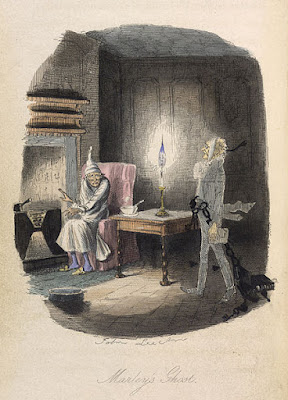
Marley's Ghost. Ebenezer Scrooge visited by a ghost

And I embrace the lot, from the trees, the cards, to all the big and trivial things.

So with that in mind, there is always a spot for the film It's a Wonderful Life, along with a sledge full of Dicken's remakes of A Christmas Carol. 

Of these the 1951 Alister Sim version renamed Scooge remains the family favourite.

And here I have to confess that I have never read the original, all of which means that the  Radio 4 In Our Time exploration of Dicken's book is a must to listen to..

"Melvyn Bragg and guests discuss Charles Dickens' novella, written in 1843 when he was 31, which has become intertwined with his reputation and with Christmas itself. Ebenezer Scrooge is the miserly everyman figure whose joyless obsession with money severs him from society and his own emotions, and he is only saved after recalling his lonely past, seeing what he is missing now and being warned of his future, all under the guidance of the ghosts of Christmases Past, Present and Yet To Come. 

Scooge and Bob Cratchit celebrate Christmas
Redeemed, Scrooge comes to care in particular about one of the many minor characters in the story who make a great impact, namely Tiny Tim, the disabled child of the poor and warm-hearted Cratchit family, with his cry, "God bless us, every one!"

With Juliet John, Professor of English Literature and Dean of Arts and Social Sciences at City, University of London, Jon Mee, Professor of Eighteenth-Century Studies at the University of York, and, Dinah Birch, Pro-Vice-Chancellor for Cultural Engagement and Professor of English Literature at the University of Liverpool

Producer: Simon Tillotson"*

It was broadcast yesterday and is available to listen to by following the link.

Pictures; Marley's Ghost. Ebenezer Scrooge visited by a ghost. Colour illustration from 'A Christmas Carol in prose. Being a Ghost-story of Christmas', by Charles Dickens, With illustrations by John Leech, 1843, British Library, and Scrooge and Bob Cratchit celebrate Christmas in an illustration from stave five of the original edition, 1843.  

A Christmas Carol, Radio 4, https://www.bbc.co.uk/programmes/m0012fl5

Waiting for the band to play ..... Middleton

Now it's been a year since I visited the story of the bandstand, and so I was pleased when Tony Goulding sent this one over.


Tony is a regular contributor to the blog and tells me "I have been busily engaged in researching a friend's (rather complicated) family history. 

In connection with this we took a trip today out to Middleton. 

I took a newish digital camera with me and took a few pictures, one of which was of this bandstand which stands in the grounds surrounding St. Leonard's church. 

I seem to recall that you have an interest in surviving bandstands so I thought I would send you this picture"

And that is all I am going to say, other than to thank Tony and invite you to read all the bandstand stories.

Location; Middleton

Picture; Middleton Bandstand, 2021, from the collection of Tony Goulding.

*Bandstands, https://chorltonhistory.blogspot.com/search/label/Bandstands

Thursday, 16 December 2021

Painting Italy .......... goodbye to Ciao

The first time I ate at Ciao’s I was hooked.

We were in the main railway station in Rome and against my better judgement Tina suggested we go there to eat.

Now fast food in a railway station even the stylish Termini I thought would be a disaster.

But not so.  There was a range of fresh food most of it cooked as you watched and a shedful of fruit and salads and heaps of good bread.

Moreover it was cheap and as a result the place was full.

And so when we got back to Varese I adopted the local Ciao’s.

Whenever we were in the town centre I contrived to call in and then without warning it had gone.

We had last eaten there in the April of 2013 and when we went back near the end of the year it had gone.

I found a newspaper account of their sudden closure which was as much a surprise to the employees as to us.*

And now the place is empty along with another at the airport and I suspect the one at the Termini which is why I asked Peter to paint the old Varese restaurant from a picture I took in 2012, after all if I can’t eat there I can at least have a permanent reminder of the place.

*Addio a Ciao e Spizzico, di Redazione Varese News 30 maggio 2013 http://www.varesenews.it/2013/05/addio-a-ciao-e-spizzico/58961/

Painting; Ciao, Varese © 2015 Peter Topping from a photograph by Andrew Simpson 2012

Web: www.paintingsfrompictures.co.uk

Facebook: Paintings from Pictures, https://www.facebook.com/paintingsfrompictures

Wednesday, 15 December 2021

Remembering Joseph Thomas from Chorlton who died in the Great War

The replica, circa 1920s
I wonder just how many of these small replicas of the Cenotaph still exist.

They would have been made in their thousands and displayed on mantle pieces and in cabinets across the country.

Some will have evoked proud memories of a war fought well but for many more they must have been a painful reminder of a lost loved one who died on some faraway battlefield or out at sea.

The end of the Second World War may have given them a renewed significance but as we passed into the long years of peace and growing prosperity most will have been consigned to a back room, and finally laid to rest in a suitcase in the attic.

And in the way of these things those that weren’t thrown away will have been given to a jumble sale and by degree made their way into a collection.

Of course the personal story which went with each will have been lost.

Joseph Thomas, circa 1914-15
But not this one.

This one I can trace to a family and the young Joseph Thomas who was born in 1894 and died on the Western Front in 1917.*

Joseph grew up in Chorlton-cum-Hardy and  worked for Richard Haworth & Co Ltd who had offices at 19 Cooper Street.

The building has long gone but it faced the Town Hall close to where the Cenotaph now stands.

And like many other young men working in the offices of the city he enlisted in one of the Pal’s Battalions.

The first had been raised in the August in a few days and Joseph enlisted in the second city battalion that September.

This was the 17th Manchester’s which after basic training left for France in the November of the following year.

I doubt I would ever have come across him had it not been for a picture postcard he sent to his brother.

The post card asked for an advance till pay day and alerted the family that he was coming home on leave.

At that stage all I had was his brother’s name and address but that was enough to begin to uncover the story of the family and shed light on the young man who just signed himself Joe.

By the end of the afternoon his early career was clear along with the details of his enlistment and a photograph of ten soldiers one of whom I guessed was Joseph.

The rest as they say just fell into place.

Within an hour of posting the story Nicola and Steven had been in touch and were able to identify young Joseph which in turn led to a meeting at which they showed me a collection of family material including photographs, certificates and the replica Cenotaph.

And that I think is a good point to close.

Of all the memorabilia I have come across from the Great War this replica Cenotaph brings me very close to the loss the Thomas family must have felt.

Picture; replica Cenotaph circa 1920s from the collection of Nicola O’Niel and detail from the picture postcard showing young Joseph, circa 1914-15 from the collection of David Harrop

*Uncovering the story of Joseph Thomas of Chorlton born 1894, died 1917 on the Western Front, http://chorltonhistory.blogspot.co.uk/search/label/Chorlton%20and%20the%20Great%20War

Tuesday, 14 December 2021

So what tram would take me to the Longsight loco shed in 1947?

 Now, I remain in awe of those people who turn their interest into something which can be shared with others.


And today I am looking at “The British Locomotive Shed Directory", which was a “complete guide to all the Main Line Locomotive Sheds and Works in Great Britan”.


It was produced by R. S. Grimsley in December 1947 and cost 7/6d.

My old friend John Anthony came across it and sent over some pages from the guide, commenting, “a gentleman named Stuart Hillston had posted several pages from the above book into the Manchester Railways FB Group, which he had bought on ebay. 

Without mentioning your name, I had requested his permission to pass these on to you.

The particular pages provided directions on how to reach each of the local locomotive depots in Manchester and surrounding areas using public transport means.

Consequently, information on tram and bus routes, together with various streets is detailed in the book.


I thought the information was quirky enough to be of some historical interest to you and have attached a zip folder with copies hereto for your consideration”
.

And of course it was just the sort of quirky bit of history I like.  

Not least because today a full 74 years after its publication it has become history.

Allowing the causal reader and the railway buff an insight into many of the locomotive sheds and works which have long since vanished with those wonderful tiny details of how you could have travel by tram, trolley bus, and bus to each of the destinations.


It reminds me of an equally fascinating book produced in the same year which offered up a guide to the then railway network.

Mile By Mile, along with Mr. Grimley’s book offer up a view of the railways which are now fast fading from living memory.*

So I thank  John Anthony for sending over the pages from the book, and to Stuart Hillston who acquired the guide and gave me permission to reproduce it.

And never one to dodge a mistake, David Ward-nadin has corrected my title by adding the comment, "There was no loco works at Longsight  it was a loco shed only  you could get a 53 bus  to outside Longsight station.  or a tram till sometime before WW11  the only loco works were The Great central one at Gorton  and near there Beyer Peacock works   these actually made locos. The tram that used to stop at Longsight station was the 53 single decker".

Thank you David ... title amended.

Location; 1947

Pictures; “The British Locomotive Shed Directory”, 1947, courtesy of Stuart Hillston

* Mile By Mile, travelling our railways in 1947, https://chorltonhistory.blogspot.com/2019/12/mile-by-mile-travelling-our-railways-in.html


Monday, 13 December 2021

When history gets a bit more personal ......... the Croton family

Now I like the way that stories become personal, and so it is with two pieces I wrote on  Charles and Reginal Croton who were two our taxi drivers the late 19th century into the 1920s.*

Reg Croton, 1925
They were successful enough to have moved from horse and cab to motor vehicle by the 1920s and were listed in the telephone book by 1911.

And Reg posed for a series of photographs which along with a picture of the family home on Sandy Lane drew me to them and hence the stories.

The images include two of Reg and Mr. David Ball, the manager of the WH Smith bookstall on Chorlton Railway Station.

In one they are posing beside Reg’s taxi and the other in front of the bookstall.

These along with the picture of their home are in the Lloyd Collection remain the best source for pictures of Chorlton.

They were collected by John Lloyd, who wrote the popular history of where we live, and many of the photographs were lent to him by local residents.

Reg and David Ball, 1922
So it is more than likely that our pictures made their way into the collection by either a member of the Croton family or Mr. Ball.

All of which adds a personal touch to the stories, to which I can now add and even more personal link in the form of a series of conversations with the grandson of Reg's younger brother, and two more images.

And rather than paraphrase what Peter Croton said, I shall instead include the full conversation with those new pictures.

Reg and David Ball, 1925 outside Chorlton Railway Station
“I hope you don't mind me writing to you about your Chorlton blog. My family lived in Chorlton from about 1895 to 1985 and I attended Chorlton Grammar School on Sandy Lane for eight years in the 60s. I find the blog to be excellent and the detail amazing, something you can be extremely proud of.

My great grandfather, Charles Wesley Croton, had a taxi business and lived on Sandy Lane from about 1895 to 1926 when he died. 

His wife, Annie, continued to live there until the 1930s. I have noticed that the blog contains some information about Charles Croton, a surprising amount in fact. Someone has been doing their homework. 

Charles Croton, 1905, Whitelow Road
Charles Croton was born in London in  1866. His father was a coachman (not a hackney coach driver) at the Wesleyan Training College, Westminster hence Charles' middle name Wesley. He arrived in Chorlton c.1895, having been in Hulme since 1890. Of four children the eldest two, including Reginald (b. 1889) were born in Oxford, and the two youngest, including Harold John (b.1890), my grandfather, were born in Hulme. 

Charles tenanted a small holding on Sandy Lane (I understand owned by the Egerton family) and could often be found with his cab at Chorlton Station or the Lloyds Hotel. He had a flock of geese at the farm which were said to be better than any guard dog. I have attached a photograph of Charles on his hansom cab c. 1905, taken on Edge Lane. A very small point, Reg would have been thirty three at the time of the 1922 photograph.

I have frustratingly been unable to find the quote from John Fielden ref. his memory of Charles. 


Harold Croton, Twenty Five years service, 1944
I have attached an image of Harold's certificate for his 25 years’ service in the electricity supply industry. Most of this time was with Manchester Corporation prior to nationalisation after WW2. Charles, his wife Ann, Harold and his wife Ellen are all buried in the family plot in Southern Cemetery”.

I doubt this is the end of the story of the Croton family, and I will go looking for their plot in Southern Cemetery, find the exact location on Sandy Lane of their home, and look for possible adverts for the taxi firm.

For now, I will thank Peter for sharing more information on his family and reflect how the Croton’s perfectly reflect Chorlton-cum-Hardy just a century and a bit ago.

At a time when the township was filling up with new residents and exchanging its rural character for an urban one, Charles like many others moved into the township, offered a taxi service to the new professional people, and by degree embraced the equally new form of transport which was the motor car, along with a telephone.

The Croton family home, Sandy Lane, date unknown
While one of his other sons went into another of those new industry’s which were to come to be central to how we lived.

But their tenancy of a small holding rented from the Egerton’s and that flock of geese takes us back into the rural past of Chorlton.

But like all things change was in the air, and Peter tells me that "Reg became a publican in North Manchester when the land on Sandy Lane was redeveloped and it is that part of the city where his only son still lives".

Location; Chorlton-cum-Hardy

Pictures; Reg and David Ball at Chorlton Railway Station, circa 1920s, and the family home on Sandy Lane, date unknown, from the Lloyd Collection, Charles Croton with his hansom cab circa 1905, taken on Edge Lane, courtesy of Greater Manchester County Record Office, Ref DPA 782/29, AND Harold Croton’s certificate for his 25 years’ service in the electricity supply industry, 1944, from the collection of Peter Croton

*The Croton Family, https://chorltonhistory.blogspot.com/search/label/The%20Croton%20Family

** Lloyd, John M, The Township of Chorlton cum Hardy, E.J. Morten, 1972, and Looking Back at Chorlton-cum-Hardy, Willow Publishing, 1985

The view from the hill ……. and other pictures ….. by Phil Mackie

Now I have been revisiting some photographs taken by our Jill of Greenwich Park a few years back, and throwing in a few I took in the late 1970s.


And today I want to add a few by Phil Mackie who posted some of his to me and kindly agreed to them being shared.

Phil added of the classic view looking down towards the river, that this is “not technically a great shot but should serve as a comparison.

Have also thrown in one rather dark pic looking further upstream Both taken 15 June 1974.  

I have also included a few – should they be of use sometime – from the top of Calderwood Street car park in Woolwich, taken 6 July 1974”.


And as you do I leapt at the opportunity of going back to where I grew up.


Location; Greenwich and Woolwich


Pictures; Greenwich and Woolwich, 1974 from the collection of Phil Mackie