Sunday, 21 May 2023

Faces at a festival … Chorlton Arts Launch ..... May 18th 2023

The second in a short series of pictures recording this year's launch of Chorlton Arts Festival, 2023

Jeff Smith MP and some of the invited guests, 2023

The Lord Mayor, Cllr Yasmine Dar 


Cllr Mathew Bentham, 2023


Man takes picture of man taking pictures, 2023


Linda, Eve and John, 2023
The full programme of events is available by following the link.**

Location, Chorlton


Pictures; launch night of Chorlton Arts Festival, 2023, from the collection of Andrew Simpson


*OK Chorlton ….. our Arts Festival is back, https://chorltonhistory.blogspot.com/2023/05/ok-chorlton-our-arts-festival-is-back.html 

**Chorlton Arts Festival, 2023, https://chorltonartsfestival.org/2023-festival-programme/


Saturday, 20 May 2023

Entrances ..... gates .... and doors .... I have passed ...

The story which is pretty much nothing more than pictures.


All were taken at the beginning of the week in and around Shudehill.

Your starter for 10, should you choose to accept the challenge is to identify each, and offer up a comment, a personal memory or a picture.*

Mine for what it’s worth is wandering into the fish market with my old school chum John Coward.

It must have been early in 1970 and I was still new to Manchester having washed up from Eltham in the September of the previous year.

All of the city was still new and exciting, and on an aimless walk through the city we encountered the fish market and there I saw a full cod, from head to tail, not the boil in the bag cod covered in sauce cod, nor the battered and crispy coated fish with accompanying chips but the real thing.

It was big, and I was impressed.


Later, long after that adventure, and after I done with studying and working I spent many happy hours in the old Greater Manchester County Records Office on Marshall Street.

You can still explore these dusty but magic bits of our history in the Archives Library at Central Ref

So that is it. 

Other than to say one building is so good I included it twice.

No prizes if you take part, just the satisfaction of adding something to the story.

Location; Shudehill and round about

Pictures; Entrances, .....gates ... and doors .... I have passed, 2023, from the collection of Andrew Simpson

*And if you want the answers but don’t know who to ask, the first is the entrance to the former Co-op Building on Balloon Street, the second is from inside the old Wholesale Fish Market looking towards Salmon Street, the third is looking at the fish market from Shudehill, and the last is the former Greater Manchester County Records Office and formerly Marsden Harcombe & Company Ltd, Marshall Street

The Garden Entrance to the City ……. At Parrs Wood in 1928

Now I have always been fascinated by that patch of land, where the Kingsway meets Wilmlsow Road.

The park in 2015
It is a small plot surrounded by fast flowing traffic and has always seemed a planner’s after thought, more so as the volume of cars, buses and lorries has increased over the last four decades, and the place is dwarfed by the cinema complex to the south and the supermarket to the east. *

Once, and we are talking the 1970s, I would sometimes take myself off and sit in the park, partly hidden by the dense bushes and trees along the Parrs Wood Lane side.

At the time I was particularly intrigued by the entrance pillars on the north side, and still wonder if they were once replicated at the other entrances.

The historian in me also speculated on when the park was built, and as you do, I occasionally made a note to go looking in the archive.

But then as so often happens I came across the story, which is not quite what I had expected, and was a sideways discovery, while researching the pubs of Didsbury. **


The park surrounded with clutter and traffic, 2015
The park dates from 1928, and was an attempt to challenge the growing presence of cars and lorries in what had once been a quiet bit of land, dominated by the 18th century estate of Parrs Wood.

All of that changed, with the construction of the Kingsway which was opened in 1923, and the Corporation bus garage which was ready for business just three years later.

And so, in 1928 “the Royal Manchester Institution after some months of preparation and consultation with the Parks Committee announced at its annual meeting, that its scheme for the development of the corner of land where Kingsway meets Wilmlsow Road will be effected.  

The scheme is to make out of the triangular plot of land a small garden which will be welcome to visitors of the city with some display of green”. ***

The plot of land, 1927
The design had been modified, and “the fountain will be replaced by glass and the low stone wall by posts.”

Aerial photographs from 1927 show the triangular plot beside the bus garage awaiting something to happen.

The Institute handed over £500 in the January of 1929 with work beginning at some point after that.

But, the park was nearly lost to a developer who wanted to erect a petrol station on the site in 1932, but that is best left to a chapter in the new Didsbury pubs book which tells the full story.

Location; Didsbury

Pictures; the green at Parrs Wood, 2015, from the collection of Liz Scantlebury**** and  Didsbury, Manchester Corporation Parr's Wood Bus Garage, Manchester, N S Roberts, m67682 courtesy of Manchester Libraries, Information and Archives, Manchester City Council, http://images.manchester.gov.uk/index.php?session=pass


*Parrs Wood .............. what was once and is now, https://chorltonhistory.blogspot.com/2019/01/parrs-wood-what-was-once-and-is-now.html

**Manchester Pubs- The Stories Behind the Doors – Didsbury, Andrew Simpson & Peter Topping, to be published later in 2019

*** Garden Entrance to City Parrs Wood Development Scheme, the Preservation of Amenities, Manchester Guardian, October 9, 1928

 ****Liz Scantleburyhttp://www.lizscantlebury.com


Friday, 19 May 2023

When a kind offer opens a heap of knowledge about how we lived in Chorlton

A while ago I revisited a story about that former chapel on Oswald Road which is now a private residence.

It sits back from the road half hidden by a variety of foliage and has had a connection with various denominations for decades.

One of its residents kindly allowed us in when Peter and I were writing our Chorlton and Didsbury church book, which to be more accurate also includes a Temple, a Mosque and a Synagogue.

This former chapel has struck me as an odd building which is positioned at an angle to the road and backs on to a garden wall. 

Its present owners told us that back in 1902 it had been “a workshop for packaging and distributing top hats which were made in a factory in Withington”.

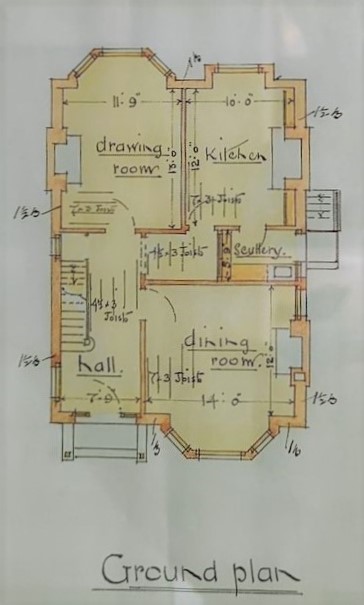
And yesterday in response to a story, Jayne Brayley got in touch to say, that “I saw your post today about the church on Oswald Road. We moved into the house next door a couple of years ago and we have an original architect drawing of the house from February 1902 and the building next door, which you've identified as a church.

 The plans label it as an office and I believe it was built at the same time as the house as part of a single property. I'll send you a picture to help any further research”.


Now the house was built for an Oliver Wood who had a commissioned the architect S. Groocoock of Brookfield Avenue, and his plans are dated to 1902.

The house must have been built sometime during the following year, and looking at the plans it was a fine property stretching over three floors, including  5 bed rooms, a bathroom, box room, and  a dinning room, drawing room and kitchen with scullery.


All of which is what you would expect, but as ever it is the less glamourous part of the house which in this case were the cellars which offers up the interesting.

The middle room was the coal cellar with access from the side of the property vis a small coal door and shute. 

The other areas included a larder at the foot of the stairs and a large space given over to the wash cellar, which had a large copper.

A copper was used to wash the clothes and consisted of a metal tub in a brick lined unit with a space underneath for a coal fire.  The proximity of the coal cellar nearby made the replenishing of the fire a less arduous task and the location of the copper close to the front of the house and to a drain was essential.

I don’t know but I suspect the floor would have gently sloped towards the front of the house allowing excess water to drain away.

The wash room was by far the largest in the cellar and would have had space for a mangle and a washing line where the clean clothes could be hung during inclement weather.

But there is no evidence that the family employed servants, so it is equally likely that they sent their washing out to one of the commercial laundries of which there were plenty in Chorlton, or alternatively employed a washerwoman to come in and do the job.

The presence of the larder at the foot of the cellar stairs meant that food might keep longer in the cooler conditions below ground and its location close to the stairs meant that it was less of a journey back and forth to the kitchen.

That said a time and motion survey would have found fault with a kitchen which involved quite a traipse from the ovens to the dining table, via the kitchen entrance and the draughty hall.

I have to reflect that the absence of a resident servant meant that the family were either modern enough to have seen to themselves or employed daily servants who left at the end of the day for their own homes somewhere in Chorlton.

Well, we shall see or though I doubt we will ever know.

As for the Wood family, Mr Wood and his son described themselves as Foreign Stamp Dealers which may explain the need for an office.  Not that Mr. Wood senior had always dealt in stamps.  

Back in 1881 he gave his occupation as a sailor and in 1901 was in manufacturing.

Nor is that quite all, because there appears a mismatch in the census returns and marriage records.

So the 1911census records that Mrs. Wood was 17 when she was married, having her eldest son at 18 which conflicts with  her marriage certificate which offers up a date of 21.

Leaving me just to thank Jayne for providing me the plans and setting me off on a journey.


Location; Chorlton

Pictures; original architect drawing’s, 1902, from the collection of Jayne Brayley


Mr. Virgil .... his epic poem ....and heaps on Roman farming .... on the wireless ... today

I wasn't going to listen to Virgil's Georgics on Radio 4.  

It is the latest programme from In Our Time, but I am glad I did, because it not only made me want to read Mr. Vergil's poem but shed light on heaps to do with how Roman agriculture, from small time farmers to the big "for profit" landed estates.

Grassland, 2023
And along the way offered up bit on Roman religion, culture and politics.  

Definitely one to listen to.

"In the year 29 BC the great Roman poet Virgil published these lines:

'Blessed is he who has succeeded in learning the laws of nature’s working, has cast beneath his feet all fear and fate’s implacable decree, and the howl of insatiable Death. But happy too is he who knows the rural gods…'

They’re from his poem the Georgics, a detailed account of farming life in the Italy of the time. ‘Georgics’ means ‘agricultural things’, and it’s often been read as a farming manual. 

But it was written at a moment when the Roman world was emerging from a period of civil war, and questions of land ownership and management were heavily contested. 

It’s also a philosophical reflection on humanity’s relationship with the natural world, the ravages of time, and the politics of Virgil’s day.

Fruits of the land, circa 63-79 AD
It’s exerted a profound influence on European writing about agriculture and rural life, and has much to offer environmental thinking today.

With, Katharine Earnshaw, Senior Lecturer in Classics and Ancient History at the University of Exeter; Neville Morley, Professor of Classics and Ancient History at the University of Exeter, and Diana Spencer, Professor of Classics at the University of Birmingham

Producer: Luke Mulhall"

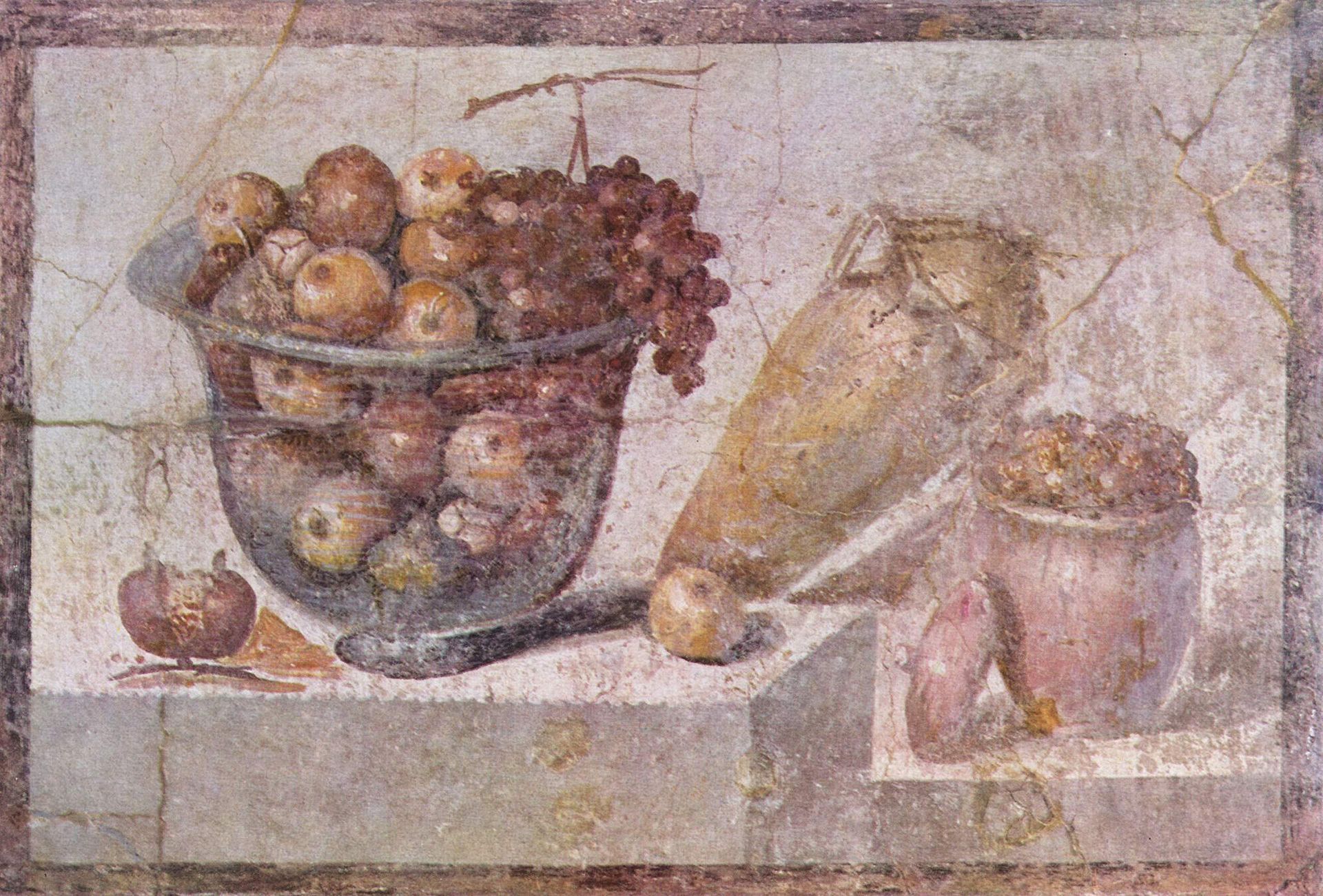
Picture; Grassland, 2023, from the collection of Andrew Simpson, Still life with glass bowl of fruit and vases, circa 63-79 AD,Naples National Archaeological Museum. The work of art depicted in this image and the reproduction thereof are in the public domain worldwide. The reproduction is part of a collection of reproductions compiled by The Yorck Project. The compilation copyright is held by Zenodot Verlagsgesellschaft mbH and licensed under the GNU Free Documentation License.

*Virgil's Georgics, In Our Time, Radio 4, https://www.bbc.co.uk/programmes/m001lyt4

OK Chorlton ….. our Arts Festival is back

So last night Chorlton Arts Festival was officially launched with its annual opening night at the South West Manchester Cricket Club on Ellesmere Road.

The Lord Mayor, Cllr Cllr Yasmine Dar, 2023

On hand to celebrate the event was the newly elected Lord Mayor, Cllr Yasmine Dar,  the city’s first female Asian Lord Mayor, who grew up in Whalley Range.

Jeff Smith MP Manchester Withington, 2023
In her opening remarks she said that she had hoped this would have been her first official invitation since becoming Lord Mayor the day before, but while something else had sneaked in it was still  the second event.

The night had begun with a session from Chorlton Park Steel Band, and was followed by the welcoming address from Carolyn Kagan, chair of Chorlton Voice.

As ever there was a fine selection of refreshments which added to a night where “friends”, invited guests and contributors mingled and swapped the shows they fancied.

And the full list of events can be found by following the link.*

Location, Chorlton

Pictures; Chorlton Arts Festival, 2023, from the collection of Andrew Simpson

Watching the Steel Band, 2023


Listening and watching, 2023

Carolyn's welcoming words interrupted by events off stage, 2023


*Chorlton Arts Festival, 2023, https://chorltonartsfestival.org/2023-festival-programme/


Thursday, 18 May 2023

Breaking News ……….. the Rec on Beech Road is officially opened

Now Chorlton’s transition from small rural community to a suburb of Manchester was pretty much accomplished in less than one lifetime.


In 1851, there were just 750 people in the township and the majority derived their living from the land.

Just a half century later, swathes of terraced and tall semidetached properties stretched from the northern boundary, across to the east and  west and were only halted by the flood plain and the River Mersey in the south.

The development was so swift that the hamlet of Martledge was engulfed and its name lost, and older inhabitants dismissed it as the “new Village or “New Chorlton” to distinguish it from the area around the village green which was still regarded as the old village.

But the loss of so much farmland was a cause for concern, and more than one individual called for a park or recreational ground.

A state of affairs which the Manchester Guardian flagged up in 1896 commenting on the opening of new public recreation grounds across south Manchester, that as “the population of the district is rapidly advancing … these open spaces where children can play free from the dangers which are inseparable from the public thoroughfares will be even more appreciated than now”.**

Back in 1896 Chorlton-cum-Hardy, along with Withington, Burnage and Didsbury were part of Withington Urban District Council which had several  recreation grounds in Withington, Didsbury, Cavendish Road (West Didsbury), Beech Road  (Chorlton) and Chorlton Green (Chorlton).

And 1896 is the significant date, because in the May of that year the Egerton estate “gifted” what was left of Row Acre which had once been a large field stretching from what is now Cross Road all the way down to Acres Road.

Our own grand opening was only one grand opening presided over by Lord Egerton and his wife, along with local dignitaries.

The day had begun at Withington Town Hall, and the official party progressed in open carriages, first to the Recreational Ground at Withington where Lord Egerton was presented with a gold key, and then on to Albert Park, and finally across the district to Chorlton, with a short stop at Chorlton Green before finishing on Beech Road.

Location; Chorlton

Picture; the Rec, 2020 from the collection of Andrew Simpson, and extracts from the Manchester Guardian, 1896

*Public Recreation Grounds at Withington, Manchester Guardian, May 18th, 1896