Sunday, 17 December 2023

When there is no one left to ask ……. part one ….. letters

I know I won’t be alone in coming to family history a tad too late.

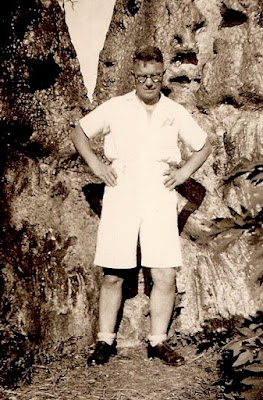
Two unknowns friends with dad, circa 1930

At 58 I launched into the business of exploring our past, building on the work of my sisters who had done it the hard way in the 1970s. 

Back then there was no internet and a search involved not an online investigation but a trawl of parish registers in situ, followed by visits to church graveyards.  Now that was daunting, given that our family stretch back in time across Scotland as far as the east Highlands.

So, my sisters explored father’s side of the family in the 1970s, when Dad and our uncles were still alive and could offer up plenty of details.

I followed them in the early 2000s looking for mum’s side, by which time the internet was offering up a wealth of information, but by then there was almost no one left to ask.

Still, I did confirm many childhood memories some of which I had begun to think that I had invented.

Of course, relying on the anecdotal memories of relatives is fraught with dangers.  They can get confused, forget things, and muddle up the timeline, placing a grandfather in the wrong occupation, an uncle in the wrong regiment and putting the date a great grandmother died in the wrong century.

But here we were lucky because all our uncles were great letter writers and prompted by questions, they provided a rich narrative of father’s side back into the 19th century.

A testamonial, 1925

Added to this were the collection of letters, documents and official forms which dad had carefully kept.  

Most were about him and stretched back into the early 1920s, along with the odd one from mother’s side.

I suspect we are luckier than many families in the amount of material that has survived, but it is a collection which is nothing compared to that of the wealthy and the aristocracy, who’s carefully archived written sources will roll back several centuries. 

Many of them I had not looked at for over 40 years and the first task has been to start scanning them, which is a long process but allows me to read the documents more easily.

For any historian the reward is in the detail and the degree to which it brings you closer to a relative.

In Dad’s case there are a clutch of testimonials written in the 1920s which vouch for his character, and work record, all of which chime with the dad I knew.

The demands of war, 1941

Added to this along with documents from the last world war they firm up the timeline of those years, placing him in Gateshead, then London, his war service back in the North East, and his return to London sometime after 1945.

He was in the entertainment industry, driving coaches on touring holidays, and when I was growing up was one of the two drivers for Glenton Tours engaged in tours across mainland Europe.  I now know that as early as 1935 if not earlier he was travelling across the Continent and had resumed those trips by 1947.

And the letters from our uncles have also corrected mistakes.  So, I now know one uncle was in the Black Watch in the Great War, and the Argyle and Sutherland’s in the second, while uncle George was in the Seaforth Highlanders not the Black Watch.   Trivial details perhaps but important to us.


Another letter sheds light on a family mystery which is the story of our lost uncle, who no one talked about and who deliberately disappeared.  

For years I thought the family had coluded in the disappearance, but no, so final was his decision that he requested that they never contact him.  

A decision which led to him dying alone, and a burial accompanied by the cheapest of services.  It would be almost a year before the family learned of the death.

A request from grandfather, 1922

And of mysteries there is another, which comes in the form of a tired looking letter from my grandfather written in 1922 to the Infantry Office. He had just been demobilized and had returned to Derby.  

The letter places him in an unexpected place, living with his mother and two of his siblings, but throws up the mystery of just when his wife and children arrived from Germany.

All of which leaves those simple questions of so what, and what relevance are these letters to anyone but a family.

Well, it is how you place them in the bigger picture of the last century.  I have never just done family history, but instead have sought to place each family discovery against the backdrop of what was going on and look to see what our domestic stories help tell us.  In that respect we were “little people caught up in a great century”.

Dad’s journey from Gateshead to London in 1933, and his return in 1940 give a personal perspective to all those who directed by the demands of war into “essential services”, which in his case was a driver for a Royal Ordinance factory.

For our disappearing uncle it offers an insight into the difficulties of getting a prewar divorce, while for granddad it illuminates his decision to stay in the army after the Great War, the British army’s occupation of Germany and his fraternization and eventual marriage to my German grandmother.

So quite a lot.

Location; the 20th century

Pictures; from the collection of the Simpson family, 1922-41

Saturday, 16 December 2023

One hundred years of one house in Chorlton ....... part 149 …..the end of a Christmas tradition …….and a big thankyou Tony Adams

The continuing story of the house Joe and Mary Ann Scott lived in for over 50 years and the families that have lived here since.*


Christmas is full of family traditions and ours is no different.

Many of the things we do date back beyond the children and are imports from how we celebrated Christmas as youngsters and even bits from our parents, and grandparents.

It makes for a seamless and slightly unique family Christmas.

But today one of those has happened for the last time, and that is the delivery of the trees from Tony Adams in the precinct.*

We have been getting our Christmas trees from him for nearly 40 years and have never been disappointed.

In the early years we went to him with the kids making the choice, and then when they had got to the stage of doing other things I went on my own.

But I must confess I was rubbish at choosing and over a decade ago I left it to Tony who has always done a better job.

Along the way we went from one to two.  

The first must be so big we have to cut a chunk off the bottom, and the second which began just as a token to mark the decoration of the dining room in 2009 has continued and has  also grown.

That said Tony always does a deal for “my teacher friend” and we get them at a wonderful price.

But the demolition of the Precinct means he is closing down and with that ends the tradition.

So, a thank you to Tony and his staff at his shop in the Precinct.  

Our kids have grown up enjoying the trees and that for me has been a part of what has made our Christmas.

Location; Chorlton Precinct, and our house

Pictures; from the collection of Andrew Simpson

*The Story of a House, https://chorltonhistory.blogspot.com/2023/11/one-hundred-years-of-one-house-in.html

**A. J. Adams, 15, Chorlton Place, Manchester, M21 9AQ

And what did you do in the Empire? …………..

Now today I have been reflecting on my family and its links with the British Empire.

Sailing for India, 1930
Ours is not a history of military glamour or the acquisition of vast wealth and nor were we victims who were exploited, harshly treated and ruthlessly suppressed.

That said we were on the winning side, born in Britain and going out to the “colonies” as soldier’s seaman and clerks and craftsmen.

My own links are very tenuous. 

I was born two years after India and Pakistan became independent, and grew up as Britain shed its empire, a process which was not as peaceful as some history books would record and which some of my teachers found difficult to come to terms with.  

So at least two classrooms were adorned with maps of the world with a quarter coloured red of the former British Empire.  But to be fair that might have more to do with a lack of resources which condemned us kids to out of date maps and textbooks as well as readers which were already old before the outbreak of the last world war.

Nor did we participate in Empire Day, which was first celebrated in 1902, and became British Commonwealth Day in 1958 and then just Commonwealth Day six years later.  Father who was born in 1908 vividly recounted his experiences of the day, which involved much flag waving, long speeches, silly costumes, and lots of “treats”

Uncle Charles in a far away place date unknown
But the family links to Empire are there, from a distant relative who was an engineer on a tramp ship plying the sea routes which linked the “colonies”, to our great grandfather who spent time in the British West indies and in peace keeping duties after the first South African War in the 1880s.

One of his sons was migrated to Canada as a British Home Child, having been given the option of crossing the Atlantic at the age of 16 or going to a training ship which was the standard practice for youngsters who were feral and in the judgement of the authorities needed a mix of training and discipline.

To this I can add my one middle name which is Bux which was the maiden name of my German grandmother.  Bux I am told is not a common name in Germany and mother always maintained that we had links with India.  It was a notion I found hard to accept given that at the very least Germany’s imperial possessions did not include anywhere on the sub-continent.

But then an idle search of shipping records found numerous sailors called Bux all from the Indian sub-continent, and as they the story is still in play.

All of which leaves our uncle who was born in 1903 in Gateshead and died just a little shy of a century later in South Africa.  I knew he had worked in both India and east Africa but took it all for granted.

Uncle Charles, Tanga, 1937
And then with an idle afternoon and a degree of curiosity I went looking for what I can find on him.  He had started work as an “apprentice turner” in 1921, four years later described himself as an “Ironmonger”, and later still as a “Hardwareman” and at the age of 42 as a “merchant”.

The records show at least two trips out to India and one return from Siri Lanka.  In between I know he was in different parts of east Africa and while the details are vague and now lost he will have been one of those ex pats who maintained local economies feeding into the bigger picture which was the British empire.

To these stories can be added that of another member of the extended family who as a young sailor spent part of 1944 on the island of Ceylon [Siri Lanka], and as young men do spent part of his spare time photographing the people he came across.

So we were the little people, always believing we were a tad higher in the social order than the indigenous peoples and on trips home not quite able to comprehend how Britain had changed.

Meanwhile in our house in southeast London, we drank tea from India and parts of Africa, used wood and rubber from the far east, ate meat from Australia and New Zealand and sugar from the West Indies.

Local women, Ceylon, Siri Lanka, 1944
And having exchanged Eltham in south east London for Manchester I was a regualr visitor to the Ceylon Tea Centre.

All of which adds to those links to empire.

Location; pretty much everywhere.

Pictures; shipping list, 1930, Uncle Charles, date unknown, courtesy of Findmypast, Uncle Charles with possibly his first wife, Tanga, 1937, fromm the Simpson collection, and a group of local women, Ceylon, 1944, courtesy of Bob Ward

Looking for Lloyd Street ........... the lost roads of Chorlton part 2


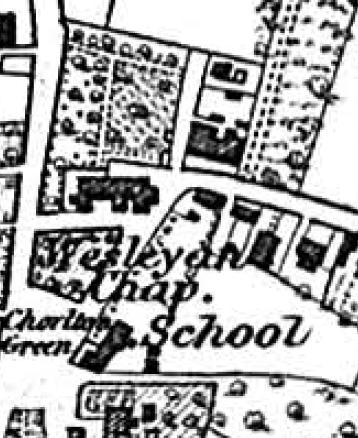
Now you won’t find it in Chorlton but it did exist and it was that short stretch of Whitelow Road running from the corner of Beech Road to that point where Whitelow bends to the left.*

This was once Lloyd land.  He was the second largest landowner in Chorlton buying into the township at the end of the 18th century and so I guess naming this little lane after him made sense.

Even now it is narrow  and hints that once it was just country lane with a few buildings on its eastern side and the large garden of William Cookson directly behind the Horse and Jockey.

But it is an interesting little place and reveals much about the life of our village.

Just at the end of the lane was the home of William Griffith.  The Griffith [s] family were active Methodists.

They appear in the ’41 and ’51 census in the tithe schedule rate books and Chapel registers.  William was a market gardener and one of his sons a wheelwright and his possession of freehold houses on Lloyd Street qualified him for a Parliamentary vote in 1832 1835 and 1840 which in turn marked him out as one of just 30 or so men who could vote.

For me an even more interesting man was Thomas Taylor.  He can also be found in the electoral registers for 1832, 1835, 1840 and 1854-55 by virtue of freehold houses for rent at end at the bottom of Beech Road and round into Lloyd Street.

These included what are now numbers 68-70 Beech Road and possibly whatever was on the site of the Beech Inn and extended on to the modern Whitelow Road.  Back in the 1840s nu 70 was the Travellers Rest which was a beer shop and nu 68 was a stationer’s and later the post office.

And it is his hand in the strange case of the loss of the Methodist Sunday school which had been in a building on the corner of Lloyd Street

This too had been built by subscriptions, and for a while was used by James Renshaw for his day school.

But the building was not secured by a trust and so reverted to the Lloyd Estate who sold the building to Thomas Taylor.

For a while Taylor charged the Methodists an annual rent but eventually in 1827 served notice on them to quit and the building was converted into cottages.

No detailed explanation has survived as to why the Methodists lost control of the building they had sacrificed so much to build but it was on Lloyd land and George Lloyd was devoted enough to the established church to give land for the building of the new National School on condition that “the school to be conducted upon principles consistent with the doctrines of the Established Church.” But it could equally have been a decision based purely on business.

Looking at the value of the cottages and the rents Thomas Taylor received it is easy to see that this might just have been a cash consideration, but more about this and the people who lived there another time.

Picture; Lloyd Street today, from the collection of Tony Walker, the Oven Door was the Travellers Rest back in the 1840 and what is now the Beech Inn may in part be all that is left of the cottages on Lloyd Street, map showing Lloyd Street from the OS map of Lancashire 1841-53, courtesy of Digital Archives,  http://www.digitalarchives.co.uk/

* It was still Lloyd Street in 1871

Watching the Santa Clause parade in Kenora, Ontario, in 1953

This is Kenora in Onraio and I am watching the 1953 Santa Clause parade.

It is the second in a short series on Christmas before now.*

There is no plan to the series, no great message, just a love of old pictures and the hope that stories will flow.

So this is Kenora and my friend Susan is there in the crowd watching the parade.

Kenora, originally named Rat Portage, is a small city situated on the Lake of the Woods in Northwestern Ontario, Canada, close to the Manitoba boundary.**

It stands on the territory of the Ojibwe or Chippewa who are a large group of Native Americans and First Nations in North America.

There are Ojibwe communities in both Canada and the United States.

In Canada, they are the second-largest population among First Nations, surpassed only by the Cree. In the United States, they have the fourth-largest population among Native American tribes, surpassed only by the Navajo, Cherokee, and Lakota.***

The town of Rat Portage was amalgamated with the towns of Keewatin and Norman in 1905 to form the present-day City of Kenora. The name, "Kenora", was coined by combining the first two letters of Keewatin, Norman and Rat Portage.

And in the December of 1955 Susan and her family were there as the parade rumbled past, and over and above Christmas there is another connection because Susan was prompted to send me the picture after reading about the petrol station that had been a cinema.****

It was one of those old fashioned ones with the now iconic petrol pumps and it led Susan to reflect to  “love coincidences...or, perhaps, synchronicity. I have not seen a photo with a BP sign in it for several years.

Now, within 2 days, I have seen two pictures: one here, Andrew, and one in a photo of the 1955 Santa Claus parade in my home town.

My parents used to use BP all the time when we were young. 

In fact, we took out little blue 'Hillman' car there quite frequently! 

Our surname was Hillman (originally from Wlitshire in England pre 1840) and I always thought it quite appropriate that our very first vehicle was named after us!”

But like all good memories Susan came back with a correction, “it was the 1953 Santa Claus parade...and it's a B/A sign.”

So there you have it, yesterday I posted of festive preparations in Varese in Italy, earlier in the week it was a postcard from 1916 and today a Santa Clause parade from the 1950s.

Picture; the Santa Clause Parade, Kenora, 1953, from the collection of Susan Susan [Hillman] Brazeau

*Christmas Past, http://chorltonhistory.blogspot.co.uk/search/label/Christmas%20Past

** Kenora https://en.wikipedia.org/wiki/Kenora

***Ojibwe, https://en.wikipedia.org/wiki/Ojibwe

****Chorlton’s first cinema, a Molotov cocktail and a shed load of new stories, http://chorltonhistory.blogspot.co.uk/2015/12/chorltons-first-cinema-molotov-cocktail.html

Suggestions for a Christmas present and an outrageous piece of self promotion ........ nu 9 nothing to do in chorlton

 Now if you had ever wondered who lived on Beech Road in 1848, or why it was called Chorlton Row and where the lost fish pond was located the new book “nothing to do in chorlton” will offer up the answers and provide you with a shedload of other interesting information to keep a pub quiz going all night and beyond.


The book costs £5, is available from  www.pubbooks.co.uk and also Chorlton Bookshop.

It is small enough to slip into your pocket or bag as you travel from location to location, and equally important for anyone looking for a special present will easily fit into a Christmas stocking.

Friday, 15 December 2023

Snaps of Chorlton No 1 a lost road and a demolished house from Ida


Most of the images we see of Chorlton in the late 19th and early 20th centuries were the work of professional photographers. 

They arrived in the township, focused on the popular bits and sold them on to the postcard companies.  Sometimes on the off chance they prowled the new roads of New Chorlton and the Ville, taking pictures of individual houses and offering them at a knock down rate to the residents.

Then there were the serious amateurs like Aaron Booth* who in the early 1880s was taking photographs of Martledge. But there are also the snappers, who captured whatever took their fancy.  Often the images are a little blurred and in many cases have a significance lost in time.

And so with this in mind here is the new series.  Snaps of Chorlton, is an occasional rummage through pictures most of which were never meant to be shared beyond the family. Of course the advent of the camera phone has given this a new lease of life.

But for now I am concentrating on old fashioned images and I am starting with two from Ida.  The first was taken by her dad and while the date is unknown it must be before the development of the precinct, because this is Manchester Road from the corner of Wilbraham Road.  Back then it is still a tree lined road of big houses which gently curved round past the Savoy Picture House and around the library.  The car park has yet to break the sweep of the road.

It is a scene I featured recently from a 1938 postcard but is well worth another look.

The second is more recent.  We are on Beech Road, after the demolition of Row House and the factory which stood beside it.  And Ida’s picture perfectly reflects that other thing about snaps which is that they seldom are of popular or photogenic views which makes them equally important.

Row House dated from the early 19th century and had quite a history.  Here lived the Blomely’s who gave their name to the fish pond that ran from Acres Road up to Chequers Road, and also lived William Batty, politician, jeweller and Methodist  For a while the house was used as our “Penny Reading Room”, while the adjoining building had been a laundry and factory.

So its passing which generated a stir at the time is important as it was one of the last examples of an early 19th century property in the township.  And here I have a confession, for I have a brick from the house.  I asked for it and the demolition gang a little bemused handed it over.  It was handmade, perhaps with clay from our own clay pits off Oswald Road and I guess was put in place around about 1800.

And a little later Ida took her picture.

Location; Chorlton, Manchester

Pictures; from the collection of Ida Bradshaw