Saturday, 5 September 2026

Playing on the Nine Fields, all the way from Well Hall to Kidbrooke

Kidbrook Lane in 1872 with the Nine Fields to the north
Now I know there will be people who know of the existence of the Nine Fields just beyond Well Hall out towards Kidbrooke.

But I think there will not be that many, and certainly now few who will have played on them

Their existence was unknown to me and it was my friend Jean who set me off on a search for them.

She rememberd that “my father told me there were fields stretching from Well Hall Road from the Catholic Church,right across to Kidbrook, before the Kidbrooke estate was built. 

Dad was talking about the 1920s when he was growing up at 47 Lovelace Green.”

And with the power of the internet there almost as soon as I started was a reference to the open land that was called Nine Fields, before the Page Brook estate was built.  Moreover she remembered that they were one vast children’s play area.  At one time small bi-planes were there offering cheap flights.”*

And in turn this led me on to an excellent description of the estates being built in the 1920.**

In the great sweep of world history I grant you that this little discovery is hardly earth shattering, but for people like me who have wandered that bit of Eltham and my sister who lives on Bournbrook Road it remains an interesting insight into what was and what has now gone.

Even more so because when we washed up on Well Hall Road in the 1960s those fields were still within living memory.

Now I am not so sure.

Location, Eltham, London

*Lily Tyrrell (Brown), from Eltham, Mottingham, New Eltham SE9
Royal Borough of Greenwich, http://www.thisiseltham.co.uk/lilyTyrrell.php
**Municipal Dreams, http://municipaldreams.wordpress.com/2013/08/06/page_estate_eltham/

And in turn this led me on to an excellent description of the eststaes being built in the 1920.** http://municipaldreams.wordpress.com/2013/08/06/page_estate_eltham/

Picture; detail from the OS for London 1862-72, courtesy of Digital Archives Association, http://www.digitalarchives.co.uk/

Catching the bus ……….. 1967

Despite all my efforts, I have no idea where we are, but as the following images in the collection are from Collyhurst, I am guessing that we are on the north side of the city.

Now, there will be those who question the significance of the image, given the absence of a location and a pretty mundane set of buildings.

But that is the point.

The workshop, and the terraced houses which were once common, have mostly vanished, along with the bus stop.

Neither of the two posters offer up clues.  One is for British Road Services, and the other advertising the film A Man for All Seasons, might just have listed a local picture house, but instead was showing at the New Oxford in the city centre.

So that is it. Although Geoff reminded me "I found this for you last year. Corner of Rochdale Road and Conran Oh and  I like the picture.

Location; unknown

Picture; catching the bus, 1967, Courtesy of Manchester Archives+ Town Hall Photographers' Collection,  https://www.flickr.com/photos/manchesterarchiveplus/albums/72157684413651581?fbclid=IwAR35NR9v6lzJfkiSsHgHdQyL2CCuQUHuCuVr8xnd403q534MNgY5g1nAZfY


Friday, 4 September 2026

That mystery house on Beech Road ........

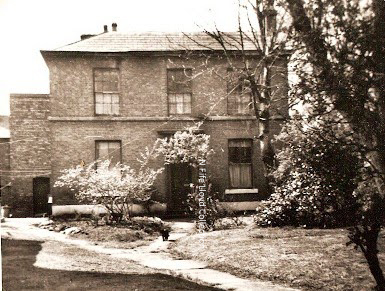
Now number 121 Beech Road vanished a long time ago.

Hunts Croft, circa, 1960s
It was one of our more elegant early 19th century properties which was set back from Beech Road, and went sometime in the 1970s.

For a long time after its demolition the land was left an open space, with the occasional suggestion that it could be a car park, a project which came to nought when the Corporation and the local traders couldn’t agree on a funding package.

There will be a few people who remember it, but sadly I am not one of them, which means it had gone before I arrived in 1976 or like so many things I was just not that observant back then.

Either way, there is little to mark its presence, save an entry in the tithe schedule for 1845, the Rate books and official maps.

If I have this right, it was Hunt Croft House and in 1845 was the residence of Thomas White who rented it from the Lloyd Estate.

With a lot of digging it will be possible to track its history through the 19th century till its demolition. I know that in 1969 it was occupied by a Frances. J Casse, and in 1911 by Mr and Mrs Chester, their five children, and a boarder.

Looking into the garden, circa 1970s
The house had nine rooms with a biggish garden at the front, ending in a tallish stone wall which ran along Beech Road.

Back in the mid 19th century it looked at on fields.  From the rear Mr White could look out on a field and orchard, while from his front windows he could gaze across to Row Acre, which stretched up to High Lane.

But by the 20th century the fields had all gone, and on either side of this fine old house were shops.

Beech Road, circa 1970s
And here I must admit my mistake, because for years I had mistaken Croft House for Joel View which stood a little further down the road and had been built in 1859.

Many will remember Joel View as the property owned by J Johnny, which I assumed had been built much later.

I even compounded the mistake by arguing that the stone tablet which carried the  name of Joel View had been salvaged from Mr White’s former home and been added to J. Johnny’s.

Dating the picture
Now, even then I knew that this was pushing it, because our own historian Thomas Ellwood had written that Joel View was one of the new developments in the township at the end of the 1850s.

All of which goes to show that sometimes when it is easy to ignore the obvious and create an elaborate theory which is built on sand and that is really just a lead in to two pictures of Hunt’s Croft sent to me by Roger Shelley who took them sometime in the 1970s and which had lain in his negative box until yesterday.

The two images compliment an earlier one taken by N. Fife for which I don’t have a date for, but maybe from the 1960s.

That said it might be possible to date Roger’s pictures, from the shop which is up for sale.  This had been Mr Westwell’s fruit and greengrocer shop in 1969, but sometime in the next decade became The Village Wholefood Shop.

Hunt's Croft demolished, circa 1979-early 1980s
It was still trading when I took a picture around 1979, showing the shop and the site which had once been Hunts Croft.

So that is it for now, although I am hoping Roger has more pictures.

Location; Chorlton


Pictures; Hunts Croft circa 1960s, courtesy of N Fife, the Lloyd Collection and again circa 1970s from the collection of Roger Shelley, and after it had been demolished circa 1979, from the collection of Andrew Simpson

A Labour candidate ......the Beswick Co-op store ..... and a day in 1967

Now I wonder if Reg, the Labour candidate was successful.

He was the Labour Party candidate in the by-election held on Thursday June 24th, 1965.

I don’t have a surname, but a trawl of the local papers for June 1965 will reveal all.

Given that he was standing for the New Cross Labour Party I suspect he was.

The rest as  they is all in the picture, which is of the Beswick Co-op grocery shop on Aden Street.

The picture dates from 1967, and was one of a collection taken during the decade in advance of the clearance programmes.


Many like me will instantly remember shops like this, with their simple promotional material and range of products which filled our store cupboards, and have pretty much vanished in the face of the supermarkets, convenience stores and online shopping.

Location; Manchester

Pictures; Manchester, 1967, Courtesy of Manchester Archives+ Town Hall Photographers' Collection,
https://www.flickr.com/photos/manchesterarchiveplus/albums/72157684413651581?fbclid=IwAR35NR9v6lzJfkiSsHgHdQyL2CCuQUHuCuVr8xnd403q534MNgY5g1nAZfY,

Eltham from the pen of Llwyd Roberts ....... nu 3 the old Brewery 1929

Now I am a great fan of the work of Mr Llwyd Roberts.

He was during the 1930s our artist in residence and during that time produced a heap of line drawings of Eltham and the surrounding area.

Some were reproduced from old photographs while others  were as he saw them at the time.

This is old Brewery which  which dates from 1928 in a building which according to Mr Roberts "originally a brewery, the upper floor of this building was later converted into the Baptist Meeting Room.  The brewery stood at the entrance of Jubilee Cottages, and the building was pulled down in 1928."


Picture; old brewery drawn 1929, Llwyd Roberts

Thursday, 3 September 2026

What did the Norman’s Ever do for Us? ….. all day on the wireless today

Well, they were either a marauding band of super gangsters who stole a country, or just another group who crossed the seas to come, settle and make a contribution.

The Battle
Of course, like all the other collections of people from the Neolithic through to 1066 they left their mark in a heap of ways.

And that is what BBC Radio 4 is going to explore today.

It’s already started with segments on the Today Programme and will march on across the day with a few repeats tonight.

The background to all this is the arrival of the Bayeux Tapestry to the British Museum and the official opening of the exhibition to the public.

The great, the good and others have already had sneak previews, and yesterday the King and Queen, the French President and our Prime Minister were invited to gaze on that famous tapestry which is in fact an embroidery not a tapestry. 

It came home in July and had a resting period but is now ready to be seen.is coming home.

I remain ambivalent at the event but that was for another blog and others I wrote back in July.*

So for now thank you BBC Radio 4 for what promises to be a memorable day for anyone who likes their history ….. even if it’s the Normans.

The first up will be What did The Normans Ever Do For Us? BBC Radio 4, when “Historians Dr Eleanor Parker, Professor Levi Roach and Alex Burghart MP, writers Kate Mosse, Muriel Zagha and Jade Cuttle trace how the Normans shaped British history and culture”.**

Followed by a heap of wireless articles.

And all available all day and on BBC Catch up by following the link.

Leaving me just to include from BBC Culture 'Chest-thumping machismo': The Bayeux Tapestry' reveals the bloody, bawdy truth about the Middle Ages.****

Postcards or comments to the blog will be welcomed on that question of were the Normans a marauding band of super gangsters who stole a country, or just another group who crossed the seas to come settle, and make a contribution?

Bishop Odo
P.S. and having listened to the first contribution which was What did The Normans Ever Do For Us? , if the remaining day's broadcast are as good, it will indeed be  a day to sit beside the wireless.  

That first programme was thoughtful, interesting and above all I learned something.

I had no idea that a group of English emigress settled in the Crimea at the invitation of the Byzantine Emperor and were there till the arival of the Tarters.

Pictures; bits from the Bayeux Tapestry, Ticket site, British Museum site 

** What did The Normans Ever Do For Us? BBC Radio 4, https://www.bbc.co.uk/programmes/m0030zjy

***Norman Day, BBC Radio 4, https://www.bbc.co.uk/schedules/p00fzl7j

**** 'Chest-thumping machismo': The Bayeux Tapestry, BBC Culture, https://www.bbc.co.uk/culture/article/20260820-the-medieval-manosphere-of-the-bayeux-tapestry

On Shooters Hill ………………… with We Anchor in Hope

Now I have no memory of the pub We Anchor in Hope.

But then when I roamed over the woods and down Shooter’s Hill and on to Welling, I was still well under the age when “dirty beer” was an attraction.

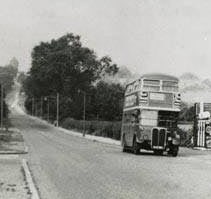
Still I am very pleased that Brian sent this picture over this morning, because it captures perfectly this stretch of the old road as I remember it.

The picture postcard is undated, but I am guessing we will be sometime in the late 1940s into the following decade and a bit.

That said there will be an expert on London buses who will be able to offer up chapter and verse on the date this one plied its route.

As to the pub, here too I am out of my comfort zone and a trawl of my limited London directories has yet to turn up any information.

Still, I am pleased to say it is still there today and is part of the Green King chain which manages many of the pubs I have researched and written about.

There will be those who are sniffy about such chains, advancing ever the cause of the independent brewery or landlord.

Which just leaves me to thank Brian,  appeal for more information, and point out before someone does that We Anchor in Hope is actually at 320 Bellgrove Road, Welling, DA16 3 RW

And to add this is  a fine shot of the old road climbing west.

And quick as a flash, Brian having read the story of his picture postcard, added a link to a bit more background.

But as ever I shall not lift someone else's research and instead just point you to the link.**


Location Welling

Picture; Shooters Hill, Welling, Kent, date unknown, from the collection of Brian Norbury

* We Anchor in Hope,  https://www.greeneking-pubs.co.uk/pubs/kent/we-anchor-in-hope/

**We Anchor in Hope, Belle Grove Road, East Wickham, Welling, https://pubwiki.co.uk/KentPubs/EastWickham/AnchorinHope.shtml