Saturday, 19 September 2026

Manchester …. ready for another international event?

 Now Manchester does its bit at hosting international events, from heaps of football matches to the Commonwealth Games and possibility the G20 annual gathering next year.

So, I wonder if there are plans to host the European Tram Driver Championship.*

This year it is in Warsaw and I have been watching live transmission of the events.  It lasts four days and judging by the pictures it is drawing big crowds.

And I have to say why not?

 Most people I talk to use our own trams and like them.

 I do and prefer them to the bus.

 Not that I don’t use the bus, I do and more so since our transport system becomes more joined up.


And the Warsaw tram network is equally neat.  And so, once our Saul who lives in Warsaw alerted me to the competition I tuned in.

The values of the promoters are all that you would want which fully endorses the motto of the European Union of "United in diversity”, and so competition stands for ... connecting people through games, entertainment and information

presenting public transport as a modern, interesting service provider

exchanging experiences and networking for drivers and managers

presenting transport companies as attractive employers

And lots of European cities have taken part and hosted the event over the last 12 years.**

Of course, Transport for Manchester may have a team out there, and I so I had better check.

Either way wouldn’t it be grand if we could have a turn at welcoming the event.

Pictures; Warsaw trams, 2026 from the collection of Andrew Simpson, and logo and image of competitors courtesy of tramem

* Warsaw 2026, https://www.tramem.eu/


**Frankfurt, 2024, Oradea, 2023, Leipzig, Brussels 2019, Stutgart, 2018, Tnnerfife, 2016, Vienna, 2025, Budpest, 2013, Dresden, 2022

What were the 3rd Battalion of the Manchester Pals doing at Alex Park in the September of 1914? ........... stories behind the book nu 10

An occasional series on the stories behind the new book on Manchester and the Great War.*

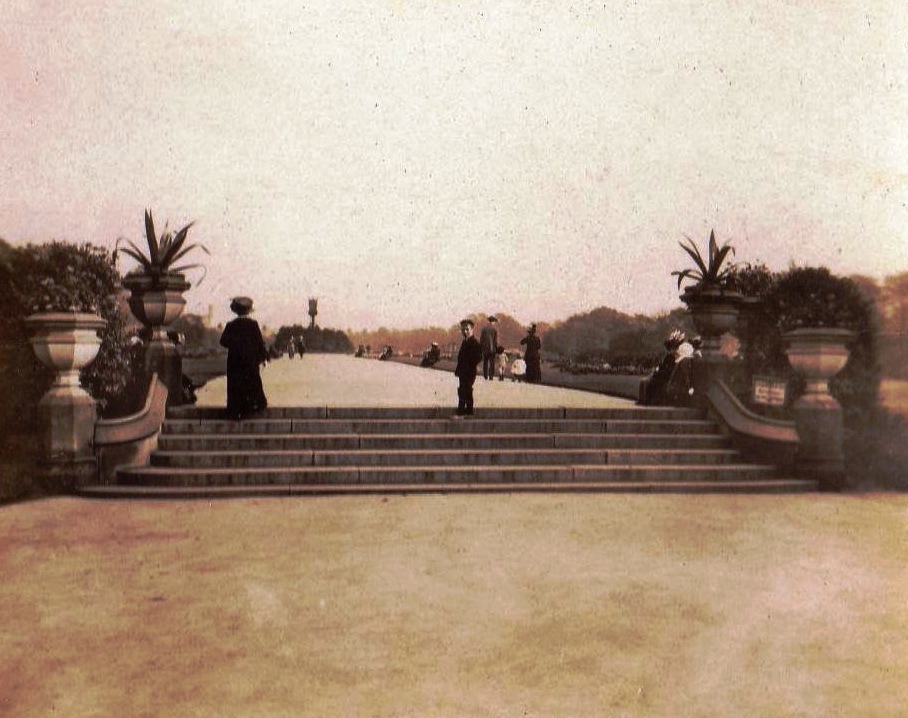
The entrance to Alexandra Park, 1907
Now this is one of those stories that started off full of promise with just a chance that I would uncover a lost part of the Park’s history.

The 3rd Battalion were one of the eight Pals’ Battalions raised in the first few months of the Great War.

The authorities had not quite been prepared for the rush of recruits.

The first two battalions had been raised in a matter of days and by the time the 3rd and 4th were complete there were still no where to put them.

So while the first and second fairly quickly moved to a tent city at Heaton Park, the 3rd was accommodated at White City and the 4th were billeted at home.

And that brings me to the 3rd Battalion and Alexandra Park.

The definitive book on the Manchester Pals* describes how the battalion had been recruited in just three days between Saturday September 5 and Monday the 7th but “unlike the first two companion battalions [it was] initially trained at White City, a sports and racing stadium in the Old Trafford area, and accommodated  there in hastily  erected and draughty constructions.  Before those huts at the White City became available this battalion’s parades were undertaken in the City Hall with route marches to and from Alexandra Park.”**

Heaton Park, 1914
As late as September 26 the Manchester Guardian reported that “the recruiting authorities have in mind the undoubted convenience of being able to billet the men on themselves, in which case they would be in the same position as the men who were recently posted to reserve, though of course their full time would be required in training.”***

Which nicely brings us back to those route marches to Alexandra Park.

I have to confess I had misread the original newspaper entries and made the assumption that they had camped out in the park but no evidence has come forward to support this and so I can only assume that on arriving at the park gates and after a suitable rest they marched away to White City where they were still to be found two month later.

Pictures; entrance to Alexandra Park, circa 1907 courtesy of Ann Love, and Heaton Park, 1914 from the collection of David Harrop

*Manchester and the Great War, Andrew Simpson, was published in 2017, http://chorltonhistory.blogspot.co.uk/search/label/A%20new%20book%20on%20Manchester%20and%20the%20Great%20War

**Manchester Pals A History of the two Manchester Brigades, Michael Stedman, 1994

***ibid, page 25

****City Battalion and Winter Quarters, Manchester Guardian, September 24 1914

Friday, 18 September 2026

Your invite to a new way of telling the stories of Greater Manchester …. today

 So, today at Chorlton Library  you have the opportunity to roam over the history of Greater Manchester in a new and unique way.

Peter Topping and Andrew Simpson have come up with a different approach to exploring Greater Manchester’s past.

It is The History of Greater Manchester by Tram …. TheStories At the Stops in which the authors take all 99 Metro tram stops on all the eight routes picking out the interesting, the serious and the bizarre as well as the humours events and people at each destination which build to become a comprehensive account of the region’s past.*

At present there are four books in the series with a fifth due out later this year. 
They cover the journey into the centre from the south, crossing the city centre down to Victoria Railway Station and then east out to New Islington.

The fifth will travel from Old Trafford to Altrincham, with further books on Salford, and all the remaining towns on the network.

The talk is part of Chorlton Book Festival is free and begins at 2pm**


Location; Chorlton Library Manchester Road

Pictures; a selection from the Power Point presentation, 2026

*Chorlton Book Festival September 17th - 26th, https://www.eventbrite.co.uk/cc/chorlton-book-festival-2026-4861494/


**Chorlton Book Festival September 17th - 26th, https://www.eventbrite.co.uk/cc/chorlton-book-festival-2026-4861494/

Bell Water Gate, 1977 a little bit of that lost Woolwich

Bell Water Gate, 1977
Its official I have joined that legion of grumpy old people who lament the passing of the places I knew as a youngster.

Now I could blame my friend Jean who has dug out and sent me a shed load of photographs of Eltham, Woolwich Blackheath and Shooters Hill from the 1970s.

But that would be unfair as she did what I asked.

The fault lies not with Jean but with me and that lingering sense of nostalgia that hangs about me from time to time.

Some of the pictures reveal changes that can only be for the best but others; well I am not so sure.

Take for Instance Bell Water Gate in Woolwich beside the Leisure Centre.

It sweeps off towards the car park and is neat and clean and allows a panoramic view across the river.

But I rather like it as it was, a little shabby and run down and a reminder of an older Woolwich.

That said I know Jean will smile indulgently and point out that I don’t have to live there, and I have to admit that we used to enjoy going to the Leisure Centre when my lads were younger and then gazing across the Thames.

So perhaps it’s best that I just accept my elevation to that grey, crinkly band of old fogies and reflect that all things change.

Picture; Bell Water Gate, 1977, Jean Gammons

Walking a bit of our city’s history ……the Rates Hall

For countless thousands of Mancunians over the decades, the Rates Hall, in the Town Hall Extension was just where you went to pay your Council bills.

The Rate Hall, 1959
But I bet a fair few of them took time out to admire the design of the place.

I know I always did, although in my case it was not to settle a bill, just as a short cut from St Peter’s Square, to Mount Street.

It was that mix of wooden counters, period lamp shades and all that gold that I liked so much.

So here, for those who remember it, is a picture from 1959, while for the rest of you there is this photograph of the restored place from the camera of Daniel Hallen, taken in 2013.

The Rate Hall, 2013

The restoration was part of that bigger project to restore and refurbish both the Town Hall Extension and Central Ref during 2010-15 and included the creation of a public service hub, as well as somewhere to sit and admire the beauty of the building.

Picture; the Rates Hall, 1959, Courtesy of Manchester Archives+ Town Hall Photographers' Collection,
https://www.flickr.com/photos/manchesterarchiveplus/albums/72157684413651581?fbclid=IwAR35NR9v6lzJfkiSsHgHdQyL2CCuQUHuCuVr8xnd403q534MNgY5g1nAZfY and in 2017 from the collection of Andrew Simpson and the Hall in 2013, Daniel Hallen, licensed under the Creative Commons Attribution 2.0 Generic license.


Miss. Mary Jane Weeks ……… domestic servant and shareholder in the Chorlton-cum-Hardy Conservative Club

Now history is messy and doesn’t always conform to rigid rules of historical development.

The Conservative Club and Public Hall, 1908
And nowhere is this more the case than in the individuals who came forward to buy shares in the new Conservative Club which opened for business, in 1892.

This was after all the party of class which represented the people of plenty.

But as we all know amongst their ranks no less than their loyal voters were people drawn from all classes.

And here it is easy to be dismissive and sniffy about those who consistently voted Tory despite coming from humble beginnings.

My father was a working class Tory.  He drove coaches all his life, and yet he voted for the party which on the surface was least likely to look after him.  That said mother was Labour and she always maintained that her vote cancelled out Dad’s which was a start on the way to a Labour Government.

The political side, 1980s
Here in Chorlton throughout the late 19th century and into the first two decades of the next the Liberals and Conservatives fought it out, and at a local level this often resulted in the electorate returning candidates from both parties on alternative years  to the Town Hall.

But like elsewhere after the last world war, the Liberals were eclipsed and the Tories came out on top, dominating local elections until 1986 and continuing to return an MP until Keith Bradley’s victory in 1987.

And I have long been fascinated by what makes people from the working class vote Conservative.  There will be many explanations and the idea that they were all just class traitors is not good enough.

So that has led me to the big book of subscribers for the Chorlton-cum-Hardy Conservative Club.  The land had been handed over by the Egerton’s in 1891, and the subscription fund opened that year.

As you would expect here can be found the very wealthy, including Samuel Gratrix of West Point in Whalley Range who bought £200 worth of shares, and a collection of our farmers, merchants and businessmen.

The club up for sale, 2013
Here too was Charles Ireland who owned a string of photographic shops, as well as estate agents, civil engineers down to shop keepers and warehousemen.

Some may have been drawn by the politics, while others by the social attractions of the club

And along with all these was Miss. Mary Jane Weeks, who held shares amounting to £2.

What makes her interesting is that she was domestic servant, working for the Adams family from at least 1891 through to 1911 and possibly beyond.

She had been born in 1849, in the small market town of Hathereigh in Devon, and was working as a servant by 1871.

I would like to know more about Miss. Mary Jane, but so far there are only the census returns to go on, but something more will turn up.

 And in the same way in the fullness of time, all the subscribers will be plotted and their lives revealed.

All of which will help get a better understanding of who voted Conservative in Chorlton  in the late 19th and early 20th centuries as well as offering up an insight into Chorlton-cum-Hardy, just as the township was evolving from an agricultural community into a suburb of Manchester.

Location; Chorlton-cum-Hardy

Pictures; The Conservative Club, 1908, from the Lloyd Collection,  in 1980, from the collection of Tony Walker, and in 2013 from the collection of Andrew Simpson

*Register of Members Chorlton-cum-Hardy Conservative Club Limited 1892-96

Thursday, 17 September 2026

That lost picture of the Royal Oak in 1902 with young Thomas Kelsey

This is a picture of the old Royal Oak I have never seen before.

The caption gives a date of 1902 and refers to “the boy Thomas Kelsey, son of the landlord of the inn at the time.”

Now it is very unusual to be able to name a person in a Chorlton photograph from the early 20th century.

Usually we are just presented with a sea of faces whose identities are lost in time.

But this is different.

Thomas was born in 1893 in Salford and his parents ran the Duke of York pub at 186 Regent Road, before moving in 1895 to the Royal Oak here in Chorlton.

The pub trade ran deep in the family, Thomas’s father was working in the Glass House on Regent Road by 1881 when he was 18 years old and his parents had run a beer shop just off Regent Road.

But what makes this picture all the more interesting is the detail which it reveals about the pub.

The Royal Oak was originally a beer shop which dated back to the early 1830s and consisted of little more than four rooms.

But what intrigues me is the building behind which seems to have been added on by the 1890s.

The OS map for 1894 and 1907 show that pub had been enlarged and the 1911 census return records that there were eight rooms.

Nor is that all because George Kelsey appears to have been more than just a publican because the sign to our right announces that he was also in the business of “CABS, HANSOMS” and offered a LIVERY STATION.”

By 1921 the secondary business had morphed in "Kelsey Brothers" with Thomas describing himself as a "motor mechanic", a job he was still doing in 1939, by which time he was living with his wife Muriel and daughter at 6 Rippenden Avenue.

And  the premise had relocated to  what had been Renshaw's Buildings which had once been entirely residential but at some time the front had been converted into a garage.

This building was demolished sometime in the late 1920s or early 1930s and replaced by the present Royal Oak Pub, but in one picture the name Kelsey Brothers appears over the garage.

His father and family were still in the old Royal Oak serving up beer and cheer in 1921.

And like so much of the early 20th century the Kelsey family have progressed with the times, so while George Kelsey had run a beer shop his son had moved into the "motor trade" and his granddaughter was a clerk dealing with W

That said there is that finger print just below the sign, now that would be a real detective story.

Picture, the Royal Oak, 1902, m50447, courtesy of Manchester Libraries, Information and Archives, Manchester City Council, http://images.manchester.gov.uk/index.php?session=pass and Barlow Moor Road circa 1920s from the collection of Rita Bishop