Showing posts sorted by date for query Andy Robertson. Sort by relevance Show all posts

Friday, 24 July 2026

Looking for the lost 32 cottages and 15 cellars, home to 208 people

Looking down Commercial Street, 2015
Now I first wandered down Commercial Street sometime in the 1980s looking for Omega Street, and its neighbours Alpha Street and Fogg’s Place.

And I must have missed them by just a few years.

That said I don’t think they would have featured in any glossy guide to comfortable inner city living.

In 1853 they had formed a complex of back to back housing consisting of 32 cottages and fifteen cellars inhabited by 208 people.*

Commercial  Omega Street, 1849
Directly opposite was the Egerton Mill, while behind them there were two more and the surrounding area was dominated by more textile mills, a handful of iron works and the Hulme Brewery.

And I doubt even the most optimistic estate agent could gloss over the noise from the nearby railway or the smell from the river Medlock which flowed in a curve close by.

Back in the 1980s you could still see the outline of the house walls in what at the time was a temporary car park but when I returned some 20 years later these had vanished under new tarmac and there was nothing left to show what had once been there.

Looking across to Omega Street from Commercial Street, 2002
Now another eighteen years on and the surrounding buildings had either been demolished or made genteel and the worst I suspect in the form of pollution comes from the noise of loud music in the flats opposite or the conversation of the office workers making their way home.

And even that car park is now boarded up which may soon mean even space inhabited by those three streets and 32 cottages will be lost for ever.

Location, Manchester

Pictures; Commercial Street, 2014 courtesy of Andy Robertson, Omega Street, 2003 from the collection of Andrew Simpson and area in 1849 from the OS for Manchester & Salford, 1842-49, courtesy of Digital Archives Association, http://www.digitalarchives.co.uk/

* Report of the Manchester and Salford Sanitary Association 1853

Thursday, 23 July 2026

Stories from a century and a bit of making what we eat ….....…

 The story of what we eat and what we are sold to eat over the last 126 years has seen regular fads and fashions dominated by diets, “healthy living” options along with the not so healthy, and increasingly dominated by processed foods, global trade and the power of advertising.

Instant food, The Golden Egg, 1966
It is a topic I keep returning to. *

And at 76 I guess like many of my generation I have seen the lot.  From the end of war time rationing and seasonal food, to the abundance and variety on offer, which brings with it a reliance on the quick ready meal and the quest for the new and different.

No more the excitement of the first strawberries or new potatoes of the year, nor the easy and familiar foods of my childhood and that of my parents.

And in the process, we seem ever more distanced from the field and the fun of taking raw ingredients and turning them into something we enjoy and above all knowing exactly what went into the meal.

Green beans slowly cooking in tomato sauce, 2026

At which point it is important to introduce the caveat that this is against the backdrop that we live in a part of the developed world, where famine and food shortages are not at present a reality. 

But some processed foods do creep into my kitchen whether it be cheese or ready-made pastry.  The first in all its rich diversity is something I would miss, while I confess shop bought pastry does make life easier.  But there I think I draw the line.

Yesterday I wrote about “Keep it simple, keep it fresh and use whatever is available”. **

And today I want to develop that theme and in particular the starting point of what is available.

Spicey vegetables, cracked wheat and mint, 2026
It was the TV chef Keith Floyd that happy and at times irreverent man of food who brought it home to me that you don’t start with the cookbook but instead focus on what you see on the market stall or in the supermarket.

Now back in the 1980s I was just beginning to be serious about cooking and on the night before the next meal I would pour over a heap of cookbooks make a choice and carefully record the ingredients dismissing Keith Floyd’s advice.

But the following day I would find that some of those vital parts were not available and others were decidedly sad looking.

By contrast the Floyd approach not only meant you came away with the best that was fresh, but it offered up the challenge of what can I do with a pile of white beans, the freshest of the fresh green beans and the newly arrived on offer Greek halloumi?

And while all the books can offer up well tested ideas there remains no substitute for a big chunk of experimentation guided by that simple of all advice, what if I mix this with that?

Gigantes, with feata cheese, 2026

The Greeks do gigantes which is just white beans cooked slowly in a rich tomato sauce to which I add a bit of paprika dribble with olive oil and eat warm or cold. 

And along the same lines using those freshest of fresh green beans I add a heap of slowly cooking tomatoes with plenty of healthy-looking basil leaves.

Fried halloumi, and salad, 2026
Both can be starters or when combined with some fried halloumi, a portion of rice or cracked wheat you have a wonderful main dish.

And then there is the humble potato which I have been known to cook adding some avocado to create a plate of green mash which will go nicely with salad and spicy roasted cauliflower.

None of them take long to prepare and make.  In the process you know what has got into them and if you do want to add salt, sugar or anything else it’s down to you to judge the quantity.

But I draw the line at tofu and polenta, both of which I have cooked, cooked again and cooked again and despite variations in the method and what I add to the stuff I remain unconvinced.

What all of these meals from gigantes, avocada mash, and green beans have in common is that they don’t take long to make, and you are the arbiter of the quantities of addiatives.  

Added to which most of them cost little to buy, combine and cook.

Pictures; The Golden Egg menu, Andy Robertson, 1966, and stuff I cook and eat, 2026, from the collection of Andrew Simpson

Avocado and potato mash, peas cucumber, sliced tomato and peas, 2026

*Food History, https://chorltonhistory.blogspot.com/search/label/Food%20History

**Stories from a Greek table and that food advice, https://chorltonhistory.blogspot.com/2026/07/stories-from-greek-table-and-that-food.html


Tuesday, 7 July 2026

There is always another on the way …… travelling by bus to Chorlton Station

I have Kevin Barker to thank for this picture.

I am looking at two employees of Manchester Corporation posing for their photograph on route number 9.

It’s a perfect example of how there is always another on the way, which might be a bus or a new picture I haven't seen before.

I think we will be on Edge Lane sometime in the early 20th century.

A quick search of The Manchester Bus by Michael Eyre and Chris Heaps reveals that this is “Daimler NA2687 at Longford Park on the service from Chorlton to the Stretford boundary at that point; it has the first of many bus bodies that would be built by the Car Works. Note the taller bonnet line of the Y type chassis”. 


They date the picture to 1914 and tell me that the bus could seat 38 but in 1923 was rebuilt to increase the number of seats to 44 by extending the upper deck over the driver’s cab.

And that is about it.

Other than to say I have no idea that there was once a bus to and from Chorlton railway station to Longford Park.

The fun will be to identify the back drop and leaving me to thank Kevin for whizzing the picture over today and to Andy Robertson for his indulgence in letting me continue to borrow his bus and tram books on an extended loan which will soon be a decade.


Location; Edge Lane?


Picture; Daimler NA2687 at Longford Park, 1914, courtesy of Kevin Barker

* The Manchester Bus by Michael Eyre and Chris Heaps, 1989


Wednesday, 1 July 2026

The Limited Stop ………….. the only way to travel

Now I remember the limited stop service that Manchester and SELNEC operated with a mix of fondness and frustration.

They were fine if you were at the start of the service and could sail happily through the city streets and on to your destination in half the time.

The 153 from the top of Penny Meadow in Ashton at 6 in the morning would get me into the heart of the city in a fraction of the time the 218 would take.

And if I was lucky, I might catch one of the limited stop buses onto Wythenshawe and work.

But of course, on a cold wet grey day, somewhere on the Ashton Old Road the sight of a limited stop bus was just a frustration as it zipped past without a second thought to those passengers waiting at the bus stop.

I seldom travel on the bus now, preferring the tram, so I am not even sure that the limited stop service still operates.  I could of course go and look, but where would the fun be in doing that?  Instead Reginald of Heald Green will offer up chapter and verse.

And in the meantime, I shall just reflect that Andy Robertson’s trip out to the Museum of Transport Greater Manchester on Sunday provided me with some excellent pictures of buses. *

Here be fine examples of Corpy blue buses from Ashton-Under-Lyne, the brash SELNEC livery and my own favourite, a red Manchester Corporation bus, from 1963.

And here for one moment I must confess I was confused, because I grew up in London with Routemaster buses, and travelled on the 161 from Eltham to Woolwich, and for one moment Andy’s picture took me back 40 years.

But this red Routemaster is a Manchester one, the livery is slightly different and those in the know will point out the technical differences.

All this I know because the Museum has a full list of its collection, and thus I know the details of all those Andy photographed. **

Location; Museum of Transport Greater Manchester

Pictures, from the collection of Andy Robertson

*Museum of Transport Greater Manchester, http://www.gmts.co.uk/index.html

** RM1414 - 414 CLT - AEC Routemaster 2R2RH - Double deck bus, from 1963, Manchester Corporation Transport,
 44 - PTE 944C - Leyland Titan PD2/37 - Double deck bus, from 1965, Ashton-under-Lyne Corporation Passenger Transport, 5871 - KJA 871F - Leyland Titan PD3/14 - Double deck bus, from 1968, Greater Manchester Transport

Monday, 15 June 2026

Back at the Imperial Cinema on Chorlton Road

The Imperial in 1980
I am back with the old Imperial Cinema on Chorlton Road with some of Andy Robertson’s pictures.

Like so many of our old picture houses it suffered from a shrinking cinema audience although it lasted into the 1980s.

But the building has survived and Andy was able to record some of its interior which gives a hint at its former grandeur.

And as I have promised over the next few weeks it will reappear on the blog and I am hoping these pictures will encourage people to come up with their memories of the place.


Inside the Imperial, 2014
In the meantime I remember that Derek Southall in his excellent book on Manchester’s picture house quoted at least one person who thought the Imperial was a cut above the other cinemas in the area.*


Pictures; the Imperial in 1980, m09229, courtesy of Manchester Libraries, Information and Archives, Manchester City Council, http://images.manchester.gov.uk/index.php?session=pass and today from the collection of Andy Robertson, with a thank you to Imperial Timber 166-172 Chorlton Rd Manchester M16 7WW‎ 0161 226 9190its former grandeur.

*The Golden Years of Manchester's Picture Houses, Derek J Southall, http://www.thehistorypress.co.uk/index.php/the-golden-years-of-manchesters-picture-houses.html#sthash.K4JJYJv9.dpuf

Friday, 12 June 2026

On being 10 in the summer of 1961 with a Red Rover and a city to explore

Now if you are of a certain age this Red Rover will be your passport to many happy memories.

Andy's ticket to roam, 1965
It offered unlimited travel for a day across London and  I can think of no better thing to do than travel anywhere those old red double deckers would take you.

In 1960 we were still living on Lausanne Road and I think we would have collected the ticket from the New Cross Garage, which begs the question of where I might have picked one up in Eltham.

I am pretty sure you couldn’t buy them on the bus but I guess someone with put me right on that.

Andy sent me this one just a few minutes ago adding, “as a bus spotting nerd I used to use these lot. This one was purchased 2 days after I was 12 3/4 years old. 

I would plan my journey taking in various bus garages, leave about 7 in the morning armed with salad cream sandwiches and arrive home about 10 hours later, all on my lonesome!”

Sadly I never had the forethought to plan in advance, going off on the spur of the moment when the sun shone and the pocket money was burning a hole in my pocket.

Needless to say some at least of my adventures ended in the most disappointing places.

The White Tower in the Tower of London, 2014
It remains one of those cast iron certainties that just because a place sounds interesting and the bus goes there it doesn’t always mean that the destination will prove memorable.

Even now I shudder at the thought of the run down canal beside some sad looking buildings which proved not to be the highlight of one trip.

But then the beauty of the Red Rover was that you could just wait for the next bus and travel on to pastures new.

And all the time there were things to see from out of the window.

 So even if the front seats on the top deck were taken there was always that seat behind the driver which not only offered up the same view that he could see, but with a bit of imagination allowed to imagine you were driving the 161 down to Woolwich or the 36b across town.

In my case it would start and sometimes end at the Tower of London, but that as they is another story.

Instead I shall just reflect that having reached that magic age which qualifies me for a concessionary bus pass I can and do roam across the city making full use of both the trams and the trains.

So there you have it, one Red Rover a shed load of memories and not once did I throw in that title of a Beatles song.

Location; pretty much anywhere in London

Picture; a Red Rover, 1965 from the collection of Andy Robertson, and the Tower of London, 2014 from the collection of Ryan Ginn


Thursday, 11 June 2026

Lost and forgotten streets of Manchester .......... nu 95 Chadwick Street ...and Mrs. Matilda Lovitt

This was Chadwick Street in 2021.

It is off Fairfield Street and faces out on to Piccadilly Railway Station.

Wyre Street, 2021
Despite being a popular place to park up and wait for someone arriving off a train, you won’t find it on any maps, and it ends pretty much soon after it starts.

Today it is called Wyre Street and dribbles out as a footpath before connecting with Travis Street.

To the casual visitor it has nothing much to commend itself, lacking any buildings bar a brick wall, the railway viaduct that cuts across it and heaps of grass.

Nor was it ever thought worthy of an entry into the directories, although back in 1850 the Stag and Pheasant was recorded in the trades section of Slater’s Directory.  The pub served the 22 houses, and surrounding streets and some closed courts, which will have provided a lot of potential customers.

Despite there being no reference to the street in the directories, I know that some of the 22 homes were back to back properties, and Chadwick Street gave access to a number of closed courts with even more small and mean houses.

Chadwick Street, 1851

We also have the names of the residents who lived there in 1851, and equally important the occupations they were engaged in.  These ranged from skilled and unskilled jobs to a clerk, the inevitable charwoman, as well as those making a living from the streets including a milk seller.

The largest group were connected to the textile trade, covering all the main areas of work and interestingly one who described himself as a handloom weaver.  This was Elias Johnson from Stretford which had been a centre for handloom weaving. 

But as he was 62 I suspect he was describing the occupation of his youth given that by 1851 machines had all but squeezed out most handloom weaving.

Just how many of these visited the Stag and Pheasant is lost, but its landlady a Mrs. Matilda Lovitt ran the place from at least 1848 and into the early years of the next decade.  The Rate Books record it separately as a Public House and also a Beer House, with the pub rated at £40 a year and the beer house at £12.

By contrast the neighbouring houses were rated at between £12 a year down to £2 suggesting that her business was indeed profitable.

We know that she was born in 1808, married her first husband in 1829, and her second in 1856, and was widowed twice.  By the age of 30 in 1841 she had three children and that two of them were still living with her at Chadwick Street in 1851.

Her second husband was also a publican who was the landlord of the Railway Inn at 221 Deansgate.  

He is listed there from at least 1850 through to 1856, but by 1863 has gone.  By which time the Stag and Peasant also does not appear on the records. 

Wyre Street, 2021

And a full thirty years later  Chadwick Street has become Worsley Street, and the Directories record only a clutch of industrial units with one beer shop, leaving yet another name change from Worsley Street to Wyre Street  sometime by 1915.

I doubt we have finished with the street, and in the fullness of time it would be fun to return to track the residents in 1851, leaving me just to add that in 1881 the former Mrs. Levitt recorded as living with one of her children in Preston at the grand old age of 71.

Location; Manchester, 

Pictures; Chadwick Street, 1851, from Adshead's map of Manchester, 1851, courtesy of Digital Archives Association, http://www.digitalarchives.co.uk/ and Chadwick Street, 2021, from the collection of Andy Robertson


Tuesday, 9 June 2026

The lost pub on Port Street ...... Mrs Ann Gleave and bit of a mystery

I am looking at a picture Andy Robertson took back in 2018 of no. 75 Port Street.

The White Lion as was, 2018
Andy told me that  "I have unwittingly taken photos of. This the White Lion on Port Street which is a pub on the 1849 map but not a pub by 1969. The building is unusual in that it now stands alone"

Once of course it was just part of a long line of properties, stretching down from Great Ancoats Street to Dale Street.

Like Andy I have passed it over the years, and watched as some of its neighbours were demolished, the car parks on either side were upgraded, and it gained and lost a mural painted on the gable end.

 It appears as the White Lion in the directory for 1822, and is lost as a pub sometime between 1909 and 1911.

In 1849, the landlady was Anne Gleave  who first appears in the Rate Books as the landlady two years earlier and continues on the books till 1857, although there is strong evidence that she died in 1855.

Either way by 1858 the new landlady was Harriet Gleave, and in the fullness of time I go looking for her.

The White Lion with its traditional lamp, 1908
For now, I want to say with Ann Gleave, who is also down in the census return as living at 54 Newton Street and was a shop keeper.

All of which is a bit odd, because the Rate books list a James Gleave living at the property which is described as a house.

Part of the answer may lie in the fact that Ann married James in 1847, both are listed as living in Newton Street and both James, and Ann’s father, described themselves as weavers.

But James  does not appear on the 1851census with Ann on Newton Street, all  of which is a bit of a mystery.

Still, I am content that we can give a name to the landlady which ran his mum back in the middle decades of the 19th century.

And soon after the story was posted, PJ commented, "The White Lion can be seen at the beginning of this brilliant drone footage of the Northern Quarter. Now with a stunning artwork on the side of the building. https://www.youtube.com/watch?v=7c4IeTOSmZM "

Location; Manchester

Pictures; the White Lion, 2018, from the collection of Andy Robertson, and in 1908, m04847, courtesy of Manchester Libraries, Information and Archives, Manchester City Council, http://images.manchester.gov.uk/index.php?session=pass

Friday, 29 May 2026

Lost and forgotten streets of Manchester ......... nu 56 the vanished fourteen and the story of the BBC

The lost streets in 1894
There will still be plenty of people who remember the close network of streets and houses that stretched back from Oxford Road to the Medlock, and from Charles Street down to Great Street.

In all there were fourteen streets and countless houses which were all swept away so that the BBC could have a new broadcasting centre here in Manchester.

The lost streets included Pritchard Street, Hesketh, Leigh and Saville Streets and along with the houses there had been a school and a pub.

Planning permission had been granted in 1968 and after a hiccup building began in 1971 was finished in 1975 and the place was home to the BBC until 2011.

The closed building, 2011
And for those wanting to impress a companion, about 800 staff worked there and with the opening of the second studio in 1981 the BBC closed Broadcasting House in Piccadilly which had been there for 52 years.

And now after Broadcasting House has gone the developers, and builders are back.

In the meantime I wonder how many memories of those that lived in that small area can be shared.

Afterall the buildings only began to be cleared in 1968.
The cleared ground, 2014

Location; Manchester


Pictures; BBC New Broadcasting House, Oxford Road, 2011, Andrew Bowden, Wikipedia, and remaining images courtesy of Andy Robertson, 2014,  and map of the area in 1894, from the OS of South Lancashire, 1894, courtesy of Digital Archives Association, http://digitalarchives.co.uk/

Monday, 11 May 2026

The Morecambe Flip …… and other stories

Memories of the Milk Maid in Piccadilly will fast be fading from living memories.

The Milk Maid, 1906
Mine is sitting in the Milk Maid looking out onto the bus station with the gardens beyond.

It specialized in milk shakes, along with frothy coffee and sweet things.

The bar was light, spacious and had a figure of a milk maid picked out on the tiled side wall.

I doubt many others will remember the place.

Or so I thought but over the last few days people have messaged me with their own fond memories.  “Pancakes”, “frothy coffee” and “wonderful ice creams”, seem to be uppermost in what many remember, along with calling in after shopping or waiting to get the bus home. 

And for one it was “tomato soup with a swirl of cream followed by a cake” which characterized the place.

We frequented it in the early 1970s, usually after a day at the College of Knowledge on Aytoun Street.  What we had is lost in time, but I guess it would have been during my frothy coffee period.

I do remember the tiled figure of the giant milk maid.

Just when it opened and when it closed I have yet to discover and I still travel in hopes that someone will have a picture.

So far, I have not found an image of the place, but yesterday an old Union colleague phoned to tell me about The Morecambe Flip which was another of the Milk Maid’s specialities which was a pancake served with shrimps in a sauce.  Now Ray is from Morecambe and couldn’t resist asking if the shrimps were Morecambe Shrimps.  I think he already knew the answer which was confirmed when the member of staff just looked back with an expression of incomprehension.

The Golden Egg, circa 1960s
But he got me thinking again about little history, those events and memories which can claim no great place in history.  They are not high matters of state, earth shattering discoveries or the reverberations of war or natural disasters which roll down the generations.

Instead, they are the trivial recollections of the lives we have led.

They can be seeing the old Queen’s coronation on the telly, remembering exactly where you were at the news of the death of President Kennedy or Ottis Reading, or that first date which turned into a long and happy relationship.

And behind those memories are the bits of our own collective history.

The Ceylon Tea Centre, undated
So, in the case of the Milk Maid I am fairly convinced that it was run on behalf of the Milk Marketing Board, one of the state agencies set up to promote British agriculture alongside the Egg Marketing Board. 

Back then plenty of government agencies both here and abroad vied to entice hungry customers to sample the produce.

In St Peter’s Square there was the Ceylon Tea Centre and on Deansgate the Danish Food Centre, and across the city and beyond there were multiple UCP outlets.

It was years before I realized that UCP stood for United Cattle Products which made sense when you walked past the trays of tripe, sausages and black puddings.

The Golden Grill, Woolwich, 1979
And in the more affluent decades of the mid-20th century there were those other chains of new cafes and restaurants, from Wimpey to the Golden Egg, and out on the main roads the chain of Little Chefs.

What they all had in common was that they offered up  uniform regular dishes, the same whether you were in Scunthorpe, Manchester or London.  

Food purists might dismiss them but for a generation on the move with more money in their pockets than in previous generations they represented all that was new and exciting about the 1960s.

Of course they didn’t have the monopoly, mum would regularly go to a Lyons Tea House in the 1940s, and the Kardomah chain had been selling that blend of food, coffee and light entertainment from the early 1900s.

The lost Kardomah, South Mill Street, 2021
The Manchester Guardian in the 1950s carried several adverts for staff to work at the Market Street Café, which in 1952 was offering a successful applicant between £5-£10 for a 47 hour week, spread over 5½ days.  

No experience was required because “full training will be given”.*

All of which makes me think perhaps I will come across someone who worked at the Milk Maid and if pushed might offer up the answer to Ray's question of where the shrimps for the Morecombe Flip came from.

We shall see.

Location; anytime between 1900 and 1980

Pictures; The Milk Maid, from a 1906 picture postcard from Tuck and Son, courtesy of Tuckdb, https://tuckdb.org/  The Golden Egg menu circa 1960s, courtesy of Andy Robertson, the Ceylon Tea Centre, date unknown**, and the rival The Golden Grill, Woolwich, 1979 and the entrance to the Kardomah, South Mill Street, Manchester, 2021, from the collection of Andrew Simpson,The Kardomah, Market Street, 1958, m62093, courtesy of Manchester Libraries, Information and Archives, Manchester City Council, http://images.manchester.gov.uk/index.php?session=pass 

The Kardomah, Market Street, 1958
*Wanted, Manchester Guadian, October 26, 1955

**Vernon Corea’s visits to the Ceylon Tea Centre at 22 Lower Regent Street London, https://vernoncorea.wordpress.com/tag/ceylon-tea-centre-lower-regent-street-london/


Wednesday, 29 April 2026

Standing on the lost Prichard Street in the summer of 1971 ……… with no thoughts of the future

There will still be some people who remember the close network of streets and houses that stretched back from Oxford Road to the Medlock, and from Charles Street down to Great Street.

Pritchard Street on the cusp of change, 1971
In all there were fourteen streets and countless houses which were all swept away so that the BBC could have a new broadcasting centre here in Manchester.

The lost streets included Pritchard Street, Hesketh, Leigh and Saville Streets and along with the houses there had been a school and a pub.

Planning permission had been granted in 1968 and after a hiccup building began in 1971 was finished in 1975 and the place was home to the BBC until 2011.

And for those wanting to impress a companion, about 800 staff worked there and with the opening of the second studio in 1981 the BBC closed Broadcasting House in Piccadilly which had been there for 52 years.

And now Broadcasting House has gone replaced by Circle Square.

Pritchard Street, 1894

In the meantime, I wonder how many memories of those that lived in that small area can be shared.

After all the buildings only began to be cleared in 1968.

Broadcasting House, 2011
All of which has been prompted by that picture at the top of the page, which must have been taken in the summer of 1971.

We were on Prichard Street with Charles Street and the Lass O’Gowrie in the distance, surrounded by the remains of a warehouse to our right and what had once been a row of back-to-back house.

At the time I doubt we had any idea what the developers had planned, and more than likely we were on our way down to The Eighth Day or to meet up with friends at the Art College on All Saints.

The picture and the memories of that day have lain hidden for over half a century but offer up a little insight into the area off Oxford Road on the cusp of its development.

Lost and forgotten warehouses, 1971
I did wander down during the demolition of the old BBC Broadcasting House, and waited patiently for the site to be redeveloped.

But it seemed an age before the ground was broken and the development began to rise, pretty much eclipsing the surrounding buildings.

Now I don't pretend to be Methuselah, but in the space of that time from the summer of 1971 I have seen the rise of Broadcasting House, its demise and the subsequent rise of Circle Square. 

I guess it is presumptuous to suppose I will be around for the next development/

Well we shall see.

Location; Oxford Road, 1971-2022

Pictures; Prichard Street, 1971,  tall buildings and stairs, Circle Square, Manchester, 2022, from the collection of Andrew Simpsonand map of the area in 1894, from the OS of South Lancashire, 1894, courtesy of Digital Archives Association, http://digitalarchives.co.uk/ BBC New Broadcasting House, Oxford Road, 2011, from the collection of Andy Robertson


One Circle Square, 2022

*Lost and forgotten streets of Manchester ......... nu 56 the vanished fourteen and the story of the BBC, https://chorltonhistory.blogspot.com/2016/10/lost-and-forgotten-streets-of_5.html

Sunday, 26 April 2026

Lost and forgotten streets of Manchester ................ nu 53 Silver Street, a bus station and some nasty history

Now this is Chorlton Street Bus Station in the 1960s and the image presents a bit of mystery, but more of that later.

Chorlton Street Bus Station, 1964
For now it is that gap between the office block and the ramp to the right of the picture and Chorlton Street which gave its name to the bus station which interests me.

That gap was the continuation of Silver Street.

You can still walk down Silver Street from Aytoun Street which ran on to David Street but my bit has vanished.

Back in the 1850s Silver Street and its neighbours were a warren of small closed courts leading off narrow alleys and filled with small back to back houses.

They were not perhaps the worst the city had to offer but they were neither the best.  In his case notes during the cholera outbreak of 1832, Dr Gaultier offers up a a vivid picture of the area. Chorlton Street he wrote “was tolerably clean and open but the vicinity crowded and populous.”*

Silver Street, 1849
But the home of the Bullock family was dire.

Mr and Mrs Bullock lived in one room with their two children and Mr Bullock’s mother.

The room was on the upper storey of a “filthy and crowded house” and was equally as “filthy.”

Even before they contracted cholera none were seen to be in good health and baby Martha aged eight months was “ricketty, and emaciated.”

In the course of just one week all of them died of cholera.

A month later our doctor was back in Silver Street attending Jane White who lived in a cellar and who died just days after contracting the disease.

Today Chorlton Street and Silver Street look far removed from the mass of courts, alleys and crowded houses of 1832 and that stretch of Silver Street occupied by Jane White is now underneath Chorlton Street Bus Station.

And here is the puzzle with that first picture, because read the histories of the bus station and they all agree that it was opened in 1950, redesigned in 1967 with the addition of the multi story car park and went through a major rebuild in 2002.

Major Street and the lost Silver Street, 1963
Now all of that is fine, but the caption on the picture offers up a date of 1964 which means that somebody is wrong.

I am confident someone will offer an explanation for the date of the rebuilt bus station and while I wait I suggest that those wishing to walk the past can just step back into the past can get a stab at it, because that vanished bit of Silver Street is now the entrance to a small car park between the back of Yates’ and the car park ramp, while the small road that runs along the bus station is the continuation of Major Street, but that is for another time.

Silver Street, 2016
But that is not quite all, because soon after I posted the story Andy Roberston sent me this picture of the corner of Silver Street where it joins Princess Street.

In may haste to complete the story I had failed to go looking for any more of Silver Street.  So the intrepid seeker after lost streets of Manchester can walk along another bit of my street, although it does end in a car park.

Location; Manchester

*The Origin and Progress of the Malignant Cholera in Manchester, Henry Gaulter M.D., 1833case notes no 5-8, page 162 and nu 71, page 178

Pictures; Chorlton Street Bus Station,  W. Higham, 1964, m56893, the ramp under construction 1963, W. Higham, m56982, courtesy of Manchester Libraries, Information and Archives, Manchester City Council, http://images.manchester.gov.uk/index.php?session=pass  Silver Street from Andy Robertson  2016, and detail of Silver Street 1849 from the OS map of Manchester & Salford, 1849, courtesy of Digital Archives Association, http://digitalarchives.co.uk/

Friday, 17 April 2026

Painting Well Hall and Eltham ....... nu 7 tram sheds and missing the tram

An occasional series featuring buildings and places I like and painted by Peter Topping.

The Tram sheds, 2017 painted from a photograph, 1977
Now I always took the bus shelters for granted after all they had always been there and had always been bus shelters.

But not so.

They had started off as places to wait for the trams which began coming through Eltham at the beginning of the 20th century and which in turn were only made possible by the extension of Well Hall Road.

Neither of which I found out until recently.

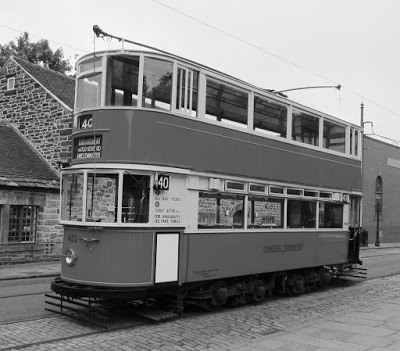
LCC tram 1622, 2015
Of course it made perfect sense to extend Well Hall Road up from Sherard Road making a more direct route from Woolwich to the High Street.

And it made equal sense to start a tram service.

If I travelled on the old trams I have no memory, although Dad told me we made a special trip to see the last one arrive at the New Cross depot in 1952.

Sadly I can’t remember, and nor did he take a picture.

All of which just leaves the shelters as a testament to what had once been.

Location; Eltham, London

Painting; the tram sheds Well Hall Road © 2017 Peter Topping from a photograph by Jean Gammons circa 1977

Web: www.paintingsfrompictures.co.uk

Facebook: Paintings from Pictures https://www.facebook.com/paintingsfrompictures

Picture;  LCC tram 1622, 2015, Crich Tramway Village courtesy of Andy Robertson


Tuesday, 24 March 2026

A blue plaque for Mary Clarke ……….. resident of 8 Alpha Place

Now, I don’t think I will ever find Mary Clarke.

Alpha Street, 2003
In 1853 she was living in the cellar of number 8 Alpha Place, which with Omega Place and Fogg’s Place formed a complex of back to back housing consisting of 32 cottages and fifteen cellars inhabited by 208 people.*

The three streets were bounded by Commercial street to the south and Jordan Street to the east and are just off Deansgate in Knott Mill.

I am not even sure how long she was there. Two years earlier she doesn’t feature on the census return and in 1854 she has gone.

And so far, while there are plenty of Mary Clarke’s living across the city in the 1850s, it is unclear which might be her.

Alpha Street, 1849
Nor am I surprised, because Alpha Place was another of those small streets where “poverty busied itself”.*

In 1853 it attracted the attention of the Manchester and Salford Sanitary Association which drew attention to the poor housing and lack of sanitation.**

I can’t be sure when they were built, but the first entry in the Rate Books for Commercial Street is 1836 and for Jordan Street the following year. 

All 32 properties were back to back and consisted of two rooms with the addition of a cellar.

Mary Clarke paid just 1/6d for her cellar room while the going rate for the houses ranged from 2/5d to 2/8d, which was a substantial chunk of a weekly wage.

For as along as I can remember the area has been a car park and back in the 1980s it was still possible the exposed lines of the brick walls.  On my last visit the car park had been given a make over and the evidence for those walls had vanished under tarmac.***

Alpha Street, 2022
Which is pretty much how I left it.

By the start of the new century the area had been fenced off, gained an odd-looking single-story hut in 2008, which subsequently vanished behind another fence, and since then the fences have slowly deteriorated.

Andy Robertson was down there a few days ago and pondered as he took pictures, that there was “Plenty of room for at least two 95 storey tower blocks”.

But a search of the planning portal has revealed no development plans.

So, for now the site which was home to Mary Clarke, John Fletcher, Ellen Hoole, James Brooks and another 204 people remains and empty space.

Alpha Street, 2022
Of course, I know that there will never be a blue plaque to remember Mary Clarke, but perhaps there should be, if only as a reminder of the thousands of unknown residents across the city, who lived, and worked in the menial jobs, and many of whom lived on the margins of poverty.

They are less the people who history has forgotten and more those who were never even recognized.

Location; Manchester

Pictures; Commercial Street, Omega Street, 2003 from the collection of Andrew Simpson and area in 1849 from the OS for Manchester & Salford, 1842-49, courtesy of Digital Archives Association, http://www.digitalarchives.co.uk/ and in 2022, from the collection of Andy Robertson


*Robert Roberts, The Classic Slum, Salford Life in the First Quarter of the Century, 1971, Pelican edition 1973

** Report of the Manchester and Salford Sanitary Association 1853

***Commercial Street, https://chorltonhistory.blogspot.com/search?q=commercial+street