Wednesday, 4 June 2025

In the kitchen ……………. in 1959

Now I had all but forgotten this metal food processor.

Long before the swish big electric models, most homes had one of these.

Ours was used to mince the meat from the Sunday roast, and I suspect everything else.

It was made of metal, was operated by hand, and sat on the kitchen table.

Unlike this one, ours had a clamp, which meant that when it was not in use it would be stored away, freeing the table for other uses.

And like so many objects from the family home, I have no idea what happened to it.

I do know that in the fullness of time the basic gas cooker on the left of the picture was replaced by a similar model on the right.

Mum and Dad, I recall bought into a Cannon cooker around 1963, which survived the move from Peckham to Well Hall and lasted well into the 1980s.  Its novel feature was that it had the grill above the hob, which at the time we thought was quite neat.

All of which leaves the source for the picture, which comes from Manchester and was one of three featuring the food processor.

I am not sure why they were taken but I suspect they were part of a series focusing on modern kitchens.

In these energy conscious days, I rather think I would like a hand operated model, if only because they were so easy to use.

At which point I am sure someone will provide advice.

And they have, Barbarello pointed out that a modern version is now being sold, and more than a few have pointed out that we called them a "mincer" which I thought was just a name unique to our family.

Then to finish off Chris Payne sent over a picture of his family mincer, which I instantly recognised as the model we had in or house.

Location; Manchester

Picture; the food processor or mincer, 1959,"Courtesy of Manchester Archives+ Town Hall Photographers' Collection", https://www.flickr.com/photos/manchesterarchiveplus/albums/72157684413651581?fbclid=IwAR0t6qAJ0-XOmfUDDqk9DJlgkcNbMlxN38CZUlHeYY4Uc45EsSMmy9C1YCk 

 , and the more humble one, from Chris Payne, 2020

Monday, 2 June 2025

Lost in the attic .............. a new collection of photographs of Chorlton........ nu 1 Whitelow Road

This is Whitelow Road sometime in the early 20th century and with the picture comes one of those intriguing little stories.

It is one of a collection of images which were donated to St Clements Church and were found in the attic of a house.

And that is about all I know of the history of the twenty or so photographs of Chorlton.

All except one date from sometime after 1900 and measure 25.5 cms by 42 cms and have been reproduced from picture postcards.

I would love to know who went to all the trouble of first collecting and then enlarging the images and later storing them away.

Now there will be a story there but I doubt it will ever come to light.

So instead I shall concentrate on this one which shows a gang of labourers at work.

I don’t have a date but the company whose name plate appears on the steam engines was Davies Brothers, Asphalt Road Makers who were listed in the 1911 directory with an office on Princess Street and a depot on Green Lane.

Green Lane ran from Brook Street to the Garratt Bridge by the River Medlock in Chorlton on Medlock and long ago was swept away by new developments which included the old BBC Broadcasting building.

What makes the picture interesting is that it is one I have never seen before and comes with a companion photograph which also shows Whitelow Road with the same team of workmen.

Both contain a wealth of detail from the steam engines, barrels of tar to the wooden sets and the large number of labourers.

This was after all at a time when much of the work still relied on muscle power and so despite the steam engines it was still down to shovels, wheelbarrows and a lot of effort.

But the pictures also include that small band of spectators who have been drawn to the scene.

Like the workman they stare back at the camera with that mix of poses, some stopped in their tracks, a few looking curious and the rest those who just can’t miss the opportunity to be in the picture.

And of these the one I am drawn to is the chap in uniform pausing with his parcels to be caught on camera.

Now I am sure there will be someone who can help explains the use of the long wooden beam across the road and others who will want to speculate exactly where along Whitelow Road the pictures were taken from so I shall close by reflecting on how many more pictures of old Chorlton are sitting in attics across the township.

Pictures; Whitelow Road date unknown, from the Simpson Collection


Sending our 10 year olds out to work in 1911

It used to be fashionable amongst some writers to lament the passing of the Edwardian Age, that short period between the death of the old Queen and almost the start of the Great War.

It can still be paraded as an elegant and almost innocent time which would soon be shattered by the horrors of a continental war which accounted for the deaths of ten million people.

And of course it all makes good telly from costume dramas to high budget films, from those images of sophisticated Edwardian men and women gliding past us to the protests of the suffragettes and a wave of industrial unrest which saw troops dispatched to many of our major cities.

Rarely do the dramas go out of the fine houses and even when they descend to those who lived downstairs we are rarely confronted with the full range of social inequality where in the words of Robert Roberts, “poverty busied itself.”*

The life expectancy of a manual worker was just 50 while for women it was only a little better.
 Life could be an uncertain struggle where illness, unemployment or the death of a wage earner could push a family into poverty and the workhouse.

And even while in gainful employment that family found it increasingly hard to manage as prices rose steadily from the 1890s but wages failed to keep pace.

Manual earnings amounted to sixteen or seventeen shillings a week compared to that of someone in the middle classes who might earn £340 a year.

So some at least surrendered to the option of allowing their children to start work at 10 and while this might not have surprised their grandparents it was shocking enough.

A full 9% of our young people between the ages of 10 and 14 were at work in the middle of 1911 which in the case of boys rose from just 1% of those aged 10-12 to 30% of those who had reached their fourteenth birthday.**

Against this we should perhaps pitch that simple statistic that the richest one percent held 70 percent of the wealth of the country.

Now in time I am going to explore in detail just what these young Mancunians did for a living and draw not only on the official records but the words of the young people themselves.

*Robert Roberts, The Classic Slum page 18

 **Occupations, Manchester 1911 Census Vol 10 page 230


“The Moat, Well Hall”.......... sometime around 1903

The caption just says the “The Moat, Well Hall” and I just love this picture.

It comes from Some Records of Eltham which was published in 1903 and written by Rev. Elphinstone Rivers who was vicar of the parish church from 1895.*

In time I will go digging for more on the author but at present I am marvelling in this old book which my sister Jill found.

The chapters cover the early history of Eltham, include a heap of old documents and some fine pictures which brings me back to this one of Well Hall.

I guess it will have been taken when Edith Nesbit was in the big house which fronted the main road.

This had been built in 1733 and survived until 1930.

I like what the Rev. Elphinstone Rivers wrote about the spot, "seen from the roadway, the present comparatively modern farm house does not strike the beholder as being of great interest.

The old fashioned cottages a little to the north are of a
much more picturesque character.

If one takes the trouble to enter the farmhouse-yard, however, and walk around the back of the stables, he will encounter a fragment of an antique moat and just beyond he will see a picturesque gable end and chimney stack of ancient brickwork which formed a portion of the venerable mansion of the Ropers.

The spot is beautifully quiet one, and should be visited if one wants to see it at its best, when the setting sun is dipping behind the western horizon lighting up the quant old brickwork with a ruddy glow and filling the glass panes with a golden blaze of brilliance.”

Now for that alone I am pretty pleased our Jill found the book, and I rather think there will be more from Rev. Elphinstone Rivers.

Alas the identity of the man sitting by the moat will I fear never be discovered, but then I haven't read through the book so we shall see.

Picture; of the Moat at Well circ 1903, from Some Records of Eltham


*Some Records of Eltham 1060-1903, Rev. Elphinstone Rivers, 1903


Sunday, 1 June 2025

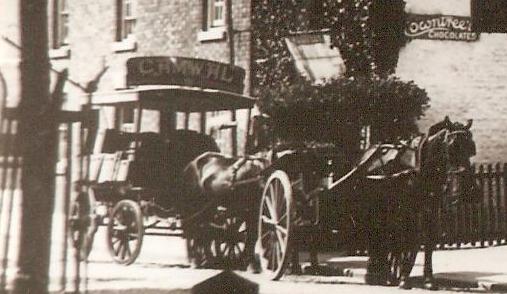
Summer days in south Manchester No 6 late morning on Chorlton Green in 1912

Chorlton Green was always a favourite of the travelling commercial photographer, and this one turns up again and again.

What makes it more fascinating is the detail.

Just behind the woman and pram is an advert for the Pavilion which was on the corner of Wilbraham and Buckingham Roads.

It was our first cinema and opened in 1904, and despite stiff completion from the two purposes built picture houses on Barlow Moor Road and Manchester Road limped into the 1920s before closing down.

But I am also drawn to Mrs Gertrude Green sweet shop at number 5 Chorlton Green and the delivery cart for Camwal which may have been unloading mineral water and soft drinks to her shop.

The firm had begun in 1878 as the Chemists' Aerated and Mineral Waters Association Limited and by 1895 had factories in London, Bristol, Harrogate and Mitcham.

It can’t be sure but it is likely that around 1901 they changed their name to Camwal or were taken over. Those wooden heavy crates would still be used well into the middle of the century for transporting various soft drinks and beers.

Now number 5 looks small and in 1911 it consisted of just three rooms. Fine for Mrs Green who was a widow and lived alone but two decades earlier it had been the home of the plumber James Moloy his wife and four children.

Today the house is bigger but looking again at our picture back then some of number 7 appears to run behind it but just how the internal geography of the two works has yet to be revealed.
Having said that our picture has not yet given up all there is to learn.

Until late in the 19th century the pub was just the space either side of the entrance at number 9 and as late as the 1891 census there were families in numbers 11, and 13. And you might think that when the picture was taken this was still the case.

The fence extends along the rest of the row and separates these properties from the pub. But by 1901 all three were described as the Horse and Jockey which may have happened soon after the death of Miss Wilton who had lived at number 13 and died in 1896.

I would still like to know who owned the horse and cart in front of the Camel delivery vehicle, and whether the woman pushing the pram was the child’s mother or one of the many servants who were employed here in the years before the Great War.

Location; Chorlton Green, 

Picture; from the Lloyd collection, undated

Annot Robinson ........ revisiting a remarkable woman

I have decided to revisit Annot Robinson*.


Mrs Annot before her marriage to Sam Robinson
I first came across her   in an excellent account of her contribution to Manchester politics in the early 20th century.**

Just weeks before I had  been reading some of her correspondence to the Daily Citizen in 1915 on the exploitation of woman in the workforce. 

“Women” she wrote “will most certainly have to take the place of men.  

There is already a shortage of men workers in Manchester  but so far as I am aware no women taking on a man’s work will be receiving a man’s wage.“***

She had been born in Scotland in 1874 married and moved to Ancoats in 1908 and returned to Scotland in 1923 where she died two years later.

She had become active in Scottish politics in the 1890s and by 1895 was working for the Independent Labour Party in Dundee.

Annot Robinson speaking at a Suffragette meeting circa 1910 with her daughter
“She entered a marriage based at first on love and shared political ideals but which was ultimately disastrous. 

Subsequently living as a single-parent in an unaccepting age, she struggled in support of her chosen and unpopular causes, a constant and active member of the ILP and at different times of the WSPU, the NUWSS and the Women’s Labour League (WLL), Women’s War Interests Committee, Women’s International League for Peace and Freedom, an ebullient speaker and tireless traveller and twice a candidate in local elections.”****

All of which was set against the backdrop of being “at first the family bread winner and then a single parent of two young children.”*****

And at this point rather than just lift Ms Rigby’sresearch I shall point you towards the article and in the fullness of time return to Annot Robinson when I found out more myself.

Pictures; Annot  before she married Sam Robinson, and Suffragette meeting in Manchester, circa 1910, Annot Robinson standing.  The baby is her daughter, Cathy.  From ANNOT ROBINSON: A FORGOTTEN MANCHESTER SUFFRAGETTE

*Annot Robinson, http://chorltonhistory.blogspot.co.uk/search/label/Annot%20Robinson

**ANNOT ROBINSON: A FORGOTTEN MANCHESTER SUFFRAGETTE, Kate Rigby, Manchester Regional History Review, Vol 1 Nu 1 Spring 1987,
http://www.hssr.mmu.ac.uk/mcrh/files/2013/01/mrhr_01i_rigby.pdf

***"no women taking on a man’s work will be receiving a man’s wage" ............stories from the Great Warhttp://chorltonhistory.blogspot.co.uk/2014/10/no-women-taking-on-mans-work-will-be.html

****ibid Kate Rigby

***** ibid Kate Rigby

Letters to the Daily Citizen, courtesy of the Labour History Archives & Study Centre,  at the People’s History Museum, Manchester, http://www.phm.org.uk/


Saturday, 31 May 2025

Fast food for the workers on our Victorian streets


The morning routine here begins at 6 with the first espresso moves on pretty quickly to those who want breakfast and by 8 it’s just me and the washing up.

And because I am soft for as long as I can remember it has been breakfast in bed, and yes even in this age of central heating and the internet there are hot water bottles before bedtime.

We take for granted that breakfast was and still is for many something you have at home but this has not always been the case.  Throughout history people and it does tend to be the poor have eaten out, often from fast food vendors and not I suspect always out of choice.

You can pick any one of a number of reasons, which usually come down to the early start of their day or the simple fact that the means to cook much in a shared room was limited.

The extent to which people ate on the move is revealed in The Victorian City, Everyday Life in Dickens’ London by Judith Flanders*

I got it for Christmas and it perfectly complements my own interest in the Chorlton of the first half of the 19th century.  We were a small rural community with strong links to Manchester and so her book is a good contrast to our own life here in the countryside and by extension an introduction to what was going on just 4½ miles away in the big city.

So while today eating out can be expensive and a life choice, back in the early 19th century it was pretty much of a necessity.  Most of the working class lived in rooms not houses with just a fire place for rudimentary cooking extending to boiling a kettle or a pot of something, and anyway lighting a fire was a costly affair which would then continue to burn long after everyone had left for work.  Likewise water was not always readily available and might only be available from a street pump and then not all the time.

On the way to work there were the coffee stalls which had the added bonus that in cold weather the mugs would warm the hands as well.

Some stalls were just simply a board laid over a pair of sawhorses and a can of coffee kept warm by a charcoal burner and others elaborate tent like structures.  A cup of coffee and “two thin” – two pieces of bread and butter might cost half a penny.

And there is much more but then having become an author I am outrageously in favour of people buying the book so I shall say no more other than it is a fascinating read.

*Flanders, Judith, The Victorian City Everyday Life in Dickens’ London, Atlantic Books, 2012

Picture;  Hot food on sale on the streets, the pictures date from the 1890s which takes them a little out of the time frame of the book, The Infirmary Corner at the top of Market Street, The Rovers Return, Shudehill, and Angel Meadow,  by H.E. Tidmarsh from the book Manchester Old & New , Arthur William Shaw 1894