Showing posts sorted by date for query hulme hall road. Sort by relevance Show all posts

Saturday, 20 December 2025

Mrs Nellie Davison at Well Hall .......... stories behind the book nu 27 making the connection

An occasional series on the stories behind the book on Manchester and the Great War*

Places Nellie would have visited, the parish church, 1915
By now I shouldn’t be surprised at how what seem random bits of history have a habit of becoming entangled and by degree draw me into the story.

Of course I know that theory that you are only seven handshakes away from  the great and the famous but I was not prepared for just how close I came to a couple who lived in Manchester during the Great War.

They were George and Nellie Davison who were married in 1908 and settled in Romiley after living here in Chorlton-cum-Hardy and in Hulme.

George Davison enlisted in 1914, spent time in Woolwich and Ireland and died on the Western Front in 1918.

Duncan and Nellie Davison circa 1916
Over the last three years I have slowly worked my way through the letters he sent and a collection of his photographs, papers and medals.

Nellie spent time with him both in Woolwich and in Ireland which I thought must have been unusual but perhaps not.

And then yesterday I came across a comment from George that a Mrs Drinkal missed Nellie commenting that “she was lost" without the presence of his wife.  Now that letter was sent from Woolwich which offered up a tantalizing clue as to where Mrs Davison stayed and perhaps where George was billited.

Well Hall Road, 1915
And with the help of my friend Tricia from Bexleyheath we think we know where that house was.

Having found one link to a Mr Drinkal I passed the task over to Tricia who came up with the goods

He was she told me “living at 7a Elmbrook Street which appears to be hutments on the site of where the Well Hall Odeon later stood.

William Henry Drinkal and Hilda May Garrod were married in 1916 at Dunmow in Essex and had their first child in 1917.”

All of which fits because a W H Drinkhall witnessed George’s will in March 1918.
Now I know the spelling is different but the coincidences are too close and so I can now place our Nellie in Eltham in 1916 on Well Hall Road.

And the real prize for me is that the Drinkal home was just minutes from 294 Well Hall where our family lived from 1964.

294 Well Hall Road, 2015
So there you have it.......  half a century may separate me from George and Nellie but there is the link.

It would be easy get a bit silly about the connection but for someone who has spent the last few years getting to know Mr and Mrs Davison, sharing their ups and downs and his final fate there is something powerful in knowing that we share the same place.

All of which just leaves me to thank Tricia, and remind  those who live in Manchester that the George Davison collection will be part of the exhibition in July to commemorate the Battle of the Somme in the Remembrance Lodge in Southern Cemetery.

Research by Tricia Leslie

Location, Well Hall, Eltham, London

Pictures; from the collections of David Harrop and Andrew Simpson

Painting; 294 Well Hall Road, © 2015 Peter Topping


Facebook: Paintings from Pictures https://www.facebook.com/paintingsfrompictures


Wednesday, 13 August 2025

Three Forgotten Graves .... another story from Tony Goulding

This memorial to Helen Richmond Cox is one of three situated alongside a boundary wall of the old St. Clement’s churchyard in Chorlton-cum-Hardy. 

 Memorial to Helen Richmond Cox

All three are to a greater or lesser extent obscured by vegetation. Not that any actually mark their remains nor even the site of their graves. 

All the bodies in the graveyard were exhumed in 1930 and reinterred in Southern Cemetery then in the 1980s when Manchester Council decided that graveyard was in a hazardous state and needed to be landscaped, most of the memorials were removed then either destroyed or haphazardly replaced. 

Esther Floweth’s memorial
Some were laid flat to form a pathway with others replaced as ornamental features.    

One of the other gravestones records the birth and death of another child, Esther Floweth, who died on 1st March 1868 aged just 5 years and 9 months. The third is of Anne Ormrod, who was 80 years old when she died on 9th June 1867 while visiting her daughter on that forgotten road of Chorlton-cum-Hardy, Lloyd Street.

None of these three burials were of a parishioner of St. Clements. Although Ann Ormrod was residing in the parish when she died, she was a native of Bolton, Lancashire. 

Helen Richmond Cox hailed from Stretford, and Esther Floweth lived in Hulme, Manchester. This is not at all unusual, as of the 841 burials recorded in St. Clement’s burial register between 1st January 1851 and 31st December 1876 only 320 show their “abode” as Chorlton-cum-Hardy. 

This comprises just 38% of internments.  However, closer examination reveals that with the expansion of the township’s population the trend from1860 onwards was for a gradual increase in the percentage of “local” burials.

Ann Ormrod’s gravestone
While many of those buried who were not residents of St. Clement’s parish were from neighbouring  townships of Didsbury, Withington, and Stretford the majority were from further afield. Hulme and to a lesser degree Chorlton-on-Medlock were the main areas although, Ardwick, Pendleton, and Salford also featured. There was even a small number whose homes were given as much further away in places like Blackpool and Everton!

The large number of non-resident burials obviously made a substantial contribution to the pressure which forced the Home Office to close the graveyard (1) following an enquiry on 25th November 1881.

It is impossible to know the motives involved in these choices to inter a loved one in Chorlton-cum-Hardy, but it is fun to speculate. One reason could be antagonism towards their local vicar leading them to worship in St. Clement’s. 

It could be a combination of the desire, with the industrial spread of Manchester during the middle of the 19th century, for a more idyllic place to bury loved ones offered by the still rural Chorlton-cum-Hardy and the opportunity for some extra revenue for the parish the burial fees would provide. 

Finally, it has been suggested that in some instances there was either no local church or one with a very limited if any graveyard. Some also will have had relatives buried in St. Clement’s. This was the case with Maria Birley of Southport, Lancashire, the widow of Rev. William Birley who had been appointed St. Clement’s first Rector on 17th February 1843 and served in that post until December 1859. (2)     

In this category also is the burial of Frederick Cope on 26th February 1874 whose home address was by far the most distant. After a successful career as a wine merchant in Manchester, when he resided for a time at Oak Bank, Chorlton-cum-Hardy, he retired to his birth county, Warwickshire, viz, Campion Lodge, Leamington. Following his death there on 19th February 1874 his coffin was brought north, and he was interred in the same grave as his wife Elizabeth and two of his children Emily Simms and Frederick Adam (3)

To conclude, like Ann Ormrod, one of the Blackpool residents, William Hughes, was also a visitor to the area. In his case after attending a sale in Manchester he intended to call at Barlow Hall hoping to get a position there and to look-up some old friends in the area he knew from his previous work as a coachman at the Hall, for Sir William Cunliffe Brooks. 

Barlow Hall - 1910
The unfortunate man was “found drowned” that being the verdict of the inquest into the circumstances of his death held at Jackson’s Boat on 17th December 1864.

The matter was widely reported in the press as he was found in “The Moat” a pit in the garden of the home of a prominent banker Conservative M. P. and a Baronet!

Pictures, Barlow Hall – 1910 by Jenny Wylie http://www.british-history.ac.uk/image.aspx?compid=41427&filename=fig99.gif&pubid=288, others from the collection of Tony Goulding.

Notes: -

1) The order prohibited the opening of new graves and only allowed burials of those with a family plot and only if there was sufficient depth to adequately cover the coffin. The final burial was that of Thomas Caleb Butcher on 25th February 1916. (Blog story 22nd August 2020).

2) Rev. William Birley had become an inspector of schools and was the Rector of St. Stephen’s in Pendleton, Salford when he died on 27th July 1865, he was interred in his previous parish’s graveyard. Interestingly the entry in the burials register of St Clement’s shows that his abode was first entered as Chorlton-cum-Hardy before being amended to Pendleton.

3) Both of Fredericks children buried in this grave died young. His daughter, Emily Simms was just 13 years old when she died in April 1846.  Frederick Adam, his only son, died in a tragic suicide when he shot himself in the evening of Friday 1st July 1853. (Blog story 24th October 2015)


Monday, 11 August 2025

Welcome back Kemp’s Corner ….. you have been missed

To all those who remember meeting up at Kemp’s Corner and the many more who only know it as part of the Four Banks I was pleased to see the development on the former HSBC  has adopted the name Kemps Corner.

Kemp's Corner is back, Wilbraham Road, 2025

Pedant’s will no doubt remark on the missing apostrophe but it’s a recognition of a bit of our past, because here on the corner of Barlow Moor and Wilbraham Roads was Harry Kemp’s chemist.*

Mr Kemp is listed in the Rate Books as present in the property from 1886, went on to open another pharmacy on Beech Road and had previously occupied a shop on Stretford Road.

And he was an enterprising individual.  

In 1900 he applied to be granted the Freedom of the City of London “by redemption of the Company of Spectaclemakers of London", was elected to the Manchester City Council in 1904, and published his own Chorlton Alamanak and Handbook in 1910.

Added to all this he was also an agent for Sutton & Co Parcels office and a regular correspondent to the newspapers.

So I am not surprised that he erected a large clock above the door of his chemists, which quickly became a popular meeting place.

In the age before mobiles, Kemp’s Corner was the place to arrange to meet, with that added bonus that if your companion was late you could admonish them by pointing to the clock face.

Just when the term Kemp’s Corner came into common use is unclear but throughout the 20th century it was in use.

A name still in use, 1978
As late as 1978, the local newspaper referred to Kemp’s Corner in an article on the redevelopment of what was once the Midland Bank into the former Chemist, leading with the headline, “Kemp’s Corner is having a facelift”.

All the more remarkable as the chemist had long ago past out of Harry Kemp’s ownership, was for a while a Co-op Pharmacy and was briefly a fast-food outlet.

And there are still plenty of people who remember the corner as Harry Kemp’s as there will be more who knew it only as only one of the corners of “The Four Banks”

I like the way that places get names reflecting their usage or location which often defy the official name.  

More than just a chemist, 1910

So, in the same way the junction of High Lane, Sandy Lane and Barlow Moor Road were known as Lane End during the 19th century which made perfect sense, more so as Barlow Moor Road had been Barlow Moor Lane.

Kemp's Corner, cieca 1900
Well done the developers for bringing back Kemp’s Corner, although like my friend Tony Goulding I am a little puzzled at addition of "Est 1878" which accompanies the pained sign.

Now Harry Kemp didn’t wash up there till 1886, and the building post dates 1881 when the Withington Board of Health’s map records the land as an orchard.

And while he was practicing as a chemist in 1881 it was from a business in Hulme.

But I guess the developer knows something I don’t, leaving me just to observe that in 1845 the land was known as Hollingworth Acres and was an orchard owned by the Egerton’s and farmed by a Francis Dakin [Deakin]

And that is that.

Other than to say the return of Kemp's Corner may prempt the call for officialy naming the junction The Four Banks which briefly was to the go to campaign on social media with the accompaying petition.

All that Mr. Kemp could sell, undated

I said at the time it was a name and campain to far, and then up pops Mr Kemp's legacy.

And incidentlty Harry Kemp was elected to the City Council in 1904 and again the following year despite what the Manchester Guardian reported  had been "some personal elements introduced into the contestby his [Tory] opponent", along with "certain insinuationsregarding his actions on the City Council".**

When Mr. Kemp sought your vote, 1904


He retired six years later through ill health and was judged to be a hard working councillor not affraid to be controversisla as with his accusations of a "land grab" by a Withington developer in 1905.***

And he died in North Wales in 1927 leaving £9,892.9s.2d to his wife and daughter.

Slater's Manchester & Salford Surban Directory, 1903
Which I thought was the end, but then I decided to follow up Sutton & Co Parcels Office and found this, which will need more investigation.

Pictures;  Kemp's Corner is back, Anne Hall, 2025, [permission being sought], Harry Kemps’ chemist shop, circa 1900, from the Lloyd Collection, the 1904 election address, courtesy of Lawrence Beedle, Chorlton-cum-Hardy District Almanack and Handbook for 1910, courtesy of Manchester Libraries, Information and Archives, Manchester City Council, Otto of Rose tub top, date unknown from the collection of Jay Hurst, and news story from the Stretford & Urmston Journal, April 12, 1978 from the collection of Andrew Simpson

*Harry Kemp, https://chorltonhistory.blogspot.com/search?q=Kemp%27s+Corner

**Todays Elections, Manchester Guardian, November 1st, 1905 Chorlton-cum-Hardy & Whalley Range 

***Mr. Kemp on Workman's Wages, Manchester Guardian, November 1st, 1905

Sunday, 3 August 2025

The shop that had almost everything ………… Lord’s Wholesale Retail Stretford Road …… 1963

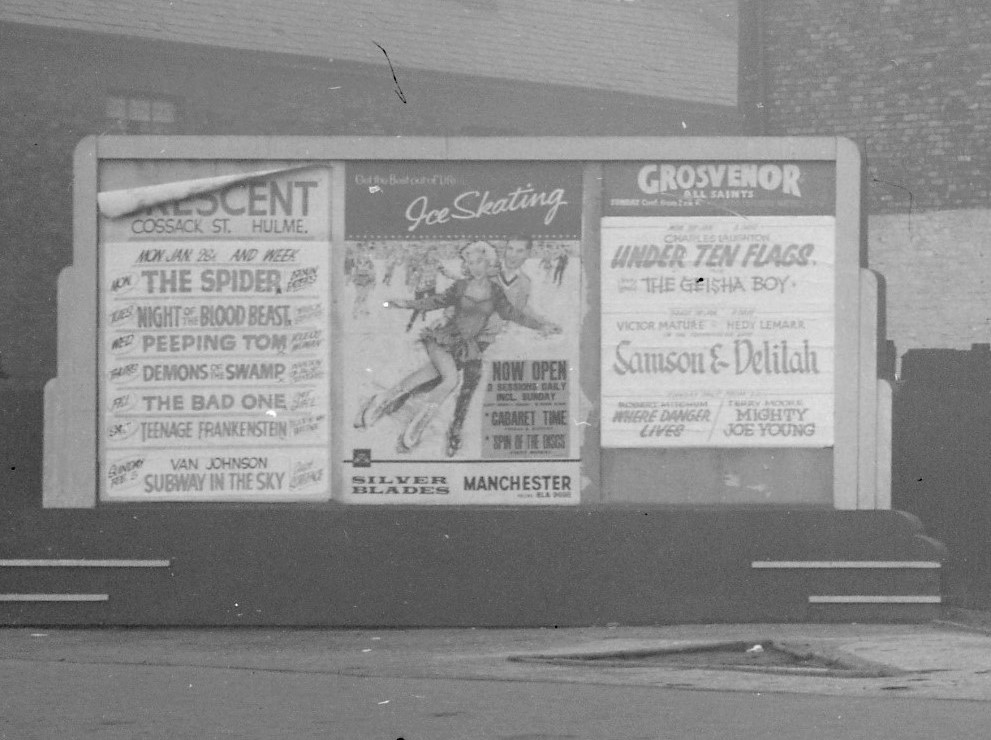
It took a little while to locate just exactly where we are on Stretford Road back in 1963, but I now know the shop on the corner is at the junction with Upper Medlock Street.

And if you were to head down Upper Medlock Street you would cross, Dale Street where the car is parked by the road sign and then Bonsall Street.

Back then it was part of a tight network of streets and terraced housing, all of which was swept away in the wholesale regeneration of the area in the 1960s and again more recently.

So much so that I suspect a time traveller from 1963 would be totally confused and at a loss to find that street corner.

Happily, Stretford Road and Bonsall Street survived and offer up a means of anchoring where the pictures were taken.

So,  with that sorted the rest of the story will be about that shop and the advertising hoarding.

Lord’s Wholesale and Retail shop was one of those places that pretty much offered everything in the way of clothing, from Donkey Jackets, moleskin trousers , to rubber boots and riding breeches, reminding me of that sign “If we ain’t got it, you can’t get it”.

I do have to wonder what demand there would be for riding breeches in Hulme, although given this was still the age of the sailing ship there might well be people wanting a cabin trunk.

That said there was a full range of things anyone might want to kit themselves out for work.

And having done work for the day, the advertising hoarding on the corner of Dale Street, gives flavour of what was showing at the cinema.  Judging by what the Crescent and the Grosvenor were showing that week, my choice would have been Samson and Delilah with Victor Mature and Hedy Lamar.

But the Grosvenor only held just over 900 seats, while the Crescent had a thousand, added to which Cossack Street was closer than All Saints.*

That said in 1963 I was just 14, and I rather think Night of the Blood Beast, showing on Tuesday, Peeping Tom and Demons of the Swamp, which followed on Wednesday and Thursday would have won over on Victor Mature, but all three, along with The Bad One and Teenage Frankenstein would have been X rated, to which I would have been barred.

But  I would have drawn the line at Subway in the Sky,  which was showing on Saturday.

The film centered on an American soldier in West Berlin who goes on the run after being falsely accused of trafficking drugs. He hides in his wife’s flat where he meets a cabaret singer who helps him prove his innocence.

And after a melodrama like that, there could only be a recourse to some fried bread, and Ovaltine, given that at 14 the joys of Wilson Ales were some years in the future.

At which point I should draw to a conclusion were it not for that beer advert, which has got me a tad confused.

As a south east Londoner, newly arrived in the city in 1969, I picked up the divide between north and south which came not by way of my accent or the dominance of the Home Counties in so many things but simply the shape of the beer glass.

My friends pointed out that those dimpled pint pots were a southern affectation and they would always demand a straight glass.

Such was the chasm between me and them.

Leaving me just to record that the church at the end of row of shops was the Catholic Apostolic Church.

Location’ Stretford Road

Pictures; Stretford Road, 1963, Courtesy of Manchester Archives+ Town Hall Photographers' Collection,  https://www.flickr.com/photos/manchesterarchiveplus/albums/72157684413651581?fbclid=IwAR35NR9v6lzJfkiSsHgHdQyL2CCuQUHuCuVr8xnd403q534MNgY5g1nAZfY

*Kinematograph Yearbook 1947

Saturday, 27 January 2024

Mrs. Beatrice Annie Bayfield another story from Tony Goulding

This is one of those stories which arise from an unintentional discovery while researching something completely unrelated.


I have recently written of this blog of the pioneering female journalist Madeline Alberta Linford; I have now discovered another, and in a quite remarkable coincidence she also lived on Claude Road in Chorlton-cum-Hardy, Manchester. Although perhaps not as illustrious as her fellow writer, Beatrice still has an interesting and important life story to reveal.

 Mrs. Bayfield was born Beatrice Annie Hodgson in the Hulme district of Manchester during October 1867 to   William Hodgson and Mary Ann (née Dawson). Her father was a Lancaster-born butcher who had, as recorded in the 1871 census, a butcher’s shop at 117, Stretford Road, Hulme, Manchester. The 1881 census record shows the family (1) had moved to 17, Moss Lane West, Stretford, Lancashire. A decade later in the census of 1891, William, by then a widower (2) and working as an "inspector of gas”, was living at 101, Crosscliffe Street, Moss Side, Lancashire with four of his children. Interestingly, while her older sister, Jessie Till, was recorded as a schoolmistress no occupation was entered for Beatrice Annie.

23, Beechwood Avenue, December 2023
An explanation of this is revealed by the Manchester Courier and Lancashire General Advertiser of Thursday 21st September 1893 which advertised the commencement in its Weekly Supplement of an extremely interesting original story entitled “The Mystery of the Mervyns” by Miss Beatrice A. Hodgson - “a young and accomplished local writer”. 

Beatrice was also very active in the Pankhurst's Women’s Franchise League, addressing many meetings around the greater Manchester area and the West Riding of Yorkshire. She was also a member of the Women’s Liberal Association. Both her advocacy of Women’s Suffrage and her Liberal political persuasion would I hazard to suggest have hampered her having further stories published in the chauvinistic and right leaning “Manchester Courier ------”.

Beatrice married Herbert Bayfield a “buyer foreign shippers” in the Chorlton Registration District during the December quarter of 1897. Newly-married the couple settled in Chorlton-cum-Hardy where they remained throughout the next 40+ years. Their first home was number 29, Whalley Avenue (off Sandy Lane), but the 1901 census shows they had moved to another rented property, 23, Beechwood Avenue, further along Sandy Lane. 

With Herbert, however, having a successful career in shipping (3) by 1911 the couple were able to purchase this large house on the edge of the newly developed garden village of Chorltonville, “Fern Lea”, 61, Claude Road. 

61, Claude Road, December 2023
Meanwhile, Beatrice continued in her endeavours promoting the extension of the franchise and women’s causes generally. She began travelling more widely, addressing meetings in Worcester, Coventry, Leamington Spa, Warwickshire and elsewhere. In the afternoon of Wednesday 6th May 1908, she shared a platform with Margaret Ashton (soon to be elected as Manchester’s first woman councillor) at a meeting in Manchester’s Co-operative Hall chaired by Dr. Rhodes, of Didsbury, to discuss a proposal to provide Nursery Training Schools for the city. (4)  At this time Beatrice styled herself as Mrs Hodgson Bayfield.

     Beatrice remained a life-long Liberal. During the first decade of the 20th century, she had toured giving a series of lectures to local Womens Liberal Associations some of which included a lantern slide show.  

In the 1911 census in which she was recorded as a lecturer and journalist her employer is given as The National Reform Union a body with strong links to the Liberal Party. Later in 1929 she stood, unsuccessfully, as the Liberal Party’s candidate in the Manchester (Gorton) constituency in that year’s General Election. She was one of just 61 women candidates (25 Liberal, 28 Labour and 8 Conservative) to stand in this landmark election, the first in the U.K. in which both sexes had an equal franchise. Beatrice continued her writing career alongside her political one. 

Once women had gained equal franchise with men in 1928, she turned more towards how that should be used to improve women’s lives. In the late 1920s and early 1930s she contributed letters and articles to “The Vote” the Organ of the Women’s Freedom League with the: - 

She also wrote for The Manchester City News whose issue of 13th November 1937 reported that she had penned her first play and was going to produce it herself at St. Werburgh’s Hall, Chorlton-cum-Hardy. The two-act play was titled “Neptune and the Lifeboatmen” with the proceeds donated to the National Lifeboat Institution of which Beatrice was the President of its local Ladies Guild.

Mrs. Bayfield was a member of several public bodies. Amongst these were The Manchester Public Assistance Committee and the Board of the Manchester and Salford Co-operative Society. The membership of this latter body caused her some difficulty when she stood in the Liberal cause in the 1929 election for which she sought advice from the editor and owner of The Manchester Guardian, the fellow Liberal C. P. Scott.

Mrs. Beatrice Annie Hodgson Bayfield died of a heart attack at her home on 17th January 1939 aged 71. She was cremated at the Manchester Crematorium on 20th January. Her estate was valued £524-18s-10d 

Pictures: - Mrs Bayfield candidate for Manchester Gorton from The Vote, April 27th courtesy of British Newspaper Archive, and “Objects----” of THE VOTE, from The Newspaper Archive on Find My Past. Others from collection of Tony Goulding.

Notes: -

1) The Hodgson family consisted of Beatrice Annie’s parents, and four siblings an older sister, Jessie Till, 

2) Beatrice’s mother died on 5th November 1884 and was buried in Ardwick Cemetery, Manchester. In the same grave were interred three of her children who died young William Lincoln (died 5/3/1867 aged 11 months) Ernest Dawson (died 1/12/1868 aged 4 years) and Mary Adelaide (died 1/4/1878 aged 10 months).

3) Herbert’s career appears to have involved widespread frequent travel as for both the 1901 and 1911 censuses he is absent from home. He was at home for the 1921 census in which his occupation is recorded as Managing Director of a Shipping Merchants.

4)  As reported in The Manchester Courier--------, the following day. The sub-heading for their story “Utopian Scheme Discussed” was indicative of “The Courier’s” usual stance on such matters.

While writing about this lady I became aware of how few women had featured in my stories for this blog to date. I am glad that this and my recent telling of Madeline Linford’s story have at least addressed this imbalance.


Saturday, 23 September 2023

See it while you can ……. the sudden appearance of Hough End Hall

Now for half a century or so Hough End Hall that Elizabethan family home has been hidden.

2015
But not for long, because as I write one of those huge slabs of a building is being demolished and for a while at least there will be views from Mauldeth Road West across to Nicholas Mosley’s grand old house.

At which point the more sniffy will sneer “but not for long because soon there will be a supermarket on the spot” following up with arguments against the siting of a Lidell on the site.

And that is true, there will be a supermarket where once a monument to 20th century office development once stood.

2023
To which I have to say, so what?  The estate opposite it has not been best served for shops for years.  There is the Co-op which I have always championed and some smaller retail outlets, but otherwise if you live off Mauldeth Road West it is a journey into Chorlton to Morrisons or further afield to Hulme or Didsbury.

Added to which there is plenty of false thinking about Hough End Hall, not least about what is left.

The interior was gutted, false ceilings added, and the upper floor was closed off, meaning that very little of the original features are there.

2023
And the restoration work undertaken to the exterior in the 1960s was according to the secretary of the Ancient Monuments Society “botched and included reconstituted stone for the mullions, sills and heads”. *

That is not to diminish a building which has been at the centre of Chorlton’s story since 1596, was the hub a of 250 acre farm for 250 years and more latterly was a restaurant and venue which is fondly remembered by lots of people. 

It was even in the 1950s and 60s the place where heaps of children gravitated to looking for sinister goings on amongst the decaying building.

2023
And I have to say it is a building I have a lot of time for and for which I wrote the book of its story with Peter Topping.**

Leaving me just to thank Andy Robertson who over the last few days was down there among the digger trucks, and piles of rubble recording the demolition.

ll of that said I am just a tad economical with the truth, because had you looked across along the processional way from what is now the park,at the edge on the right of the pictures would have been part of a long barn which extended up to Mauldeth Road West and along what was that demolished office block.

So not quite the view Sir Nicholas would have encountered. 

Location; Mauldeth Road West, Chorlton

Pictures; that office block in 2015 and now, from the collection of Andy Robertson 

*Bulmer-Thomas, Ivor, letter to the Manchester Evening News, January 1969

**Simpson, Andrew, & Toping, Peter, Hough End Hall the Story, 2015


Wednesday, 12 April 2023

Sharing a day at the Lloyds ….. with friends … some silly history …. a bit more

I have always maintained and maintained most strongly that you should always have some fun when launching a new book.

Books and a guest writer, 2023

My first one was in the Horse and Jockey and was accompanied by a folk group.

And since partnering up with Peter Topping, we have celebrated the launch of our books in local libraries, Ken Foster’s Cycle shop, an art gallery and a few times by the Narnia lamp post on Chorlton Green.

Reading the book, 2023
More recently we have been the guests of the Lloyds Hotel which has given us the large side room in full view of the rest of the pub.

Over the years we have invited a host of local singers and writers to perform at our events. 

They have included the artist and folk singer Susan Parry, the poet Melanie Neades and this time the writer Stephen Smythe.

It may seem odd that during the promotion of our own book we should want to share the moment with others, but that is part of the fun.

And there was fun this Easter Monday when the writer Stephen Smythe joined us.  He was born and grew up in Hulme and still lives locally.  

Stephen Smythe sharing hist stories, 2023

He came late to writing and is a master of the 40-word story which presents his take on life, often drawing on his own experience of family and work, and invariably concludes with a funny punch line.

One of my favourites revolves around a work mate who long ago acquired a nick name.

These have always fascinated me, like the day a school friend called Peter Driver, fell into the swimming pool fully dressed and was was for ever known as “Dribble”.

Lindy shares a moment with Stephen, 2023
And like the “Dribble" nick names arise out of a particular moment which then stick.  

They can be witty, sometimes a little cruel but always a clever observation on the character of the individual.

Stephen’s story was no exception and I can see why he has won awards in writing competitions and been invited to festivals.

He was warmly received at the launch, which leaves me just to mention our own book which is the fourth in the series of “nothing to do in chorlton”, and is entitled, The Lych Gate and Grave Situations Beyond

Like all our books it tells “the stories behind the doors”, concentrating less on the great and the good but exploring the lives of the “little people” who at best history has forgotten but mostly never even bothered to notice.

Friends and interested readers, 2023
People like Mary Crowther who was the last woman in Chorlton to do penance in St Clement’s Church, Samuel and Sarah Nixon who ran a beer shop on Beech Road for half a century and the unknown mother and child whose bodies were found underneath a side aisle of the church.

That said we do also acknowledge the important role of Thomas Walker who despite being an important Establishment figure in Manchester during the late 18th century campaigned for the abolition of the slave trade and was indicted for sedition for supporting the values of the French Revolution. 

He lived at Barlow Hall and was buried in the graveyard.  And for me what makes this collection of stories the most important to date is that it is linked to efforts to restore the parish graveyard, along with the Lych Gate which are in need of some tender care and attention.

At the Lloyds with the book launch, 2023

But all of that and more is in the book which is available from us at  www.pubbooks.co.uk  as well as Chorlton Bookshop.

Location; The Lloyds Hotel, Chorlton

Pictures; Easter Monday at the Lloyds celebrating the launch of The Lych Gate and Grave Situations Beyond, by Andrew Simpson and Peter Topping, 2023, from the collection of Andrew Simpson

Wednesday, 22 March 2023

So, when did they steal Chorlton’s name?

Now there is a bit of a debate on social media this week as to just when Chorlton-cum-Hardy, became just plain Chorlton.


Chorlton -cum-Hardy was the historic name for the township which was bounded by the Mersey on one side Hulme on the other and Withington and Stretford. 

It was made up of the townships of Chorlton, Hardy, and Martledge, and the name appears to have gone out of official and popular use sometime in the 1970s.

Just when that was is open to debate.  There are plenty of people who will remember growing up when the name was still in use, and I guess it will be a badge which distinguishes you from old and new Chorlton.

As does those who still use the term Rec rather than Beech Road Park.

I have yet to plot our official transformation to plain Chorlton but there will be some way of finding out, which I suspect will start with the post office, and post marks.

There may also be an official note in the minutes of the Corporation’s highways department but that will take a long time to find out.

In the meantime, I know that Hardy as a hamlet disappeared in the 1850s when the last cottages hard by the Mersey were abandoned, and Martledge which was the area around the library was lost in the big building boom of the 1880s.


So, within a couple of generations of that housing boom, the name Martledge had vanished and instead people talked about the New Village or New Chorlton to distinguish the area from the older settlement around the green and along Beech Road.

And for those intrigued by lost names, Beech Road had traditionally been called Chorlton Row and appears to have been renamed in the 1870s, while the area called Ash Tree which stood close to the Methodist Church was so called because of an ash tree which grew in the road.

Leaving me just to comment on Lane End, and the Flash.

The first was at the junction of High Lane, Barlow Moor Road and Sandy Lane, and made perfect sense given that until well into the early part of the 19th century, Barlow Moor Road was called Barlow Moor Lane.*

The Flash was where Manchester Road joined what is now Seymour Grove, and was also known as West Point.**


I could go on ….. adding Kemp’s Corner and Brundrett’s Corner to the list, along with the lost road names, but I won’t, and will just wait for the comment which offers up the definitive date of when we moved from Chorlton-cum-Hardy to Chorlton.

And reflect that as Chorlton cum-Hardy we have over the years been the butt of comic and music hall jokes and featured in that wonderful lament for the passing of the branch lines by Flanders and Swann in 1963 which included the memorable line, “No churns, no porter, no cat on a seat, At Chorlton-cum-Hardy or Chester-le-Street”***


Location; Chorlton-cum-Hardy

Pictures; Chorlton and Hardy, 1818, from Greenwood's map, 1818, the railway station, date unknown, rom the collection of Tony Walker, and the train route from Central Station south towards London from MILE BY MILE ON BRITAIN’S RAILWAYS, S.N.PIKE, published by Aurum Press Ltd, and original Mile by Mile on the L.M.S. 1947

*Walking in the north of the township through Martledge in the summer of 1847 part 2, https://chorltonhistory.blogspot.com/2013/05/walking-in-north-of-township-through.html

**West Point on the edge of Chorlton, https://chorltonhistory.blogspot.com/2017/10/west-point-on-edge-of-chorlton.html

***The Slow Train, Flanders and Swann, https://www.youtube.com/watch?v=U6OHD2uCpfU


Friday, 23 September 2022

The Lodge Family Grave …. another story from Tony Goulding

The inscription on this gravestone situated in the old St. Clement’s Churchyard, Chorlton-cum-Hardy is now very weather-worn and is becoming increasingly difficult to de-cypher. 

Indeed, I have been unable to make out the lowest portion and I issue a challenge to anyone to come up with the wording.

It marks the final resting place of two young daughters of Robert Lodge and his wife Mary (née Watkins). 7-years-old Grace Helen who was interred there on the 3rd January, 1856 having died the previous 30th December at her home on Dudley Road, Whalley Range and Winifred Beavan who was only 14 days old when she was buried on the 7th January, 1860. Grace Helen was baptised on the 15th January, 1849 in the parish church of Ashton-on-Mersey, Cheshire. 

In the baptismal register her father’s status is recorded as a “Gentleman” of Sale (Cheshire).  The census of 1851 records the family at School Lane, Sale, with the father’s occupation being given as “merchant (oil)”. (1) By this time a second daughter, Elizabeth, had been born in, 1850. Winifred Beavan was christened at St. Mary’s Church, Hulme on Christmas Eve, 1859, a sister, Isabella, had been christened in the same church on the 31st May of the year before.

St. Mary's Church, Hulme.
Robert Lodge, who was born in Halifax, West Yorkshire, in 1817, married Mary, the daughter of William Watkins (2) of Ardwick, Manchester, in Manchester’s Collegiate Church (now Manchester Cathedral) on the 5th August, 1847.

Following the tragic loss of his two daughters Robert and his remaining family relocated to North Meols on the West Lancashire coast. His still young, at just 38-years-old, wife died there soon after their arrival. Her body was returned to Manchester, and interred, on the 22nd November, 1860, in the same grave in Chorlton-cum-Hardy as her two children. The 1861 census shows that as well as Elizabeth and Isabella mentioned above Robert was left with three other children, all born in Whalley Range, Caroline Ann, 9, Alice, 7, and John William, 5. Completing the household at 166, Lord Street, North Meols were Robert’s unmarried sister, Alice and three servants.

In 1871, the Lodges were still in Lancashire at 11, Queens Road, Southport, however by then a further tragedy had hit the family as Caroline Ann, at only 14 years of age, had passed away in the June quarter of 1866. The household consisted of Robert Lodge, three of his children, Elizabeth, John William, and Isabella, and four servants. His daughter, Alice, was away from home at a boarding school for young ladies.

Upper Bishopdale
In retirement, Robert returned to his birth county becoming a “country gentleman” in Bishopdale, Yorkshire (North Riding). His house, “The Rookery” which he inherited in July, 1873 from his uncle Ralph, remained the family home for more than 30 years. (3)  He died there on the 12th September, 1888 leaving an estate of £12, 215-4s-7d. (£1.1 million at today’s value). 

Finally, the verse: -

 “He shall gather the lambs with his arm and carry them in his bosom” 

is from King James’s Bible, Old Testament -Isaiah 40:11

Pictures: - Lodge family grave, Chorlton-cum-Hardy, from the collection of Tony Goulding.

St. Mary's Church, Hulme by H. Milligan m70933 

Courtesy of Manchester Libraries, Archives and Information, Manchester City Council http://manchester.gov.uk/index.php?session=pass 

 Upper Bishopdale by Chris Heaton, CC BY-SA 2.0,

 https://commons.wikimedia.org/w/index.php?curid=3099436 

Alderman William Benjamin Watkins by George Patten (1801-1865) – (photo by Manchester Town Hall) Creative Commons Attribution-NonCommercial-NoDerivatives licence (CC BY-NC-ND). From Art U K website https://artuk.org

Notes: -

1)   Subsequent records describe Robert Lodge as a “Drysalter”

2)   Alderman William Benjamin Watkins J.P.;

Alderman William Benjamin Watkins

Alderman William Benjamin Watkins
Served as the 5th Mayor of Manchester 1845-1846. He was born in 1789 in Hereford, Herefordshire and married (Mary Lodge’s mother) Caroline Beavan in Herefordshire before coming to Manchester and setting up in business as a drysalter. Alderman Watkins resigned from office on the grounds of ill-health in August, 1862 and died during the June quarter of 1864. His widow survived him for over three years dying at their home Legh House, Legh Place, Ardwick, Lancashire on the 30th June, 1867.

3)    Robert’s son, John William, died at “The Rookery” on the 23rd August, 1917. He was “called to the Bar” of the Inner Temple on the 26th January, 1883.  Three days later, the 29th, January, 1883, after having previously graduated with a B.A. from Gonville and Caius College, Cambridge, the same college conferred an M.A. degree on him. While still at Cambridge he joined the British Army, being gazetted into the 3rd (volunteer) battalion of The Princess of Wales Own Yorkshire Regiment on the24th June, 1874. He remained an officer with this regiment for almost 40 years, including service in South Africa during the 2nd Boer War, before retiring, in 1912, as the Colonel in command of its 3rd Battalion.  At the outbreak of the First World War, he volunteered for war service and when he died was commanding the 2nd (Garrison) Battalion of The Yorkshire Regiment. He was a county magistrate and served on both the North Riding and District councils and an enthusiastic follower of “country sports”.

The estate passed to his sister, Elizabeth, the widow of Matthew Liddon, and following her subsequent death, on the 20th July, 1920, to her son, Major Matthew Robert Liddon. Major Liddon sold up the property the following year and its long association with the Lodge family came to an end.

Acknowledgements: - Find my Past’s Newspaper Archive and Thoralby through time https://www.thoralbythroughtime.net  which was a good source of data on the Lodge family and the “Rookery”. 


Wednesday, 14 September 2022

Walking Chorlton’s past ……. another in Andrew Simpson’s History Walks

Well next week sees the start of another Chorlton Book Festival.

Wilbraham Road, 1900, once Kemp's Corner and later the Four Banks
And yet again that will include the 13th annual history walk, where there will tales of dark deeds, silly stories and a place called Martledge. 

Together we will revisit a lost hamlet, encounter historic Chorlton individuals and uncover an awful murder.

All of which will help explain how Chorlton-cum-Hardy changed from being a small rural community on the edge of Manchester into a suburb of the city in just three decades.

Meeting at the former Four Banks at the junction of Barlow Moor and Wilbraham Roads we will take a gentle walk past some farms, the old Royal Oak pub, and a very interesting block of houses dating from 1832. 

The Sedge Lynn, once the Temperance Billiard Hall, 2017
Then by degree out across the Isles to gaze at the sight of the old Chorlton Ice Rink, catch a glimpse of the Lloyds and the story of the Great Chorlton Burial Scandal, to finish at the Edge Theatre on Manchester Road

Along the way there will be  murder of young Francis Deakin in 1847, the Hulme potato thieves and the amazing Mr Booth who lived at Sedge Lynn and took some of the first photographs of Chorlton.

All of which will help explain how Chorlton-cum-Hardy changed from being a small rural community on the edge of Manchester into a suburb of the city in just three decades.

The Isles, looking out to Longford Hall, circa 1880
In those thirty years the fields, farms and market gardens gave way to rows of tall houses, banks, posh shops and a railway. 

So complete was that transformation that the old name of Martledge was lost and people referred to it as simply New Chorlton.

We will meet outside the MR Floors Tile shop on Sunday September 18th at 2 pm.

The cost is just £7.50 which includes heaps of history, some interesting people and refreshments at the Dressing Room Café on Manchester Road after the walk.

Tickets are available from https://www.ticketsource.co.uk/chorltonbookfestival

Location; Chorlton

Pictures; Wilbraham Road, circa 1900 and the Isles, circa 1880, from the Lloyd Collection

Painting; Sedge Lynn, 2017, by Peter Topping, Paintings from Pictures, www.paintingsfrompictures.co.uk

Friday, 8 October 2021

The Arts in Chorlton-cum-Hardy ...... another story from Tony Goulding

As a celebration of the recent Chorlton-cum-Hardy's Arts festival, I decided to investigate some of the area’s past artistic connections. 


As I have previously written here (1) of Thomas Mostyn’s art school (now the Buddhist’s World Peace Café) and the three Knowles siblings, artists who lived in the house which is now Our Lady and St. John’s Parish Centre on the corner of High Lane and Chequers Road.

 I have also written of The Oaks Music School on Wilbraham Road run by the Haigh family (who, coincidentally were related by marriage to the Knowles’s) (2) 

Knowles's residence on High Lane

This time I have decided to look into the area’s theatrical heritage.

Picolo Theatre 

"Chorlton-cum-Hardy" Con Club

The Picolo Theatre was a short-lived theatre company which, aided by a grant from the Arts Council, performed a number of plays at Chorlton-cum-Hardy's repertory theatre (3) based in the public hall on the upper floor of the Conservative Club on Wilbraham Road in 1954

This was a serious professional company as is indicated by the plays they put on that season. 

They opened with “Mistress of the Inn” a comedy by the 18th century Italian playwright Carlo Goldoni. 

Their repertoire also included J. M. Synge’s “Playboy of the Western World”, “The Barber of Seville” by Beaumarchais, Shakespeare’s “Twelfth Night” as well as two somewhat lighter offerings, “Treasure Island” and “Dial “M” for Murder”.

The personnel involved, both acting and off stage included many who became well-known names later in their careers. One of the actors was Patrick Wymark, who played in a starring rôle in two popular T.V. shows of the mid-1960s, “The Plane Makers” and “The Power Game”.  Another was Eric Thompson who found fame as the voice of “The Magic Roundabout” for which he also provided the English commentary. His two daughters also became accomplished actors, the multiple Academy Award winner, Emma, and her younger sister Sophie, also an award winner (Olivier). (4) A third cast member, Mike Morgan, had just had his big break into films, playing alongside Sir Alec Guinness, when near the completion of his second film he was taken ill with meningitis and died tragically young, aged 29.

Design sketch of Manchester Royal Exchange Theatre 1976

The leading female actor was Avril Elgar who was newly-married to fellow member of the company James Maxwell. Avril has been prolific in her appearances on Television over nearly half a century. She passed away, sadly only a few days ago on the 17th September, 2021. Her husband, James, acted too on television and in films but it is his Theatre work which is most well-known particularly in this area. Initially with his work, as both actor and artistic director, with the 69 theatre company based at the Manchester University Theatre and, following the success of that venture, the development of Manchester’s Royal Exchange Theatre, for which he was a co-founding art-director

Another of the co-founding art directors and the designer of the theatre itself was also a former Picolo Theatre member, Richard Negri. All of the company had been trained at the Old Vic Theatre School in London founded by George Devine who was the director of the Picolo Theatre’s first production. A director of some of its later shows was the company’s founder Frank Dunlop; now 94-years-old he has directed in London’s West End, on New York’s Broadway, the opera, Carmen, at the Royal Albert Hall, and for eight years (1984-91) ran the Edinburgh Festival.

 Hon. Secretary of the Chorlton-cum-Hardy theatre club at this time was Cecil Walkley Lloyd of 32, Cavendish Road, Chorlton-cum-Hardy, Manchester. Cecil was born on the 12th February, 1907. However, there is something of a mystery concerning his place of birth, the birth was registered in Hulme, Manchester but the 1911 census shows him as born in the Maida Vale area of London. His family were then living at Ashton Barracks, Ashton-under-Lyne, Lancashire where his father having completed 21 years' service in the army was working as the canteen manager. The family’s residence on the 11th March, 1908 recorded, on his discharge, in his father’s army records was 46, Beresford Road, Moss Side, Manchester

Cecil Walkley, trained to become a teacher at Chester teacher Training College, qualifying in 1927, when he started working, as an assistant master, at Christ Church Boy’s School. He later moved on to Heald Place Boy’s School, then Ladybarn Senior Boy’s School, Withington, Manchester. In the June quarter of 1936, at St Ann’s Church, Tottington Nr. Bury, Lancashire he married Mabel Lois Mary Peachment, the daughter of George Henry, a hairdresser and newsagent and Mary (née Barnes), an elementary school teacher. The couple had two children a son born in Stretford in the March quarter of 1937 and a daughter born in Manchester in the March quarter of 1943. 

On the 21st June, 1949, Cecil Walkley Lloyd applied to Manchester City Council to be registered as a Stage Manager as required by the Theatrical Employers Act of 1925 and its subsequent amendment of 1928. (5) 

Walter Stott – Film maker and Theatre Propriet

Walter Stott was both the manager and one of the directors of Chorlton-cum-Hardy's first cinema. He was also a producer of commercial films for a wide variety of organisations. These ranged from The Mersey Docks and Harbour Board, Henry Bannerman & Sons Ltd. Cotton Spinners and Manufacturers Ltd. to a propaganda film for The Hospital Saturday Fund and even a film of a local football match shown at the Trocadero, Rusholme in October, 1919.

I was having a good deal of trouble tying together various strands of information I had on him until I read Andrew Simpson’s pieces on The Chorlton Pavillion and Winter Garden, one of which provided me with Walter’s address in 1910. Armed with this vital item of data I am now able to tell his story.

Walter was born in Chorlton-on-Medlock, Manchester on the 14th December, 1877. He was the 4th child of Charles Stott, a pawnbroker, and his wife Elizabeth (née Longmore). His mother died, aged just 29, before he had celebrated his second birthday. The 1881 census shows his widowed father at 12, Milton Street, Chorlton-on-Medlock as the lone parent of 4 children all under 10. (Edith (9), Charles (7), William Longmore (5), and Walter (3)). He was aided by a general servant in the household 27-Years-old Elizabeth Eccleston, from Market Drayton, Shropshire. Before the next census was taken, in 1891, Walter had lost his remaining parent too; he had died, aged 39, on the 4th October 1889. Under the provisions of their father’s will Walter and his siblings were placed under the guardianship of their “Auntie” Elizabeth Jennett and her husband, Walter Broadhead Jennett, (6) a fellow pawnbroker, of 37, Union Street, Ardwick, Manchester. However, the 1891 census shows all 4 Stott siblings living with another “Auntie and Uncle”, William, a silk finisher, and Caroline Pearce, both of whom were born in London. They were at 19, Lincoln Street, Rusholme, Manchester together with Mr. & Mrs. Jennett, 4 of their grown-up children and a servant.

Walter’s tragic early life continued as, having already been bereaved of both his parents his step-father William Pearce died in the March quarter of 1894, Walter having just turned 16. 

 He married first Louisa Bell Selby, the eldest daughter of James Selby, the publican of The George Hotel, 67, Clowes Street, West Gorton, Manchester, and his wife Isabella Barlow (née Mills). In the March quarter of 1905, Louisa Bell died very likely due to complications arising from the birth of the couple first child, Nora Louise. Walter and his baby daughter went to live in The George Hotel, where they were when the 1911 census was taken. Also in the household was James and Isabella’s youngest daughter, Edith, an elementary school teacher, who Walter was to make his second wife in the December quarter of 1915

Chorlton Pavilion and Winter Gardens

Walter Stott’s connection to Chorlton-cum-Hardy in the records is in 1910 when he is described as both the manager and a director of the newly opened Chorlton Theatre and Winter Garden in various issues of “The Stage” and “The Era” of that year. This was only one of a number of cinemas he operated as he became a leading figure in the embryonic film industry. Although initially a great success the Chorlton Theatre---- did not prosper long term. The original owners put it up for auction in December 1911, and it was sold again in 1916 by which time it was being “upstaged” by The Palais de Luxe, a purpose-built cinema on Barlow Moor Road, Chorlton-cum-Hardy opened in April, 1914.

Walter Stott’s enterprises were divided between two companies. His cinemas and film distribution business, The National Film Agency, was carried out with his partner, and an old schoolfriend, Frederick White. His partner in his film production company, Manchester Producing Company, was Jerry Somers, a gifted film cameraman.

 As befits an entrepreneur engaged in the highly fashionable and lucrative if sometimes volatile business of the early growth of the film industry, Walter was apparently a “larger than life” character who held positions on several committees and could be relied on to be the life and soul of any gathering. On one particular occasion, in April, 1921, he issued a challenge to his fellows in the cinema industry to consume 12 Eccles cakes at one sitting, a challenge he completed himself the following day. His unconventional behavior did however on one occasion became unacceptable. In September, 1913 he appeared in court in Huddersfield charged with making unwanted sexual advances towards a 16-year-old programme seller in his employ. After a three-day hearing the magistrate dismissed the case through insufficient evidence but in doing so admonished Walter and his fellow defendant saying their behaviour “---- had been disgraceful and reprehensible as regards to their position----”    

Pictures; Knowles's house on High Lane and Conservative club from collection of Tony Goulding , Plans of Royal Exchange Theatre m 06619 Courtesy of Manchester Libraries, Information, and Archives, Manchester City Council, http://images.manchester.gov.uk/index.php?session=pass, Chorlton Pavilion and Winter Gardens from the Lloyd Collection.

Notes: -

1) “The Art Heritage of Chorlton-cum-Hardy" (15th August 2017).

2) “The Haigh Family of Chorlton-cum-Hardy" (23rd January, 2017).

3) Joan Sims one of the stars of the “Carry On” films made her stage debut in this venue in 1950.

4)  Sophie Thompson has been nominated 6 times for an Olivier award but only won it the once in, 1999, for “Best Actress in a Musical” in “Into the Woods”.

5) These acts were introduced to tackle the problem of bogus managers who would “hire” a troupe of performers only to disappear with the theatre’s takings leaving them stranded.

6) The ties between the two families were further strengthened when Charles Stott’s eldest son, Charles Henry, married Walter Broadhead Jennett’s first-born daughter, Amy, on the 4th September, 1901 at St. Thomas’s Church, Ardwick, Manchester.