Saturday, 8 November 2014

Crossing the Mersey back in 2012 with the Metro line

Now my much advertised trip on the newly opened tram service from Chorlton to the airport never happened.

I was all set; with camera charged and keen to take advantage of that glorious November sunshine which I reckoned would show the metro stops and the surrounding landscape off to their best.

But for very mundane and boring reasons it didn’t happen.

So the plan is for today and unlike Monday when it was just an adventure today there is a purpose.  We are off to meet our Saul at the airport and with Josh and Polly over from Sheffield and Ben and Ania around the tram seems a plan.

And as you do I was thinking back to the early days of its construction which for many was a tedious round of disruptions along the Barlow Moor Road, Hardy Lane and Mauldeth Road West corridors.

There were frequent diversions, and long waits at the traffic lights, but while all this was going on out by the meadows the engineers were working on crossing the river with the metro line.

Now I know of friends who went for regular walks just to watch the progress of the work and we managed one trip on a warm summer’s evening.

I should have taken a camera but didn’t so I am pleased that Andy Robertson did and captured the construction one July day back in 2012.

Andy regularly supplies some wonderful pictures for the blog and specialises in recording moments in our history which will soon just be a memory.

His series on the new build at Oswald Road, and his current projects recording the development down at Darley Avenue and our closed and endangered public lavatories are the stuff of history.

So that is it, just one day in the story of the Metro Mersey crossing, now just a memory.

Pictures; the metro crossing of the Mersey under construction, July 2014, from the collection of Andy Robertson

Friday, 7 November 2014

Today at Central Ref ...... ‘Carrying on for Children’ the story of the Manchester & Salford charity during the Great War

Now I plan to attend the event ‘Carrying on for Children’ at Central Ref which will focus on the work of the Manchester and Salford Boys’ and Girls’ Refuges.

It was established in 1870 to help destitute children in the twin cities and expanded into almost all aspects of child welfare, providing homes, and training for young people along with actively campaigning against the exploitation of children.

It is now known as the Together Trust and not only continues to work on behalf of young people but has an extensive archive of material about its work and those who both worked for it and were helped by it.

It also publishes a regular blog, Getting Down and Dusty, which highlights the history and the continuing work undertaken by the charity


During the Great War many of those it helped volunteered and some of their stories have regularly appeared on the charity’s blog.

But what I had not fully appreciated was the pressure the War put on those voluntary contributions that the charity needed to do its work.

As the archivist of the trust points out in the recent blog post, “the outbreak of the First World War however, saw the charity buffeted on many sides. 

 Fighting for donations against the various War funds that were set up, it saw its financial income cut drastically; an increased number of children needing aid and those boys previously cared for head across the seas, some never to return. 

Despite heavy debt it spent the next four years fighting to continue to provide for those children in Manchester left desolate by the War. It came out in 1918, scarred but alive.”*

All of which brings me back to the event ‘Carrying on for Children’  which will feature stories of the work of the charity during the Great War and is on today at 2 pm in Central Ref, and if you want to know more you can contact the Together Trust.

Picture; courtesy of the Together Trust, www.togethertrust.org.uk

*‘Carrying on for Children’ from the blog, Getting down and dusty,  http://togethertrustarchive.blogspot.co.uk/


At Stretford with Andy Robertson and a little bit more of our lost public history

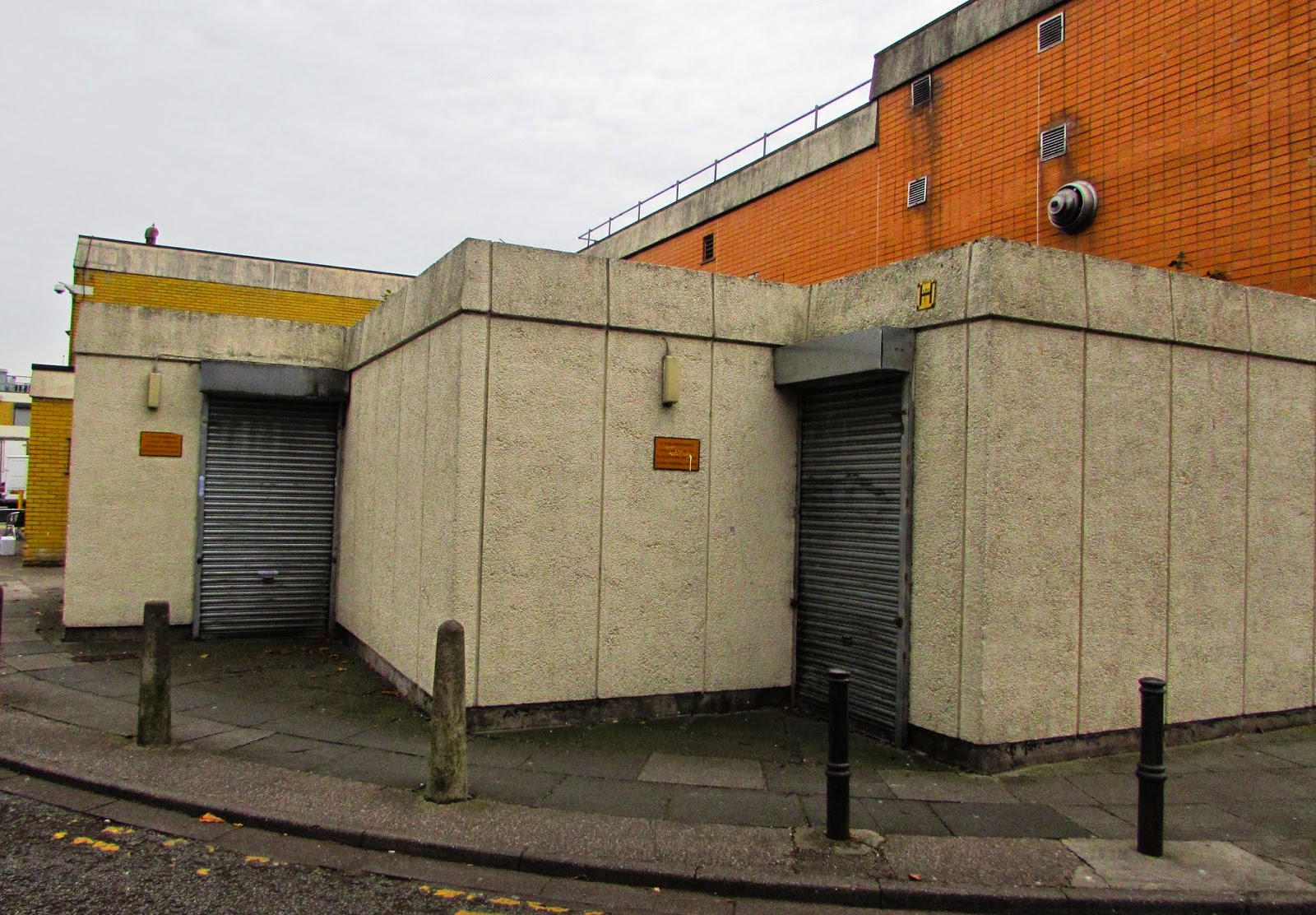
So even the ugliest looking of public lavatories will fall victim to economies.

I have to confess I never even knew these ones existed but as part of his continued plan to capture our closed conveniences Andy Robertson snapped them earlier this week adding  “these were the public loos for Stretford Arndale or the ex public loos for Stretford Mall.

They have been closed for at least 10 years possibly even 20 and replaced by ones inside the building. The old ones were the best because they were free, now costs 48 old pennies!”

And with that nostalgic comment Andy moved off looking for more which will appear in the fullness of time.

Now there is of course a series point to the exercise, for not only are they a little bit of our history but also they are a public piece of history, opened in more optimistic times and in the case of the Victorian and Edwardian predecessors provided as part of that civic provision.

Picture; courtesy of Andy Robertson, 2014

Remembering those of the Great War in Southern Cemetery today at 10.30

This year the ceremonies remembering all those who participated in the wars Britain fought has a special significance as we reflect that 2014 is the centenary of the outbreak of the Great War.

And so today at 10.30 in Southern Cemetery there will be the annual commemorative service organised by the Friends of Southern Cemetery Group.

David Harrop who has a permanent exhibition to those of both world wars in the Remembrance Hall writes, “Rev David Gray will be officiating plus 100 school children, with tributes to the British Legion.

David Harrop will be reading in Flanders Fields plus his unique commemorative display will be on view!”

And that display is well worth a visit, offering a wide range of memorabilia, from photographs, letters and postcards, to official correspondence, medals and much more.

What I like about the exhibition is the very personal items which draw you in and give you a sense of what it was like to live through those four years.

But it is not a melancholy collection for here is humour as well as saddness, and it is a powerful insight to how those who fought as well as those who stayed at home.

I am always drawn to the little things like the porcelain tank bought as a souvenir and the comic sometimes saucy postcards sent back from the Front.
Pictures; from the collection of David Harrop

Thursday, 6 November 2014

All you ever wanted to know about the history of Manchester street names, today at St Ninians, Wilbraham Road


Today at 1.30 Jean Bailo, a Blue Badge Guide, will talk  about the history of street names in Manchester hosted by the Chorlton Good Neighbours at St Ninians Church Hall  on Wilbraham Road

Mary Street and James Leigh Street, 1844
Now we all have our own favourite bit of town and I suppose my is Castlefield.

That said over the years I pretty much wandered all over the city, armed only with my camera, a note pad and heap full of curiosity.

And as you do you can uncover some hidden gems, from buildings tucked away and missed by the developers to lost and bizarre bits of our history.

On one such adventure I found a forgotten and derelict stables in one of the railway arches off Water Street.
It entailed a bit of trespass and more than a bit of careful footwork but there it was from a time when all the railway companies still relied on horse power to deliver goods which had arrived at their stations.

It will have gone I guess by now but more often there are still clues to our past history, and some at least are there in the street names.

I was reminded of this when I turned down New Wakefield Street past the Salisbury and up that flight of stairs to Oxford Road Station.

Now the Salisbury is another one of those old Manchester pubs which seems to offer the past up with your pint.

The Salisbury on the corner of James Leigh Street, 2013
It dates from at least 1841 and can be found on the OS map of Manchester and Salford for 1849 surrounded by mean houses which were packed together in between Oxford Street and the railway line.

In total there were three of these narrow streets consisting of James Leigh Street, Cayley Street and Mary Street, which took in 28 small back to back properties.

And while the back to backs have long gone, the names of the people who built the houses are still there. So James Leigh, and perhaps his wife or daughter Mary left their mark as did Mr William and Mr Frank just round the corner in the streets they built.

And I bet Ms Jean Bailo, will have plenty more names and stories.

Map; New Wakefield Street and the surrounding area from the OS map of Manchester & Salford, courtesy of Digital Archives Association, http://www.digitalarchives.co.uk/

Painting; The Salisbury, © 2013 Peter Topping, 

Facebook; Paintings from Pictures,, Web: www.paintingsfrompictures.co.uk

Wednesday, 5 November 2014

Back at Pomona Docks

Yesterday Andy Roberston was out with his camera at Pomona Docks and shared a series of pictures which I shall post over the next few weeks.

He was there back in September and some of his images featured on the blog, so here are some more.*

I rather think they need no additional commentary.


Pictures; Pomona Docks, November 2014, from the collection of Andy Robertson


*Pomona Docks, http://chorltonhistory.blogspot.co.uk/search/label/Pomona%20Docks

Tuesday, 4 November 2014

Another two buildings closed and empty in south Manchester

Now compared to those impressive Victorian and Edwardian public lavatories these two are ugly buildings which even function cannot bestow any beauty on.

Withington Road and Moss Lane East, 2014
But like so many of those early public lavatories these have long been closed and I doubt will ever be reopened.

Indeed I remember a for sale sign gracing the side of the one on Withington Road and Moss Lane East.

I thought at the time and still do that this was an act of staggering optimism rather than a practical assessment of the property market.

Barlow Moor Road, 2014
Likewise the second at the top of Barlow Moor Road must be almost unique in that as Andy Robertson asks out it is “is there a facility like this anywhere that is  closer to two pubs, probably a combined distance of 40 yards?”

All of which is part of a new series which Andy has called a “bog for a blog” and which promises over the next few months to record many more of our closed and increasingly threatened public lavatories.

Pictures; Withington Road and Moss Lane East and the  top of Barlow Moor Road, 2014