Wednesday, 28 August 2024

Down our alley ...........

I have always been fascinated by those narrow throughfares behind houses.


Once they were just cut throughs or places to play as kids, but now more and more of them have been gated off.

I can understand why this should be the case, after all anything that makes the work of Burglar Bill just a bit more difficult is to be applauded, but it has deprived many of us the chance to save time by slipping down the alley to avoid the main road on the journey to the shops.

At which point the word alley will provoke some to intervene with alternative names, from back alley to ginnel and snicket.

My Wikipedia tells me that a “A ginnel is a word in various Scottish and northern English dialects describing a fenced or walled alley between residential buildings that provides a pedestrian shortcut to nearby streets. Ginnels are typically found in suburban areas, and do not contain any business premises, unlike some other types of alley. Other related terms include snicket, tenfoot and snickleway. 

Suburban streets in Sydney, Australia similarly feature "cut-throughs", which are fenced or walled passages found between residential lots that grant pedestrians easy access to nearby facilities situated on other roads. 

They may feature a nature strip and are generally secured by bollards to prevent vehicle access”*

And cut throughs along with back doubles were what we called them in my bit of south east London, although that said they were not a feature of the houses where I grew up, which meant the dustbin route from the garden involved carrying it through the house.

Leaving me just to reflect that while some alleys win competitions for the way their residents add potted plants and even chairs to enhance these back strips, others are just a repository for wheelie bins.

And there is nothing wrong in that.

Location; Chorlton

Pictures; one back alley, 2024, from the collection of Andrew Simpson

*Ginnel, https://en.wikipedia.org/wiki/Ginnelhttps://en.wikipedia.org/wiki/Ginnel

Tuesday, 27 August 2024

A story of recent Chorlton in 20 objects nu 1 ......... A Blockbusters card

Now most of us will have one lurking somewhere.

In my case the card made its way from my wallet to a cupboard long after the shop closed but never quite got thrown away.

And now of course it has passed into history and now even the shop has gone.*

But for a long time Blockbusters offered up a cheap way to see a film with the added bonus of being able to rent something for the kids at a knockdown price becoming as much a part of home entertainment as the old TV rental shop and the weekly delivery of the Beano and the Dandy.

It wasn’t the first such shop, that I think was  almost opposite Beech Road which is now an off license and for a time there was that other one on Wilbraham Road facing the Post Office.

Over the last thirty or so years we have used them all, walking out first with VHS tapes, then DVDs and later plenty of games.

So much did it become part of family life that it even provided work for one of our sons.

Now I am always a hoarder and can make an argument out for keeping  the oddest bits of the past and I am pleased I have kept the card.

After all it is now almost as obsolete as the telegram and the telephone card, but it has its place in the story of those Friday nights which became pretty much a ritual.

One of you went off to collect the takeaway while the other sorted out the kids movies, dodged the demands for three packets of popcorn and then argued about who took the films back the following day, which more often than not you forgot to do and so  incurred the fine the next time round.

Pictures; of the Blockbuster card from the collection of Andrew Simpson and the Blockbuster shop courtesy of Andy Robertson

*The Essoldo, Blockbusters and plans for a new Morrisons on Barlow Moor Road, http://chorltonhistory.blogspot.co.uk/2014/06/the-essoldo-blockbusters-and-plans-for.html


On being 10 and a bit in Edmund Waller School ........ still living with a humiliation

Some memories just do not go away despite the passage of a full half century.

Edmund Waller School, 2007
This one I have carried for 63 years and goes back to Edmund Waller School and Miss Reeves sometime in 1961.

I was the lad who had been promoted at the end of what now we would call Year 5 into the top class, which I greeted at the time as a mixed blessing.

4A was what passed in Edmund Waller as the top class from which the bright and gifted would have their chance at the 11 plus and all the promise that followed from a grammar school place.

Not that I was one of them, having attained a place in 4A, the following September I joined the lads from 3B along with various other schools in the neighbourhood and began five years at Samuel Pepys Secondary Modern  School for Boys.

In the past I have been harsh about Samuel Pepys but on reflection given that they were afforded less cash than the grammar schools, I had an excellent education from teachers who were committed to giving us the best.

Me, 1961
None of which is relevant to the memory, which at the time confirmed by own low esteem.  Having not cut the muster with Miss Reeves I was made to feel even lower by a group exercise where working in teams of four we were tasked with a project.

I can’t now remember the topic, only the burning humiliation of being told by the other boy in the group that I shouldn’t make contribution.  I remember his name, and found him some years ago on a social networking site,  full of his achievements on this and the other side of the Atlantic.

I do remember one of the girls intervened on my behalf and I think I did add something, but my heart wasn’t in it.

Looking back almost sixty years I chide myself for continuing to harbour the memory, and reflect that many 11 year olds can be cruel, arrogant and self opinionated but even given those caveats, the humiliation burns deep, and will follow me to the grave.

Not that I wallow in that bitter moment, instead it is a permanent reminder that I went through an educational system predicated on the idea of failure, for with every 11 plus achiever there had to be a legion deemed second rate.

Detail of the school
The apologists for that system, then and now, will advance the fatuous argument that we were not failures just not suited for an academic career which is a falsehood, and a falsehood challenged by the many talented individuals who went on to achieve in a full range of activities despite having failed to make the grade at 11.

So I will continue to let that memory bubble to the surface from time to time.

I could have confronted the individual on his social media site, but I doubt that he would remember such a trivial incident, secure in his glittering achievements.

Nor will I name him.

Location; Edmund Waller School

Pictures; Edmund Waller School, 2007, courtesy of Liz &  Colin Fitzpatrick and me in 1961, from the collection of Andrew Simpson

A little bit of Manchester in Deptford …….. football …… VHS …… and a charity shop

Deptford in south east London was almost where I grew up.

Au Revoir Cantona, date unknown

As a kid it was just a short bus ride from Peckham, and when we moved to Eltham was still a place I went back to.

But long ago I moved to Manchester, and never thought I could make a link between the two, but my new Facebook friend Paula, managed to find the link. 

And of course, I am the first to admit it will not appeal to everyone …… as the comments to the post will no doubt reflect.

That said it is a neat piece of history, being not only a record of Eric Cantona’s time with Manchester United, but one of those bits of lost technology.

VHS tape with time scale

Au Revoir Cantona is a VHS tape, which is now another example of a technological back alley.

Video Home System was briefly in the 1970s and 80s, the go to way of recording stuff to watch on the telly.  It saw off the Betamax rival but in turn was sent off the scene by the DVD.

For perhaps a decade and a bit more they were an essential addition to the television, allowing you to both buy or rent commercial films to watch at home, and to record stuff to watch at a later time.

It’s downfall was that often the tapes became slack or just got jammed, and for those with a hectic social life, recording something to watch later, didn’t always work given that the hectic social life left little time to watch even the recorded shows.

I bet most of us will still have the odd VHS tape knocking around, which can never be played given that the accompanying VHS recorder has long since been skipped.  So they sit in a corner of the cellar or attic waiting the time  they will be transferred to a DVD, which is a time that never comes.

My kids are of an age which means that they remember them, but not so the next generation.  To them these clunky rather unsophisticated looking bits of technology are as remote as the cassette, the 78 record, and telegrams.

We will have had a few Man United VHS tapes given that three of our four lads are fans, and deep in the cellar at least one may have escaped the cull of all things obsolete.

And there they will stay, for without the recorder they are lost to us.  And I doubt any of the three will be beating their way to a shop to have them transferred to a DVD.

Deptford Town Hall
Leaving me just to ponder again on my time wandering the streets of Deptford, playing out one of many adventures, now over 60 years in the past.

Still it has rekindled an interest in the place, and I have asked Paula if she has pictures of Deptford, which in turn I suspect will lead to a series of stories.

We shall see.

Pictures; Au Revoir Cantona, 2021, from the collection of Paula Griffin,VHS tape with time scale, May 20, 2020, Tobias ToMar Maier, licensed under the Creative Commons Attribution-Share Alike 3.0 Unported license  and Deptford Town Hall, SE14, Philip Talmage / Deptford Town Hall, SE14 / CC BY-SA 2.0, licensed under the Creative Commons Attribution-Share Alike 2.0 Generic license.


Sunday, 25 August 2024

One hundred years of one house in Well Hall part 27 ....... answers

 This is the continuing story of one house in Well Hall Road and of the people who lived there including our family. *

Well Hall Road, 1950
Over the last few days, I have been exploring when the Progress Estate ceased being primarily a place for the families of Royal Arsenal Workers, and just when it became a place of home owners and not tenants.

Now most people know it was built to house those who made munitions in Woolwich during the Great War, and who paid rent rather than owned the properties.

When Dad bought 294 Well Hall in 1964, there were still plenty of people we knew who rented their homes, not that anyone of them worked making weapons.

Which begs the question of when things changed?

The dramatic fall in the number of Royal Arsenal workers at the end of the Great War is the most obvious reason for a change in the occupations of those who lived here.

In the case of our house, Mr. and Mrs Nunn who moved in 1916 from Ipswich were gone three years later and the house was occupied by a Police Sergeant and his family.

Walking in the estate, 1950
And that will have been replicated across the estate.  After all the London County Council who administered the houses for the Office of Works will have been keen to see no drop in the revenue from the rents they were paid.

But there is still the question of just when the properties begin to be sold off.

Dad bought 294 outright in 1964 from a young couple who had lived there since 1960, and if we still had access to the deeds, I could locate which of the residents after Mr. Nunn bought our house.

But I can’t.

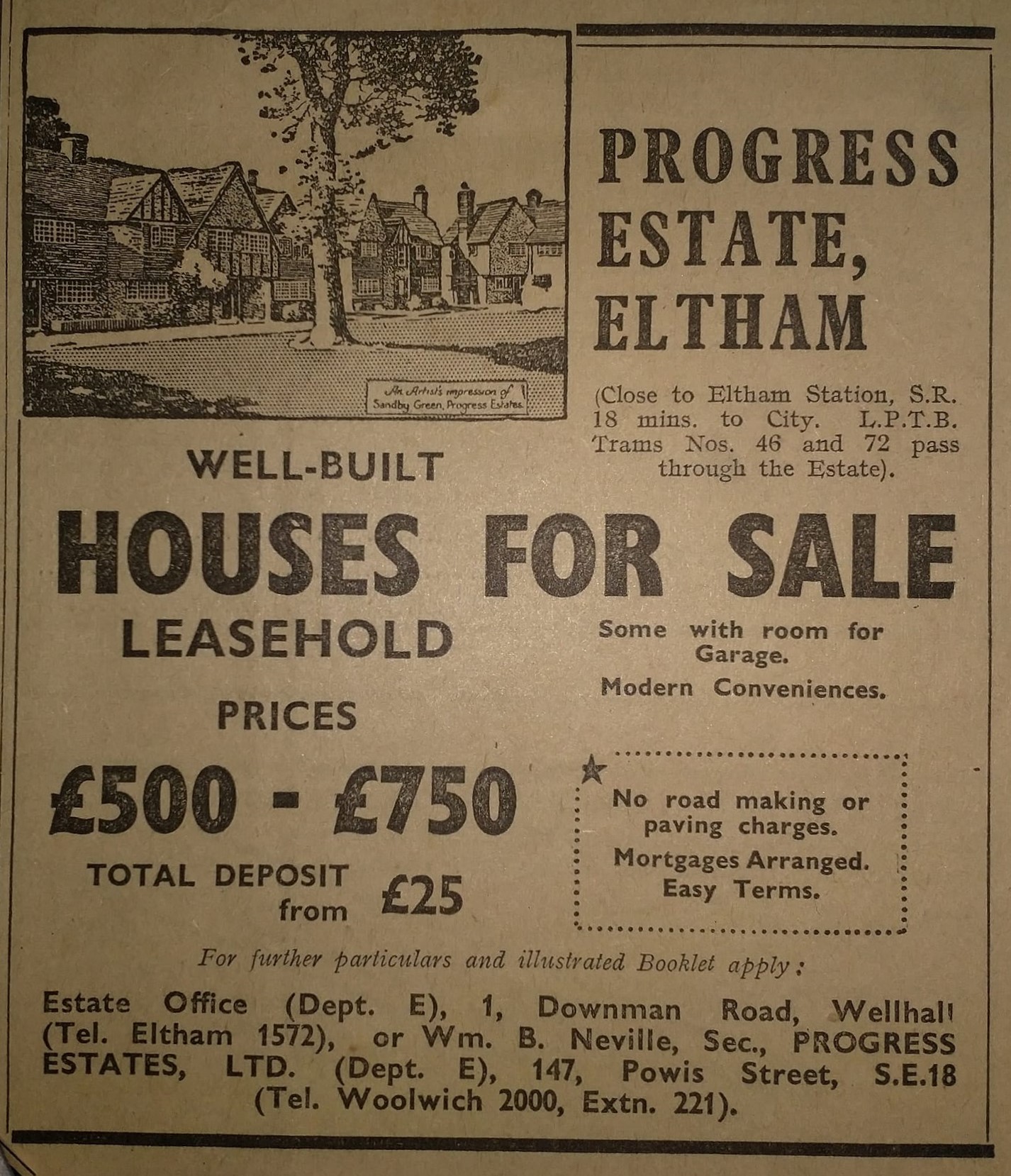
Houses for sale, advert for houses, date unknown 
So instead, I have turned to Keith Billinghurst’s book, The Origins and Evolution of the Progress Estate, which is an excellent and very detailed account of the estate which sets the place in the context of the Garden Suburb development.

Along the way a series of tables on everything from the development of London’s suburbs to the numbers of residents on the estate.

As well as the inclusion of diagrams and plans showing houses and comparing them with similar garden suburbs.

But one of the real attractions has to be the descriptions of the roads around the estate and the origins of their names.

What’s more there is a comprehensive bibliography and index making it perfect for anyone wanting to follow up on the subject.

And the answers are all there.

Changes in housing legislation in 1967 made it easier for sitting tenants to buy their home and I guess many will have done so.

Our house, 1974
The surprise was that at the outset in 1916, 64 houses had been sold and while some were later bought back by the Progress Estate this was a surprise.

Even given that Royal Arsenal workers were well paid I wondered how they could have managed it, but in a conversation yesterday with Mr. Billinghurst it became apparent that some at least of the houses were reserved for managers who had to live close by.

So that is pretty much it, leaving me just to make the appeal for anyone who lives on the Estate and does have access to their deeds to check out when their home moved from rented to owned.

Location; Well Hall, Eltham

Picture; Well Hall Road in 1950, from Well Hall Estate, Eltham:  An Example of Good Housing Built in 1915, S.L.G. Beaufoy*** for sale advert undated advert courtesy of Philip Burkitt, and our house in 1974 from the collection of the Simpson family, cover of The Origins and Evolution of the Progress Estate, 2017

*One hundred years of one house in Well Hall, https://chorltonhistory.blogspot.com/2022/06/one-hundred-years-of-one-house-in-well_10.html

** The Origins and Evolution of the Progress Estate, Keith Billinghurst, 2017, costs £13.95 includes free delivery by second-class mail to addresses in the UK and there are discounts for those on the Estate and others living elsewhere in SE9.  

To order, either write to theprogressestate@gmail.com stating your name, address and phone number or call or text 07962 877389 to provide the same information.

*** Well Hall Estate, Eltham:  An Example of Good Housing Built in 1915, S.L.G. Beaufoy, The Town Planning Review Vol. 21, No 3, October 1950, Liverpool University Press 


The mysteries and the unpromising ….. alleys I have known

Now when you are ten taking a step off the main road and down an alley is always an adventure.

Barlow Moor Road, Chorlton, 2022

It is the thrill of not knowing what is at the end or what stories you might later spin out from the visit.

In most cases the adventure ends shortly after it started, with nothing more that a litter strewn dead end.

But at other times you are rewarded with something,  like the time me, Jimmy O’Donnell, and John Cox took a leap into the alley and found a tired, dingy curio shop selling the things that the 1950s consumer society judged old fashioned and tat.

Not that we went in, the place was shut, and the dirty windows were protected by iron mesh.

Passageway to Mortgramit Square, Woolwich, 2013
Still, it was a find of sorts, and we dined out for the rest of the day on the objects for sale, which included an old wireless, a shabby stuffed weasel, and some boxes of pre-war cigarettes.

In the 19th and early 20th centuries alleys often led to closed courts of mean houses where sunlight and fresh air rarely penetrated, and only the foolhardy or local resident would venture.

Not so the one off Barlow Moor Road which runs down the former Co-op shop twisting and turning before it gives up on Keppel Road, but the passage way to Mortgramit Square in Woolwich has more promise, but that as they say is for another time.

Location; Chorlton and Woolwich

Pictures, the alley, Chorlton, 2022, from the collection of Andrew Simpson, and the passageway to Mortgramit Square, Woolwich, 2013,  from the collection of Liz and Colin Fitzpatrick


When politics comes in the badge collection ……

 The collection spans five decades.


Along the way many of the earlier badges have been lost or given away, and by the end of the 1990s it peters out.

Some of the campaigns proved successful, some not so and with the passage of time into old age some I would no longer embrace.

But each says something of the period from the mid-1960s to now.

The campaign badge has been around a long time.

It is one of those instant bits of political activity which makes the point cheaply and effectively.

A round bit of cardboard, some sticky tape and a safety pin and you have a badge.

Easier than that and just as effective is coloured ribbon, so loved of election rallies in the early 19th century, and the Suffragettes, and before ribbon there were bits of plant, flowers and bush stretching back into the past all of which were designed to mark out your political preference.

My first was “Lets Go with Labour” which I wore in 1966 but must have been a remnant from the ‘64 election.

It was a shinny plastic badge with a plastic pin which fixed into the back and I wore it throughout the campaign knocking on doors in Well Hall.  I was just 16 and such are the things you cut your political teeth on.


Today the badge machine has made it all the simpler and allows almost anyone to turn them out for next to nothing in just a few minutes.

But for me it will always be those enamelled badges which take pride of place in the collection.  I have a few none of which date back before the 1950s.

Of these the old fashioned Labour Party badge is my favourite with its torch, pen and shovel representing all aspects of the labour movement combined with the torch of progress.

The newer version never really caught my imagination in the same way.

Of the remaining enamelled ones it is that of the Sutton Manor NUM badge which stands out because of the contribution  made by many local people to their struggle during the Miners Strike.

And if like me you bought or picked up badges in support of campaigns they now have a place in our history.

Some were deadly serious, a few used humour and others were celebratory, and many today now seem to belong to a landscape that has long since vanished although that said it always seems that gains made in social progress do sometimes have to be fought all over again.

So for those of us who argued against a divided South Africa, wore  the Anti Apartheid badge can now look back on twenty years of that new rainbow nation.

But other campaigns  like the attempt to save the Greater Manchester County Council failed and many more like Justice for Pensioners and the defence of the NHS remain real issues.

Looking back at my collection I cringe at some of the things I supported in my teens and early twenties, are saddened by those that were defeats but also remember how much I learnt by taking part and of some good friends I made along the way.

So each of the badges does represent an important moment in someone’s history and I think I shall return to some of them and explore their stories in more detail.

Many are almost all that is now left of an impassioned moment when people came together to defend something they thought important.

Long after the paperwork has been lost , the newspaper stories discarded and the memories faded these badges record that moment.

They also point to that other simple observation that history does not always turn out the way you would like.

The years since independence in Zimbabwe have been difficult but I still remember the pleasure many of us felt at its promising start as a new country.

And in the same way there was the bitterness at the vote to leave the European Union.

It was a vote which split the country and even now is one of the divides that defines the last eight years.

And I bet out there there are lots more badges and even more stories.


Location; the bade collection


Pictures; badges from campaigns I embraced, 1966-2016, from the collection of Andrew Simpson