Tuesday, 19 November 2019

Mrs Sykes, her son in the 6th Manchester's and the Diggle Hotel ....... part 1 a picture postcard

I am pretty sure that one of these young men staring back at us will be Gordon Radcliffe Sykes, aged 21 of the Diggle Hotel, Diggle.

I just don’t know which one.

But in the fullness of time I might just be able to identify him because I have tracked his parents back to the Diggle Hotel which they were running by the 1880s and in one of those remarkable strokes of luck the present owners have pictures of Mr Sykes on the pub wall.

All of which promises a trip up to Diggle to meet Mr and Mrs Shaw who took the place over in September.*

Already Lynn Shaw has promised to copy some of the photographs and send them down, which will be a start, and will also lead to a whole series of stories about the pub and Mr and Mrs Sykes who were married in 1887.

And that as they say will be the start of a new friendship.

In the meantime I am intrigued by the picture, partly because of the detail and the freshness of the image but also because there is a story here.

When I first saw the card I assumed that here were group of men from the 6th Manchester’s sometime during the Great War but not so for although the inscription on the front carries the title 6th Manchester’s, on the back the location is West South Downs Camp and the postmark on the back dates it to 1910.

And that makes this a photograph of one of the Volunteer Battalions of the Manchester Regiment and suggests they were on a training exercise.

Now I am fully prepared to be corrected on this by someone given that my knowledge of the Manchester’s is still quite limited but if I am right it makes this card quite unique, more so because we can track the Syke’s family and link them to the pub which is still doing the business a century and a bit after James and Lauretta nee Platt were pulling pints in the spring of 1910.
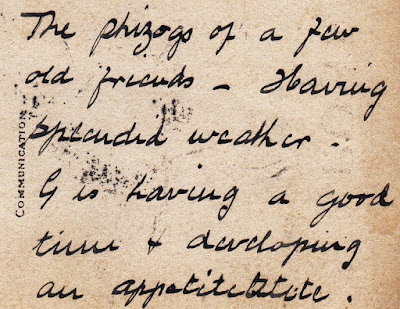
All of which leaves just one last puzzle, because the card was signed S.S.D., and refers to “G having a good time and developing an appatititite.” 

Now I am guessing that G is Gordon who in the spring of 1910 was 21 years old and worked in a machine shop but I have no idea of the identity of S.S.D.

But maybe that trip to the pub will help.

In the meantime I shall have fun reporting back to David Harrop who showed me the card which comes from his extensive collection of memorabilia from the Great War, some of which is on permanent display at the Remembrance Lodge in Southern Cemetery.

Picture: with the 6th Manchester's 1910 at West South Downs Camp, courtesy of David Harrop

*The Diggle Hotel, Station Houses, Diggle, Oldham, Lancashire OL3 5JZ, 01457 872741
Local family takes over historic Saddleworth pub thanks to funding from RBS,  Aimee Howarth, Saddleworth Independent,  HTTP://SADDIND.CO.UK/LOCAL-FAMILY-TAKES-OVER-HISTORIC-SADDLEWORTH-PUB-THANKS-TO-FUNDING-FROM-RBS/

Monday, 18 November 2019

A late day in summer on Barlow Moor Road sometime after 1911

It is one of those pictures which are easily recognisable.

We are on Barlow Moor Road and just by the tram is the junction with High Land and Sandy Lane.

Now I can’t be sure of the date but it will be after 1911 when the parade of shops on the left had been built.

Just at the edge of our picture is Christopher Wilson who in 1911 was dealing in furniture.

That’s him I think standing in his shirts sleeves underneath the awning displaying his name.

Next to him was Mrs Winifred Blake the tobacconist with William Armstead confectioner at number 90 and on the corner with High Lane was John Gordon, the fruitier.

Judging by the shadows and trees we must be in the late afternoon of a summers’ day and given the number of people about perhaps close to the end of the working day.

In the middle of the road staring back at the camera are the crew of car number 150 who along with a few other bystanders seem to have little else to do.

Not that everyone is over bothered by the presence f the photographer, so much so that the two men by the lamp post seem oblivious to what is going on while in the distance on the benches in front of the church sit a group of people taking in the sunshine.

And what I like is the little details which fix it in another age.

To our left is the ladder and handcart while beside the tram is another cart and just coming out of Holland Road is a waggon.

There will be lots more I could say about the picture but I rather think I will just leave it at that.

Picture; from the Lloyd collection


Sunday, 17 November 2019

Who knows the secrets of the little room at the top of the stairs? …………

So, I know you will have to be of a certain age to link the title with that TV advert for Black Magic Chocolates, but then if you can, you may well be the person we are interested in, because it is of the forgotten gems,  carefully put away in the box room or the attic which could be the subject of our new book.*

It started when Peter brought down box loads of stuff which had been stored in the attic, gathering dust and almost sliding out of recorded memory.

There was a collection of military cap badges, from both world wars, assorted old computers, and electronic games, along with a packet of Edwardian tea, and an empty carton of Player's Weights.

Nothing you might think as valuable, but each offered up clues to how we used to live during the last century.

Having got hold of some of the treasures I wrote the story with a promise of more to come, and then Peter came up with the idea of asking to look into other people’s attics, spare rooms and garages.**

Now I  know that the idea is not new and one TV channel specialized in programmes rummaging around in the attics of celebrities, but what makes Peter’s idea a tad different is that we will be looking into the homes of people from across south Manchester and ignoring “celebs”.

And having been given permission to unearth the boxes of promise, we intend to tell stories of what those boxes contain, with the firm expectation that the bits and pieces will offer up a slice of our collective past.

Looking again at Peter’s cornucopia of forgotten interests, I fastened on all those old 1980s computers and the games which went with them, remembering the hours our kids spent playng on Sim City, Tetris, Dungeon Master and Prince of Persis.

At which I could explore the power of this new form of entertainment and its impact on how we did leisure, but instead that’s for the book.

For now, here is the challenge which “ should you choose to accept”, is to  go rummaging amongst your old and neglected store of half-forgotten objects and get in touch with us.  We will come around, take the pictures and in consultation with you choose some which tell a story.

Unlike Mission Impossible this story and your stories will not “auto destruct in 5 seconds” but will linger long enough for lots of people to become inspired by the project.

And in the fullness of time become another book which Peter Topping and I offer up to the world.

Leaving you to leave comment on the blog or contact us through social media.

Location; your attic, garage, or spare room,

Pictures; things that have sat in Peter’s attic for decades, courtesy of Peter and Linda Topping

*Who knows The Secret of The Black Magic Box? was an TV advertising  campaign from the 1970s

**The time capsule that is Peter’s attic …….. part 1, https://chorltonhistory.blogspot.com/2019/11/the-time-capsule-that-is-peters-attic.html

On Barlow Moor Road at the Macfadyn Memorial Church sometime in 1929 with a postcard from mother


Recently I was at the Macfadyn Memorial Church on Barlow Moor Road, sometime between 1903 and 1913.

And today I am back again at almost the same place this time in the 1920s.  

Now I can be fairly certain of that because the postcard was sent in the September of 1929 and while the picture might be older I doubt that it will stretch beyond the beginning of that decade.

It is fairly recognisable but of course today the church has gone, replaced by a block of flats and trams haven’t run up Barlow Moor Road since the late 1940s.


Judging by the coats and the leaves on the trees we may be in late spring when a turn in the weather can still produce a cold spell.

By contrast the postcard was sent on a day when “we are still having summer here, today is lovely.”

What intrigues me about the postcard is that it was not sent through the post.

There is no address to which it should be delivered and no stamp so I guess it must have either been taken by hand to Morris and Marie or perhaps was inside a letter or parcel.

Now this is a bit of a shame as the couple were on holiday somewhere and Marie’s mother was concerned that they liked the apartments but was reassured that the holiday weather was equally good.

And that little comment reminds me that this was still the age of the postcard, and that people regularly sent them, not only as a greeting but for the more mundane business of arranging a meeting.

So on another card in the collection Lena had apologised for not being able to meet Miss Taylor that evening but would arrange to do so for Tuesday.

The card had been sent from Oldham on Monday afternoon with every expectation it would arrive that evening in advance of the time they were to meet.

In the same way Marie had sent her own holiday postcard to her mother at 43 St Anne’s Road and might well receive a reply the same day.

Picture; from the Lloyd collection.

Friday, 15 November 2019

Stockport …… the centre of the known world

There may well be those that dispute the claim, but Andy’s picture would suggest otherwise.

Location; Stockport


Picture; Stockport’s finger post, 2019, from the collection of Andy Robertson

How to steal a continent ………………. stories of India and the East India Company

I suppose I am the last generation to be brought up on stories of Empire, when in countless lessons at school we were told of the quarter of the globe which was painted red.

In the case of India, I only vaguely knew of the role of the East India Company in the history of the sub-continent, and how that played out with the British Empire.

It was the first multinational company and its ships were often just referred to as “Indiamen”.

It had been founded in 1600 to trade in the Indian Ocean region, and until 1858 controlled large parts of the Indian sub-continent, along with parts of Southeast Asia and Hong Kong, and arguably damaged the
the Indian economy which its asset-stripped, looted, and plundered.

All of which means I have been fascinated by Anarchy,  on the wireless this week.

In five episodes Radio 4,  has taken “William Dalrymple's new and acclaimed history of the East India Company [and explored] how a small trading company founded in 1599 led to the formation of the British Raj. The reader is Alistair McGowan.

Adapted by William Dalrymple
Produced by Elizabeth Allard”*

Today is the last of the five episodes, but all are available to listen to, for the next month.

Picture; East India coin, 1835, courtesy of the National Numismatic Collection, National Museum of American History

*The Anarchy, Radio 4,  https://www.bbc.co.uk/sounds/play/m000b4wf


Thursday, 14 November 2019

The time capsule that is Peter’s attic …….. part 1

Now when Peter ventured into his loft and brought down the accumulation of 40 years of stored stuff, I doubt he was quite prepared for just what had been “ carefully put away”.

But that is just what most of us do when faced with the need to clear the backroom but unwilling to part with treasures.

In some cases, they will be the product of a collecting enthusiasm, or just that assumption that one day they will become useful again.

That said I challenge him to explain how in the 21st century he will use the contents of the box of “Players’ Weights, Made from PURE VIRGINIA TOBACCO”, or for that matter the packet of blended tea sold  by “Yates Brothers, Wine Lodges Ltd”.

But I suppose that is less relevant than just what so many of his treasures tell us about the last century.

So, I was intrigued by that Yates’s tea, and had no idea they sold it.

I remember the lodges as big smoky rooms, filled with people of a certain age, drinking in a place that hadn’t much changed since Victorian times.

And that brings me back to the tea, and that simple question of whether it was sold in  the bars, alongside their “Blob”, their wines and their white rum?*

I do remember reading somewhere that they also sold beef, so perhaps an expert will wade in with chapter and verse.

In the meantime, I am equally intrigued by the box of military cap badges, the metal bottle openers, and those testaments to late 20th century gaming, which includes a Nintendo 64, a Commodore Amiga, and the CD Rom of NODDY The Magic of Toytown.

Nor is that all, but some like Peter’s time as a snake keeper and his time with Chorlton Breakers are best left in the shadows.

But I am drawn to the cap badges, partly because of book I wrote on Manchester and the Great War, and partly because each will have a story to tell, and after all stories are what it is all about.**

So, I will be beating a path to Peter’s house to borrow the box and continue the stories.

And when they are done, I shall follow up on the time of the Nintendo 64, Commodore Amiga, The Kodak bellows camera, and the posh leather wallet and newspaper clipping.

Location; Peter’s attic

Pictures; assorted attic history, 2019, from the collection of Peter Topping

Next; Stories from cap badges


*Blob was a mix of sweet Australian wine, and brandy, to which was added hot water, sugar and lemon.  The company began in 1884 when they opened their first lodge, and within 20 years had nearly 20 lodges across Lancashire

**Manchester Remembering 1914-18, Andrew Simpson, 2017, https://chorltonhistory.blogspot.com/search/label/A%20new%20book%20on%20Manchester%20and%20the%20Great%20War