Friday, 24 November 2023

Time for Another Clock … another story from Tony Goulding

This clock is a feature of the old St. Mary’s Hospital building on Oxford Road, Chorlton-on-Medlock, Manchester. 

This institution has its origins in the “Manchester Lying-in Hospital and Charity for the delivery of poor women at their own habitations.”, established by Dr. Charles White and Richard and Edward Hall, in 1790. The first buildings used were in Salford, a house on Old Bridge Street and later, from 1795, the former “Bath Inn”, Stanley Street on the banks of the river Irwell. (“Manchester Mercury” 4th August 1795). 

The explosive increase in the area’s population together with an expansion of the services the charity offered, soon meant  it became necessary for larger premises to be sought. After initially moving to 2, South Parade, St. Mary’s Churchyard in 1840 (1) a new purpose-built hospital, designed by the Salford-born architect Nathan Glossop Pennington and funded by Dr. Thomas Radford, was opened on land purchased for £500 by Miss Eleanora Atherton (2) on Quay Street, Manchester in 1856. 

The foundation stone of the new building had been laid by the Bishop of Manchester, the Right Rev. James Prince Lee D.D. on 3rd September 1855. The Manchester Courier and Lancashire General Advertiser carried a very detailed report of the ceremony in its edition of the 8th September. 

This included listing the collection of items enclosed by the foundation stone as a sort of time capsule; a set of newly minted coins, copies of Manchester Newspapers of the day, and a commemorative medal celebrating Queen Victoria’s visit to the city on the 10th of October 1851.  

More interestingly also buried were documents associated with the hospital including a summary of its early history and how the Queen's visit had provided a catalyst for the fund-raising efforts of the ladies of Manchester on behalf of the hospital

 St. Mary’s Hospital Quay Street in 1892 (3)
When this building was built, it was seen to incorporate the latest ideas of hospital design however within three decades the further advances in medical knowledge, in particular advances in the understanding of how infections are spread, it once again became desirable for the hospital to acquire new premises to accommodate this. 

A prolonged fund-raising effort was undertaken from the mid 1880s, but it was not until Monday 9th October 1899 that the foundation stone of a new hospital was laid. The duty was undertaken by the Countess of Derby at noon on that day.  

One of the reasons for the elongated appeal was the complication caused by a proposed amalgamation of St. Mary’s Hospital with Manchester’s “Southern Hospital for Diseases of Women and Children” at 26, Clifford Street, Chorlton-on-Medlock. The long-drawn-out negotiations between the two charities ended in November 1904 when agreement was reached to merge subject to approval by the Commissioners. 

There would still be two separate buildings, however, confusingly both called St. Mary’s Hospital as the combined charity went under the name of “St. Mary’s Hospitals (plural)” Charity. The original St. Mary’s completed the construction of the one started in 1899 on the corner of Oxford Road and what was then Gloucester Street (now Whitworth Street West). 
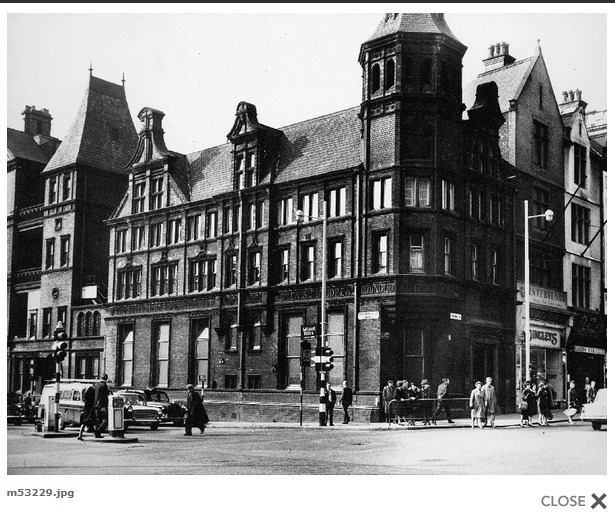
St. Mary’s hospital on Whitworth Street West in 1964 
This was one of the last buildings associated with the prolific architect, the designer of Manchester Town Hall, Alfred Waterhouse and after the two charities combined would be designated as providing outpatient care and beds solely for maternity cases.

On land acquired by Manchester Southern Hospital in the 1890s a new facility was erected further along Oxford Road on the corner of Haversage Road (then called High Street). In due course this was to provide in-patient beds 80 for women and 25 for children The architect appointed was John Ely, who’s designs had also just won the competition for an extension to Salford Royal Hospital.

This building, which is now Grade 11 listed, was built between 1907 and October 1909; the builder being Robert Neill and Sons.   After some delays due to lack of funds, the first patients were admitted in April 1911, however, it was not officially opened until Tuesday 6th February 1912 when Lord Derby, the president of the charity’s board of trustees performed the ceremony.

St. Mary’s hospital building on 15th May 2012
Following the building of a new maternity hospital, which became known as St. Mary’s Tower on Haversage Road in 1969 the site on Whitworth Street was run down and demolished in 1973. (As, subsequently was the “Tower Block”). The building facing Whitworth Park is still being used to provide an N.H.S. service, a Reproductive Medicine Clinic.

Pictures; St. Mary’s clock from collection of Tony Goulding. 

St. Mary’s Hospital, Quay Street, 1892 by S. L. Coulthurst (m53203) and St. Mary’s Hospital, Whitworth Street West, 1964 by W. Higham (m53229) courtesy of Manchester Libraries, Information and Archives, Manchester City Council. http://images.manchester.gov.uk/index.php?session=pass

 St. Mary’s Hospital (1909 building) on Oxford Road, May 2012 Stephen Richards, CC BY-SA 2.0,

 https://commons.wikimedia.org/w/index.php?curid=64788474

Notes: -

1) This building was severely damaged by fire on the morning of Thursday 4th February 1847. Fortunately, the hospital was at that time not admitting in-patients and the three staff and the matron’s two female relatives managed to escape the flames by utilizing the time-honoured method of climbing down knotted bed sheets, as per a report in the Manchester Courier and Lancashire General Advertiser dated Saturday 6th February 1847. Such was the dedication of those associated with its work by the end of March the hospital was again providing aid, all be it in a diminished capacity to the women of Manchester.In passing it is a curiosity to note that for a time prior to his death in 1845, Hugh Hornby Birley (of Peterloo infamy) was the chairman of the hospital’s trustees.

2) Miss Eleanora Atherton was an extremely wealthy woman, the inheritor of a vast amount of wealth from several family members A large sum being derived from sugar plantations in Jamaica previously owned by her slave-owning uncle, William Atherton. She was a noted philanthropist, endowing churches as well as hospitals and supporting the fine arts through her rôle with The British Institution. When she died on 12th September 1870 she left £400,000 (almost £40 million at today’s value) including bequest of £1,000 to St. Mary’s Hospital, one of many such charitable donations).

3) This building was the first to be designated as “St. Mary’s Hospital” as the annual general meeting of the charity’s board on Wednesday 10th January 1855 adopted the name “The St. Mary’s Hospital”.


Acknowledgements: - 

Architects of Greater Manchester 1800-1940 https://manchestervictorianarchitects.org.uk

And Our Manchester https://manchesterhistory.net

As well as usual sources Find My Past’s Newspaper Archive and Wikipedia

Painting Peckham ............ that Telephone Exchange

Now I recently used that well known phrase “you can take the boy out of Peckham but you can’t take Peckham out of the boy.”

It was during a conversation with my old friend Peter who reposted “you can take the boy out of Preston but you can’t take Preston out of the boy” which pretty much tells you where we were born.

All of which led to an exchange of banter about the merits of both places and at the end of it all I promised to write about Preston and Peter decided to paint Peckham.

I say paint Peckham but it would be more accurate to say he has set about painting some of those iconic buildings we all know and remember.

The series will run alongside “My Peckham” which reflects on some of the buildings and places which mean a lot to me.*

And in some cases Peter’s painting and my stories will replicate each other but then there will be plenty who say you can never get enough of Peckham.

He has already painted the Montague Arms, and the old New Cross Library which will appear later in the month.

And here because I like it and it struck such a resonance with everyone when I wrote about it the other day is the New Cross Telephone Exchange, which Peter painted from an original photograph by Stephen Craven.**

Painting; The New Cross Telephone Exchange © 2015 Peter Topping
Web: www.paintingsfrompictures.co.uk

Facebook: Paintings from Pictures https://www.facebook.com/paintingsfrompictures

* My Peckham .............. nu 1 the New Cross Telephone Exchange St Mary’s Road, http://chorltonhistory.blogspot.co.uk/2015/08/my-peckham-nu-1-new-cross-telephone.html 


** New Cross Telephone Exchange, © Copyright Stephen Craven and licensed for reuse under this Creative Commons Licence, http://www.geograph.org.uk/photo/23315

Thursday, 23 November 2023

The Cut Out Girl .....

In the midst of the turmoil of the war in Gaza with the wait for a cease fire and the release of some at least of the Hostages, I have come across this book.*


It won a series of awards in 2018 and 2019, and is one I shall read

The publisher’s commentary runs, “Little Lien wasn't taken from her Jewish parents in the Hague - she was given away in the hope that she might be saved. Hidden and raised by a foster family in the provinces during the Nazi occupation, she survived the war only to find that her real parents had not. Much later, she fell out with her foster family, and Bart van Es - the grandson of Lien's foster parents - knew he needed to find out why.

His account of tracing Lien and telling her story is a searing exploration of two lives and two families. It is a story about love and misunderstanding and about the ways that our most painful experiences - so crucial in defining us - can also be redefined”.

*The Cut Out Girl, Bart van Es, Penguin, 2018


Lost in the back streets of Sorrento

Strictly speaking we hadn’t got lost. 

And even if we had there is something about wandering the back streets of Sorrento on a hot August day.


That said it was one of those days that alternated between heavy showers and spells of blistering heat.

Not that we cared over much.

Picture; Via S. Paola, Sorrento, August2001, from the collection of Andrew Simpson

Wednesday, 22 November 2023

A film, a song and a clash of cultures, Italy in the '50s

Rome, an alley off  the Trevi Fountain, 2011
Black and white movies, Italy in the 50s, and a Neapolitan song 

Yesterday evening we sat and watched an old black and white Italian movie from the 1950s.

Perhaps it has a lot to do with getting old.

When I was young I avoided films that were in black and white. They were drab and boring and came from a time when technology had not mastered the art of colour. They were simply, the films of my parents and grandparents.

With age comes an appreciation of the subtle way the film maker can play with light and shadow.

When you first come across Harry Lime in The Third Man it is half way through the film and we catch just a glimpse of him, half hidden in the shadows.

A man who is not what he seems to be, and who evokes different responses from different people. Friend, lover, and criminal suspect, Harry Lime plays all these parts, with a playful smile and cavalier manner but also deals in deceit and poisoned medicine. It is a dark film and the shots of post war Vienna are best seen in black and white. Here is a grim city where people are on the margin making do in rubble strewn streets.

But there is another reason why I am drawn more and more to black and white films, and it is because many were made during the years I was growing up and take me back to my childhood. Those I remember best were often the B movies like the one shot near Tower Bridge looking out on a busy River Thames which is the drab workaday river I remember full of cranes, barges and tramp steamers

Naples, 1961
And that I think was the attraction of the Italian movie. It was set in the same post war world that I grew up in. Here were funny old cars, big odd looking radios and shops which were not giant supermarkets.

The film like so many of our own also had a charming innocence. The plot was implausible, a lot of the acting slightly dodgy, and there was a happy ending. Even so here was a vivid slice of a way of life as dead as Dixon of Dock Green or the trolley bus.

I watch fascinated as the storyline unfolds against a backdrop of Rome in the 1950s. I excitedly point to the floating bar and dance floor moored on the Tiber, and wonder if this is the same floating dance floor where Gregory Peck kissed Audrey Hepburn.

 For a while I forget the silly story line involving two best friends competing for the beautiful girl who in the end dumped them both for someone else, and try matching this Rome of fifty years ago with the one I know and love. It becomes part geography lesson and part history lesson and like Roman Holiday I lose myself in memories of Roman streets I have walked down and bars which bear have an uncanny resemblance to the ones we have been in.

Films of this period also bring alive that tension between the old and new Italy as well as the growing influence of the U.S. Smart little Italian cars and vespers compete for road space with horse and carts, and for every young man in his stylish suit there is a little old lady dressed in black. Our two young heroes dance with girls in bikinis and the music on the floating bar is a mix of traditional Neapolitan love songs and American swing.

Rome, 2011
And by one of those coincidences, Simone had been playing the classic 50s Tu vuò fà l'americano in the car as we headed back from Tuscany. It is a song written in Neapolitan, and translated runs so you want to be American. It pokes gentle fun at those Italians who act like Yankees by drinking whisky and soda, dancing to Rock ‘n Roll and smoking Camel cigarettes. But the sting is that the pretend Yankee depends on his Italian parents to give him the money, and with much fun Tina and Simone almost shout the lines

You want to dance rock and roll;
you play baseball
but the money for the camels,
who give it to you??
Mamma’s handbag!

And behind the fun is that very simple truth that someone else’s culture can be the ruin of your own for

How can those who love you understand you,
If you speak half in American?
When one talks of love under the moon,
how can you say "I love you"?


Pictures;  from the collection of Andrew Simpson

Living on the streets ………… Manchester 1870

Some of us will in the course of family research come across the relative who was living on the streets, which will be as shocking as that other revelation that they may also have spent time in the Workhouse.

On admission, date unknown
But it is easy to gloss over the realties of being destitute, seeing it as the precursor to the story of what happened next.

And yet, those experiences are vital in helping understand the extent of the problem and the efforts of some to combat it.

Today we may be quite surprised at the absence of provision for homeless children in the twin cities of Manchester and Salford, but in 1869 there was no where to offer them safety and a degree of comfort.

All of which makes that decision by Leonard K Shaw, and his fellow teachers including Mr B. Taylor to set up a place of safety where homeless young people could come and be given a bed for the night and breakfast the following morning a hugely important one.

The Manchester and Salford Boys' and Girls' Refuge opened on January 4 1870 at 16 Quay Street off Deansgate and at first was limited to just twelve beds.

The admission book for that first year recorded that one lad aged fifteen had been “living on the streets and sleeping in Boiler Houses” while William Owen who was just eleven had been “staying in a house of ill fame” on Hardman Street and two brothers who presented themselves at the door of the Refuge were regularly “sleeping in a yard at the back of one of the worst houses in the Charter Street neighbourhood.”

The extent of the homelessness was shocking. In the first decade of its existence the Refuge had picked a thousand young people off the streets and according to the Chief Constable the number apprehended with no fixed home amounted to 1,063 between 1870-72 and while this fell away slightly during remainder of the decade it still stood at 603 in 1879.

Emma on admission to the Refuge, 1913
Nor did the problem abate, in 1886 the Refuge reported that during the previous year it had provided 4,984 meals and given a bed to 1,648 young people.

Behind each of those admissions was a story.  Thomas from Salford, had had been living on the streets for three years having been turned out of the family home by his parents while what had pushed another “on to the streets for some time had been an unkind stepfather.”

But not all of those who occupied a bed were there because of their parents.  Some had left home to find work in the city but without sufficient funds for a lodging house had been “helped with a free supper, a bed and a breakfast, and are afterwards put in the way of returning to the country or their town and sometimes helped to get to sea or to join the army.

In this way many youths have been saved from the alternative of having to spend a night on one of the brick-fields of the city, with the result perhaps of being arrested and sent to prison for "sleeping out.” 

And the risk of arrest was a real one with all its attendant horrors of a night in the cells.  That said the police increasingly used the shelter as an alternative to the lock up in preparation for an appearance in the police courts.

Emma after admission to the Refuge, 1913
Both the authorities and the charity were well aware of the risks that living on the streets posed.

On one of his nightly trips across Manchester and Salford, Leonard Shaw encountered “groups of idle vagrant boys and girls from about 15 to 18 years of age ..... on Angel Street and Charter Street, few of them can read and write, and many have been in prison.”*

The Refuge offered the chance for some at least to turn their lives around and many did just that.

Adapted from the newly published book on the work of the Manchester and Salford Boys’ and Girls’ Refuges, published  by the Together Trust as part of the events to
commemorate the Trust’s 150th anniversary.

Location; Manchester and Salford

Pictures; courtesy of the Together Trust, https://www.togethertrust.org.uk/

* Saving the Children, Work of the Boys ‘and Girls’ Refuges, Manchester Guardian, April 12 1912


**The Ever Open Door: 150 years of the Together Trust, Andrew Simpson, The Together Trust, 2020, 140p, £14-99. ISBN 978-1-5272-5671-2. You can obtain copies of the book from, https://shop.togethertrust.org.uk/     But given the current circumstances there may be a delay in getting books out in the post to people.

This is Rome .......... from 1960

I have never lost my fascination for Rome.

I have friends who long ago fell in love with Venice, others who keep going back to Florence and yet more who never cease talking about Paris, but for me it is Rome.

It started with an all consuming interest in Roman history and has been cemented over the years by visits to the Eternal City.

The place always amazes me and you never quite get away from that feeling that down every street there is a ruin, and around every corner a piazza.

And despite its magnificent buildings, wide avenues and frenetic pace it remains on a human scale.

Over the years I have invested in guide books, scholarly accounts of the city and picked up those free little maps full of adverts for pizzerias, car hire firms and taxis and recently I added This is Rome to the collection and it is one of my favourites.

Unlike the others it is aimed at children, was first published in 1960 and comes from a series written and illustrated by Miroslav Sasek.

Now I am a great fan of the books of Mr Sasek, partly because they are informative and written with a degree of wit but also because of the illustrations which are bold bright and imaginative.

So on one page there is a fine picture of the Pantheon with a bit of history, while on another a mix of motorbikes with the caption, “Rome is full of statues, but full of motorcycles too.  We prefer the statues, they are so much quieter.”

And it is those illustrations which do it for me.

The style is one you saw a lot of in the 1950s and 60s, which still look fresh today.

In the same series are books on Venice, London, New York, Paris and Edinburgh as well as Hong Kong San Francisco and Texas.

In time I think I will collect the lot after all if the ones on Rome and London are representative of the rest they will not only be fun to read, very informative but will provide me with some excellent pictures to look at.

Picture; Rome, 2009 from the collection of Andrew Simpson, remaining images from This is Italy, Miroslav Sasek, 1960, reprinted 2007