Showing posts sorted by relevance for query cuban missile crisis. Sort by date Show all posts

Monday, 21 January 2019

On the pier at Weston-Super-Mare with a Dalek and a dark memory

Now, if you were born sometime between 1949 and 1958 and watched TV, the chances are, you were terrified of the Daleks.

A Dalek at Weston - Super-Mare, 2019

They first appeared on Dr Who in 1963 and have continued to reappear across the years, remaining the epitome of all that is evil.

It starts with that ugly voice, and the sinister machine which incases each one, and grows as you realize that they view all other life forms as inferior, fit only to be enslaved or exterminated.

Added to which they are determined to conquer the universe, and while they always get defeated, their malevolence coupled with their technical genius makes sure they always come back.

All of which makes them very scary, and best observed behind the armchair in the company of a dozen grownups.

But for me, aged 13, the fear was less the Daleks and more the circumstances which had created them.

They were the product of a nuclear war which had caused them to mutate and become reliant on that tin box in which they existed.

Atomic bombing of Nagasaki on August 9, 1945
Their enemies were the Thals, who by contrast were tall, and blonde but could only exist on the surface of the ruined planet with the help of drugs to counter the radiation which permeated everywhere.

And that for me was more terrifying, because when the Daleks made their first appearance on British TV, it was just a year after the Cuban Missile Crisis, when the confrontation between the USA and the Soviet Union came close to a nuclear war.*

During the October of 1962 it is not an exaggeration to say the World held its breath, as the Super Powers squared up to each other with no apparent way of backing down.

On the Saturday of the crisis I was playing school rugby about 40 minutes from home and expected to see a mushroom cloud rise from the direction of London.

Nor was I alone, for in the last few years other people of my age have shared that fear, and we were not alone.

The US Secretary of State looked out of his office window and wondered if he would see the morning, while his Soviet counterpart quietly told his wife and family to leave Moscow.

And one friend remembered entering his front room to the hushed conversation of his parents which trailed off as he sat down beside them.

A Dalek at Weston - Super-Mare, 2019
All of which meant, that when the series was shown in the December of 1963, into the following February, the horror of what had almost happened was brought back out of the shadows.

None of the subsequent appearances of the Daleks have affected me in the same way, although even now I catch myself reflecting back to that first show, when Dr Who, his granddaughter and companions wander the petrified and irradiated forests of the planet.

Not of course that many people will share those thoughts, instead the Daleks have become part of the landscape with them even appearing on a postage stamp in 1999 and allowing this one to wander at will down the pier at Weston-Super-Mare yesterday.

Leaving me just this passing thought, that while the people of Weston may view Derek the Dalek with a mix of fondness and tolerance, I remember his grand father on the planet Skaro, along with those petrified forests and the chilling Dalek cry “Exterminate”.

Location; Weston-Super-Mare

Picture; a Dalek in Weston-Super-Mare, 2019, from the collection of Diane Thomas, Atomic bombing of Nagasaki on August 9, 1945, Charles Levy from one of the B-29 Superfortresses used in the attack.
 This image is a work of a U.S. Army soldier or employee, taken or made as part of that person's official duties

*The story of one house in Lausanne Road number 24 .................... the missiles of October 1962, https://chorltonhistory.blogspot.com/search?q=cuban+missile+crisis


Monday, 12 April 2021

The scary one …….. October 1962 …… one to listen to

Now, anyone born just a few years either side of 1950, will remember the Cuban Missile Crisis.

Atomic bombing of Nagasaki on August 9, 1945

Even now a full fifty-nine years after those days in the October of 1962 I can feel a sense of foreboding and that was nothing to the emotions I felt back at the time.

Some are still all too vivid and the power comes from reliving them through the memory of a twelve year old.

I was playing rugby out in Ewell and on that Saturday morning I kept looking for that mushroom cloud which I was convinced would appear.

Nor was I alone in picking up on that sense of uncertainty.  My friend Robin who is a year younger was also keenly aware of the events remembering “going into a room and my parents conversations falling away into silence.”

It is an event I written about.*

There have benn other “nuclear crises”, some of which are less well known, but Cuba always will have the power to scare me stiff.

So, I shall be listening to Nuclear destruction, which was broadcast this morning on Radio 4 and is available to listen to right now.**

“In 1962 the world teetered on the edge of nuclear destruction as the Presidents of the USA and the Soviet Union fought over Soviet warheads installed on the islands of Cuba. In Nuclear Folly: A New History of the Cuban Missile Crisis, the historian Serhii Plokhy retells the tortuous decision-making and calculated brinkmanship of John F Kennedy, Nikita Khrushchev and Fidel Castro. He tells Amol Rajan it was ultimately fear that saved the planet, and it’s time to draw lessons from the many mistakes that were made at the time.

The Cold War era did produce a nuclear arms-control agreement – the Intermediate-Range Nuclear Forces Treaty – signed in 1987. But the nuclear physicist and former director of the UN Institute for Disarmament Research Patricia Lewis says that in 2019 the United States and Russia withdrew their support. Lewis, who now leads the International Security programme at Chatham House, asks whether we are now entering a second nuclear age.

The BBC journalist Sarah Rainsford visited the sites of the Soviet Union's nuclear stations in Cuba when she was posted there in 2011. She wrote about her experiences and the end of the Castro era in Our Woman in Havana. Rainsford is now the BBC’s Moscow correspondent and explores how far Khrushchev’s political scheming and disinformation compare to the strategy of President Putin.

Producer: Katy Hickman”

Picture, Atomic bombing of Nagasaki on August 9, 1945, Charles Levy from one of the B-29 Superfortresses used in the attack, This image is a work of a U.S. Army soldier or employee, taken or made as part of that person's official duties

*The missiles of October 1962 ............... when great events are remembered by children,https://chorltonhistory.blogspot.com/2016/10/the-missiles-of-october-1962-when-great.html

**Nuclear destruction, https://www.bbc.co.uk/programmes/m000v1mz


Friday, 13 August 2021

The story of one house in Lausanne Road number 24 .................... the missiles of October 1962

The story of one house in Lausanne Road over a century and a half, and of one family who lived there in the 1950s.*

The Atomic bombing of Nagasaki on August 9, 1945
I was 12 when the Cuban Missile Crisis threatened to muck up my life in Peckham in 1962.

It had begun when the Americans  discovered that the Soviet Union was placing missiles in Cuba which could reach a large number of cities in the USA

The options were stark and pretty much seemed no win solutions ranging from bombing the sites to an all out invasion of the island.

Any such moves raised the possibility of a Soviet move on Berlin which in turn would prompt a NATO response and in all probability be followed by an invasion of western Germany by the Warsaw Pact and pretty quickly an exchange of intercontinental ballistic missiles on the major cities of each side.

Even now a full fifty-five years after those days in the October of 1962 I can feel a sense of foreboding and that was nothing to the emotions I felt back at the time.
Some are still all too vivid and the power comes from reliving them through the memory of a twelve year old.

Me in 1962
I was playing rugby out in Ewell and on that Saturday morning I kept looking for that mushroom cloud which I was convinced would appear.

Nor was I alone in picking up on that sense of uncertainty.  My friend Robin who is a year younger was also keenly aware of the events remembering “going into a room and my parents conversations falling away into silence.”

It was a tense moment and one that I was reminded of all over again when I was rereading the sleeve notes of Bob Dylan’s second LP, The Freewheelin' Bob Dylan released in 1962 where he recalled that in writing A Hard Rains A Gonna Fall, "Every line in it is actually the start of a whole new song. But when I wrote it, I thought I wouldn't have enough time alive to write all those songs so I put all I could into this one."**

Of course for those at the centre of events with a great knowledge of just what was going on the future looked no less scary.

Tracking the missiles across the Atlantic, 1962
At a conference in Moscow a few years ago two of those at the heart of the crisis reflected on those few days.

The Russian had quietly phoned his wife and told her to take the children out of Moscow while the American had looked out from a White House window and wondered if would see the sun rise in the morning.

But it is those childhood memories that lock me into the seriousness of that confrontation and by extension to that second Cold War in the late 1970s and 80s.

But by then I had left Peckham and so are stories and memories for another place.

Pictures; Atomic bombing of Nagasaki on August 9, 1945, Charles Levy from one of the B-29 Superfortresses used in the attack, This image is a work of a U.S. Army soldier or employee, taken or made as part of that person's official duties,  Andrew in 1962 from the collection of Andrew Simpson, and a U.S. Navy aircraft  flying over a Soviet freighter, these image  in the public domain in the United States 

*The story of one house in Lausanne Road, http://chorltonhistory.blogspot.co.uk/search/label/The%20story%20of%20one%20house%20in%20Lausanne%20Road

**Which I have to confess loses something from discovering the song had actually been written in the May of 1962.

Wednesday, 19 October 2016

The missiles of October 1962 ............... when great events are remembered by children

Atomic bombing of Nagasaki on August 9, 1945
Child hood memories don’t always make good history but that said they remain a powerful link to the past.

The trouble with them is that they end up telescoped into a vague point in time and more often are jumbled up with a whole mix of things.

That for the historian makes them tricky because they can’t always be verified, may refer to different periods and above all suffer from that rosy glow which walks with all nostalgia and would have us believe that summers were always sunny and hot and Wagon Wheels were bigger.

But just sometimes they can be very powerful and lock you into the great events in a way that news reels, photographs and official histories fail to do.

And so it’s with the Cuban Missile Crisis now so far away in the past to rank for many alongside Harold dying at Hastings, the victory at Trafalgar and the news of the relief of Mafeking.

U-2 reconnaissance photo over Cuba, 1962
It began at the height of the first Cold War with the discovery by the Americans that the Soviet Union was placing missiles in Cuba with a range which would threaten many US cities.

The options were stark and pretty much seemed no win solutions ranging from bombing the sites to an all out invasion of the island.

Any such moves raised the possibility of a Soviet move on Berlin which in turn would prompt a NATO response and in all probability be followed by an invasion of western Germany by the Warsaw Pact and pretty quickly an exchange of intercontinental ballistic missiles on the major cities of each side.

Me in 1962
Even now a full fifty-five years after those days in the October of 1962 I can feel a sense of foreboding and that was nothing to the emotions I felt back at the time.
Some are still all too vivid and the power comes from reliving them through the memory of a twelve year old.

I was playing rugby out in Ewell and on that Saturday morning I kept looking for that mushroom cloud which I was convinced would appear.

Nor was I alone in picking up on that sense of uncertainty.  My friend Robin who is a year younger was also keenly aware of the events remembering “going into a room and my parents conversations falling away into silence.”

It was a tense moment and one that I was reminded of all over again when I was rereading the sleeve notes of Bob Dylan’s second LP, The Freewheelin' Bob Dylan released in 1962 where he recalled that in writing A Hard Rains A Gonna Fall, "Every line in it is actually the start of a whole new song. But when I wrote it, I thought I wouldn't have enough time alive to write all those songs so I put all I could into this one."*

Tracking the missiles across the Atlantic, 1962
Of course for those at the centre of events with a great knowledge of just what was going on the future looked no less scary.

At a conference in Moscow a few years ago two of those at the heart of the crisis reflected on those few days.

The Russian had quietly phoned his wife and told her to take the children out of Moscow while the American had looked out from a White House window and wondered if he would see the sun rise in the morning.

But it is those childhood memories that lock me into the seriousness of that confrontation and by extension to that second Cold War in the late 1970s and 80s.

It like the first was brought on by a mix of circumstances.  There were hard line politicians in the White House and the Kremlin, a new generation of nuclear weapons and delivery systems capable of reaching their targets in ever shorter time, and an escalation of tensions brought on by the Soviet invasion of Afghanistan.

Put them together and they made for a potent cocktail all of which has been well documented so I will leave you with the comments of Kay who is a sixteen years younger than me and so was growing up during that second Cold War “I would lie awake at night, listening to planes going overhead. When they lowered their landing gear on their approach to Ringway, I was sure it was the bomb doors opening. “

And today equally horrific childhood accounts march across the news stories from Syria to the refuge camps and across the world

All of which is perhaps a reminder that history is not confined to the professional historian or the media commentator.

Pictures, Atomic bombing of Nagasaki on August 9, 1945, Charles Levy from one of the B-29 Superfortresses used in the attack, This image is a work of a U.S. Army soldier or employee, taken or made as part of that person's official duties. Andrew in 1962 from the collection of Andrew Simpson, and U-2 reconnaissance photo over Cuba and a U.S. Navy aircraft  flying over a Soviet
freighter, these image  in the public domain in the United States and badge advertising the Chorlton Peace Festival 1984, from the collection of Andrew Simpson

*Which I have to confess loses something from discovering the song had actually been written in the May of 1962.


Sunday, 8 March 2020

The news from Italy ……….

Now with family in Northern Italy, I watch the news and in particular the rising number of reported cases of that virus almost on the hour.

And today we got the announcement that we had expected that all of Lombardy and 14 provinces were in isolation.*

I am the first to acknowledge that the 24-hour news culture we now live in means that there is little escape from the incessant coverage, and in turn that can add to people’s concern and the perception that we are living in dangerous times.

But then some of us are ………….. if like me you were born in the first half of the last century, and can count as one of your vivid memories, the Cuban Missile Crisis, longed for a Davey Crocket hat  and know exactly at what moment to throw away a jubly.

So, I view the current events with a little trepidation and try to cheer myself up by taking the long view.

I could slide back to the Hong Kong Flu epidemic of 1968-69, the Spanish Influenzas pandemic in the aftermath of the Great War, or of course be really cheery and fasten on the Black Death.

I was clearly not alive for either of the last two, and recollect that the Hong Kong epidemic was not something I was over bothered with, leaving me with the small pox outbreak of 1961-2, which I remember because of the mass vaccinations of school children of which I was one.

I read every day that I should stay calm, which I do, and wash my hands regularly, which I do, and I haven’t over bought on lavatory roll, but sadly have stopped shaking hands or kissing.

As reported in la Repubblica
I wonder what my grand parents and parents would have thought about all this, given that they waved loved ones away to war, were drafted into essential war work, coped with rationing and shortages as well as dodging bombs.

Some, although not mine, will have agonized over sending their children out of the cities, or saying goodbye to a relative who would not return for the duration of the conflict.

Which beings me back to Italy and the uncertainty of whether some of the family will be able to return in this fast moving situation.

Italy is to be commended for the speed with which it has acted, and the degree to which it has introduced testing, which may be why their case numbers seem so high when compared to other countries.

And as ever I suspect there will be a story to write after it is all over.


Pictures; northern Italy on a sunny day in March

*la Repubblica, March 8, 2020

Wednesday, 24 April 2024

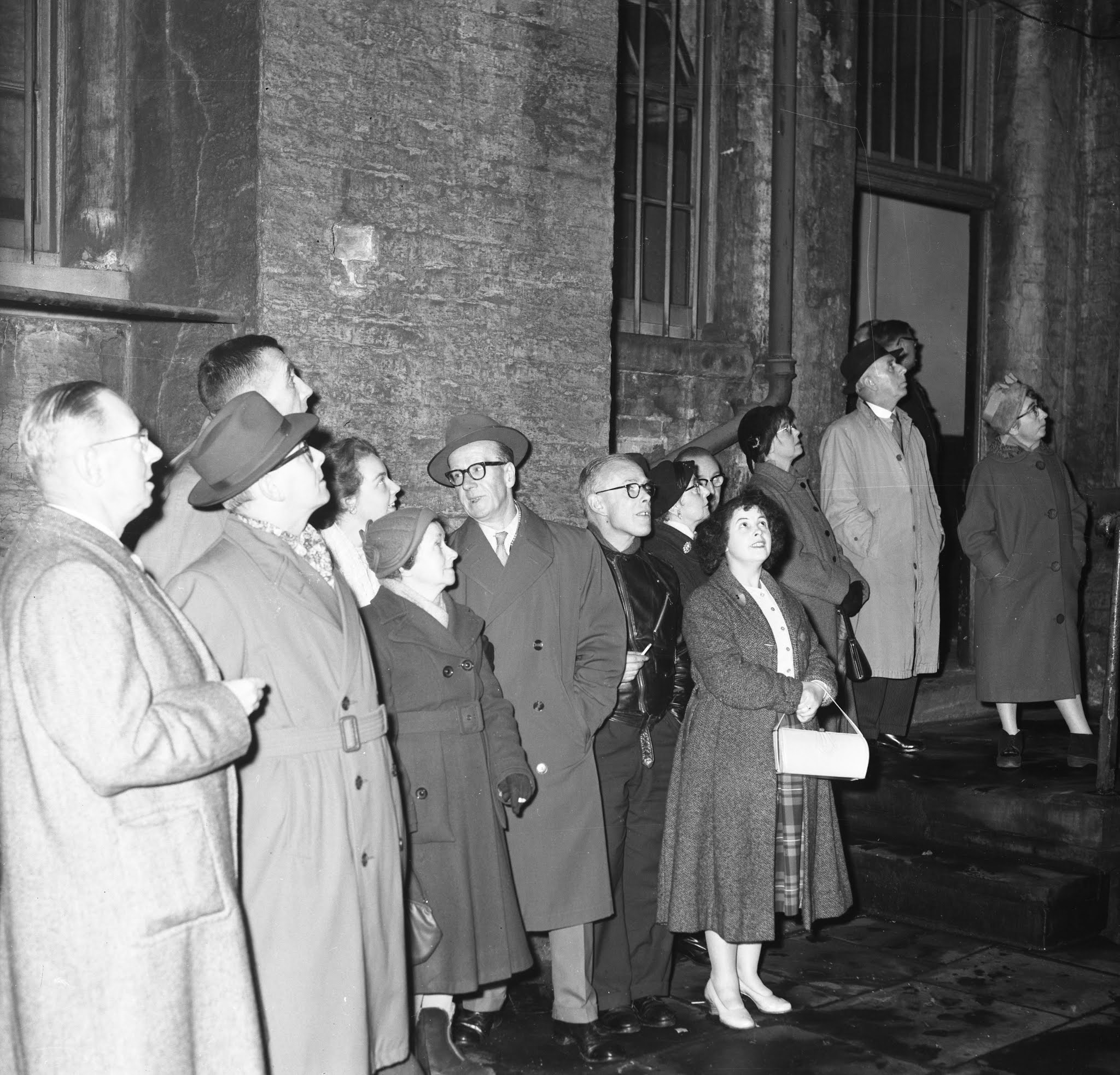
Watching the unthinkable ……………….. Manchester 1960

Now, as unhistorical as it is, sometimes you have to speculate on the origins of an unknown picture.


In the case of this one, the information is limited to the date it was taken which was 1960.

Other than that, it is pretty much a mystery.

I don’t know where this group of people were, or what caught their interest.

Suffice to say, it is evening judging by the overcoats, a night in the cooler months of the year.

There are two shots of the group, but no caption, and so we are left wondering.

That said in the same batch, there are a series of pictures of what looks to be a staged rescue of an injured man from a tall building, along with a few of men in uniform.


And that takes us closer to a possible explanation, because in 1960 we were in the middle of the Cold War, which was that stand off between the Soviet Union and the USA, made more deadly because both sides were engaged in arms race, which included the development of bigger and more powerful  nuclear war heads along with the delivery systems.

Added to which both sides were engaged in proxy wars, across the world, any one of which had the potential to drag the two superpowers and their allies into a nuclear confrontation.

Just eleven years earlier there had been the Berlin Blockade, followed by the formation of NATO and later the Warsaw Pact, while in 1961 tensions were further exacerbated by the construction of the Berlin War, and a year later the Cuban Missile Crisis threatened to plunge the world into a nuclear war.

All of which brings me to the conclusion that our group of people are watching a Civil Defence exercise.


The Civil Defence Corps, had been established in 1949 and was a civilian volunteer organisation whose purpose was to mobilise and take local control of an affected area in the aftermath of a major national emergency, which for most people was an attack by the Soviet Union using nuclear weapons. 

There were the obvious links to how Britain had prepared and coped during the Second World War, when many of our cities, and towns came under regular bombardment by the Germans.

And looking at the faces of the men in Civil Defence uniforms, some well have served in the Home Guard, the Auxiliary Fire Service or as Air Raid Precaution Wardens, while others may been in the armed forces.

I was ten in 1960 and much of this passed over me. B


But I do remember the short television films that showed RAF bombers taking off in under four minutes with their nuclear payload , which those of my age and older will instantly recall chimed in with the “Four Minute Warning” which was the accepted duration of the time between detecting an incoming Soviet strike and its arrival.

All of which brings me to those two counter approaches to the unthinkable.  

On one hand there was the Government line reflected in this Civil Defence poster, and on the other the comic response of Beyond the Fringe which pointed out that when Britain  receives the four minutes warning of any impending nuclear attack. Some people have said, "Oh my goodness me — four minutes? — that is not a very long time!" Well, I would remind those doubters that some people in this great country of ours can run a mile in four minutes”.

All of which might not have been lost on the people watching the Civil Defence exercise on the streets of Manchester in 1960.

Location; Manchester, 1960

Picture; Civil Defence, Manchester, 1960, 1960-3179-1, -3179-51960-3179.8, courtesy of Manchester Libraries, Information and Archives, Manchester City Council, http://images.manchester.gov.uk/index.php?session=pass and a civil defence poster produced in 1957 by the Central Office of Information (INF 2/122)Civil Defence is Common Sense, National Archives, https://www.nationalarchives.gov.uk/education/resources/fifties-britain/civil-defence-common-sense/


Wednesday, 29 September 2021

One Friday night in Edmund Waller in the November of 1963

Every generation has that defining moment when a public event triggers a lasting memory of where they were and what they were doing when they heard the news.

For my parents it was the death of President Roosevelt and later the funeral of Winston Churchill while for some just a bit younger than me it was the death of John Lennon.

Most of the events are deaths and most are of world leaders mixed with tragedies like Aberfan or the Munich Air Crash although there can equally be moments of great hope and optimism of which the release of Nelson Mandela, the inauguration of President Obama and Dr King’s "I have a dream speech" sit deep with me.

But all of these are a backdrop to the one that still has the power to take me back to a night in the November of 1963.

I had been at Sea Cadets which was held in the lower hall of Edmund Waller, a school I had left just two years earlier.

We got to wear naval uniform, learned to drill, master Morse code, recognise a multitude of flags used as messages and on windswept and bitterly cold Sundays go rowing at the docks.

And at the half way mark in the evening for the price of a few pennies there was a huge mug of tea and a selection of misshaped jam tarts provided by the caretaker’s wife.

The sessions have pretty much merged into a blur but bits of that Friday on November 23rd have stuck with me of which my total humiliation at failing to tie a reef note are all too vivid.

Of course that memory only sticks because of the bigger picture which was the assassination of President Kennedy.

I was just 14 and politics and current affairs were just beginning to take over from Dan Dare, rugby and Airfix models.  That said like many of my generation I had been scared stiff during the October of 1962 when the Cuban Missile Crisis  seemed to threaten a nuclear war.

But President Kennedy was a remote figure and it was more the stunned reaction of my mother which made the event assume such a powerful significance.

The shooting had occurred at 12.30 Central Standard Time and President Kennedy died half an hour later so with the confusion and time difference I guess the first news of the shooting and then his death would not have been flashed up on the telly until 7 in the evening.

By then I would have set off for Edmund Waller and it would be a full two hours and a bit before I bounced back into the house by which time mum and dad would have had hours to mull over the news and ponder on what it held for the future.

Later I fell asleep listening to the radio in the kitchen.  The scheduled programme had been put to one side in favour of more news and reactions from around the world.

Such is the impact of an event half way round the world on a 14 year old lad in Lausanne Road.

Pictures; President Kennedy, February 20 1961, White House Press Office, and a young Andrew Simpson circa 1963 from the collection of Andrew Simpson


Friday, 21 August 2015

Where did the last half century and a bit go?

I have reached that age when I can go to the post office and collect my State pension which of course is that bitter sweet confirmation that I am officially an old man.

I have lived through two centuries, was almost there for the birth of the National Health Service, trembled at the awful implications of the Cuban Missile Crisis, marched against the Vietnam War and felt a little of my world had been lost at the news that Otis Redding had died.

But the immediate trigger for this bout of reflection was nothing more significant than the powerful fragrance of some flowers I passed this morning which transported me back to those long childhood summers when the sun always shone and each morning offered up new possibilities of adventures.

For a full minute I was back in the big garden that my grandparents retired to with its ornamental pools, the carriage shed and hay loft and big open field beyond.

It was August 1958 and I was nine years old and like many summers during my childhood I was spending the holiday with my grandparents in the tiny village of Chellaston.

We didn’t have a television, there were none of my friends to play with but that month walking the country lanes, catching the humming of the telegraph wires and the odd bird song were magic.

Now of course none of that is unique to me, all of us will have memories as powerful, some good, some not so good but reaching “that age” does mean they can crowd in on you.

This bout of reflection is inevitable and will come and go with varying degrees of intensity mixed with the knowledge that there are fewer years ahead of me than behind.

And everyone who looks back on the six or seven decades they have been around will perhaps reflect that in their life there was the most profound set of changes.

So had you been born during the last years of the long wars with Revolutionary and Napoleonic France you would have seen Britain transformed by the Industrial Revolution, entered middle age as the country acquired an empire and still have had a few years left to be able to sample gramophone records, make a telephone call and see a flying machine.

And some people experienced even more.

My uncle George was born in 1899, lived through the entire 20th century and died in 2001.

He was given a present to mark  the passing of the old Queen in 1901, celebrated Empire Day, fought in the Great War and remembered when  he saw his first aeroplane.

And during that long life he mastered the telephone, bought an early wireless, enjoyed the first "talkies" and while he had little time for television wanted a computer.

Against which I can advance the mobile. This when I was growing up  was still in the realms of science fiction.

And yet today we use that tiny hand held device not only to speak to friends and family but also to check the weather, make a hotel reservation and send an image of Manchester halfway across the globe.

And yet we remain blind to the history we are losing be it photographs, buildings or people’s memories.

I still have a very real soft spot for my first mobile but it is now as ancient and outdated as the telegram, the Model T Ford or the fountain pen.

It has long since been lost, and while it only allowed you to speak and text it did have a battery which didn't die by midday and played Snake.

Now that was something worth preserving.

Pictures;  from the collection of Andrew Simpson

Tuesday, 3 September 2019

Stockwell ……..Winds of Change ……. living through the 1960s…… one to listen to

Now I lived the 60s, with all its brash new ways of doing things, from music to fashion and much else. 

But it was also the decade in which we seemed to be marching to a nuclear disaster with a backdrop of the Cold War, manifested  by the Berlin Wall, the Cuban Missile Crisis and countless nasty little proxy wars fought with the support of the Superpowers who used them as a form of shadow boxing, and many of which could have spilled over into a Third World War.

Of these, the Vietnam War was the most prominent, but there were plenty more in Africa, South America and Asia.

All of which is just a plug for another new Radio 4 series, which this time comes from the political historian Peter Hennessy who  reads "from his new study of Britain in the early 1960s.

Peter grew up in Nympsfield in the Cotswolds and, apart from the excitements of new music from the Beatles and the Rolling Stones, satirical TV in the form of That Was the Week that Was and the coming of the first motorways, those adolescent days were overshadowed by the threat of nuclear war. Not least in the form of Prime Minister Harold Macmillan’s top-secret nuclear-proof stronghold, code-named Stockwell, which was being built just a few miles away.

Written and Read by Peter Hennessy
Adapted for radio by Libby Spurrier
Produced by Simon Elmes

A Pier production for BBC Radio 4”*

Picture; Atomic bombing of Nagasaki on August 9, 1945, Charles Levy from one of the B-29 Superfortresses used in the attack, This image is a work of a U.S. Army soldier or employee, taken or made as part of that person's official duties


Stockwell ……..Winds of Change, https://www.bbc.co.uk/programmes/m000823h

Monday, 18 November 2024

A shopping list, a coal receipt and a little bit of how we lived in the winter of 1963

Now in an age of online shopping I still like the idea of making a list and going down to the shops but I have grown lazy and have reverted to that simple practice of the man with the van.

And today that was what arrived at 6.30 this morning courtesy of the latest supermarket to get into the business of delivering our groceries.

I resisted for a long time arguing the joy of getting out and meeting people and choosing for myself was a paramount adding that it was just another example of that creeping invasion of the internet into my life.

But historically of course the idea of the man with a van is not new, and if I had been from a certain class I might well have expected pretty much all of my food to have arrived at the door courtesy of the “boy and the cart” from the local tradesmen.

The only difference I suppose is that instead of sending the servant with the list or making a phone call today the order is placed by computer and of course the man in the van is equally likely to be a woman.

And as I stare at the itemised receipt I am reminded what a wonderful little bit of history this list is containing as it does not only a record of what we consume but the cost of everything from two bottles of Gavi, three of Pinot Grigio and assorted household products.

All of which neatly leads me to the shopping list made out by my old friend Marjorie Holmes in the winter of 1963 along with a receipt for two bags of coal delivered to the house by H.Hawkard, “Coal & Coke Merchant, Station Approach, Chorlton-cum-Hardy.”

Now such lists and receipts are the stuff of everyday life and most will be discarded pretty much straight away.

My father being a more canny person did tend to keep these records if only to make it easier to shop next time, which I guess is not unlike that tab on the online site which directs you to your favourites.

In the case of Marjorie few of her shopping lists have survived so I can’t say how typical this one was but it gives an idea of the cost of living back in 1963.

Moreover it indicates she was both a regular customer of the Co-op as the divi number at the top of the page testifies and that the order was delivered.

Back in 1963 we still had a Co-op on Beech Road and the coal merchants continued to operate from the Station approach after passenger trains ceased to rum from Chorlton into Central.

Of course there will be those who mutter this is small history, compared to the bigger picture which saw the Cuban Missile Crisis the year before, the assassination of President Kennedy in the November of 1963 and the slow decline in the popularity of the Conservative Government but this is my sort of history.

Pictures; shopping list circa November 1963 and coal receipt, November 1963, courtesy of Marjorie Holmes from the collection of Andrew Simpson

Wednesday, 23 January 2019

A slow morning in the office

Now it has been a bit of a slow morning in the office, which has left me reflecting on why any of us write, and how a random thought or image becomes a story.

Birmingham, 1983
I came late to writing, and even now don’t take myself seriously, added to which my grasp of grammar and spelling verges on the non-existent, and so I write as I talk, which pretty much breaks every rule in the book.

 And unlike friends I don’t write to a plan, which means that often all I have is a vague idea, or at best a sentence which morphs into something.

So recently, when a friend posted a picture of a Dalek on the pier at Weston-super-Mare, my accompanying story evolved into one which linked them to the Cuban Missile Crisis of 1962.

Nor is this random journeying confined to photographs, and so when writing about someone or some event in the past, the story can go off in any one of several directions.

All of which is part of the fun is, and makes up the challenge, but it begs the question of how different the story might be if it was written today rather than yesterday.

Manchester, 2017
And brings me to these four images. 

The first dates to 1983, and was taken on a march through Birmingham, protesting at the rise in unemployment, the second is the view across the Square on a warm sunny day in Manchester, the third  of a Swiss lake and a solitary man, and the last also dates from the 1980s.

Each has a story, but the way we tell it and above all what is revealed can vary.

Sometimes there is no background information, other than that I was there and thought the man by the lake would make an interesting picture and what followed was less about him and more about the town by the water.

Others, like the white suited figures, was one of a series taken at a demonstration in October 1983, when the growing tensions between the super powers brought people out onto the streets to protest and the subsequent story was one which reflected on the history of demonstrations and the motivation of those who took part and the degree to which such events have an impact.

Switzerland, 2012
In some cases, it is just the juxtaposition of two different subjects, which in the case of the Birmingham march left me reflecting on the line of protesters who were observed by the children looking out from the window.

Lastly, some like the view across the square are full of possibilities and might draw on the history of the place, or its transformation over time.

But always I am guided by the broadcaster Alister Cook, whose Letter from America would always end where it started, neatly roaming over a series of related subjects in between.

And that is where I shall close, having filled the slow morning and mindful that I soon have an appointment in Manchester Central with a beer festival and pile of my books.

Manchester, 1983
For the curious I shall just add that what is now Manchester Central was GMex, which for 80 years had been Central Railway Station, and the beer festival will be an appropriate venue to publicize the two books on Manchester Pubs I wrote with Peter Topping.

Location; everywhere


Pictures, 1983-2018, from the collection of Andrew Simpson

Monday, 17 May 2021

Happy birthday Mr. Zimmerman …….. listening to Bob Dylan for the first time …… and that radio programme

Now, with all the hype on the radio this week I had assumed that today was Bob Dylan’s birthday, but no that is a week away.

The Times They Are A- Changin', 1964

Still it didn’t stop the Today programme this morning broadcasting some of his songs which were accompanied by reflections from a collection of celebrities on what those songs meant to them.

All of which will be followed up this afternoon by “It Ain’t Me Your Looking For: Bob Dylan at 80”.*

There are five episodes in the series and the first  is “Learn Your Song Well (1941-1964)”.

And it is the one that will most resonant for me, because it was in June 1964 that I bought two of his LPs.

These were “The Freewheelin Bob Dyan” and “The Times They Are A-Changin'”, and while a year separated their release, I know I got them together.

They sit along side four other LPs bought between 1964 and 1966, and another which came out three years later.

I was 15, fired by the injustices I saw around me, and in particular the news stories from the USA of Dr. King, the Freedom Riders and the campaigns for voter registration.

And the songs off those two LPs spoke directly to me, focusing as they did in part on the discrimination, poverty and the power of the Establishment to seemingly do what they wanted.  

There are lighter and more personal songs which also chimed in with an adolescent, but it was the political ones that took me over.

Of these it was, and perhaps still is, “A Hard Rains -A-Gonna Fall", about the unthinkable landscape of a post nuclear war, which was “written during the Cuban Missile Crisis of October 1962, when those who allowed themselves to think of the possible results were chilled by the imminence of oblivion. ‘Every line in it’ says Dylan ‘is actually the start of a whole song.  But when I wrote it, I thought I wouldn’t have enough time alive to write all those songs so I put it all I could into this one’”.**


From Dylan I went on to some of his contemporaries like Tom Paxton and Phil Ochs, and from there via Peter Seeger Joan Baez, and Buffy St Marie onto English folk music.

I also weathered the electric conversion, muttered darkly at his move away from the early stuff but kept buying the LPs because electric or not they were great music and powerful songs.

Unlike a colleague of mine who at concert in Manchester in 1966, shouted out “Judas” during one of Dylan’s electric songs.  I have to confess I only half believed him, until I came across a newspaper story which confirmed the account.***

All of which I guess is pretty much as close as I will ever come to Bob Dylan, other than the seven LPs and eight CDs I have of his work.

So, I shall be listening to the Radio 4 programme, later today at 13.45, and maybe thinking about him next Monday on his birthday.

Pictures, the LP  covers, “The Times They Are A-Changin'”,1964, “The Freewheelin Bob Dyan”, 1963, from the collection of Andrew Simpson

“It Ain’t Me Your Looking For: Bob Dylan at 80”, Radio 4, https://www.bbc.co.uk/programmes/m000w4ny

**Nat Hentoff, sleave notes, “The Freewheelin Bob Dyan”, 1963

***Bob Dylan: How I found the man who shouted 'Judas', Andy Kershaw, The Independent, July 17th, 2013, https://www.independent.co.uk/arts-entertainment/music/features/bob-dylan-how-i-found-man-who-shouted-judas-314340.html


Thursday, 19 September 2024

Shopping the years …… with Habitat

The blog doesn’t do nostalgia … it’s a false and dangerous place, where the sun always shines during summer holidays and Wagon Wheels never lose their size.


But just sometimes it worms its way into the blog and in the case of these Habitat catalogues it is allowed.

If you are of a certain age to have thrilled at the first time you heard “She Loves You”, felt the light go out at the news of the death of Otis Reading and trembled during the Cuban Missile Crisis, then Habitat will resonate.

It was the go to place for those of us rebeling at our parents taste, and wanting to set up home with the exciting designs of the 1960s and 70s.

Much of what they sold was relatively cheap and allowed us to think we were chic, and different.

And even if after an hour of wandering through the show room you came out with just a set of wine glasses or ceramic pot advertising “Dripping” you felt you were up there with Conran, Quant, and heaps of forgotten pop stars.

These catalogues were sent over by my friend Ann in France.  

I had finished a story on design and history with an appeal for anything Habitat.*

Ann replied with “In response to your request, I have an assortment of these, from, I think , when the Habitat shop opened in Manchester.

It was when I was at Art College, and our tutor took us on a visit.

After having to search for good design in large stores, it was wonderful to find that everything in the same shop was well designed.

I have long been a fan of Conran, and much of our first and second home was based on what we saw in the Conran House, and Kitchen books. And later on his book on France.


I laughingly said to Howard, what Andrew needs is a couple of days over here, with a small van.

Then I went to look for the Habitat magazines.  I have about 20 dating from 1972, which was the year after we got married.

Will shake off the vintage dust, and send a couple of pictures, when I've got my breath back!”

And sure enough she did with the promise that some will come back with friends returning home after visiting Ann and Howard.

So there you are …… a little bit of 60s and 70s design when we were all so young.

And yes I suppose it is a slice of nostalgia

Next; a wander through the insides.


Location; the 1960s and 70s

Pictures; catalogues from Habitat, circa 1970scourtesy of Ann Love 

*Wendy houses …… and a bit of social history, https://chorltonhistory.blogspot.com/2023/06/wendy-houses-and-bit-of-social-history.html


Thursday, 11 June 2020

Stories from the attic ...... part 10 ........ when history is a dangerous thing

Always be careful of the history you read …………… because it ain’t always what it seems.

Now that might be a surprise to many, who like my mother always maintained that  “the past is what it is”, which because it is based on facts as Mr. Gradgrind espoused in Hard Times, is never to be questioned.

But I have enough books on the shelves which by their age and scholarship would seriously challenge that idea.

And lurking in a corner of the cellar are the six editions of Pictorial History, published by the Daily Mail in 1962 “telling the story of man from the Ice Age to the Space Age in six monthly parts”.

In cost two shillings and sixpence and arrived each week on the door mat from the local newsagent.

I remember pestering mother to buy them and I remember carefully looking at the pictures and pretty much leaving the text.

But a full 58 years later I have been reading each of the six.

On one level they deliver a comprehensive account of the history of the world, which is not over Eurocentric and includes  all the ancient civilizations, even if China and India are confined to five paragraphs on one page of Book One, and  Africa and Colonialism don’t get a look in.

I suppose they are of their age, which was still one where in schools little outside European history was taught and great chunks of the world’s heritage were ignored.

And that in turn makes them interesting, because they have become history books in their own right.  It starts with the total absence of women in the text summed up by that opening paragraph which refers to “the story of man”.

It signs off on Stalin and Russia with the comment “But the final aim of Communism never wavers.  The technical triumphs in science, industry and sport are only wayside stations on the crusade to make the world Communist”, while passing over the powerful and pervading influence of the United States of America in all things economic and cultural.

Nor does it hide the real concerns which preoccupied many of a future war between the two superpowers.

The penultimate chapter is entitled The Shadow of the Bomb, and concludes with “There is little doubt that this permanent shadow of disaster which has hung over a whole generation of young people is responsible for the instability of their conduct.  

The only encouraging side to the problem is that the results are now so certain and so terrible that even the most foolhardy statesmen would hardly risk a major war.  Nevertheless less the testing [of nuclear devices] continues to increase radiation dangers”.

Which was an optimistic interpretation nearly overturned by the Cuban Missile Crisis and the later nuclear brinkmanship by the USA and the Soviet Union during the Yom Kippur War of 1973.

And as frightening as the paragraph was, it does highlight that age-old concern that the young are somehow doing something wrong, which echoed through the earlier decades of the last century and into the century before that.

So, Pictorial History is of its time and as such might well be a little misleading if not dangerous as a guide to the past.

But in one aspect it is spot on, and that has to be the artwork which runs through the six volumes.

The cover designs are of the period, and I remember coming across posters and adverts which used the same bold style, some of which have also sat in our cellar for over half a century.

In time I may dig them out, and ponder on their inclusion in our new book “The Lost Stories  of Chorlton-cum-Hardy …. In Our Attics, Cellars, Garages and Sheds”.

The book is predicated on that simple idea that we all have “treasures” stored away which tell our own personal story as well as casting light on the history of the last two centuries.

Peter and I are working on it as I write, but would welcome contributions.

You can contact us by leaving a comment on the blog or through Facebook, telling us just what you have and its importance to you and your family.

Location Chorlton-cum-Hardy, Peckham, and 1962.


Pictures; from Pictorial History, 1962, from the collection of Andrew Simpson


*“Now, what I want is, Facts. Teach these boys and girls nothing but Facts. Facts alone are wanted in life. Plant nothing else, and root out everything else. You can only form the minds of reasoning animals upon Facts: nothing else will ever be of any service to them. This is the principle on which I bring up my own children, and this is the principle on which I bring up these children. Stick to Facts, sir! “Thomas Gradrind Hard Times, Charles Dickens, Chapter 1, 1854

Tuesday, 13 January 2026

Uncertain times ……… when nasty bits of history don’t go away

I suppose every generation at some point comes to terms that with uncertain times, threats become real and the unthinkable becomes a prospect to be prepared for.

Poland, 2026
This is a Polish guide which today slipped through the letterbox of our kid who lives in Warsaw.

The title is "Poradnik bezpieczeństwa", subtitled "Przeczytal;przecwicz! zachowaj!" which translates as "Safety Guide Read it! Practice it! Keep it!"

And given that Poland neighbours Ukraine which continues to defend itself from Russian aggression the message is clear.

For my generation it was the Cold War and the very real threat that the superpowers would plunge the world into a nuclear war.

It was a very real threat that never really subsided from the 1950s onwards and had a second visitation in the 1980s.

I can remember the Civil Defence Drills, the short public information messages on the telly showing how RAF bombers could be in the air in under 4 minutes and the sheer horror of the Cuban Missile Crisis.  

All of which resurfaced in the 1980s when with growing tensions between the USA and the Soviet Union a new set of nuclear warheads were developed on a new set of delivery systems.

Britain, 1957

That second Cold War resulted in the little booklet "Protect and Survive" which was delivered to every household across the country and was accompanied by television adverts.

Britain, 1940
So grim were the outcomes of a nuclear exchange of weapons and so helpless it seemed were the prospects of survival when you lived in a city that most of didn’t even open the booklet.

That said the preparations made during the run up to the Second World War did save heaps of lives.

My parents and grandparents will have worked their way round those preperations and regulations, carrying gasmasks, observing the blackout and in the case of dad leaving his job as a coach driver and to take up eseential war work in the north east. 

As far as I know Dad never joined the Home Guard, but others in the family will have done.

In time I will get to know what is inside the Polish document.

But history suggests it will make grim reading.

Pictures; Poradnik bezpieczeÅ„stwa, Polish Ministry of Defence, a civil defence poster produced in 1957 by the Central Office of Information (INF 2/122)Civil Defence is Common Sense, National Archives, https://www.nationalarchives.gov.uk/education/resources/fifties-britain/civil-defence-common-sense/ Rifle Training for War, a textbook for Local Defence Volunteers by Captain Ernest H. Robinson, 1940

Sunday, 29 June 2014

Where did the last half century and a bit go?

May 1966
I will soon have reached that age when I can go to the post office and collect my State pension which of course is that bitter sweet confirmation that I am officially an old man.

I have lived through two centuries, was almost there for the birth of the National Health Service, trembled at the awful implications of the Cuban Missile Crisis, marched against the Vietnam War and felt a little of my world had been lost at the news that Otis Redding had died.

But the immediate trigger for this bout of reflection was nothing more significant than the powerful fragrance of some flowers I passed this morning which transported me back to those long childhood summers when the sun always shone and each morning offered up new possibilities of adventures.

For a full minute I was back in the big garden that my grandparents retired to with its ornamental pools, the carriage shed and hay loft and big open field beyond.

March 1954
It was August 1958 and I was nine years old and like many summers during my childhood I was spending the holiday with my grandparents in the tiny village of Chellaston.

We didn’t have a television, there were none of my friends to play with but that month walking the country lanes, catching the humming of the telegraph wires and the odd bird song were magic.

Now of course none of that is unique to me, all of us will have memories as powerful, some good, some not so good but reaching “that age” does mean they can crowd in on you.

This bout of reflection is inevitable and will come and go with varying degrees of intensity mixed with the knowledge that there are fewer years ahead of me than behind.

September 1970


And everyone who looks back on the six or seven decades they have been around will perhaps reflect that in their life there was the most profound set of changes.

So had you been born during the last years of the long wars with Revolutionary and Napoleonic France you would have seen Britain transformed by the Industrial Revolution, entered middle age as the country acquired an empire and still have had a few years left to be able to sample gramophone records, make a telephone call and see a flying machine.

And some people experienced even more.

My uncle George was born in 1899, lived through the entire 20th century and died in 2001.

Sometime in 1960
He was given a present to mark  the passing of the old Queen in 1901, celebrated Empire Day, fought in the Great War and remembered when  he saw his first aeroplane.

And during that long life he mastered the telephone, bought an early wireless, enjoyed the first "talkies" and while he had little time for television wanted a computer.

The Nokia 3310, 2000
Against which I can advance the mobile. This when I was growing up  was still in the realms of science fiction.

And yet today we use that tiny hand held device not only to speak to friends and family but also to check the weather, make a hotel reservation and send an image of Manchester halfway across the globe.

And yet we remain blind to the history we are losing be it photographs, buildings or people’s memories.

I still have a very real soft spot for my first mobile but it is now as ancient and outdated as the telegram, the Model T Ford or the fountain pen.

It has long since been lost, and while it only allowed you to speak and text it did have a battery which didn't die by midday and played snake.

Now that was something worth preserving.

So I guess I know how I want to spend the time after collecting the pension and I hope others will help me by continuing to send me their pictures, their stories and contribute their own little bit of the story of this and the last century.

And the places are all there from Well Hall and Eltham to Chorlton, Manchester, Salford, Ashton-Under-Lyne, Stretford and Stockport.

And while I am at it I will just throw in Newcastle-Upon-Tyne, Sunderland and big chunks of Canada which of course pretty much gives away the family history.  I doubt however whether Naples, Varese and Cologne will surface .......... well not yet any way.

Pictures; Albert Square and the Town Hall, 1960, courtesy of Sally Dervan and the rest from the collection of Andrew Simpson