Showing posts sorted by date for query Leaf Street. Sort by relevance Show all posts

Friday, 28 July 2023

Who buried Mr. Birley in an open space in Hulme?

I should say that it’s not just who buried him but it’s who then found him.

What was lost is found, 2023

At which point I should point out that it is not Mr. Birley as such but the memorial stone commemorating the opening of Manchester’s first Board School in the June of 1874.

It is a story I have already visited but always promised myself a second go. *

I had thought I would crawl over the newspaper accounts of the opening, featuring the speeches of the good and worthy and their observations on the importance of education and in particular the features of Board School No. 1.

The school, 1962
These included a basement kitchen “with all appliances for tea parties”, “large places for storing fuel, with convenient shoots from the street above, so that all the rooms are warmed by open fireplaces and are thoroughly well ventilated”. 

Added to which the Manchester Guardian reported “The walls are faced to a certain height with glazed bricks, which can be easily cleaned, and on which writing or other defacement is impossible. 

Round both school rooms run bands of encaustic tile, bearing Shakespearean mottos”.**

But one Victorian worthy’s speeches on the value of education are pretty much like another so instead my thought turned to how the stone got there and who decided it should see the light of day again.

Walking to the Brooks Building 2023
Manchester Board School No.1 or Vine Street School as it became was situated close by and so it is entirely possible that when the school was demolished the memorial stone was just part of heaps of building spoil.  Just a little distance away developers found the original sunken baths of the Leaf Street Swimming Baths which were back filled after the walls of the building had been knocked down.

Or it may have been carefully stored away ready for the moment when a new educational institution was built in Hulme close to the old school.***

Someone one will know, and perhaps also reveal who decided to put it on display in a small area of land left to grow wild.

We shall see.

Location; off Old Birley Street, Hulme

 Pictures, memorial stone of Board School No 1, 2023, from the collection of Andrew Simpson, and the school, 1962, H. Milligan, m64822, , courtesy of Manchester Libraries, Information and Archives, Manchester City Council, http://images.manchester.gov.uk/index.php?session=pass  

*The lost Hulme School ……, https://chorltonhistory.blogspot.com/2023/07/the-lost-hulme-school.html

**The First Board School in Manchester, Manchester Guardian, June 12th 1874

***The Brooks Building, part of the MMU.


Tuesday, 4 April 2023

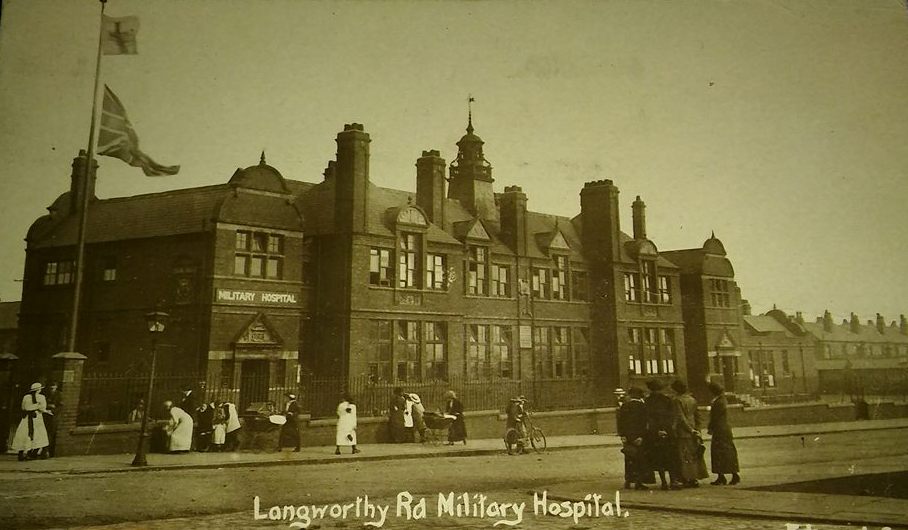
No more school at Langworthy Road ......... and in its place a military hospital

Now if you are seven years old and going to school on Langworthy Road in Salford the only bright bit of news as the Great War rolls into its second year might be that your school was to become a military hospital.

In the March of that year the authorities identified five schools which they thought might be suitable “for new hospital accommodation required by the military authorities.”*

The five were Secondary School for Boys, Leaf Square, Grecian Street Girls and Infants Schools, Halton Bank School, Langworthy Road School and Tootal Road School, with the option to substitute “Leicester Road School for one of the others.”

The attraction of the five/six were that they were all modern school.
In the case of Langworthy it had only been opened five years earlier in 1915 and had a total intake of 376 boys, 376 girls and 442 infants.

By all accounts it would have passed an Ofsted visit with flying colours.  The average attendance was nearly 100% and it was judged good by a report in 1905.

All of which just left the difficult question of what to do with 1,194 students.

The authorities had not fully worked out the answer to that question in the March of 1915 but considered that “There a number of Sunday Schools and halls in Pendleton and Broughton districts which may be utilised and suggestion has also been made that schools in the neighbourhood of the five selected schools should have two courses a day – one from 8 am. To 1pm. and the other from 1pm.to 5 pm., - one for each school."

This half day schooling was also adopted by Manchester where by 1915 the number of schools taken over amounted to eight. The first was the Central High School for Boys and Girls on Whitworth Street which had a thousand students and became the headquarters of the 2nd Western General Hospital.

The following year another seven schools were taken over.

These were Alfred Street in Harpurhey, Alma Park in Levenshulme, Grange Street in Bradford, Lilly Lane in Moston, Ducie Avenue, Moseley Road and Heald Place which amounted to the loss of 3897 places.**

It had resulted in a degree of ad hoc provision for some at least. In the February of 1916 the Manchester Museum reported that it was providing effective instruction for 900 to a 1,000 children per week drawn from the higher standards of the elementary schools.***

A similar scheme was underway at the City Art Gallery, the Whitworth Institute, and “kindred institutes in the city” and had proved so popular that children not only travelled some distance to attend but even brought their parents.

And that pretty much is that.

Location Salford

Picture; Langworthy Road Military Hospital, circa 1915-17 from the collection of David Harrop

*The New Hospitals, Five Salford Schools to be used, Manchester Guardian, March 17 1915

** 2nd Western General Hospital, Manchester, 1914-1919, Margaret Elwin Sparshot

*** War Service in the Museums, Teaching the Half Timers, Manchester Guardian, February 21, 1916

Monday, 10 January 2022

Two streets …… one builder ….. and the incomplete story of William Frank

Now it is odd how you can be drawn to someone from the past who less than a decade ago I wouldn’t have wasted any time on.

Mr. Frank's property empire, 1836 from the Poll Book

And so it is with William Frank, who was a small-time property developer whose empire seems to have begun with two streets in Little Ireland in the 1830s.

Frank Street and William Street, 1849

For those who don’t know, Little Ireland was that notorious slum, much written about by Dr. Kay, Frederick Engels and a heap of social observers and historians.

I first came across the two streets over 30 years ago, by which time they had been swallowed up by a factory and were relegated to access points into the building.

But once they were part of a complex of streets off Great Marlborough Street bounded on two sides by the River Medlock and dominated by Frank Street Mill, a gasometer, an iron foundry and boiler houses.

In the 1980s when I first came across these two ghost streets, I was mildly interested in how they became known as Frank Street and William Street, but never took it any further.  Much later I speculated that perhaps they were named after a builder or speculator, but again left it at that.

Great Marlborough Street, with our two streets to the left, 2019

But more recently I went looking for a Mr. Frank and Mr. William and discovered they were the same person.  Added to which his portfolio of 10 properties which he added to, conferred on him a Parliamentary vote in the newly reformed House of Commons.

At which point I still maintained he was like Mr. Gradgrind a hard-faced man of property, profiting on the backs of the workers.

Now he may well have been, but speculators and slum landlords are also worthy of research if only to give a rounded picture of the time.

So, Mr. Frank was born in Guisborough in 1788, died and was buried in 1868 in the old Manchester General Cemetery, and shares his resting place with two others who were mostly likely not related.

And that is about it.  He was married but his wife was dead by 1851, and there are only two references to where he lived.  So in 1836 I can track him to Baxter Street in Hulme, where he lived for at least four years and in 1851 to 99 Duke Street which was just around the corner.

By then he was a lodger in the home of John Hope who was a warehouseman.

Baxter Street and Duke Street, 1849

All of which is hardly a story of unparalleled wealth, because despite adding to his portfolio he appears not to have had a vast number of houses.  And calculating from the rents we know he charged I suspect his total income from all the houses was about £60 a year.

But that fits with what we know was going on in the first decades of the 19th century where small time businessmen built a few houses and rarely ended up with anymore.

Certainly, on both Frank Street and William Street, there were a number of property owners who may have built their own houses on the two streets or bought from William Frank.

The Rate Books do not record anything more on his empire, and as yet don’t even have a reference to Baxter Street.  

Nor have the other usual official documents been kind to him, so apart from his record of baptism there is nothing.  

And to add to the yawning gap, there are no photographs of Baxter Street and none of Duke Street that I can confidently date to the 1850s.  Alas anyone who goes looking for them will be disappointed, for while Leaf Street still exists, Baxter and Duke Streets vanished long ago.

All of which just leaves a certain Samuel Frank who was living on Plymouth Grove in 1861, who may have been the son of William Frank, but as yet the trial is confusing.

So all still to look for.

Location; Chorlton Upon Medlock and Hulme,

Pictures; William and Frank Street, 1849, and Baxter Street, and Duke Streetfrom the OS of Manchester & Salford, 1849, courtesy of Digital Archives Association, http://digitalarchives.co.uk/ extract from the Poll Book for South Lancashire, 1836, and Great Marlborough Street, 2019, from the collection of Andy Robertson 

*”Facts alone are wanted in life. Plant nothing else, and root out everything else. You can only form the minds of reasoning animals upon Facts: nothing else will ever be of any service to them. This is the principle on which I bring up my own children, and this is the principle on which I bring up these children". Mr. GradgrindSchool Inspector,Hard Times, Charles Dickens, 1854

Thursday, 22 July 2021

Lost and forgotten streets of Salford nu 11 Collier Street

Now Collier Street will mean many things to many people.

Collier Street, 2015
For those with a preference for music there is the Blueprint Studios directly opposite on Queen Street and for those who fancy a drink as well as their music there is the Eagle half way up Collier Street.

For others it will be the old baths on the corner with Rolla Street where I am told Mark Addy learnt to swim and which were opened by the same company that built the Leaf Street baths in Hulme and others across Manchester.

But sadly there is no one left who can tell me about learning to swim in its pool or even of a Saturday morning splash about with friends and family because the  baths closed  in 1880 after just 25 years of serving the community.


The Eagle Inn, 2011
So you might be forgiven for thinking that Collier Street has abandoned its history, but not so.

My old friend Val got in touch to tell me that her grandparents lived  in “Artisans Dwellings on Collier Street. 

I have now looked up the place and an interesting tale emerges. They were built by the Artizans Company mainly they built in London.

The man who started it started out working as a scarecrow! The company went bust at one point because of embezzlement by the Company secretary and others. 

His name very Dickensian was Swindlehurst.”

The company had begun in 1867 with high intentions of building for profit good quality low rise properties for working people.  This put them slightly at odds with other companies also building for the poor who had gone down the model of multi story blocks of flats.

Most of their properties were as Val said in London, but they seem to have built here on Collier Street running up from Queen Street as far as Rolla Street.

I can’t exactly date them yet, but they are listed in the 1901 census and while they don’t appear in earlier lists there were people on the site in 1891.

Of course these may be earlier buildings which predate Artisans Buildings but there are a row of properties on the 1895 OS map which do seem to conform to what I think they would be like.

Collier Street, 1895
According to the 1901 census Artisan S Buildings consisted of 68 properties in which lived 276 people.*

Their occupations ranged across the sort of\semi and and unskilled jobs that this bit of Salford had to offer.

So far no picture of the buildings has come to light but Elaine Craven remembers “we left the Greengate area in 1959/1960 I don't know when the Artisans were pulled down, but they were a red brick and cream brick if I remember rightly, it had a big courtyard with a gate which was always locked, and I think they were three high, could be wrong, and they looked good. 

All the kids played in the dwellings, but I don't remember how many kids lived there."***

And that just leaves me with the story behind nu 19 Collier Street in 1911 which was home to Mr and Mrs Stone who lived in the last house on the corner of Collier Street and Rolla Street, which was a pub and here in just five rooms lived the Stone’s and their nine children.**

Pictures; looking down Collier Street towards Queen Street, 2015 from the collection of Andy Robertson, and detail of the area in 1894 from the OS map of South Lancashire, 1894, courtesy of Digital Archives Association,  http://digitalarchives.co.uk/

Painting; the Eagle Inn, Salford © 2011 Peter Topping

Web: www.paintingsfrompictures.co.uk

Facebook: Paintings from Pictures https://www.facebook.com/paintingsfrompictures

*Enu 14 10- 19, Greengate Salford, Lancashire, 1901

**Enu 131, Salford, Lancashire, 1911

***Elaine Craven, 2016

Monday, 11 January 2021

What was lost is found .... the forgotten Manchester Baths in Mayfield

 Now like a lot of people I was fascinated at the news that “A large Victorian washhouse that served Manchester textile workers more than 150 years ago has been uncovered during work to create the city’s first public park in a century”.*

Leaf Street, 2016

It appeared on an online Guardian report on Sunday and promises to be very exciting, given that "The ornate tiles of the Mayfield baths, whose pools measured nearly 20 metres, were found in ‘stunning’ condition beneath a car park 164 years after it opened”.

Since then, Graham Mottershead, the project manager at Salford Archaeology, has been on radio 4 to explain the significance of the find, which  he said “is a fascinating example of the social and public health advancements that came about during the Industrial Revolution”.

The baths were opened in 1857 by the Manchester & Salford Baths and Laundries Company which had been formed two years earlier and had  built baths in Salford, as well as Mayfield, Victoria Park and Leaf Street in Hulme.**  Its assets were bought by Manchester Corporation in 1877. 

At the company’s first shareholder’s meeting on January 7th 1857, the company proudly announced the details of their first bathhouse in Greengate on a plot of land bounded by Rolla-street and Collier-street which was owned by the Salford Union.

Leaf Street, 2016

And having commissioned six architects to submit plans  of which three did, and while the successful plan was more expensive it was decided that it was affordable given that the demolition of the old workhouse would provide materials which could be used in the construction of the new building.

The Directors pointed out that “This establishment is placed  in the centre of a large and dense population with convenient thoroughfares and approaches leading thereto from every direction and is situated only eight minute’s walk from the Exchange”.***

And having opened the "Greengate establishment to public bathing on August 27th [1856] and the laundry on September 1st the receipts during the limited period have exceeded the most sanguine expectations …”

Leaf Street, 2016

So with the promise of even greater returns, the Directors announced that their second bathhouse was to be built at Mayfield in Ardwick.  

The company had already secured an “arrangement with the corporations of Manchester and Salford for a supply of water at the rate of 3d. per 1, 000 gallons of water" and having bought the plot expected the Mayfield Baths to be open on March 31st 1857.

They explained that “This establishment will be placed in the midst of a large and dense population .  The vendors of the land will construct a bridge over the Medlock by means of which , through Boardman-street, a ready and convient access from the districts of Ancoats as well as from all parts of Ardwick, will be secured”.

Mayfield 1924

The rest as they say is history, with the Baths being enlarged in 1925 only to be destroyed during the last world war.  The OS map for 1950 marks the site as “ruins” and the decision to just fill it in and use the site as a car park saved it.

But it isn’t the first of the company’s establishments to reappear into the daylight, because back in 2016 the Leaf Street comples was also redisvovered and excavated.  It had closed it 1977 and like Mayfield had just been filled in.

And it is from the Leaf Street baths that I have taken the pictures, which were taken by Andy Robertson.

Mayfield Baths, 1894

The Leaf Street remains show a striking similarity to those from Mayfield which is not unsurprising.  Sadly copyright considerations have precluded the use of those from the Guardian article, but I bet there will be more Mayfield pictures to see soon.

Location; Mayfield and Hulme.

Pictures; remains of Leaf Street Baths, 2016, from  the collection of Andy Robertson, the opening of the Public Washhouse Mayfield Baths, 1924, City Engineers, m57352, courtesy of Manchester Libraries, Information and Archives, Manchester City Council, http://images.manchester.gov.uk/index.php?session=pass, and Mayfield Baths, 1894, from the OS map of South Lancashire, courtesy of Digital Archives Association http://digitalarchives.co.uk/

*Victorian bathhouse uncovered beneath Manchester car park, Josh Halliday, January 10th, 2021, The Guardian, https://www.theguardian.com/science/2021/jan/10/victorian-mayfield-bathhouse-uncovered-archaeologist-beneath-manchester-car-park?CMP=share_btn_fb&fbclid=IwAR1mK29vk49WyMlFafXQ2vSnx9ZXETrIUBtSxRHCJN1yjhEXiPBeIxxjAGM

**Leaf Street Baths, https://chorltonhistory.blogspot.com/search?q=Leaf+Street

***Manchester and Salford Baths and Laundries Company, the Manchester Guardian, January 8th, 1857


Thursday, 5 March 2020

From green fields to gas works, the Reverend William Birley’s change of parish in 1859


In 1859 the Reverend William Birley had left Chorlton where he had been for seventeen years exchanging the small rural living for one in the  in the heart of Salford.  

This was St Stephens* and it was surrounded by rows of terraced housing which hid smaller houses and dark courts as well as the gas works, timber yards, iron works and cotton factories .

To the west and north the area was cut off by the river and to the east by the railway.

The contrast between the two places could hardly be starker.  During the day there was the noise from the countless factories, mills and foundries, while at night the clunk of shunting railway wagons and the whistle of steam locomotives carried over the roof tops.  Added to this was the all pervading smell from the gas works and the ever present pall of smoke from countless domestic fires and factory chimneys. **

But this was just the outward appearances of a hard and grim parish.  In the area bordering the church most were engaged in manual occupations.    Many of these were best described as pauper trades,

“for the wages can never enable a man to rear a family in independence.  Street sweepers, night soil men and policemen, handloom weavers and cotton dyers, hawkers, strikers in foundries, minders of planning and drilling machines, railway porters and the whole range of labourers, ....their wages varying from 12 to 18s [60p-80p] per week.  Deduct from this highest sum of 2s 6d for rent and how can a man keep and clothe himself, wife and four or five children on the remainder?”***      

These were also physically demanding jobs which could be dangerous.

Nothing perhaps prepared the casual visitor to the scene in the gas works as the men cleared the coke from the ovens and transported the red hot material on hand waggons, or the noise, dust and repetitive labour of the spinning room of a mill.
Perhaps it was the wish to bring a message of religious hope to such a place which motivated William Birley.

After all the income at St Stephens’s was £145 a year which was just £42 more than he had received in income from St Clements’ in the township.****    His sense of duty had also led him to sit as a Poor Law Guardian while still living in the township and later became an Inspector of schools for the county.*****

He was comfortably well off having described himself as of independent means at the 1841 census, held shares in a number of railway companies and was a director of at least two companies.  

He chose to live some distance from his parishioners in Leaf Square.  This was a pleasant and elegant spot separated from Greengate and St Stephen’s by a double loop of the river, and further isolated by the Manchester, Bolton and Bury Canal, and the Lancashire and Yorkshire Railway.

Looking out from his windows he had an uninterrupted view of the delightfully laid out square, and across open land to the river and Peel Park beyond.  Only the railway and canal could be said to act as mild blots on what was otherwise a fine vista.

Moreover his neighbours were drawn from the same genteel class.  They included a property owner, retired solicitor, fellow cleric, an iron merchant and those on independent means.      As would be expected all had a variety of servants, housekeepers, cooks and governess’s to ease their comfortable lives.

True there were nearby examples of industry in the form of cotton and flax mills, a dye works and brewery but these were surrounded by open land and houses with large gardens.   Even the rope walks which were some distance away between the square and the railway could not have been said to distract from what was a pleasant place.

St Stephen’s, it has to be said was more impressive than our own church in the township.  It was made of plain brick, dated from 1794 and was reckoned by contemporary observers to be comfortably fitted, containing three galleries and an organ.   All of which made it bigger than ours and with its tall classical tower and two floors it stood out from the village church William had previously preached in.***

But then it was set in the middle of Salford, with a timber yard running alongside the graveyard and a  foundry at the back of the church.   Just across the road towered the gasworks and a little further away was the rope works.

There is more on William Birley, the book. The Story of Chorlton-cum-Hardy, http://chorltonhistory.blogspot.co.uk/2011/11/the-story-of-chorlton-cum-hardy.html

Pictures; St Clements Chorlton-cum-Hardy, from the OS map of Lancashire, 1841-53, and St Stephens in Salford & Leaf Square, from the OS map of Manchester & Salford, 1844-49, courtesy of Digital Archives, http://www.digitalarchives.co.uk/

*Duffield, H. G., The Strangers Guide to Manchester 1850, 29, , The church was demolished in 1962 and the site is now a small park between Trinity Way and St Stephens Street.

**In the 1861 census these comprised the enumeration districts of numbers 7, 8, 9 , and 10, where the occupations included labourers, warehouseman, textile workers, foundry workers, laundresses, and porters

*** Watts, John, The Facts of the Cotton Famine, Simpkin, Marshall & Co, Manchester 1866, page 99, Google edition page 120

****Lewis, Samuel, A Topographical Dictionary of England, S Lewis & Co Vol 1& 3 1840

*****He held shares in the Birkenhead, Lancashire and Cheshire Junction Railway and the Fleetwood, Preston and West Riding Junction Railway [Preston Guardian December 24 1846], and  was a director of the Socttish Amicable Life Assurance Society [Manchester Times Saturday February 17 149], and the Manchester and London Life Assurance and Loan Association [Manchester Times Saturday March 12 1853],

Wednesday, 26 June 2019

Discovering the story of one British Home Child, born in London, migrated to Ontario and buried in Manchester

Now I doubt I will ever come across a photograph of young Thomas John Loveland.

Southern Cemetery, 2015
He was buried in Southern Cemetery in 1918 and was just 21 years old.

Not of course that there is anything unusual in that.  Plenty of people still died young in the early 20th century and not everyone could afford to have their picture taken in a photograph.

But in the course of the last few days I have come to know a lot about him.

He is one of the 26 men of the Canadian Expeditionary Force who are buried in a neat line in the cemetery.

Each will have a story and it was only by chance I settled on his grave.  He enlisted in the August of 1915 and was in the First Battalion of the Canadian Machine Gun Corps, and here the story becomes a little personal.

Like me he was born in London not that far from where I grew up and was a British Home Child like my great uncle who also enlisted in the August of 1915.

I had suspected he was a British Home Child because his Attestation Papers showed that his next of kin was an Eliza Loveland living in London and she was his sister..

Thomas John Loveland
Their father who had been a gas labourer had died in 1903 at the age of 35 leaving his wife Eleanor to bring up five children on her own.

The eldest who was Eleanor was eleven years old and the youngest was just two.

By 1911 they were living in a four roomed house at number 4 George Street at Walsoken in Cambridgeshire.

But only Eliza and her mother are in the property which they share with a William Fearis and his daughter who was 18 months old.

Both Mr Fearis and Mrs Loveland give their status as widowed and she describes herself as “Domestic housekeeper.”

In time I am minded to explore the story of Mr Fearis but for now I am content just to record that on the night of census Mrs Loveland’s youngest son was visiting.

He was eleven years old, is described as a “scholar” and this offers up the possibility that he too was in care.
I doubt that he could have been living with either of his elder siblings because they were only sixteen and fourteen.

And with the help of friends it seems I was right.  Liz Sykes who is the Archivist at the Together Trust thought that he may have been a Barnado boy and Catherine West and Dawn Heuston dug into the archives of the Library and Archives Canada and confirmed it.

from his Attestation Papers, August 1915
He arrived in Canada on board the SS Dominion in 1907 and had been migrated by the Barnardo Charity.

Like my great uncle he was the only one of the direct family to have been sent to Canada.

Somewhere there will be the records of how that migration came about and the decisions which led him to Canada but his siblings to stay in the UK.  Some of these will be locked away in the Barnardo records and as I am not a family family I will never get to see them.

That said I am in contact with a relative via ancestry and so maybe they will be able to get permission to reveal what happened.

Later I will also try and find his siblings.  One of his brothers I know was killed on the Western Front in the August of 1917.  He was Edward Loveland who was 27 when he died and he is buried atLijssenthoek Military Cemetery  in Belgium.

All of which underlines the enormity of the Great War, and like Private Thomas Loveland and his brother Bombardier Edward Loveland my family made a huge contribution.

Along with my great uncle in the CEF the family roll of honour includes my grandfather, another great uncle, two uncles and my great grandfather, and some who served in the German armed forces.

In honour of the Canadian Expeditionary Force
I hadn’t expected when I first came across his grave that Private Loveland would take me on my own personal journey which will for now conclude with a visit to his resting place in Southern Cemetery which is just ten minutes away from where we live.

And I intend to go on July 1 which is timely given that it is the centenary of the first day of the Somme and of course Canada Day.

I will also call in at the special exhibition in the Remembrance Lodge devoted to the Battle of the Somme.  It is maintained by David Harrop who in honour of the men of CEF buried here has included a special item of remembrance to those Canadians.

Nor should we forget that the cemetery also holds the graves of men of the ANZAC forces as well as the British army.

And something of the story of Southern Cemetery and the history of Manchester during the Great War is revealed in Manchester Remembering 1914-18 published today.

Location; Southern Cemetery

Research; Liz Sykes, Catherine West and Dawn Heuston

Pictures; Southern Cemetery 2013 from the collection of Andrew Simpson, grave of Private Thomas John Loveland, courtesy of David Harrop and Maple leaf from Lori Oschefski

*Manchester Remembering 1914-18


Thursday, 13 June 2019

Lost and forgotten streets of Manchester nu 33 Leaf Street ........ the workhouse, the swimming baths and more flats

Leaf Street, early in 2016
Now if you remember this bit of tiling you will have fond memories of the Leaf Street Baths in Hulme. It was built by the Manchester & Salford Baths and Laundries Company which had baths across the city and into Salford.

Ours offered both swimming facilities and a Turkish Bath, and every time the baths are featured there are always plenty of contributions from those who learnt to swim there or just had fun in the water.

Leaf Street, 1920
But like other Victorian baths they never made it past the middle of the 20th century.

Leaf Street went in the 1970s as part of the huge clearance programme.

What I hadn’t realised is that when they were demolished much of the building was just covered with soil and left.

So when the site began to be redeveloped recently a fair amount of those buried bits were exposed to the light of day.

Andy Robertson was on hand and took a series of pictures recording the excavated site, and was back yesterday to see what the developers and builders had done since.

And this is the result which in time will become more flats and continue the re population of Hulme.

Leaf Street, autumn, 2016
Sadly Andy was not on hand to snap the old workhouse run by the Chorlton Union which sat on the site for twenty or so years until it was replaced by the bigger and more impressive one at Withington in the 1850s.

As for Leaf Street I suppose it will soon not count as a long or forgotten street.

Once it was a busy place which then after the clearances became just a dead end beside the motorway going into town.

But with those new blocks of flats, and  their new set of residents Leaf Street will again be on the map as a place people come home to, write letters to and no doubt will evolve a new a history.

Location; Hulme


Pictures; Leaf Street in 2016 from the collection of Andy Robertson, Leaf Street Public Baths, 1920, m57327  courtesy of Manchester Libraries, Information and Archives, Manchester City Council, http://images.manchester.gov.uk/index.php?session=pass

Thursday, 29 December 2016

A day in December on our High Street ................. nu 4 the parish church

Now if you still live where you grew up the chances are that you take it all for granted.

For those of us who long ago moved away from Eltham that is something we can’t do.

So here for the next few days are a selection of Eltham High street on a December day just before Christmas.

They were taken by Ryan and are not in any order but take me back to the High Street I remember and given that we are close to Christmas it is fitting that there should be one of the church which I am regularly drawn back to.*

And before any one says anything, I too have just spotted the trees are in full leaf, which is either another sign of global warning or this is is a summer picture which I have picked up from Ryan by mistake.

Either way it will feature in June in a walk down the High Street in summer ........... can't be bad.

Picture; St John’s, 2015 from the collection of Ryan Ginn

*Eltham Church, http://chorltonhistory.blogspot.co.uk/search/label/Eltham%20Church

Saturday, 16 April 2016

Capturing images of where we live before they are lost for ever ............... the photographs of Andy Robertson

Now the collection has just expanded with a vast new set of pictures from Andy Robertson.

Many of them will have already featured on the blog and they represent a wonderful record of how Manchester, Salford and the surrounding areas are changing.

Andy specialises in capturing bits of the landscape just before and during that moment when they are being redeveloped.

It is an eclectic collection covering everything from derelict pubs and cinemas, to grand old houses past their best and a shed load of industrial sites.

Yesterday it was the old Leaf Street Baths in Hulme, before that the skyline from a car park and before that bits of Chorlton’s shopping history and some old street furniture.

And what makes his work unique is that once he has spotted a subject he follows it through from crumbling and empty relic to demolition, a cleared site and the development.

These two were taken in 2014 of the Wilburn Basin when there was talk of redevelopment.  Since then has been back.

And that is all I am going to say for now other than to thank Andy and to say here is the link to over 150 stories featuring his pictures.*  There are more I just haven't catalogued them yet.

Location, Wilburn Basin

Pictures; the Wilburn Basin June 2014 & January 2016, from the collection of Andy Robertson

*Andy Robertsonhttp://chorltonhistory.blogspot.co.uk/search/label/Andy%20Robertson


Friday, 15 April 2016

More fascinating pictures of the lost Leaf Street Baths.

Just when you think that is the end of a story up pops something new.

And just about an hour ago Andy Robertson sent over some fine pictures of the site.

With his usual modesty he made little comment, but they reveal so much of the old baths and make me want to go down there and explore the site.

But Andy has done an excellent job so here are some of what was lost under back fill and is now again open to the sunlight.

The baths had been in by 1860 the Manchester & Salford Baths and Laundries Company which  had been formed in 1855, and built baths in Salford, Mayfield at Ardwick and Victoria Park.*

Its assets were bought by Manchester Corporation in 1877.

The company had added a Turkish bath in 1860 which was the first in a public baths in Manchester.

The Leaf Street Baths were demolished in the clearances of the 1970s and today the site is open ground.

When I first posted the story I pondered on who remembered them and the response has been impressive.

There are those who wrote to me describing their first swimming lessons and those who still have their certificate proudly proclaiming their achievement at swimming a length, and memories from Tom who supervised children from nearby Royce School when they attended in the early 1970s.

Nor were the baths just a place for recreation, most also had a washhouse and facilities for families and individuals to take a bath, and in the case of Leaf Street it's own Turkish Baths.**

Location; Leaf Street, Hulme


Pictures; remains of Leaf Street Baths, 2016, from  the collection of Andy Robertson

*Leaf Street Swimming Baths, the first of a set of stories,http://chorltonhistory.blogspot.co.uk/2013/09/leaf-street-swimming-baths-first-of-set.html

**Manchester and Salford's Public Baths, http://chorltonhistory.blogspot.co.uk/search/label/Manchester%20and%20Salford%27s%20Public%20Baths

Wednesday, 13 April 2016

A last chance to go visiting Leaf Street Baths in Hulme

Yesterday I suggested that anyone interested in the old Leaf Street Baths in Hulme should get down there because after half a century of being buried they are briefly open again to the sunlight.

It has all been prompted by a couple of pictures Ian Wilson posted on facebook, and having read the story my old friend Andy Robertson was down there in a trice.

Andy has been steadily recording our disappearing past from old textile mills and warehouses to shops houses and the odd garage.

So Leaf Street was a project not to be missed.

With breakfast out of the way, and the blog read, he was down there taking pictures which will become a record not only of what is going on now but what will be to come.

And yesterday in a series of pictures he captured the work being done, but more importantly the geography of the site, including one of the almost intact pools but also the base for what I think is one have been a stone column archways and cellars and my own personal favourites, a set of floor tiles.

Now for the practised visitor to Roman ruins it may not mean much but for me and countless others who remember the baths with fondness these bits of the past will be fascinating.

I never used them but there will be lots who did and they will be able reel off memories of swimming lessons, visits with mum and dad and of course magic moments with their mates.

What I always find interesting is the way so many of these remains are just below the surface which I suppose makes sense when the land above was just being landscaped.

But what a find for the archaeologists and reminds me of the work done in the mid 1970s down at Castlefield when a complex of early 19th century working class cottages revealed that they sat on top of the old Roman town outside the fort.

And for once the lack of foundations and poor construction of those houses was a positive in that the builders had not disturbed the Roman remains.

Of course there will be someone who mutters Leaf Street was no Roman villa but the provision of public baths in working class area in the 19th century is an important bit of history, as is the whole development of municipal baths and wash houses.*

Some are being restored and saved like Victoria Baths just across the city and the impressive one in Ashton-under-Lyne.  Others like the one on Ashton Old Road are empty and neglected.

And so I am pleased Leaf Street is out in the air again and something of its past and the part it played in the lives of Hulme people is briefly remembered again.

Location; Leaf Street, Hulme


Pictures; down at Leaf Street Baths, 2016 from the collection of Andy Robertson


*Manchester and Salford's Public Baths, http://chorltonhistory.blogspot.co.uk/search/label/Manchester%20and%20Salford%27s%20Public%20Baths 

Tuesday, 12 April 2016

Leaf Street Baths in Hulme .............what was lost has been found ............ if just for a short time

Open to the sunlight again .............. the pool, 2016
I am always fascinated when a bit of our collective history is found.

In this case it is the pool of the Leaf Street Baths in Hulme which vanished during the clearance programmes of the 1970s.

It is place I have written about before *and features in the series on our Public Baths.**

To be honest my path to Leaf Street Baths had been via the old workhouse which had been established by the Chorlton Union in the 1830s and which within two decades had been replaced by the bigger and more impressive workhouse in Withington.

Leaf Street Baths, 1920
So in the course of the research I came across  the Manchester & Salford Baths and Laundries Company which opened Leaf Street in 1860.

This  was their third public bath house since the company had been formed in 1855, and it built baths in Salford, Mayfield at Ardwick and Victoria Park.  Its assets were bought by Manchester Corporation in 1877.  The company had added a Turkish bath in 1860 which was the first in a public baths in Manchester.

The Leaf Street Baths were demolished in the clearances of the 1970s and today the site is open ground.

Tiles unseen for nearly half a century
Well it is open ground but not for long because there are plans to build here and that takes me to these two pictures of the uncovered baths which were taken by Ian Wilson.

I had no idea that just below the surface bits of those baths were still there or that they would be uncovered.
When Ian posted the pictures on facebook they brought forth quite a few memories from people who had learned to swim there and I suppose for them as much as for me seeing the pool open to the sunlight again is quite wonderful.

Entrance, 1920
All of which just leaves me to suggest you take a visit down there before they vanish again.***

Location; Leaf Street, Hulme


Pictures; Leaf Street Baths, 2016, from the collection of Ian Wilson, and Leaf Street Public Baths, 1920, m57327 and entrance m57328, courtesy of Manchester Libraries, Information and Archives, Manchester City Council, http://images.manchester.gov.uk/index.php?session=pass

*Leaf Street Swimming Baths, the first of a set of stories, http://chorltonhistory.blogspot.co.uk/2013/09/leaf-street-swimming-baths-first-of-set.html

**Manchester and Salford's Public Baths, http://chorltonhistory.blogspot.co.uk/search/label/Manchester%20and%20Salford%27s%20Public%20Baths 

***170 new homes expected to be built in Hulme, Bell, Alex MEN, August 3 2015, http://www.manchestereveningnews.co.uk/business/170-new-homes-expected-built-9780001

Wednesday, 21 October 2015

Going swimming on Ashton Old Road in 1905 in the Whitworth Public Baths

Outside the Baths in 1960
Whitworth Baths on Ashton Old Road is a place I have passed countless times and never even knew existed.

It was just one of those buildings which you passed on the bus but never gave any though to.

I wished I had made the effort to visit them when we were leaving off Grey Mare Lane, but I am not quite certain when they closed.

I guess the whole sale clearance of the area of houses made them less used and by the time we were there along with a few other old public and industrial properties they stood isolated and alone surrounded by grassed open areas.

The Turkish Bath Cubicles, 1906
They were designed by the Manchester architect J W Beaumont and was built in 1890 by the executors of the engineering magnate Joseph Whitworth and were then donated to the Openshaw Local Board and when Openshaw was incorporated into the city in 1890 were run by Manchester Corporation.

Like Leaf Street Baths* which were built a little earlier they also had a Turkish Bath and may have had facilities for washing.

I would really like to know more and a trawl of the net turned up a number of sites including one with pictures of the interior** with some very evocative images of it’s now abandoned inside.

And one that I fear will not long survive in its present state.

Of  course there will still be many who remember them and so I hope there will be people wanting to share their memories and a little of the history of the place.

There is even a petition calling for the baths to be saved, and I rather think it is one of those places worthy of protection which can be accessed via the link below.

Now not all old buildings can be protected but here is a one which with a little tender care and attention could live again.

Not I grant you as a swimming baths but there are plenty of imaginative and exciting uses this place could be put to, particularly since the area is being redeveloped.

First class pool, 1905
Sadly the place looks to be fading fast.

Trees and bushes are growing at the roof level and more have taken root in front of the building and are slowly obscuring the place from the road.

Soon the fabric will have deteriorated too far for a rescue to be mounted.

Which of course raises the question of why should it be saved?

Part of the answer lies in the wonderful interior, with the glazed tiles, and iron work  and the sheer beauty of the some of the big rooms.

And then there is the part the building has played in the history of the area and  its contribution to the health and hygene of  the people who lived here.

For many this was one of the only grand buldings they could ever hope to enter, more impressive in its way than many of the local churches, and far superior to the pubs.

Now not even many of the pubs have survived the changes of population and the big development plans.

The last time I was on the Old Road there were few of them left, and the old engineering works and factories.

So the romantic in me hopes it can be saved.

Pictures, Whitworth Baths, Ashton Old Road, 1960, H W Beaumont, m12602, interior showing Turkish Baths cubicles, 1906, m51842, and First Class Swimming Baths, 1905, m51839, courtesy of Manchester Libraries, Information and Archives, Manchester City Council, http://images.manchester.gov.uk/index.php?session=pass


*Manchester and Salford’s Public Baths, http://chorltonhistory.blogspot.co.uk/search/label/Manchester%20and%20Salford%27s%20Public%20Baths
**Whitworth Baths Ashton Old Road, http://historyme.wordpress.com/2011/08/12/whitworth-baths-ashton-old-road-openshaw/


Tuesday, 20 October 2015

Who remembers Leaf Street Public Baths?


Now one of the things I like about writing history is that you get to meet lots of people all of whom have a story to tell, but in the way that history used to be written, most of these people would have been ignored.

They did not hold great offices of state, did not engage an enemy in heroic combat and didn’t come up with some profound invention.

My history lessons at school were full of Kings and Queens, and generals as well as politicians but never about the army of cooks, maid servants or foot soldiers without whom all these noble people could not have done sterling things.

This came back to me recently when I was rereading a story on the old Chorlton Union Workhouse which had stood on the island formed by Leaf Street, Streford New Road, Nelson Street and Devonshire Street. It was replaced by the Withington Workhouse built in 1855.

And the site was taken over by the Manchester & Salford Baths and Laundries Company opened their third public baths on the site between 1858-60.

The company had been formed in 1855, and built baths in Salford, Mayfield at Ardwick and Victoria Park.  Its assets were bought by Manchester Corporation in 1877.  The company had added a Turkish bath in 1860 which was the first in a public baths in Manchester.  The Leaf Street Baths were demolished in the clearances of the 1970s and today the site is open ground.

All of which is a roundabout way of wondering if any one remembers the baths, and more importantly has stories about them?

Picture; Courtesy of Manchester Libraries, Information and Archives, Manchester City Council, Leaf Street Public Baths, 1920, m57327 http://images.manchester.gov.uk/index.php?session=pass

Wednesday, 18 March 2015

On Windmill Street thinking of Cox's Bar

Now it is pretty easy to miss this building on Windmill Street, especially in the summer when the trees in front are in full leaf.

But for any over a certain age this was and will always be Cox’s Bar which was a rare place to spend an evening.

Like Andy who took the pictures I spent many happy hours there but for all sorts of reasons stopped going.

And then it was gone, or at least transformed into something more smooth which then also went.

There will be those with more vivid memories of the place and above a detailed history of when it first opened,
some of the characters that inhabited both sides of the bar and a few sad tales.

But then I suppose a bit like that rather silly observation on the 1960s .......... if you remember it you weren’t there.

That said I do remember the bar and invite others to supply their memories.

Pictures; on Wndmill Street with a lost building, 2015, from the collection of Andy Robertson