Thursday, 15 December 2016

A tram ............... a name and a journey

Now this is a tram story.
So turn away all those who prefer the bus, drive each day in a car or have never taken to that mode of transport which travels equally happily on the city’s roads and railway track.

Me, I just love the tram and will go out of my way to use it even when it is more sensible to go by bus.

It is of course partly because trams are quicker and more direct but also because they give you a clear view of where you are passing through.

And when they travel along the old railway network there is a sense of going back in time.

So when the Metro extended to East Didsbury from town I jumped at the opportunity to travel on what had once been the passenger railway line from Central Railway Station out to Stockport and Derbyshire.

Metro did it in two chunks, terminating at first at St Werburghs and then comleting the route to East Didsbury which meant with a bit of imagination you could think yourself back to steam locomotives and a time when Chorlton had a railway station called Chorlton-cum-Hardy.

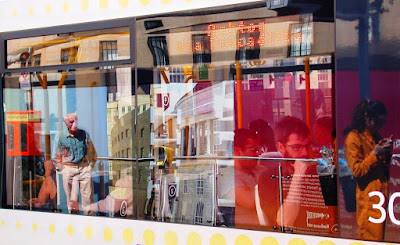
And it was at East Didsbury that David spotted tram number 3020 “working the Deansgate, East Didsbury service” which just happens also to a have a name.

It is the Lancashire Fusilier and David tells me he thinks it is the only tram currently to have a name, and that pretty much is the end of the story.

Except to say like Alfred Hitchcock, David couldn't resist getting in his own picture.

Location. South Manchester

Pictures; name plate of the Lancashire Fusilier, number 3020 courtesy of David Harrop and another by me ........ an East Didsbury tram passing through St Peter's Square, 2014 from the collection of Andrew Simpson

Wednesday, 14 December 2016

Looking for the story of Brookfield House on the edge of Chorlton Park

Brookfield House, 2014
Now over the last few months I have been reflecting on the fate of Hough End Hall and its future.

And occasionally I have also written about Brookfield house which stood directly opposite.

It stands on the edge of Chorlton Park.

Now I can’t be sure of when it was built, but there are buildings on this site as early as 1750.

Brookfield House, circa 1913
That said I suspect this one dates from the early 19th century.

In the 1840s it was the home of an accountant and later the doctor James Partington.

Strictly speaking it was actually in the township of Withington as was Hough End Hall.

I am not sure when it passed into the ownership of the Corporation but I guess it will have been in the late 1920s when Chorlton Park was finished.

Brookfield House today
It is somewhere I have tried to get into but with no success, although I am reliably told that there is nothing left inside of the original building.

The Corporation seemed vague about its history and I was surprised that part of it is still in residential use and perhaps at some time in the future I may be able to find out more.

Pictures; Brookfield House, circa 1913 from the Lloyd Collection, and the building today from the collection of Andrew Simpson

Selling the donkey for the war ........ Mr Booker a Red Cross Fund and a day in Stretford

Now here is one of those fascinating postcards which lifted the carpet on a bit of history.

The caption reads “Mr Booker sold to aid of British Farmers Red Cross Fund at Stretford for £395. 6. 0. October 1915.”

And that is all there is.

But of course that was just the incentive to dig deeper.

The British Farmers Red Cross Fund was one of a number run by the society and part of the thousands established during the Great War to raise money for everything from Belgian Refugees to socks for men in the trenches.

"The British Farmers Red Cross Fund mainly raised money through agricultural sales. Around 1,600 were organised during the war. The proceeds were earmarked for particular schemes, such as providing motor ambulances, cars and lorries to the various battle-fronts. More than 150 ambulances were provided in this way.

Hospitals, known as British Farmers Hospitals, were supported by this fund in Belgium, France and Serbia.

The fund received a total of £1,024,808 19s 2d."*

The picture postcard has just been acquired by my old friend David Harrop who want to make it a feature of his display at the book launch in February  next year of my book Manchester Remembering 1914-18.**

But more of that later, for now it is that donkey that fascinates me and of course the event that it participated in.

Given that we have a date and a place it should not be too difficult to unearth a newspaper story.  There is nothing in the Manchester Guardian but somewhere in the archives of the local heritage centre there will be something.

And there may be a clue in the company who produced the card which was Inghams.

There is a reference in the trade directories to a J Ingham & Sons, Photographers, Withington Road, Brooks Bar, in 1911 which just might be them.

They appear to have been in business from the 1870s and into the 1930s and there is also a reference to them in Sale Through Time which records “that a local landmark was John Ingham & Sons, photographers on the opposite corner of Aston Lane and Washway Road at Winton House.”***

So with all that local connection it is quite possible that Mr Ingham & Sons  took the opportunity to wander down in to Stretford in the October of 1915 to snap Mr Booker.

Location; Stretford

Picture; Mr Booker sold to aid of British Farmers Red Cross Fund at Stretford for £395. 6. 0. October 1915.” Courtesy of David Harrop

*British Farmers Red Cross Fund, 

** *Manchester Remembering 1914-18 by Andrew Simpson will be published by the History Press in February 2017

Order now from the History Press, or Chorlton Book Shop,  0161 881 6374

***Sale Through Time, Steven Dickens, Amberley, 2013

Remembering the Spanish Civil War .......... one to do next year

The Spanish Civil War began eighty years ago when a group of generals declared war on the democratically elected government of Spain.

Aid for the Basque People, 1936-39
It finished three years later with the defeat of that government and the establishment of a totalitarian dictatorship which lasted until 1975.

It was for many at the time the fault line which divided progressive Europe from a repressive authoritarian and conservative set of values which many had thought shattered by the French Revolution.

And added to this was the participation of Fascist Italy and Nazi Germany on the side of the Generals marking the war a test of whether the dark forces of totalitarianism would triumph over democracy.

Here in Britain as well as around the world men and women of all classes chose to support the legitimate Government.

Some were active in raising funds for food and medical aid while others made the difficult journey to Spain to fight or work in the hospitals.

I had quite forgotten just how strongly I felt about that war until recently when in the space of a few days I began researching the story of Madge Addy and met Dolores Long the daughter of Sam Wild who was the last commander of the British Battalion of the International Brigade.

Liberty's Volunteers, 2017
Miss Addy volunteered to serve in a Republican hospital, was active in promoting the cause of the legitimate Government writing detailed letter home about the conditions she encountered and she was the last British nurse to leave Spain as the Nationalist Generals succeeded in defeating the Republic.

Dolores kindly agreed to share information on Ms Addy along with her own work in maintaining the publics’ interest in the Spanish Civil War and the role of the British men and women who went out to help.

All of which leads me to an advance notice for a conference on the war early next year.

It will take place in March in the city centre and details are available by following the link, http://www.international-brigades.org.uk/

And nearer the time I will return with more details along with some articles from Dolores.

Location; Manchester & Spain

Pictures; the poster Aid for the Basque Heroes, S H Prives, from The Palette and the Flame, 1980 and poster of the conference courtesy of International Brigades Memorial Tust

Monday, 12 December 2016

Coming soon a new book on Manchester and the Great War ............ to be published in February 2017

Now the book has been a long time in the writing, but Manchester Remembering 1914-18 will be in the shops in February of 2017 

It is a book I have long wanted to write and draws on official reports and newspaper accounts as well as letters and photographs and a multitude of other personal items.

Much of this material has never been seen before and some of it is unique in that it allows us to follow families through the whole conflict challenging many of those easy and preconceived views of the war.

So here is the story of George and Nellie Davison of Harpurhey and Hulme, including his years at night school while living in Chorton before they married, her regular trips to stay with him in London and Ireland and his final letters home before his death in the June of 1918.

Across the city and over the river we learn of Miss Rebecca Chapman’s first week as a Salford tram clippie, and Mrs Fannie Jane Barlow’s juggling act of bringing up two young children while working long houses in a Red Cross Voluntary Hospital.

And amongst all these stories there are those of the thousands of children on “part time education” because their schools had been taken over to look after wounded soldiers.

Much is also made of the opposition to the war, the campaigns against profiteering and the unequal status of women in the workplace.

So it rather has the lot.

And to mark the event the book launch will be held in Central Ref on Saturday February 18th.

The event will include military en actors in period uniform, live contemporary music and a selection of memorabilia featured in the book from David Harrop’s collection

Pre order now from the History Press, or Chorlton Book Shop,  Chorlton Bookshop,  0161 881 6374


Pictures; Clara in the uniform of the East Lancs, date unknown,  courtesy of David Harrop, Central Ref, 2014 from the collection of Andrew Simpson

Location; Manchester

*Manchester Remembering 1914-18 by Andrew Simpson will be published by the History Press in February 2017

Pre order now from the History Press, or Chorlton Book Shop,  Chorlton Bookshop,  0161 881 6374


Saturday, 10 December 2016

REMEMBERING THE EMPLOYEES OF MANCHESTER CORPORATION TRAMWAYS ...... CHRISTMAS 1916 ... more from Martin Logan

A war that was supposed to be over by Christmas 1914 is now approaching its third Christmas of fighting. 

A Princess Mary Gift Fund Box
As we celebrate Christmas 2016 surrounded by family and friends try and remember what it must have been like for those employees’ miles from home in a foreign land and trying to exist in the trenches in freezing temperatures.

Christmas to most people is a season of excess, with coloured lights displayed everywhere you go and buying presents for loved ones with plenty to eat and drink.

Back in 1916 it was the simple pleasures that the soldiers craved for, a letter or post card from home and a parcel or gift box containing little mementoes to take ones mind off the awful conditions experienced by many in the trenches.

One of these gifts sent to the troops was a small metal box. The Princess Mary Gift Fund Box was an embossed brass box that originally contained a variety of items such as tobacco and chocolate. It was intended as a Christmas present to those serving at Christmas in 1914 and was paid for by a public fund backed by Princess Mary.

Attached is a photo of this box which is part of my WW1 collection

Another way for people to keep in touch was with the use of postcards.The embroidered silk postcard was a common souvenir of the First World War.

Silk postcard
The embroidered postcards were very popular with British soldiers who often sent them home. They were sold in thin paper envelopes but were seldom sent through the post as they were too fragile and, more particularly, they represented quite an investment – they were not cheap souvenirs.  Usually they were mailed with letters.

 For this reason, they are often unwritten, with no marks on the back, any message having been sent in an accompanying letter.

Attached is a photo of a silk postcard showing the flags of the combatant nations from my own WW1 collection.

1916 would go down as a terrible year for casualties amongst the Tramways employees.  To date my research has uncovered information on at least 89 MCT employees who lost their lives during this period.

So as we celebrate Christmas 2016 spare a thought for the employees of Manchester Corporation Tramways who 100 years ago struggled to survive.

LEST WE FORGET

©Martin Logan, 2016

Pictures; from the collection of Martin Logan

Friday, 9 December 2016

One hundred years of one house in Chorlton part 70 ...... who made the fires?

The continuing story of the house Joe and Mary Ann Scott lived in for over 50 years and the families that have lived here since.*

Now I wonder who laid the coal fires back when Joe and Mary Ann lived here.

In our old house it was my dad who saw to the big kitchen stove and the downstairs fires before he went to work.

In the case of the kitchen stove that was very important because it heated the hot water.  All of which just left mum to keep an eye on them all during the day.

I rather think dad even got all the coal we would need for the day up from the cellar before he left.

Like everyone else on the street we had ours delivered and coal day was one of those that came round regularly.

Even now I can remember the sound of the coal as it thundered down into the cellar followed by that much quieter sound as it settled which seemed to last much longer.

After which there was just that smell of coal which made its way up from below and lingered for the morning.

I would like to reinstate the coal cellar here which John bricked up in 1974 along with the down stairs fire places.

A decade and a bit later and we opened them up again although I haven’t yet convinced the family of the advantages of a coal cellar.

But in time I may.  For now I collect it form the coal bunker in the back from where once a fortnight ours is delivered by our coal man.**  He has been bringing the different varieties of smokeless fuel kindling and Christmas logs for almost thirty years.

And for even longer it is my job to clean out the ash, lay the new fire and sometime in the early afternoon set the thing going.

There will be those who see it as a chore, but not me.

It stars at six when the fire is raked allowing the coals to cool, and an hour or so later the grate is emptied.

The bigger bits of unburnt coal can be used again and over these you lay some paper, a bit of kindling and firelighters followed by the coal.

The traditionalist will pour scorn on my use of firelighters, pointing out as dad once did that I should make “paper bricks” from the old newspapers, which he and countless others will have been expected to make as one of their childhood tasks.

I have tried but they never worked.  More successful was the sheet of newspaper over the fireguard which adds to the draw when the fire is first going.

Nana I am convinced didn’t use the guard and on occasions the paper went up the chimney which always frightened to me especially given that ever present fear of a chimney fire.

But then we have our chimneys swept each year which is another of those events that I keep too.  The sweep comes at the end of spring which has that double advantage of ensuring we are not at the end of a long waiting list and the flues are clean of soot as the warmer weather approaches.

All of which makes me wish I could talk to Joe and Mary Ann if only to establish if they ever ran a fire upstairs.

Location; Chorlton

Pictures; fireplaces in the house, from the collection of Andrew Simpson

*The story of house,
http://chorltonhistory.blogspot.co.uk/search/label/The%20story%20of%20a%20house

**Paul Rogers, http://paulrogersandsons.co.uk/