Monday, 7 January 2019

Telling the story of our canals ………… a new book in the making

Now if you were born in the first half of the last century, you will have seen our canal network slowly decline, from a once proud and busy set of waterways, to a dismal, neglected and in places dangerous afterthought.

The Rochdale Canal, 1980
But many are now fully restored and while they may not anymore be used to transport goods, they offer up opportunities for recreation, from those who take to the water in colorful boats to those who walk the water or cycle its paths enjoying the scenery and reflecting on the history.

And all of that, has inspired Peter and I  to write a new book, which will feature the much-loved Cheshire Ring.

Like all the other Topping/Simpson books, it will be a mix of original Peter paintings, contemporary and old photographs, along with stories about the canals, the people who worked on and around them, and the buildings and places of interest which survive along the line of each waterway.

The Rochdale Canal, 1979
The chapters will be designed so that they can be walked, cycled, or sailed, with plenty of places to stop off to take in the sites, or the local hostelries.

At this point we are still in the planning stage, and welcome contributions, which can be stories, photographs or memorabilia.*

For our part Peter has already begun painting some of the iconic buildings on the Ring, and I have started the research, which has taken me back to my favourites which are Bradshaw’s The Inland Navigation of England and Wales, and  Joseph Priestley’s Historical Account of the Navigable Rivers, Canals, and Railways, published in 1830.

Both are full of maps historical background and wonderful descriptions of the network in its heyday.

Added to which there are some fascinating memories from people who describe the canals when they were still working waterways, children who played along the derelict towpaths, and plenty from those who take to water for holidays or the odd weekend.

All of which leaves me to share my own favourite canal which is the Rochdale, which will be well known to those who take it to cross through the city from the Castlefield to the Dale Street Basins.

Manchester Canals, 1830
"The canal is one of the main links in the chain of inland navigation between the east and west seas, being made for vessels of such size as enables them to navigate the tide way, and to pass between Liverpool and Hull without the expense of reshipping their cargoes, thus affording great advantages to the populous towns of Manchester, Rochdale, Halifax, Wakefield and others on the banks of the intermediate rivers. 

The Baltic produce can thus be readily conveyed into Lancashire and the manufacturers of Lancashire in return exported through the ports of Goole and Hull to Hamburg, Petersburg, Lubeck and other continental markets. 


The Rochdale Canal, 2003 
The stone from Cromwell Bottom and its neighborhoods is hereby also conveyed to Rochdale and Manchester. 

These connections are likely to make it ultimately an undertaking of considerable profit to the proprietors.” **

So, our own international highway and one that carried everything from “corn, timber, woollen cloth, coals and raw materials.”

But like all our canals find it difficult to compete with the railways and finally closed in 1952, although the section through the heart of the city from Castlefield to Piccadilly proved profitable and stayed open.

Pictures; from the collection of Andrew Simpson, 1979-2003, map of the canal network around Manchester from Bradshaw’s map of 1830, The Inland Navigation of England and Wales, and the extract from Joseph Priestley’s Historical Account of the Navigable Rivers, Canals, and Railways, 1830 courtesy of Digital Archives http://www.digitalarchives.co.uk/ 

*You can contact us by leaving a comment on the blog, or emailing peter@pubbooks.co.uk or leaving a message at 07521 557888


** Priestley, Joseph, Historical Account of the Navigable Rivers, Canals, and Railways, 1830, Page 579


Another Salford Bandstand

Now I don't know the story of the bandstand in Parr Fold Park. but I am pretty sure someone will.


And so having been sent these pictures by Antony I will await developments.

Location; Salford


Picture; the bandstand Parr Fold Park, 2016, from the collection of Antony Mills.

Friday, 4 January 2019

Modern Salford bright and proud ................ nu 2 seen before but well worth a another showing

Now as much as I like the images of old Salford sometimes it is worth remembering that there are some very interesting new ones going up.


Location; Salford

Pictures Salford today, from the collection of Andrew Simpson

Thursday, 3 January 2019

In search of the lost Chorlton artist … J Montgomery

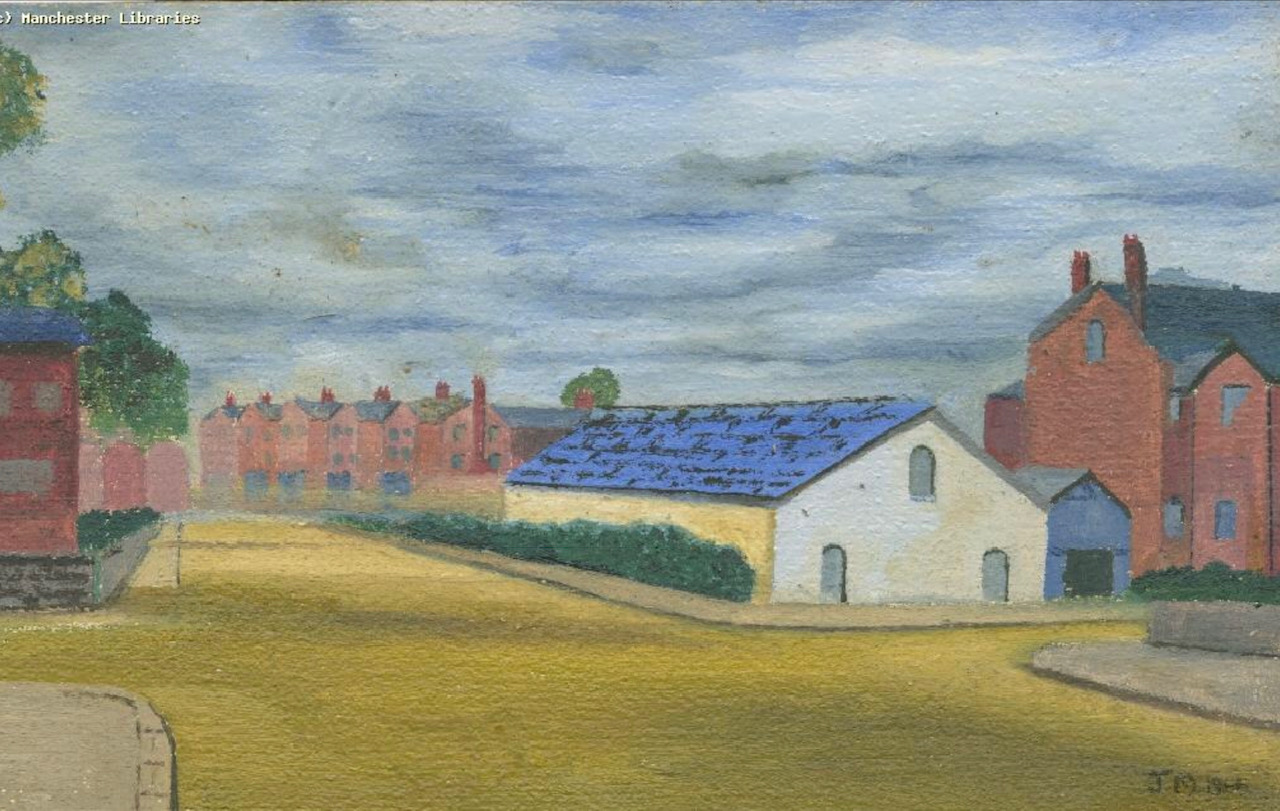
Now, if you dig into Chorlton’s history, at some point you come across J Montgomery, who for two decades painted Chorlton.

Chorlton Ice Skating rink and Picturedrome, 1964 from a picture circa 1915
I first came across his work in the Local History Collection, where there is a huge collection of his work.

Most were painted from old photographs and record a Chorlton which was lost a long time ago.

In some cases, we do not have the original picture and so Mr. Montgomery’s paintings are the only evidence for old buildings and agricultural landscapes, which were once familiar.

Of the hundreds I have come across, one of my favorites in the old ice rink and Picturedrome which stood on the corner of Oswald and Longford roads.

Chapel on Albany Road, 1960
And until I came across his painting, I had no idea of its existence.

But despite all of these paintings, no one knew anything about him and all my attempts to piece together his story came to nothing.

All of which is remarkable given that his last painting was in 1968 and he must have been local, leading me to assume someone would remember him.

Despite appeals over the years on the blog and in talks and walks around Chorlton I could find nothing, and even the library which holds the digital collection could offer nothing about the man, leaving just one reference in Trafford local study Centre in a catalogue listing local artists.

It is one of those mysteries which has intrigued both me and my old friend Andy Robertson, and after a recent conversation Andy decided to go looking all over again.

Sally's Pond, 1958
This time he struck gold, commenting that “the John Montgomery I found died in 1970, and the last dated work of his on images was 1968, so that fits.

In 1966 his daughter's death in the Wills Index lists his occupation as commercial clerk. My guess is this our man”.

He was born in 1902 and his buried in Southern Cemetery with other family members and in 1939 was living on Brookbank Road

But here there is a hitch, because there is appears a mismatch between some of the names in the family grave and those on the 1939 register, so while it would appear Mr. Montgomery and his daughter, Laura are together, the names of the other two women do not conform to the person assumed to be his wife in 1939.

Lilly's Cottage, 1948
Of course that “hitch” is what fascinates both me and Andy, and I have no doubt with more digging the matter will be resolved as will the mismatch between the occupation given by his daughter which was "clerk" and that in 1939 which was “Property repairer and window cleaner”.

But then this was 1939, just a decade after the Wall Street Crash and eight since the Great Depression threw thousands out of work across the city.

So, a work in progress.

*Research by Andy Robertson

Location; Chorlton

Pictures; “Chorlton Skating Rink, later The Picturedrome”, 1964, m80132, Chapel on Albany Road, from a 1950 photograph,1960, m80123, Sally’s pond, 1958, copied from a 1922, photograph, m80104
Lilly Cottage from a 1948 photograph, Montgomery J 1952 m80050, courtesy of Manchester Libraries, Information and Archives, Manchester City Council, https://images.manchester.gov.uk/index.php?session=pass

Wednesday, 2 January 2019

British Home Children ……… advancing the story 150 years after it began

Now, there are still many who have no knowledge of the migration of young people to Canada, and other parts of the former British Empire during the late nineteenth and early twentieth centuries.

The power point
The reasons were complex as were the motivations of those involved, and for the children their experiences were equally mixed.

That said the story is better known in Canada than here in Britain, and that is in part due to a handful of people who have worked hard to bring the subject out of the shadows, to the point where it is now a serious area of historical study.

Here in Britain we still lag behind, and to that end Tricia Leslie and I set up a facebook site* where stories can be shared, and information exchanged, and in the process raise awareness of the topic.

We weren’t the first,** but together with Patricia ‘s group we are working to move the story on.

The poster
And this year, given that it is the 150th anniversary since the first party crossed the Atlantic, it is fitting that we should ask for support to reach a wider audience, especially when there will be a series of exciting events staged throughout the year in both Britain and Canada.

So, do not ask what BHC can do for you ……. more what you can do for British Home Children.

That includes visiting the two British sites, or any of the Canadian ones, including British Home Children Advocacy and Research Association.***

We have a poster which can be downloaded, and a power point, which can be accessed by leaving a comment on either the blog or British Home Children …… the story from Britain.


Location; Britain, Canada, and other parts of the former British Empire


Pictures; a party of young people on the steps of Manchester Town Hall courtesy of the Together Trust****, and the poster, from British Home Children …… the story from Britain.

*British Home Children …… the story from Britain, www.facebook.com/groups/bhchildren
**Reclaim Our British Children, www.facebook.com/groups/283545170795/
***British Home Children Advocacy and Research Association, http://www.britishhomechildren.com/

****The Together Trusthttps://www.togethertrust.org.uk/


Wine labels I wish I had known .......

Now if there is one certain thing after death and taxes, it is that there will be a blog about almost anything under the sun.

Silver vine leaf label, 1858
And today my old friend Bruce Anderson, alerted me to his new venture, Bottle Tickets or Wine Labels?*

It follows on from his fascinating site * on all things to do with the history of Rusholme, and the new site is just what it says on the bottle …………… a series dedicated to the collection of wine labels.

But there will be no articles on cheap and cheerful Reds from Tashkent or the labels from happy French table wines which came in litre plastic bottles and offered up change from a pound note.

Instead the stories range from antique sliver labels, to the work of Mahala Jago who was a woman silversmith, working in the early 19th century and in between are packed with interesting images, as well as history and guides to the current prices of featured labels.

And that is it.

Location; Rusholme and the World

Picture; from the blog


* Bottle Tickets or Wine Labels? https://bottleticketsorwinelabels.blogspot.com/2018/08/


**Rusholme & Victoria Archive, http://rusholmearchive.org/

Tuesday, 1 January 2019

With Henry Hunt we’ll go, We’ll raise the cap of liberty, In spite of Nadin Joe*

Manchester, 1819
It is time for another two pictures from the collection of Manchester’s history of protest.

I tried resisting using an image of Peterloo but it remains an important event in the history of the city and one that I have written about before.

So I shall confine myself to the picture and move on to a more peaceful demonstration which wound its way through the city streets passing close to St Peter’s Field in November 2011 and represented one of the biggest protests in Manchester since the the Coalition Government was formed.

* Henry Hunt, a popular song from the period of Peterloo.  Henry Orator Hunt was a radical who argued for annual parliaments and universal suffrage,

He had been invited to speak at the rally in St Peter’s Field in the August of 1819 and was arrested and convicted for his part in the demonstration.

Manchester 2011
Joseph Nadin deputy-constable of Manchester 1801-1821.  “He was a renowned thief-catcher with the reputation of turning every offence into a felony.  The significance of this peculiar twist is that a successful felonious charge was rewarded with a fee of 40 shillings” Hewitt Eric J.,A History of Policing in Manchester, 1979

This  reputation  led the radical Samuel Bamford to observe of Nadin that “he had the homely tact to take care of his own interests.  

He housed a good harvest whilst his sun was up and retired to spend his evening in ease and plenty on a farm of his own within the borders of Cheshire.” Bamford Samuel Passages in the Life of a Radical, 1840-42, also quoted by Eric Hewit

Nadin was also no friend of popular protest and radical politics and during the period that Habeus Corpus was suspended was zealous in his arrest and imprisonment without trial of radicals, and those suspected of being radicals.

Pictures; Peterloo, 1819, m07589, Courtesy of Manchester Libraries, Information and Archives, Manchester City Council http://images.manchester.gov.uk/index.php?session=pass and 2011 from the collection of Andrew Simpson