Wednesday, 3 March 2021

Ghost signs on Beech Road ..............

A little bit of the past came out into the sunlight on Beech Road this week.


I have to admit l missed it but Lawrence clocked it.

And the clue to what was sold in the shop is there in the ghost sign.

That said you have to have lived on Beech Road over a decade ago to have bought some stamps or sent a parcel by recorded delivery and picked up a birthday card for good measure.

I will have to go back and check because my memory has played me false and l can't  now remember exactly when the Post office closed. Since then it has traded under a number of names, from Pillar Box, Melanie Jones, and Love Lucy.


I can't remember B & J McLaughlin, but someone will.

In 1969 it was run by Joseph Hartley who was listed as "stationers & post office", with a separate listing "Post & M.O. Office".

And no sooner had I posted the story, and Marilyn Clough commented, "the Hartley's ran it in the 1950s and 60s I lived on Beech Road in the 50s. I was friends as a child with their son Michael".

Location; Chorlton

Picture; ghost signs on Beech Road, 2021, from the collection of Lawrence Beedle

Tuesday, 2 March 2021

Uncovering more of those who lived in Eltham's Alms Houses in the April of 1851

The Alms Houses in 1909
Sometimes the past can be quite stubborn about revealing the lives of people.

But then I am constantly surprised at how much there is, particularly on the “little people” whose rank, occupation and position in society merited little interest.

Which is the starting point for an exploration of the lives of the nine people who lived in the six Alms houses on Eltham High Street in the April of 1851.

The alms houses had been built by Thomas Philpot in 1694 and were to accommodate “six poor people of that parish [Eltham] and Chislehurst £5 per annum each, four to be chosen out of Eltham and two out of Chislehurst.”*

They consisted of two rooms, one above the other, a wash-house and a small garden and over 200 years after their construction were still reckoned to be “kept in good repair at the expense of the Trust.”**

In 1851 the average age of those living there was 86 with Sarah Glazebrook at 84 and Elizabeth Blackman aged 62.  I suppose I should also have included Mary Inson who was a mere babe at 53 but she described herself as a lodger and sadly the past has been unkind to her for apart from one reference in the 1851 census she remains hidden to us.

Residents of the Alms Houses in 1851
But not so some of the others.

In total there were nine occupants of these six houses and along with Mary Inson were the widows, Jane Rivers, Sarah Glazenbrook, Elizabeth Dean, and Mary Fulgar as well as George and Elizabeth Blackman and Thomas and Ann Foster.

Thomas Foster had been born in Carlisle around 1771 but was in Eltham by 1819 when his son was attending the first National School.  He worked the smithy on the High Street which was a little to the west of the present library and was well known enough for stories of his exploits to have lingered on a full fifty years after his death. ***

Exactly when he died is unclear but the records show that three men with his name died between 1852-54, unfortunately the parish records for those years are missing and it is the same story for his wife Ann who may have died in 1869 but does not show up in the burial records of the church.

But we are on firmer ground with Elizabeth Dean who was one of those "two out of Chislehurst" where she had been living in 1841.

Detail of the Alms Houses, 1909
Born in Cornwall she was here in Eltham in 1812 when she and her husband baptized their son at St John’s and she was buried at St John’s in the February of 1854, but alas so far any more on her son Edmund or her husband William has yet to be found.

All of which leaves us with two of the widows.

Jane Rivers who had been born in 1769 in Burford in Essex can be traced to a cottage in the High Street in 1841, while her future neighbour, Sarah Glazebrook was  living in Court Yard.

All of which is slim picking I know and hardly the stuff that makes a riveting story but it is a start on bringing some more of Eltham’s people out of the shadows and that can’t be bad.

Location; Eltham, London

Picture; The Alms Houses from The story of Royal Eltham, R.R.C. Gregory, 1909 and published on The story of Royal Eltham, by Roy Ayers, http://www.gregory.elthamhistory.org.uk/ and extract from the 1851 census, Enu 1c 31, Eltham, Kent, ancestry.uk & National Archives

*Charity Commissioners Report 1895 quoted in The Story of Royal Eltham, R.R.C. Gregory, 1909
**R.R.C. Gregory, the Story of Royal Eltham, 1909
***http://chorltonhistory.blogspot.co.uk/2013/08/heating-and-hammering-at-smithy-on.html

The silly story from sometime in the 1970s …. the unforgettable headline ….a pair of loons …. and that lava lamp

I am in a reflective mood brought on by a conversation about the 1970s, which remains one of those unfashionable decades.


So, while the 1960s will always be the “Swinging 60s” and the 1920s “the Roaring 20s”, history and the popular press has been less kind to the decade which will always be remembered for the Three Day Week, the Milk Snatcher and Apollo 13, not to forget the Vietnam War, the Bay City Rollers and Ernie, the fastest Milkman in the West. 

I have fond memories of both the 1960s and the 70s.  

I grew up, went to school, passed my A levels, and had my heart broken a dozen times between 1966 and 69, and then came to Manchester, graduated from the College of Knowledge, started work, got married and bought a house all during the first half of the 1970s.

So with all that in mind, I come to that memorable headline from the News of World, which was required reading, if only because it offered up some bizarre stories, like this one, “Nudist welfare man's model wife fell for the Chinese hypnotist from the Coop bacon  factory”. 


It was coined by the journalist, Monty Levy who was a sub editor at the News of the World, and if you follow the link there is more about him.

Leaving me just to throw in loons, and lava lamps as well as  including the one photograph of me which has survived from the early part of that decade.

The rest as they say is for everyone to offer up their own treasured memories of that period, and for me to be reunited with Mr. Levy’s headline which I could only remember bits of.

But having posted part of it, sure enough someone came up with full wording.

And that is that, or it would have been but for my discovery of this picture where you could buy your loons, along with the sticks of incense, and all manner of vinyl.


By the time this picture of the Eighth Day was taken, I had reverted to short hair, and embarked on the wonderful world of work, picking up a mortgage and house along the way, and marking my own transition from a carefree student to grown up.

Pictures; lava lamp, 2007, Saltmiser, licensed under the Creative Commons Attribution-Share Alike 3.0 United States license., Andrew Simpson, 1970, from the collection of Andrew Simpson, and ; On the Eighth Day, 111 Oxford Street, in April 1973, m00173, y H. Milligan, H.,  courtesy of Manchester Libraries, Information and Archives, Manchester City Council, http://images.manchester.gov.uk/index.php?session=pass

*Tributes to former Barrow journalist with talent for headline writing, The Mail, Barrow,February 22nd, 2016,  https://www.nwemail.co.uk/news/barrow/16459621.tributes-to-former-barrow-journalist-with-talent-for-headline-writing/


Chorlton no banks? …………….

The Four Banks, or Four Bank Corner, was one of those simple but effective place names, which no official invented, but just arose from the fact that there was a bank on each corner of the junction of Barlow Moor and Wilbraham Roads.


And because people do, they described what they saw, and made it the destination name of choice, and that I like.

Go back several decades and the corner which once was home to the Midland Bank and later the HSBC was known as Kemp’s Corner because here was Harry Kemp’s chemist shop which had a large clock above the door, making it a perfect place to arrange to meet in those pre mobile days.

And for those wanting more, the junction of Barlow Moor, Sandy Lane and High Lane was officially marked as Lane End but for generations was Brundretts’ Corner on account of the grocery shop belonging to Mr. Brundrett which was situated there.*


And returning to the Four Banks it was at the very beginning of the last century known as "Bank Corner" and appeared as such on messgaes sent on various picture postcards.

But the Four Banks, became Three banks and something else, and is now down to two.

And now what was the TSB on Barlow Moor Road and from memory was once the Bank of Ireland has also closed.

Although here I am prepared to be corrected by the Friends of Barlow Moor Road, who may point out it closed a while ago ….. but then I haven’t been out as much during the series of lockdowns.

Location; Chorlton

Picture; the closed TSB, Barlow Moor Road, 2021, from the collection of Andrew Simpson 

*Living at Lane End in two rooms, more stories of one up one downs, part 2, https://chorltonhistory.blogspot.com/2012/03/living-at-lane-end-in-two-rooms-more.html

From dug out canoe to nuclear merchant ship ..... the history of sea travel from 1961

I don’t remember coming across Travel by Sea as a child, which is a shame because it would have certainly powered my imagination.

It is as the title implies the story of ships from early times to the mid 20th century and like so many of the books produced in the 1950s and 60s by A. & C. Black it is a fine mix of illustrations and text.

And like so many of these books what adds an extra element of interest is the final section which focuses on the ships which were plying the oceans in the middle decades of the last century.

Along with the changing design and technologies there are descriptions of how sea travel was moving from the preserve of the very rich and steerage class into the tourist trade.

So “travelling by sea today is like spending a holiday in a floating hotel” and the development of the cruise liner continues to be an important aspect of modern tourism

And nowhere is this more evident than in Naples where the tall ships given over to cruising the Mediterranean dominate the sea port.

I lost count of the number of these giants of the sea, patiently waiting for the hundreds of passengers who would soon be boarding for that potent mix of sun, foreign sites and a bit of history.

But what really fascinated me was the description of “the first nuclear-powered merchant ship to go into service.”

This was "the Savanah which in 1959 was being built in the U.S.A ...... [and which will be] fuelled with uranium oxide, [which] will enable it to operate for three and half years, covering 300,000 miles before refuelling.”

Now given the number of nuclear powered warships I don’t know why I was surprised but I was.

And she was one of only four such ships built and in her case remained in service for just ten years and today remains quietly moored in Maryland awaiting a developer with an idea of what to do with her.

All of which just shows what you can learn from a children’s history book published in 1961.

Picture; from Travel by Sea, 1961

*Travel by Sea through the ages, Robert J Hoare, 1961

Monday, 1 March 2021

Manchester's Bus Depots …… another story from Tony Goulding

This impressive clock tower in Parrs Wood, East Didsbury is all that remains of the first purpose-built motor bus garage/depot of Manchester Corporation Transport Department. 

“Tesco” Clock

It was opened on the 23rd March, 1926. Mr. Stuart Pilcher, the new general manager of M.C.T.D. was an advocate of bus transport and initial replacement of tram services by buses proved to be more profitable and negated the need for an expensive renewal of obsolete parts of the tram network. (1) 

As the city’s bus fleet steadily increased with the tram network being cut back the tram depots were also converted to garage buses. There were several of these around the city at Princess Road, Moss Side, Hyde Road, Ardwick, Queens Road, Cheetham Hill and Birchfield Road, Fallowfield, needed to house the fleet of Manchester Corporation's buses. 

When the short-lived S.E.L.N.E.C. took over responsibility for running the bus services in 1969, Manchester City Transport  were operating 1,250 vehicles at the hand-over on the 1st November, 1969.

Another purpose-built bus depot was built in Harling Road, Sharston, Wythenshawe. Despite its location, it was known as the Northenden Depot. When completed in 1942 its first use was in the construction and repair of Lancaster Bombers. 

Grade II listed Wythenshawe Bus Depot
Due to its pioneering design by Manchester City Architects Department, (chief architect G. Noel Hill) it has been designated a Grade II listed building. In 1946, the building reverted to its peacetime use of housing up to 100 double-decker buses. 

On a personal note, from 1952 to 1974, it was the home depot of my father working first as a bus conductor and later, after the introduction of driver only operated buses, bus cleaning and general maintenance.

Hyde Road Depot - 1958
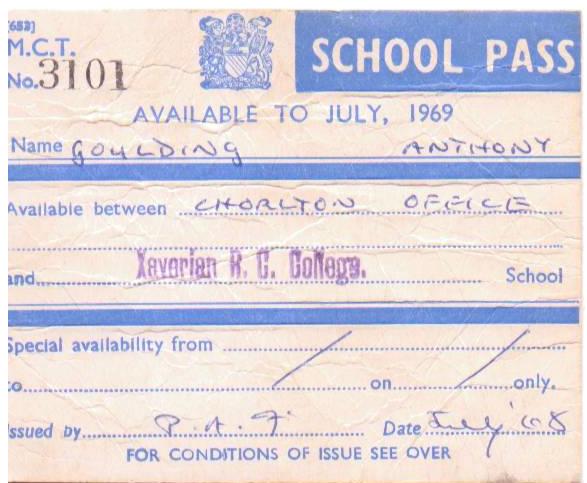
The Hyde Road depot housed the transport department’s lost property office on Devonshire Street North which I had occasion to visit more than once as a schoolchild in order to retrieve a bag or on one occasion a “Scholars Pass”. 

The huge building was very much a local landmark and featured this famous five faced clock!

I also have vivid memories of the large transport depot on Princess Road as it was located on one of the routes, I would take to attend matches at Maine Road in the late 1960s .

After alighting from either the 80 or 88 bus from Chorlton-cum-Hardy Office on Alexandra Road we would skirt the park and cross Princess Parkway by the Y.M.C.A Hostel before continuing down the road at the side of the bus depot. 

My Pass

Hyde Road's famous five-faced clock


I remember being impressed by the size of the walls and the view through the wide entrance into the garage.

Princess Road Depot in 1967

Pictures: - “Tesco” Clock courtesy of Andrea Martinez, School Pass from the collection of Tony Goulding, Princess Road depot 1967 by D. Wildgoose and Hyde Road Depot and clock 1958 by F. Hotchin (m38470 and m27231 respectively) courtesy of Manchester Libraries, Archives, and Information, Manchester City Council http://manchester.gov.uk/index.php?session=pass Wythenshawe Bus Depot: - By KJP1 - Own work, CC BY-SA 3.0, licensed under the Creative Commons Attribution-Share Alike 3.0 Unported license.

Notes: -

1) Manchester was one of the first cities to make the change from an extensive tram network to bus services, some of which in the initial phase were trolley buses which were powered from the overhead power lines but did not run on rails.


Travels with a loaf of bread over time and space ……….. today and all week on the wireless

I won’t bore you with the story of my bread making efforts, other than to say after years of failed and half hearted attempts to make the stuff, all now seems to be going well.


So I bake every other day and have expanded the type of flour I use with growing success.

All of which makes the new Radio 4 series Slow Rise: A Bread Making Adventure, a timely addition my wireless listening.*

“Adrian Scarborough reads from journalist Robert Penn’s account of his search for the perfect bread made from ancient wheat grains – a quest that takes him to several countries around the world, including Egypt, Turkey and America, before he returns home to grow his own wheat in the Black Mountains in Wales. Can he learn to plant, harvest, thresh and bake enough sourdough bread to feed his family for a year? Abridged by Anna Magnusson, Producer: Bruce Young”

Episode one was today, and that will be followed across the rest of the week with a programme on how 

“In Egypt - where the rich alluvial soil once made the Nile delta the grain store of the Roman world - Robert Penn learns how to scythe wheat as farmers have done for thousands of years. Back in Wales he makes his first attempt to harvest his own home-grown wheat”.

Followed by episode three, “in America, Robert Penn discovers how the combine harvester transformed the vast plains of the Midwest. In Wales, his first harvest provides enough flour to make bread for a year – but it’s still a disappointing return for his back-breaking labours".

And finally in the last two programmes,  “in his quest for the perfect bread, journalist Robert Penn examines how from ancient times white bread became the preserve of the richer classes, while the coarsest brown loaves were eaten by the poor, [and finally he] explores how bread has been central to religion through the ages, how modern manufacturing processes have radically changed the taste of bread, and after weeks of trial and error he tries out his new bread-making skills on his family. Will they give him the thumbs-up for the perfect loaf?"

Picture; courtesy of the BBC

*Slow Rise: A Bread Making Adventure, https://www.bbc.co.uk/programmes/m000sqt6