Thursday, 5 September 2024

Trams … trolley buses …… and a thank you

I am a fan of those old stately Corporation trams which trundled our towns and cities for almost half a century and were the workhorse of public transport from London to Manchester and onto Glasgow and pretty much everywhere in between.

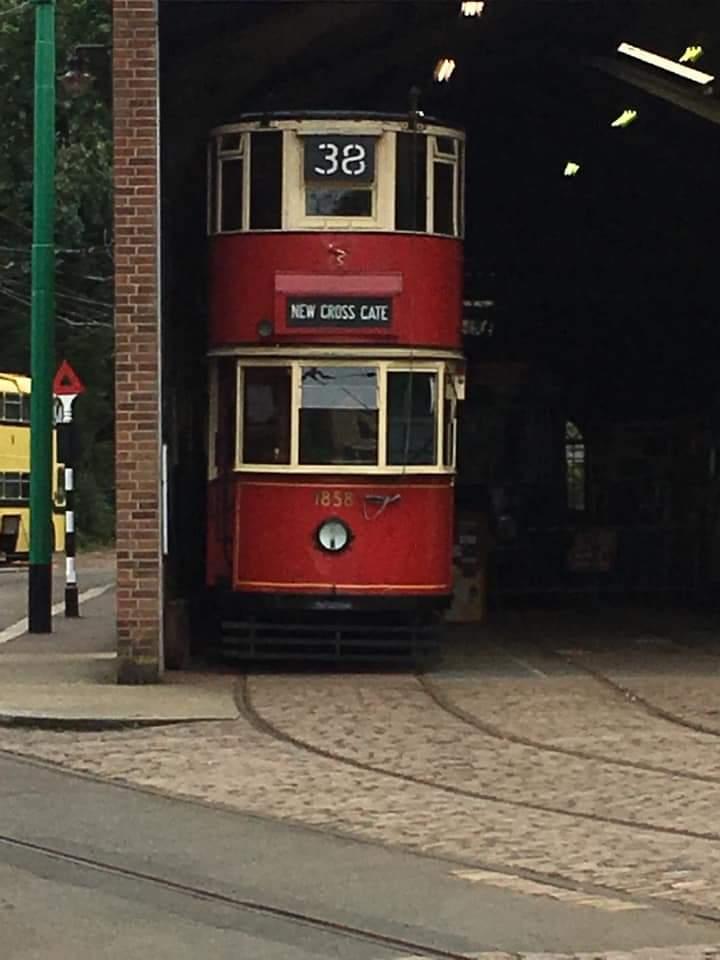
Car 1858, route 38, destination New Cross Gate

I am told I was present as the last London Transport tram finished its last journey and with some ceremony slid into New Cross depot and into history.

Trolley bus route 696  Welling to Woolwich Ferry
I was only three and have no memory of the event, but it is just possible I travelled on one as a passenger on a journey.

That said I can own up to regular trips on a trolley bus which while it looked a bit like a motor bus was powered by electricity from overhead cables.

They were operated by most local authorities, but my experience of them was via Derby Corporation, and consisted of tortuous journeys from the town centre out to the small village of Chellaston.

I have never travelled well in cars or buses, but trips in those trolley buses were infinitely worse.

It may have been the mix of smells from the leather and fabric seats combined with the disinfectant and the heat but I never once escaped feeling sick and to this day that humming, whirring noise the engine or what passed for an engine makes still brings back horrible memories.

The terminus for the trolley bus at Chellaston was Shelton Lock which was a good ten-minute walk from Nana’s house, which gave time for a sort of recovery.

But the dread was always that there would be another journey on another day, on another trolley bus.

Still over 60 years later I can be objective about the trolley bus and recognise its place in transport history, but will always have a soft spot for its predecessor the tram.

All of which brings me to Ron Eaton who posted some wonderful images of a London tram and trolley bus with the message “Hi Andrew thought you might like these”, which of course I do.  

All the news fit to print, on car 1858, r, 
It was on the back of the story “Travelling on LCC number 1622 with memories of the Old Kent Road and Well Hall which appeared yesterday on my blog.

I have yet to ask Ron where he took them and indeed whether I have permission to reproduce them.  But as he sent them via social media, I am guessing it’s ok. 

So thank you Ron, and I hope your trolley bus experiences were better than mine.

And Ron now tells me  'they are all ianEast Anglia Transport Museum well worth a visit".

Location; the days of trams and trolley buses

Pictures; courtesy of Ron Easton, 2024

*“Travelling on LCC number 1622 with memories of the Old Kent Road and Well Hall,  https://chorltonhistory.blogspot.com/2019/11/travelling-on-lcc-tram-number-1622-with.html


Wednesday, 4 September 2024

When they took away my swimming baths ……..

So, after years of waiting for something to happen that building on Manchester Road is being demolished.

Poster place, 2022

For many of us who knew and loved it as our swimming baths it’s passing is a little sad. 

But just how sad I wonder? 

Reading carefully the news story of the demolition and the new development it appears it will offer much needed accommodation for the over 50s and include affordable homes.* 

Overgrown, 2022
I am loath to see any historic building vanish, especially one which represented a promise fulfilled to the voters of Chorlton when we voted to join Manchester in 1904. 

Added to which I have many fond memories of taking the kids there. 

But the building which dated from the 1920s is not unique architecturally and was perhaps tired for the purpose it had been erected.

That said they are a bit of Chorlton’s history which when opened had “two swimming baths – one for men and one for women, wash-baths and a suite of Turkish Baths.” **

They were the fulfilment of a promise made in 1904 but only fulfilled years later.  

Along with the promise to build the library, the Corporation had also offered to provide swimming baths. 

In 1915 there had been moves to buy land beside the railway for the sum of £730 and five years later the City Council was seeking to raise money to acquire the site. ***

Finally in the September of 1929 we got those baths and perhaps the wait was worth it.  According to the Manchester Guardian a large crowd gathered outside on Manchester Road, and while the building “could not be described as a thing of beauty, it has two swimming baths – one for men and one for women, wash-baths and a suite of Turkish Baths.” ****

The cost to attend the Turkish Baths was half a crown which The Manchester Guardian reported would allow “the people of Chorlton to lie for half an hour or so in a pale blue room amidst blue sofas and blue curtains” concluding that “thus has luxury come to Chorlton.”

That said Miss Annie Lee speaking on behalf of the City Council at the opening of the Baths argued “that it was time we ceased to think of the Turkish bath as a luxury invented for the sole use of elderly and obese millionaires.”

Now that is a sentiment I approve of and I would like to have met her.  She was born in 1875 and was elected to represent Gorton South as a councillor in 1919 and was the first woman Alderman on the City Council.  

You can come in now ..... official opening, 1929
As a member of the Labour Party on the Council she successfully opposed the Education Committees attempts in 1922 to reintroduce the prewar regulation which prevented married women from becoming teachers.  

The prohibition had been relaxed during the war but authorities across the country began to reassert the ban allowing only married woman “whose husbands were unable to support them” or women “who had great teaching abilities.”

Miss Lee also campaigned in 1929 for the Public Health Committee to give instructions in birth control in Council clinics, was active on the old Board of Guardians and later in 1930 on the Public Assistance Committee.

Alderman Wright Robinson recalled she was “a woman who had the strongest convictions and stood by them fearlessly, whilst her independence could be described as fierce.  Nothing could shake her on such matters as Sabbath observance and opposition to Sunday games or equal pay for women.” *****

Nothing to do, 2022
Many I think might be intrigued by that reference to “Sabbath observance and opposition to Sunday games” but would concede that in some instances Sunday working has led to exploitation and certainly the Gorton United Trades and Labour Committee were on record as expressing the opinion that “the feminist and trade union causes owe her a great debt.”

And that is it.

Over the years there has been speculation on what might happen to the site  including the suggestion that Unicorn might move in.****** 

The  announcement of the demolition had met with a mixed response including one from someone who clearly hadn’t read the article before making wild assertions about who might become residents of the new development.

And now that building so loved by so many for so many years is being demolished as I write, and on hand yesterday were Andy Robertson and Dave Kennedy who recorded the work as Derek the Demolition machine did its business.

Leaving me just to revisit memories of  that clammy feel as you exited the changing booth with at least one sock not quite on properly while the sleeve of your tee shirt was damp from falling on the wet floor of the changing room, and just how hungry you felt.

Yesterday as recorded by Dave Kennedy
Adapted from The Quirks of Chorlton-cum-Hardy, Andrew Simpson and Peter Topping, 2018

Location' Manchester Road, Chorlton

Pictures; Chorlton Leisure Centre, 2022, from the collection of Andrew Simpson, an impression of the new homes, 2023, courtesy of Manchester City Council,  and the opening of the Baths, 1929, m77636, courtesy of Manchester Libraries, Information and Archives, Manchester City Council, http://images.manchester.gov.uk/index.php?session=pass knocking down today, from the collection of Dave Kennedy and Andy Robertson, 2024

And a little later by Andy Robertson

*Former Chorlton Leisure Centre could be turned into dozens of affordable homes, Hakim Hafazalla, February, 13th, 2023, https://www.manchestereveningnews.co.uk/news/greater-manchester-news/former-chorlton-leisure-centre-could-26226682?fbclid=IwAR0d_KN7U8E_vhkyXVV44oQtWKb5OgXEYPwxtv--hOZfXwW_NlbI9vpm8lA

**Manchester, the Manchester Guardian, September 20, 1929

*** Ibid, the Manchester Guardian, September 20, 1929

****  Alderman Annie Lee Obituary, Manchester Guardian October 26, 1945

***** Chorlton’s Unicorn Grocery could be moving... to former Chorlton leisure centre, Beth Abbit, April 22, 2016, MEN, http://www.manchestereveningnews.co.uk/news/greater-manchester-news/chorltons-unicorn-grocery-could-moving-11223328
The church ...... and a water cart ....... in the summer of 1890 on Barlow Moor Road

 Now, there is a lot going on in this picture.

We are on Barlow Moor Road, and the caption says, “Macfadyan ‘School Church about 1890 before the Church proper was built.  The passing water cart is lettered Withington Local Board”.

All of which is consistent with the history, because the “Church proper” was opened on October 25th, 1894.

Added to which Chorlton-cum-Hardy, along with Burnage, Didsbury and Withington were part of Withington Urban District Council, and would remain so until the four townships elected to join the City of Manchester in 1904.

And the water cart is itself an interesting little bit of our past when they were used to water the roads to keep the dust down.  

And here I am at the edge of my knowledge of late 19th century roads, some of which were made of wooden blocks.  


I remember in the 1950s in very hot weather the tar would melt, allowing us kids to play with it using lolly sticks, so the experts in road technology my confirm my wild theory that the water carts could have been used to cool the highway, and perhaps in the age of the horse helped disperse the piles of horse poo. 

Leaving me just to point out the original frontage to the “church school”.

Location; Barlow Moor Road

Picture; Macfadyan ‘School Church and water cart, 1890, courtesy of C.E. Jones, from the Lloyd Collection


Tuesday, 3 September 2024

Rumours of war from Germany on a winter's night in Derby

Two of her nephews
12 Hope Street, Derby seems a long way from Berlin. But perhaps not for my grandmother who in the 1930s listened to the news from her native Germany.

With the family out or asleep listening to the broadcasts on the shortwave was her link with that other life, away from the grime, and poverty and making do in a two up two down cottage just off Traffic Street hard by the canal and railway station. It took her back to a more privileged and comfortable world in a large timbered house near Cologne.

Of course that idealised life had been shattered first by the Great War, and then the terrible period of inflation where money became valueless, and people like my great grandfather lost everything. In the late 1920s Germany had recovered but then was hit by the great depression, mass unemployment and the rise of the Nazi Party.

My great uncle Richard
It was this which increasingly occupied her mind when she listened to broadcasts from Germany, and in particular the speeches of Hitler whose ranting hatred and threats were all too real as first he destroyed democracy, turning on anyone who offered up opposition and finally all who were just different.

Sitting alone in the backroom with the heat from the stove, the familiar sounds of Derby streets the promise of what might come was unnerving.

No one else in Hope Street spoke German, and there were few she could confide her own deep feelings of anxiety to.

In the early 1920s she had suffered persecution in a country still adjusting to the losses from the first war with Germany and now the shadow of another conflict was clear in the words that poured from the radio.

 The near hysterical assertions of racial superiority, the call for military arms to readdress the defeats of 1918, and the mass applause and unthinking adulation were only softened by the way the broadcast would fade and come back depending on the atmospherics.

And for a generation that had lived through one war, seen family and friends disappear for the Front, the prospect that it might all happen again was a fearful thing. All the more so as both her children would soon be of military age as would her nephews away in Cologne.

Our family like countless others paid the price. Her son died in an enemy POW camp and her daughter was invalided out of the services. In Germany her brother had suffered at the hands of the Nazi Party and she had been unable to be with her father when he died in 1942.

It would be another five years before she could return to Germany. The drab, war damaged streets of Derby were nothing to what greeted her in Cologne.

Little of the centre of the city was left standing after the allied bombing and it was hard to navigate around the streets when there was so little left. In places faded signs announced to anyone who cared to read that such and such a family had been bombed out and were now living with Cousin Otto. Some also included messages for loved ones returning from the battle fronts with the hope that soon all would be reunited.

In this desolate city she did have my grandfather’s letters, which were sent every few days. They were full of familiar people and everyday life back in Derby. Tales of meals eaten, rationed food swapped for other items, a local scandal and in the middle of one letter, the news that “a fire engine has just raced by down Traffic Street and people are running about

Pause for excitement.”
Nana on a Derby street

It was a strange turn of events. She had left Cologne in the early twenties with two small children and now back in the city of her birth there was the regular comings and goings of Hope Street and Derby.

Pictures, Family members in Germany circa 1939, great uncle Richard, 1930, and Emilie Hall in Derby circa 1930s from the collection of Andrew Simpson

Monday, 2 September 2024

Apple crumble ….. it’s place in history .... and a lesson in doing your homework

For decades I was in awe of anyone who made apple crumble, until of course I made one, and discovered that it is one of the easiest puddings to make.


The crumble topping is just a matter of mixing flour, sugar and butter, which in my case has relegated pastry making to the bottom of pudding league table. 

And as such it made sense that it should have been invented during the last world war to save on flour.

Or so I thought.

At this stage I must admit I didn’t delve deep into the assertion that it was a war saving recipe, and never bothered to compare the quantities needed for pastry compared to crumble.

Had I done so I might just have questioned  that it sat beside Woolton Pie and National Bread as one of those wartime meals.

And here I have to thank Christianna, who commented “Apple crumble was popular during WWII but is is known as Apple Crisp in America and the first recipe in America was published in 1924 well before WWII.

However a recipe for it was in Mrs Beeton dated 1896.*

In America the earliest reference to apple crisp in print occurs in 1924, with a recipe in the Everybody's Cook Book: A Comprehensive Manual of Home Cookery, Isabel Ely Lord [Harcout Brace and Company: New York] 1924 (p. 239). 

In 1924, apple crisp also makes an appearance in a newspaper article in the Appleton Post Crescent on Tuesday, December 9, 1924 (Appleton, Wisconsin). 

Its popularity further spread during World War II, when food rationing limited access to pastry ingredients used for making apple pies”.

Armed with this information I looked again at a variety of recipes for pastry and crumble, and pastry does indeed win out in the contest of which is more economical in its use of flour and fat.


Leaving me just to comment that my crumble recipe comes from the delightful “The St Michael All Colour Cookery Book”, which was published in 1976 and compiled by Jeni Wright.

And long before I discovered Claudia Roden, and the other greats of cookery, this book took me through my first faltering steps in cooking.

Like many of my generation born in the first half of the last century I had the job of cooking for my sisters when mum and dad were out, but as you do as I passed into adolescence and onto adulthood I lost the knack, only wanted to regain the skill in my mid 20s.

So that is it. 

Thank you to Christianna for helping redress my historical mistake and to Marks and Spencer’s who I don’t think will mind me reproducing their book published 45 years ago.

*All of that said two years on from when I published the story someone has questioned the assertion that an apple recipe is featured in the 1896 edition of Mrs Beeton.  So I shall go and look.

Pictures; The St Michael All Colour Cookery Book, Jeni Wright, 1976 


On King Street …………… trying to remember

Now, it is another lesson in always adding a few notes to a picture.


In this case, I should have added the date and exactly what the building was when I wandered down King Street on a sunny summer’s day in the late 1970s.

But I didn’t, because like most of us when I took the picture, it would all have been very familiar.

But the passage of almost forty years has left me unable to date the image or say what went on in the building.

I rather think it was still a bank or may have been offices, and the sign high up on the wall recorded its history as a bank.

Since then it has been a record shop, a clothes shop and more.

Location; King Street

Picture; King Street, circa 1978, from the collection of Andrew Simpson

Sunday, 1 September 2024

The picture with secrets ………. or what to do with Montague?

 We will all have one of these pictures.


It is undated, has no name on the back and could be anyone in our family or no one in our family.

What I do know is that it comes from a large collection of photographs which date from the early 1920s into the 50s which belonged to our dad.

They have pretty much lain undisturbed since they came north from London in the mid-1990s.  

Every so often I look through them trying to identify some of the people and the locations and others I will use for stories.

But this one has always eluded me and at the same time fascinated me.

And yet again I am drawn back to it.

I doubt that his name was Montague who was my great grandfather and belonged to my mother’s side.

It is more likely that he was connected to Dad and if so perhaps I am looking at my paternal great grandfather, which means the baby could be dad, or one of my uncles.

But dad was born in 1908 and the picture I think may be a little later.  I am pretty confident it isn’t me, so he might be my cousin Mary who was born in the 1930s.

Or it might just be a distant family member.

So, with no idea of the identity of the man or child, what do I do with the picture?

I could bin it, but that seems outrageous, and an act of betrayal on dad who felt sufficiently connected to it to have kept the picture in his collection for perhaps 60 years.

And even though Dad will never know, I will, so it will go back into the collection prompting me to ponder that I should get the entire collection in order, given that at 74 there are fewer years ahead of me than behind.

And in doing so give our kids and perhaps grandchildren a better context on what they are looking at.

Leaving me just to reflect on the scene behind the two of them with its vague view of a cut glass bowl, a fireplace and what looks like another person.

The full picture reveals that they were sitting outside, possibly under a veranda with a door to the right and a bamboo thing to the left.

And that is it.

Location; unknown

Picture; unknown man and baby, undated, from the Simpson collection