Wednesday, 4 June 2025

What to do with the children? …… British Home Children …. a story only partly told … the talk June 10th

 Between 1870 and 1930 100, 000 children were sent to Canada, and placed on farms and in domestic service ….. the youngest were aged just 4 years.

Young people admitted to the Manchester & Salford Boys' & Girls Refuge, undated

Opinions are still bitterly divided as to why they were sent, the morality of the project and the impact on the young people who were migrated.

Emma before admission, undated
In the early years some of the children were those who were found homeless, living on the streets and potentially vulnerable to predators and open to petty criminality.

Others were from families who had fallen into poverty through illness, unemployment or the death of one of the parents and sought help from charities who promised that migration offered a better life and a new start for one or more of the children.

And it was children’s charities, along with the Poor Law Unions who offered the opportunity to participate in the scheme.

Critics pointed out that many were used as cheap labour, were open to all sorts of abuse and in the case of those sent to farms were cast adrift at 16 to fend for themselves.

In the absence of strict supervision some farmers failed to keep the promises they made to adequately feed and clothe the children or ensure they had access to a school.

To these critics the programme was the exploitation of young people who were powerless to protect themselves, an opinion summed up by William Edward Skivington one of the three Socialist Poor Law Guardians on the Chorlton Union in 1905 who wrote, “they were robbed of their childhood and of the opportunity of a sound education .... the emigration of young children for working purposes savoured of a traffic in child labour carried on between agencies in this country and agencies in Canada and children would not be allowed to go from the care of the Guardians to anything like such conditions in this country.”

Leaving for Canada on the steps of Manchester Town Hall, 1897
It was a policy which those engaged in the practice recognised was a cheaper solution to keeping the children in care.

But many of the advocates of the policy genuinely believed they were engaged in giving hope and lifting children from appalling conditions. 

Leonard Shaw of the Manchester and Salford Boys’ and Girls’ Refuges argued that “some [children] would be dragged back to vagrant, drunken and vicious associations …. their only salvation for them was to be placed far away from the baneful environment of their early life … and supplied a colony with one of the other needs – healthy, honest Labour”.

Mr. Shaw was speaking in 1910 of the situation that he had encountered forty years earlier, when destitute children were to be found in many of our cities and towns, and while that scandal had pretty much vanished there were still families who were on the margin of poverty and some who had toppled over.

Application for a BHS boy, 1914
Today the arguments about the policy remain and the battle lines no less tightly drawn. Many who discover they have a family member who was transported are bitter and condemn the practice.

Other’s like me whose great uncle went out in 1914 aged 16 are more nuanced, and as the study of British Home Children finds its way on to University courses, and attracts more writers, the story enters the grey zone.

That said it is a subject which is still not well known.  More so in Canada than in Britain but still a story which deserves better coverage.

So, while there are a growing number of books and sites devoted to British Home Children across Canada, here in Britain the list is small which led me and Tricia Leslie to set up a Facebook site, where stories can be shared and information exchanged all of which will raise awareness of the subject. *


And added to the site I am back again talking to groups about the story which is the lead into my next presentation this coming Tuesday at 1.30 on June 10th to Chorlton Good Neighbours at St Ninians Church on Wilbraham Road.**

And beyond the talk  .... there is Home Children Canada which is "a proactive charity established in 2012, has been dedicated to elevating the profile of the Home Children and preserving their memory. 

Emma after admission, undated
Through diligent efforts, the organization has worked tirelessly to shed light on the historical experiences of the Home Children and to honor their legacy. With a strong commitment to raising awareness and promoting understanding, Home Children Canada strives to ensure that the stories of these children are recognized and respected. 

By honoring their memory, the charity seeks to ensure that the Home Children's contributions and struggles are never forgotten and that their rightful place in history is acknowledged with dignity and compassion".***

Location, June 10th, 1.30, St Ninians Church on Wilbraham Road 

Pictures; Young people admitted to the Manchester & Salford Boys' & Girls' Refuges, undated, Emma before and after admission to the same Charity, undated, party of boys on the steps of Manchester Town Hall about to leave for Canada, 1897, courtesy of the Together Trust, Application for a BHS boy, 1914, British Home Children, poster from the collection of Andrew Simpson

* British Home Children ....... the story from Britain, https://www.facebook.com/groups/1624406061006317

** Chorlton Good Neighbours, https://chorltongoodneighbours.org/ Wilbraham St Ninians Church, Egerton Road South, Manchester M21 0XJ, 0161 881 2925

***Home Children Canada, https://www.britishhomechildren.com/

Paradise Walk ..... almost a lost Manchester Street .... but not quite

 Paradise Walk ought to be one of those twisty little byways which to misquote the poem is “half as old as time”.

Store Street, 1920 looking for Paradise Walk
It was a place I had never come across despite many happy hours wandering the area between Ducie Street and Store Street.

It was Sean Kelly who alerted me to its presence today, with “Could I suggest Paradise Walk, off Ducie Street, Andrew? It’s a sort of short cut and I suspect a lot of history......”, adding “it's been well poshed up, relatively, since around 2000. Wonder whether the Central Library archives have a photo”.

On a warm summer’s day with little else to do, I can see its attractions, because it starts as a narrow pathway sandwiched between a tall building,  before joining the towpath of the Ashton Canal and exiting by a set of steps onto Store Street.

But as delightful as the walk can be, you do have to look for it, and it’s easy to miss both starting points.  

The area in 1894
The Ducie Street entrance is almost opposite where Ducie Street joins Aqueduct Street, while access from Store Street is up a flight of stone steps beside the arch of the aqueduct which carries the canal over the road.

Still I thought I was dealing with one of those very old routes, and mused that here could be all that was left of a closed court which long ago had lost its houses.

But not so, it does not appear on the OS map for 1849, Adshead’s map of 1851, or subsequent ordinance survey maps into the 1950s.   

In 1951 at the Ducie Street end there was a Whittles Croft, which sixty years earlier had been Whittles  Croft Wharf.

And yes, once a long time ago that stretch of Ducie Street which twists away up to Pigeon Street was Whittles Croft and Mather Street. 

Whittles Croft Wharf, 1939
So I await those in possession of more recent maps to pinpoint when Paradise Walk emerged.


If I had to guess, I reckon it will be sometime at the turn of the century when work was undertaken on the canal ….. but I could be wrong …… probably am wrong.

Sorry Sean.

Location; Ducie Street/Store Street

Pictures; Store Street, 1920 looking for Paradise Walk, T Brooks, m10640,and Whittles Croft, 1939, m53789, courtesy of Manchester Libraries, Information and Archives, Manchester City Council, http://images.manchester.gov.uk/index.php?session=pass  Ducie Street/Store Street, 1894, from the OS map of South Lancashire, courtesy of Digital Archives Association, http://digitalarchives.co.uk/ 


What we bought in Chorlton in 1936

Now I have Steve Casson to thank for this page from the 1936 St Clement’s Parish Magazine.


The rest as they say is up to you.

For those who go back a long time, some of the names will be familiar, and search of the locations using google street maps will offer up what has taken the place of these businesses.

All I will comment on is the emphasis on pure milk.

Location; Chorlton-cum-Hardy

Picture; St Clements’s Parish Magazine, 1936, courtesy of Steve Casson

Monday, 2 June 2025

Sending our 10 year olds out to work in 1911

It used to be fashionable amongst some writers to lament the passing of the Edwardian Age, that short period between the death of the old Queen and almost the start of the Great War.

It can still be paraded as an elegant and almost innocent time which would soon be shattered by the horrors of a continental war which accounted for the deaths of ten million people.

And of course it all makes good telly from costume dramas to high budget films, from those images of sophisticated Edwardian men and women gliding past us to the protests of the suffragettes and a wave of industrial unrest which saw troops dispatched to many of our major cities.

Rarely do the dramas go out of the fine houses and even when they descend to those who lived downstairs we are rarely confronted with the full range of social inequality where in the words of Robert Roberts, “poverty busied itself.”*

The life expectancy of a manual worker was just 50 while for women it was only a little better.
 Life could be an uncertain struggle where illness, unemployment or the death of a wage earner could push a family into poverty and the workhouse.

And even while in gainful employment that family found it increasingly hard to manage as prices rose steadily from the 1890s but wages failed to keep pace.

Manual earnings amounted to sixteen or seventeen shillings a week compared to that of someone in the middle classes who might earn £340 a year.

So some at least surrendered to the option of allowing their children to start work at 10 and while this might not have surprised their grandparents it was shocking enough.

A full 9% of our young people between the ages of 10 and 14 were at work in the middle of 1911 which in the case of boys rose from just 1% of those aged 10-12 to 30% of those who had reached their fourteenth birthday.**

Against this we should perhaps pitch that simple statistic that the richest one percent held 70 percent of the wealth of the country.

Now in time I am going to explore in detail just what these young Mancunians did for a living and draw not only on the official records but the words of the young people themselves.

*Robert Roberts, The Classic Slum page 18

 **Occupations, Manchester 1911 Census Vol 10 page 230


“The Moat, Well Hall”.......... sometime around 1903

The caption just says the “The Moat, Well Hall” and I just love this picture.

It comes from Some Records of Eltham which was published in 1903 and written by Rev. Elphinstone Rivers who was vicar of the parish church from 1895.*

In time I will go digging for more on the author but at present I am marvelling in this old book which my sister Jill found.

The chapters cover the early history of Eltham, include a heap of old documents and some fine pictures which brings me back to this one of Well Hall.

I guess it will have been taken when Edith Nesbit was in the big house which fronted the main road.

This had been built in 1733 and survived until 1930.

I like what the Rev. Elphinstone Rivers wrote about the spot, "seen from the roadway, the present comparatively modern farm house does not strike the beholder as being of great interest.

The old fashioned cottages a little to the north are of a
much more picturesque character.

If one takes the trouble to enter the farmhouse-yard, however, and walk around the back of the stables, he will encounter a fragment of an antique moat and just beyond he will see a picturesque gable end and chimney stack of ancient brickwork which formed a portion of the venerable mansion of the Ropers.

The spot is beautifully quiet one, and should be visited if one wants to see it at its best, when the setting sun is dipping behind the western horizon lighting up the quant old brickwork with a ruddy glow and filling the glass panes with a golden blaze of brilliance.”

Now for that alone I am pretty pleased our Jill found the book, and I rather think there will be more from Rev. Elphinstone Rivers.

Alas the identity of the man sitting by the moat will I fear never be discovered, but then I haven't read through the book so we shall see.

Picture; of the Moat at Well circ 1903, from Some Records of Eltham


*Some Records of Eltham 1060-1903, Rev. Elphinstone Rivers, 1903


Sunday, 1 June 2025

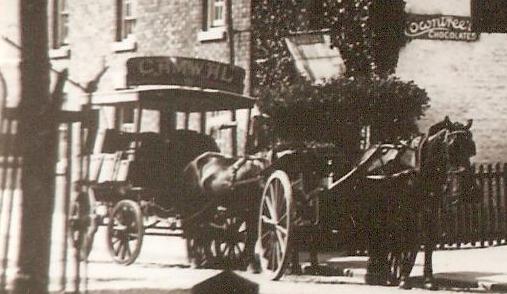
Summer days in south Manchester No 6 late morning on Chorlton Green in 1912

Chorlton Green was always a favourite of the travelling commercial photographer, and this one turns up again and again.

What makes it more fascinating is the detail.

Just behind the woman and pram is an advert for the Pavilion which was on the corner of Wilbraham and Buckingham Roads.

It was our first cinema and opened in 1904, and despite stiff completion from the two purposes built picture houses on Barlow Moor Road and Manchester Road limped into the 1920s before closing down.

But I am also drawn to Mrs Gertrude Green sweet shop at number 5 Chorlton Green and the delivery cart for Camwal which may have been unloading mineral water and soft drinks to her shop.

The firm had begun in 1878 as the Chemists' Aerated and Mineral Waters Association Limited and by 1895 had factories in London, Bristol, Harrogate and Mitcham.

It can’t be sure but it is likely that around 1901 they changed their name to Camwal or were taken over. Those wooden heavy crates would still be used well into the middle of the century for transporting various soft drinks and beers.

Now number 5 looks small and in 1911 it consisted of just three rooms. Fine for Mrs Green who was a widow and lived alone but two decades earlier it had been the home of the plumber James Moloy his wife and four children.

Today the house is bigger but looking again at our picture back then some of number 7 appears to run behind it but just how the internal geography of the two works has yet to be revealed.
Having said that our picture has not yet given up all there is to learn.

Until late in the 19th century the pub was just the space either side of the entrance at number 9 and as late as the 1891 census there were families in numbers 11, and 13. And you might think that when the picture was taken this was still the case.

The fence extends along the rest of the row and separates these properties from the pub. But by 1901 all three were described as the Horse and Jockey which may have happened soon after the death of Miss Wilton who had lived at number 13 and died in 1896.

I would still like to know who owned the horse and cart in front of the Camel delivery vehicle, and whether the woman pushing the pram was the child’s mother or one of the many servants who were employed here in the years before the Great War.

Location; Chorlton Green, 

Picture; from the Lloyd collection, undated

Annot Robinson ........ revisiting a remarkable woman

I have decided to revisit Annot Robinson*.


Mrs Annot before her marriage to Sam Robinson
I first came across her   in an excellent account of her contribution to Manchester politics in the early 20th century.**

Just weeks before I had  been reading some of her correspondence to the Daily Citizen in 1915 on the exploitation of woman in the workforce. 

“Women” she wrote “will most certainly have to take the place of men.  

There is already a shortage of men workers in Manchester  but so far as I am aware no women taking on a man’s work will be receiving a man’s wage.“***

She had been born in Scotland in 1874 married and moved to Ancoats in 1908 and returned to Scotland in 1923 where she died two years later.

She had become active in Scottish politics in the 1890s and by 1895 was working for the Independent Labour Party in Dundee.

Annot Robinson speaking at a Suffragette meeting circa 1910 with her daughter
“She entered a marriage based at first on love and shared political ideals but which was ultimately disastrous. 

Subsequently living as a single-parent in an unaccepting age, she struggled in support of her chosen and unpopular causes, a constant and active member of the ILP and at different times of the WSPU, the NUWSS and the Women’s Labour League (WLL), Women’s War Interests Committee, Women’s International League for Peace and Freedom, an ebullient speaker and tireless traveller and twice a candidate in local elections.”****

All of which was set against the backdrop of being “at first the family bread winner and then a single parent of two young children.”*****

And at this point rather than just lift Ms Rigby’sresearch I shall point you towards the article and in the fullness of time return to Annot Robinson when I found out more myself.

Pictures; Annot  before she married Sam Robinson, and Suffragette meeting in Manchester, circa 1910, Annot Robinson standing.  The baby is her daughter, Cathy.  From ANNOT ROBINSON: A FORGOTTEN MANCHESTER SUFFRAGETTE

*Annot Robinson, http://chorltonhistory.blogspot.co.uk/search/label/Annot%20Robinson

**ANNOT ROBINSON: A FORGOTTEN MANCHESTER SUFFRAGETTE, Kate Rigby, Manchester Regional History Review, Vol 1 Nu 1 Spring 1987,
http://www.hssr.mmu.ac.uk/mcrh/files/2013/01/mrhr_01i_rigby.pdf

***"no women taking on a man’s work will be receiving a man’s wage" ............stories from the Great War, http://chorltonhistory.blogspot.co.uk/2014/10/no-women-taking-on-mans-work-will-be.html

****ibid Kate Rigby

***** ibid Kate Rigby

Letters to the Daily Citizen, courtesy of the Labour History Archives & Study Centre,  at the People’s History Museum, Manchester, http://www.phm.org.uk/