Thursday, 20 September 2018

Predicting the football results in 1943 can be a tricky business.....

Now I fully concede that on this, I am outside my comfort zone and pretty much at the edge of what I know about football pools, war time football and Mr A Thompson of Albert Road Manchester 19.

Mr Thompson predicts ...... 1943
But that won’t stop me reflecting on a list of football predictions for Saturday October 30th 1943 which were offered up by a Mr A Thompson.

There are eight cards, but only one has a date and that is limited to the day and the month.

What makes them even more interesting is that some of them have a drawing of a fighter aircraft on the reverse.

They were acquired by my old friend David Harrop who thought the planes dated from the 1930s.

Bergamaschi (Caproni) API
A search for the aircraft revealed that some at least date from the late 1930s, but went into operational use in the 1940s.

Given that the October 30th in the predictions has to be a Saturday, a search offered up two possible candidates, which were 1932 and 1943, and as some at least of the planes postdate 1932, I rather think Mr Thompson penned his predictions during the war.

And that led to a slight doubt because I was convinced that the war had put an end to the league.

Lockhead 14 Bomber
But not so, the games carried on, with teams mounting a depleted professional list of stars and were reorganised on a regional basis.

A trawl of the Manchester Guardian revealed the fixture for October 30th and there under the section headed League South were the teams on Mr Thompson list, including Millwall, Arsenal and Southampton.

That said, his track record of predicting winners was a bit off.
Millwall drew with Aldershot, as did Arsenal and Crystal Palace, while Southampton went down to a stunning defeat, losing to Queens Park Rangers 7 goals to 1.

The results, November 1, 1943
Nor did he fare much better in the North where he confidently asserted that Chesterfield, Sunderland, and Wolves, along with Oldham and Gateshead would be winners.

In reality only Gateshead was successful, with Sunderland and Wolves managing a draw, and Chesterfield and Oldham going down to defeat.

All of which makes me wonder whether the true winner was the artist who used the back to draw those fighter aircraft.

But I did learn something, because having been stumped by the word nap, David tild me it is a “term used in betting circles, for example my nap for the day is Andrew’s Pride in the 2.30 at Newmarket”. 

Alas Mr Thompson has stayed in the shadows, his house was occupied by someone else in 1939 and so far nothing else about him has come to light.

But it is early days.

Location; Manchester

Pictures; Mr Thompson’s football predictions, and those aircraft, circa 1943, courtesy of David Harrop and Results Manchester Guardian, November 1, 1943

Automata .......... listening to Radio 4 ..... at its best

Today I came back to In Our Times, that excellent Radio 4 programme which for forty or so minutes, offers up an insight into a topic with the help of four experts.

The programmes can range over science, literature and my own favourite, an episode with an historical slant.

And today, it was on Automata, which involved

“Melvyn Bragg and guests discussing the history of real and imagined machines that appear to be living, and the questions they raise about life and creation. 

Even in myth they are made by humas, not born. 

The classical Greeks built some and designed others, but the knowledge of how to make automata and the principles behind them was lost in the Latin Christian West, remaining in the Greek-speaking and Arabic-speaking world. Western travellers to those regions struggled to explain what they saw, attributing magical powers. 

The advance of clockwork raised further questions about what was distinctly human, prompting Hobbes to argue that humans were sophisticated machines, an argument explored in the Enlightenment and beyond.

With Simon Schaffer, Professor of History of Science at Cambridge University, Elly Truitt, Associate Professor of Medieval History at Bryn Mawr College and Franziska Kohlt, Doctoral Researcher in English Literature and the History of Science at the University of Oxford”.*

And that allowed me to wallow in the film Metropolis which is one of my favourite silent films and explores issues of industrialization, its impact on the workforce and so much more.

And there is a link between Automata and the image of the character, Maria from the film, but of saying more, you will have to go off and watch it and then  make the connection with Automata.

Picture; Replica of the character Maria from Metropolis. This image is freely available under the Creative Commons,  Attribution-ShareAlike license, Date 8 March 2011, Source Maria from the film Metropolis, on display at the Robot Hall of Fame, Author Jiuguang Wang from Pittsburgh, Pennsylvania, United States

*Automata, In Our Time, BBC Radio Four, https://www.bbc.co.uk/radio/play/b0bk1c4d

**BBC notes

Wednesday, 19 September 2018

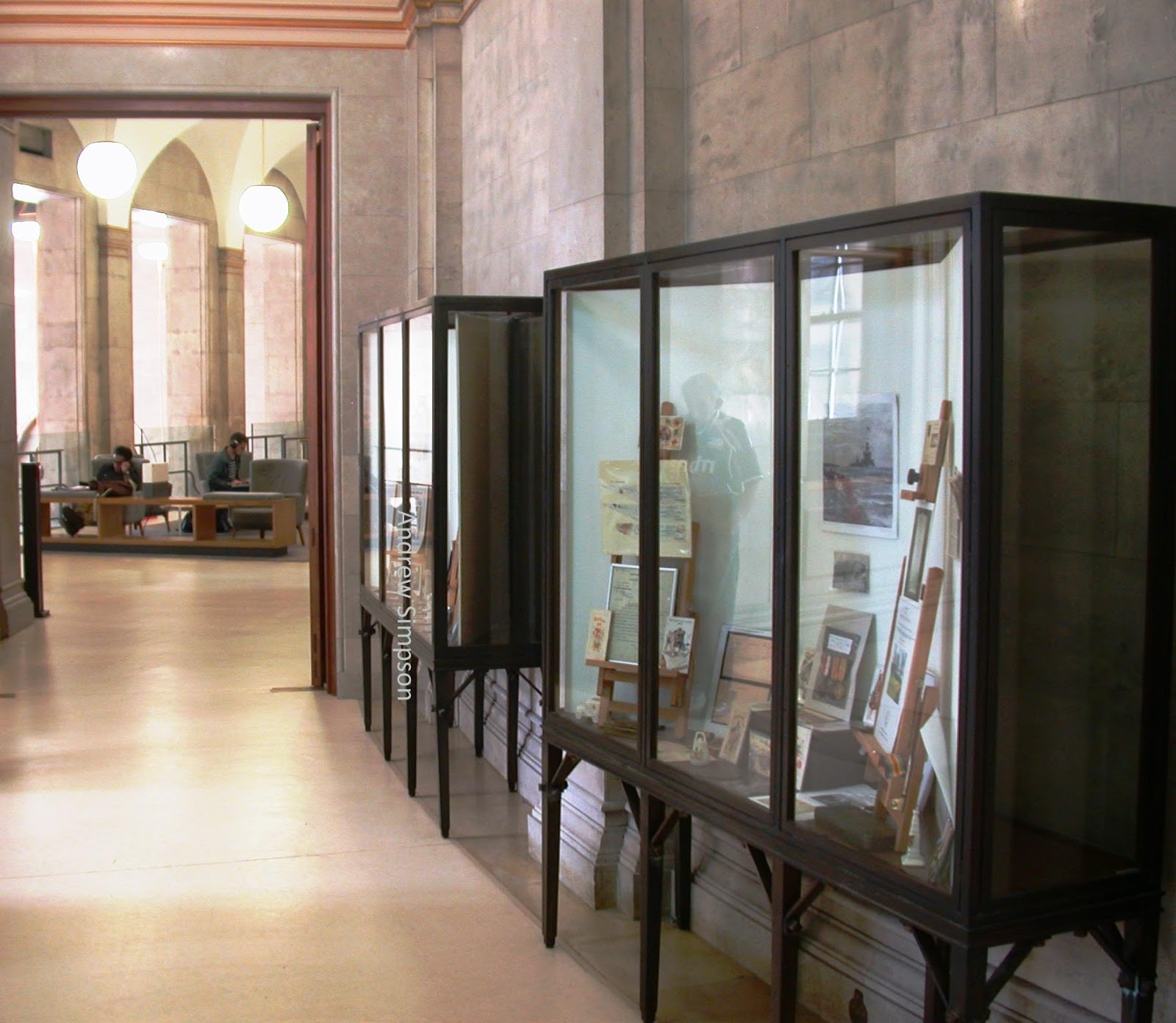
Manchester Remembering 1914-18 ......... the exhibition at Central Ref

Now I think it is highly appropriate that Central Ref should host the exhibition on Manchester and the Great War.

After all, it is the central library of the city and contains both the Archive and Local History libraries, added to which it is just a short walk from the Cenotaph.

The exhibition is the work of David Harrop who has a huge collection of memorabilia from both world wars along with a fascinating collection of material on the history of the Post Office.

David already has a permanent exhibition of his collection in the Remembrance Lodge at Southern Cemetery, but the Ref offers the opportunity for a lot more people to see learn about Manchester and the Great War.

Along with medals, letters and photographs there are picture postcards, crested china and official documents.

Together they tell the story of Manchester’s war from the serious to the silly, from the start of the conflict to the end and beyond into the first years of peace.

David is a modest man, and more than once he asked me what I thought of the exhibition and whether it did convey that period in our city’s history.

And I have to say it does, partly because of the range of material on display, but also because it focuses on individuals and their war.

So, one entire cabinet is devoted to George Davison, who enlisted in 1914, leaving his wife and son to serve first in Woolwich, then Ireland and finally on to the Western Front.

We have a photograph of the family, a collection of the letters he sent home and the official document reporting his death just months before the armistice.

The exhibition, which is entitled In Flanders Fields, runs until November.

Location; Central Reference Library, Manchester

Pictures; In Flanders Fields, Central Ref, 2018, from the collection of Andrew Simpson


Monday, 17 September 2018

The Duke of York on Marlborough Road ............ a pub with a history yet to be revealed

Now given its distinctive appearance you would think there would be more stories about the Duke of York on Marlborough Road.

After all Peter’s painting captures the place at its best but unless I have missed something there is little on the pub.

True there is a reference on the Joseph Holt site but as the Duke of York is a Holt’s pub that is only to be expected.

But it is confined to the simple "a beautiful Victorian Gothic building is within close proximity to Salford, Cheetham Hill and Broughton.

The Duke of York offers a traditional pub experience with darts, pool and live music nights at the weekends. 
The friendly pub also caters for the local community and newcomers are always welcome.”*

Nor does it appear on the Salford City Council page of local pubs or other sites which list pubs in the area.

Perhaps that’s because it still exists and is a bit off the usual Salford tourist haunts.

I am not yet sure when it was built but it will be after 1894 because the OS map for that year shows this stretch of Marlborough Road as undeveloped and the following year the directories still show it as unoccupied.

But just nine years later Mr Joseph Lord is pulling pints and dispensing Salford gossip.

So that pins down the date to a pretty narrow window and I am guessing the Holt’s brewery will know, so that will be my next port of call. Of course in the meantime someone may know and if they do I would welcome the information.

For one fleeting moment there was the possibility of a ghost story but that turned out to be another Duke of York in Eccles, and while there is an interior shot from the Getty Library dated 1926 it is unclear which of our two Salford pubs it is.

So that is it really.

Location; Salford

Paintings; the Duke of York, Marlborough Road, © 2015, Peter Topping,
Facebook; Paintings from Pictures, Web: www.paintingsfrompictures.co.uk

*Joseph Holt,  http://www.joseph-holt.com/pubs/view/duke-of-york

Remembering those from the Great War ...... today ...... the exhibition at Central Ref

The new exhibition In Flanders Fields at Central Ref starts today and will run until November.

Central Ref, 2016
We will all have our own images of the Great War.

Some will be very personal; others more general and they will stretch from family pictures of young men in ill fitting uniforms, to women in the munitions factories and scenes of the carnage on the battlefronts.

And as we move towards the anniversary of the armistice in November, those images along with the stories of heroism and of quite fortitude on the Home Front will be everywhere, which is as it should be.

The danger of course is that we set upon familiar images, which include the young men staring back at us, the smiling “munitions girls” and the news coverage of frail old men and women, often in wheel chairs attending ceremonies across the country.

But that is to forget that in between those sets of powerful images, there were lives lived out, raising families, contributing to the common good and generally getting on with things.

First City Battalion of the Manchester Regiment, Heaton Park, 1914
For my generation, who were born in the years directly after the Second World War, those people were our grandparents, and when I was growing up many of them were still in full time employment, some had yet to have grandchildren and most treated the four years of war as just part of the bigger picture.

And so it seems to me that any exhibition on the Great War must reflect all of that, and at the same time focus on all those who lived through that conflict.

Souvenir created china, date uncertain
It should of course focus on the men and women who went off to the battlefronts, either to fight or serve in hospitals, but also those who stayed behind, working in essential war work, or bringing up children as single parents, and it should also include the children, many of whom coped with part time schooling and the anxieties of having fathers, uncles and brothers serving in uniform.

All of which will be included in David Harrop’s major new exhibition which will begin on September 10th at Central Ref and run through till November.

The Davison family, 1916
David has a vast collection of memorabilia, from medals, and photographs to letters, postcards and the ephemera which includes crested china souvenirs, official documents and the very human stuff like a tram clippie’s manual from 1918.

So, for those who wander in to the Ref next week, you may come across David setting up the exhibition, or if you are like me, you will wait till it is unveiled.


Either way it promises to be instructive, as well as moving, and will prompt many to ask questions and renew their own interest in that conflict which as I write was drawing to its conclusion.

The exhibition is called In Flanders Fields and will take up the whole of the first floor gallery.

Location; Manchester

Pictures; Central Ref,2016, from the collection of Andrew Simpson, remaining pictures courtesy of David Harrop

*In Flanders Fields runs from September 10th till November at Central Ref and is free.

Wednesday, 12 September 2018

Finishing Sigi and the Italian Girl ..... under the same Italian sky

Now I think it is quite appropriate that I should have finished Sigi and the Italian Girl by Stephen Hale, just 20 minutes drive from where it was set just north of Genoa.

We have been staying with our Italian family in Varese, and moved on to a small village on Lake Mergozzo not unlike the place he writes about.

I won’t of course spoil the plot, other than to say it is set in a small mountain community in 1944 and switches from the war to the present.

Stephen captures perfectly small town Italy, where everyone knows what everyone’s family has done all the way back four generations, and where petty rivalries and loyalties can shape who you like, and who you sit with.

In our bit of Varese, Rosa can tell you who ran off without paying at the local bakery, the last time her neighbour washed the curtains and much more.

And sitting in the Piazza Monte Grappa, I can recognise people who could be a double for some of his characters, like the old man sitting in the late September sun or the group of retired friends who walked up and down the Corso Giacomo Matteotti, never quite being able to part from each other’s company.

I watched them walk back and forth, stop, shake hands, tell a final joke, and then stay together for one final walk back past the patisserie, the entrance to the church square, and the statue of one of Garibaldi’s Red Shirts.

And that all makes Sigi and the Italian Girl, a good read because these people walk Stephen's pages.

Not that you have to have lived in Italy to be gripped by the plot or convinced by the characters.

Running through the plot are
themes of resistance, loyalty and hard decisions about how individuals face up to authority.

And on our way here we passed the a big museum to the Resistance and everywhere there are memorials to those who fought the occupying German army and the Fascists.

So more than a bit empathetic.

And that just leaves me to hunt for a postcard to the kids at home in the house.

The book stands on its own and is well worth the read.

It's available in two formats: paperback at £7.99 and Kindle at £2.99.*

Location; Italy

Pictures; cover of Sigi and the Italian Girl, courtesy of Stephen Hales, and the Piazza Monte Grappa and Corso Giacomo Matteotti, 2013, from the collection of Andrew Simpson

* Sigi and the Italian Girl, https://www.amazon.co.uk/Sigi-Italian-Girl-Stephen-Hale/dp/1545431876/ref=sr_1_2?ie=UTF8&qid=1534927648&sr=8-2&keywords=sigi%20and%20the%20italian%20girl


Tuesday, 11 September 2018

"over the Mersey at Jackson’s Boat and on to Baguley Moor and Hale Moss and after having botanized there ....returned to Manchester at dusk, all pleased with our day’s excursion” Richard Buxton in Chorlton


“one of the hottest and driest summers that I can remember, and there had been no rain in the neighbourhood for two or three months; but on the day appointed for our meeting, very heavy rain came on about five in the morning. I should not have thought of stirring out of doors; but, having made the appointment, I thought it just possible that my friends might come, and I would not on any account disappoint them. We all went in the rain, through Manchester to Chorlton-cum-Hardy. After staying at the last named place sometime the weather changed and a fine day ensued then over the Mersey at Jackson’s Boat and on to Baguley Moor and Hale Moss and after having botanized there ..... returned to Manchester at dusk, all pleased with our day’s excursion”

It is almost impossible to know when Richard Buxton walked the meadows of Chorlton and botanized the day away with his friends. But I guess it must have been sometime in the 1820s. We were still a very rural community and there would have been plenty to see and record. And record Buxton did, for he was one of those remarkable working men who were self taught, became an expert on botany, wrote books and struggled against poverty before dying obscurely. “I am well aware” he wrote “that a narrative of the life of a poor man like myself .... is anything but interesting.” and yet it has proved to be so.

Which is why over the next brace of weeks I want to tell his story. He was born in rural Prestwich grew up in Ancoats just as Manchester was becoming the “shock city of the Industrial Revolution” and died as he had lived in poverty.

I was introduced to Buxton by my old pal David Bishop who is a passionate botanist and has patiently explained nature to me over the years. It was David who lent me the book Buxton wrote in 1849. For a self taught man his Botanical Guide to the Flowering Plants, Ferns Moses and Algae found Indigenous within Sixteen Miles of Manchester is both a wonderful record of what there was to see but also a testament to his interest and tenacity.

In a world where reading and writing are taken for granted, it is easy to gloss over the fact that at the age of sixteen he was illiterate, and had to set himself the task of learning to read. What is all the more remarkable is that having mastered the spelling book and the narrative of the New Testament he realized he needed to know not only how to pronounce the words but their exact meaning. And so “By this means I was enabled not only to read, but also to understand the meaning of what I read, and to speak it correctly.” All the more remarkable given that his working day lasted from six in the morning till eight or nine at night.

The result is a book that has stood the test of time and one that botanists still use as a hand book.

Picture; Junction of Gore Brook and River Mersey J Montgomery 1963 based on an earlier picture, m8014, Courtesy of Manchester Libraries, Information and Archives, Manchester City Council