Monday, 20 September 2021

Summer in the City

Now for no particular reason other than I took them and they are of Manchester, here is a short series celebrating places I like.

All have appeared before and some a long time ago.


Location; Castlefield, Manchester

Pictures; around Manchester 2002-2015, from the collection of Andrew Simpson

Chris Hall: The Nurse who Became a Spy......... Tuesday September 21 .... at Chorlton Library

This is a talk I have been looking forward to ever since the publication of Chris Hall's book on Madge Addy.

"On the wall of 34 Manchester Road, there is a plaque dedicated to Madge Addy.


A former hairdresser, she served as a nurse in the Spanish Civil War and became a special agent in France in World War II.

Chris Hall’s book The Nurse who Became a Spy, tells her remarkable story.

Chris is a historian, trade unionist, librarian and expert on the Spanish Civil War.

He uncovered Madge Addy’s story and led the campaign for the plaque.

He’s the author of books including Disciplina Camaradas and In Spain with Orwell, and a member of the International Brigade Memorial Trust."*

The talk is part of this years Chorlton Book Festival.

Book free tickets here, https://www.eventbrite.co.uk/e/chorlton-book-festival-madge-addy-the-nurse-who-became-a-spy-tickets-159588971911


Location, Chorlton, Spain, France

Picture; Nurse Madge Addy; Daily Worker, November 11, 1938 the plaque unveiling ceremony on May 12 2018

*Chorlton Book Festival September 17th-25th, https://www.chorltonbookfestival.co.uk/

30 do Chorlton's past ......

The weather stayed good, we didn't lose anyone, and so the 12th Chorlton Book Festival History Walk passed off well.
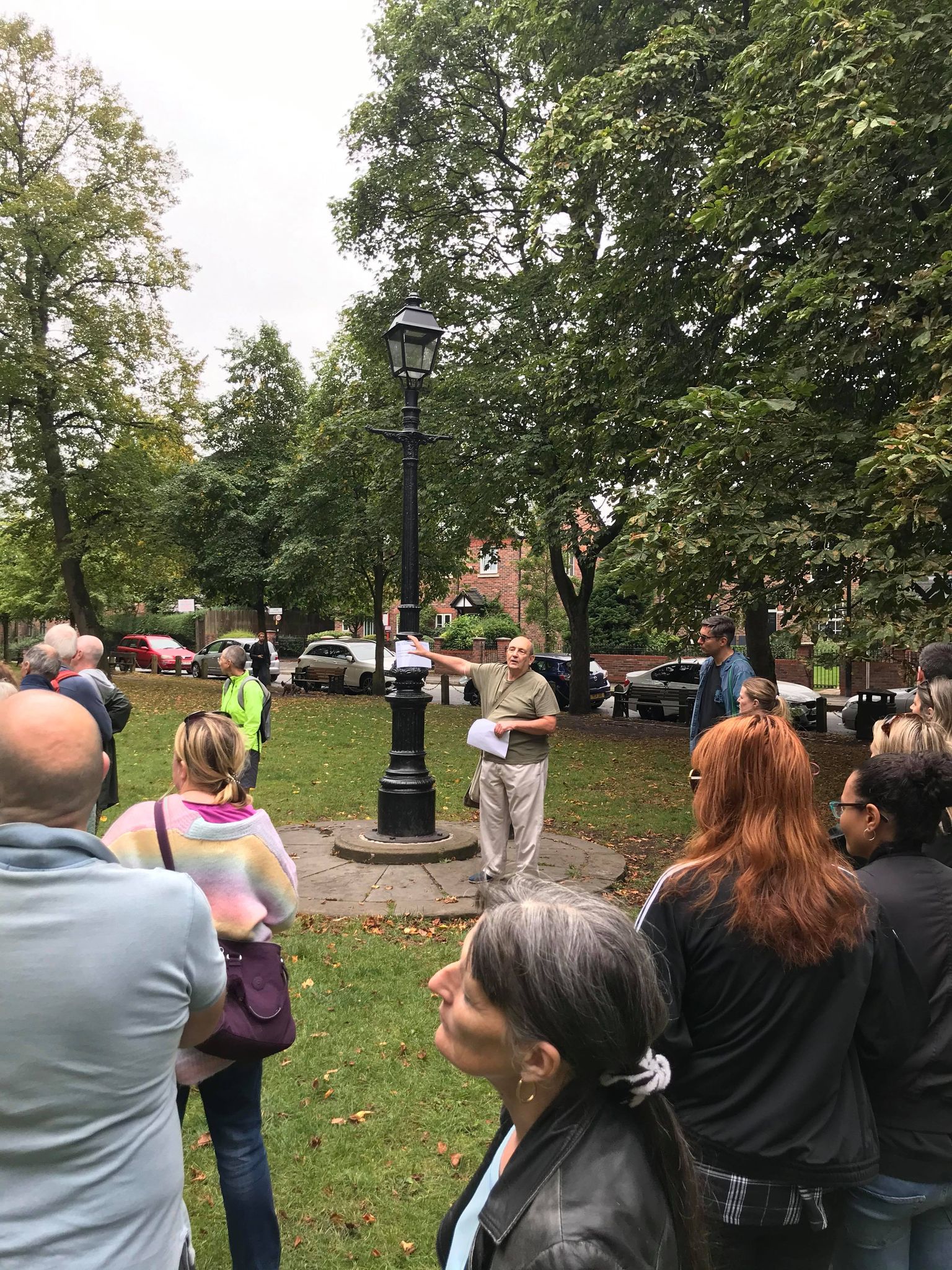


Leaving me just to thank the 30 who turned up, The Libray Service who commissioned the Walk as part of Chorlton Book Festival, and Gail Mallet from the Library who organised it.

Along with Mathew Benham who ensured I kept to time with his ingenious red and green cards, and ofcourse the Edge who provided an excellent meal at the end of the walk.


Leaving me just to remind everyone of the full programme of events at the Chorlton Book Festival available by following the link.*


Location; Chorlton


Pictures, courtesy of Mathew Benham, and Balzano, 2021

*Chorlton Book Festival September 17th-25th, https://www.chorltonbookfestival.co.uk/

Sunday, 19 September 2021

Tram watching .............. down at Castlefield Deansgate

Now my old friend David has collected the numbers of all the trams in service.

Me, I just do the pictures.

And so on one hot sunny day before the rain came back I was down at the Castlefield Deansgate Metro stop watching the trams go by.

I have to say like a lot of people I was very impressed with the stop.

And equally with the route to Victoria  which was started life as the  Second City Crossing.

I can’t claim I was there for all the new openings but did the trip in stages on the East Didsbury line, followed it up with the Ashton, Oldham and Rochdale services and much later than planned the trip out to Trafford Centre..

No doubt I will be one of that small bunch armed with camera and recording equipment some of who fifty years ago could have been seen at the end of railway platforms writing down the numbers on the passing locomotives.

For reasons to long to explain I never did get into train spotting partly I guess because there were very few steam locos on the South Eastern Region delivering passengers into London Bridge, Waterloo and Charing Cross.

I am sure that the experts could spot the difference in the green liveried electric trains but I couldn’t and so instead of number snatching I favoured those plastic aircraft kits with the odd Historic figure and ship thrown in.

All of which is a long way from watching the trams but having long ago collected my concessionary bus pass and with acres of time stretching out each day there could be worst places to spend an adventure.

Location; Castlefield Deansgate,

Pictures; tram watching at Castlefield Deansgate, 2016, from the collection of Andrew Simpson

The unexpected ………………….. more from Wirksworth

Now my guide book tells me that Wirksworth is a small market town in Derbyshire with a population of five thousand, while Samuel Lewis, in his A Topographical Dictionary of England, published in in 1831, observes that there were 3,787 residents in the town with another 3, 528 living in the surrounding hamlets and villages.


Adding that “The town is situated in a valley surrounded with hills, at the southern extremity of the mining district; it is not regularly lighted or paved, and is supplied with water, brought by pipes from the hills on its eastern side.


The chief employment of the inhabitants arises from the lead mines, but some are also engaged in the cotton manufacture; kand there are, in the town and its immediate neighbourhood, three establishments in which cotton ginghams are made , and others for the production of  hosiery, hats, tape, silk and for wool-combing.  The Cromford Canal, and the Cromford and High Peak Railway, commence in this parish”.

All of which was news to me, but then as a tourist I am particularly inept at reading up on the places we visit.

And that of course is my loss, because I might have been better able to enjoy the history of the town.

That said there was still plenty to get entranced by, like the ting thoroughfare leading from a busy street into the area surrounding the parish church.

The stone gate posts have a date of 1721, and along with the wrought iron gates there is that “Narnia” lamp post.

The paved entrance leading to the gates was restored in 1992, by the Wirksworth Civic Society with help from “The David Knightly Charitable Trust, English Heritage, Derbyshire Dales District Council, Derbyshire County Council and owners of adjoining properties [and] marls the completion of the Wirkswoth Project which began in 1978”.

All of which has set me off on a voyage of discovery, and as I wander over the town’s history, I came across an interesting site, which is well worth a look.**

For now, I shall close with that simple observation, that what was a casual day’s visit, has turned into a quest to know more about the town, which no doubt will emerge over the coming weeks, albeit from far away Chorlton-cum-Hardy, assisted by a cornucopia of online historical references and sources.***

Location; Wirksworth

Pictures; Wirksworth, 2019, from the collection of Andrew Simpson

* Samuel Lewis, A Topographical Dictionary of England, Vol 4, 1831

**T’owd Man: The Wirksworth Data Miner,  https://towdman.co.uk/

***Wirksworth, https://chorltonhistory.blogspot.com/search/label/Wirksworth


Summer in the City

Now for no particular reason other than I took them and they are of Manchester, here is a short series celebrating places I like.


All have appeared before and some a long time ago.

Location; Manchester


Pictures; around Manchester 2002-2015

Saturday, 18 September 2021

Coming to you in Didsbury …….. a barrel of Taylor Eagle’s best bitter. ….. by steam lorry

The brewey's; steam wagon
Now if you had been walking in the vicinity of the Royal Oak or the Station sometime just before 1914, you might have seen the steam lorry of Taylor Eagle delivering beer to our two pubs.

The brewery was founded by Joseph Taylor in 1849, registered in February 1888 and was sold in 1924 to a company which retained 60 pubs and was acquired by Marston, Thompson and Evershed Ltd in 1958.*

Now, it is easy to fall into the trap of speculating on the origin of the name Eagle in the title, and I wish there were something bizarre about how it came to be included.

But alas it is nothing more exciting than that the brewery was situated on Eagle Street, although later it was listed on Lloyd Street and Burlington Street which almost adjoins it.  It was here by 1863, and was advertised as “Taylor, Joseph, ale & porter brewer Eagle Brewery, Lloyd Street, Burlington Street, Oxford Street, Chorlton on Medlock”.

The full description
Mr. Taylor does appear to have prospered, because thirteen years earlier, he didn’t qualify to be listed in the trades section as a brewer and only appears in the alphabetical listings of the directory as “brewer 12 Calder Street”, and “beer retailer 25 Brownhill Street”, both in Salford.

It is a measure of just how modest his two enterprises were back in 1850, that neither Calder Street nor Brownhill Street were significant enough to be included in the directory.

 Nor does he show up in the historic records. 

In 1851, a Joseph Taylor is recorded as a pauper in the Salford Workhouse, while a second was living in Prestwich, was 73, and on “private means”, neither of which is he.

So, the search will go on, but in the meantime, I do have a map showing the brewery in 1893, a couple of beer bottles bearing the company name, and of course the ongoing mystery of where to find Mr. Taylor.

And a later steam engine
But, for all those who like lists, I do have a full list of the pubs owned by Taylor’s Eagle Brewery.  Most are in Manchester, with a few in Salford and others in faraway Altrincham, Knutsford, Timperley and Urmston, but the company had two in Didsbury, of which the second was the Station, but that is a story in another chapter.

And to compliment that list my old friend Bob Potts offered up an even more fascinating list of pubs and the year they obtained their first license covering the city centre, and the surrounding areas including Didsbury.

For the record, Bob  produced a fine book on the pubs of Hulme and Chorlton on Medlock. **

His records offer up a date of 1847 for its first license, and I wonder whether our Mr. Taylor on a visit out from Salford set about persuading the beer keeper at the Royal Oak to give up making his own beer and turn instead to Mr. Talyor’s “superior ales and porters”, which I am the first to accept is silly speculation.

And that is it.

Location; Didsbury

Picture; Taylor Eagle Brewery Steam Wagon, circa 1914 GMC Records, courtesy of Manchester Libraries, Information and Archives, Manchester City Council, http://images.manchester.gov.uk/index.php?session=pass  and a later steam lorry, 1980 from the collection of Andrew Simpson


 ** Potts, Bob The Old Pubs of Hulme and Chorlton-on-Medlock, 1997