Showing posts sorted by relevance for query food. Sort by date Show all posts

Thursday, 7 November 2019

In Honour Bound ................. giving up a slice of bread for the war effort


In Honour Bound, 1917
Now here is a jolly poster I have never seen before.

It dates from March 1917 when food shortages were beginning to get the Government worried.

The official line at the beginning of the year was that there was no problem and even by March Mrs Peel of the Ministry of Food commented that “whilst the food position is serious, there is every reason to hope that if people carry out the recommendations of Lord Davenport we shall come through a very difficult period without anything worse than considerable inconvenience.”*

The recommendations had included an appeal for families to adopt ‘The National Scale of Voluntary Rations’ of 4 pounds of bread or 3 pounds of flour, 2½ pounds of meat and ¾ of sugar per week which was the allowances already in place for people eating in restaurants and hotels.

Queue for potatoes, Manchester, 1914
All houses agreeing to do this received a small placard which proclaimed "IN HONOUR BOUND WE ADOPT THE NATIONAL SCALE OF VOLUNTARY RATIONS."

The campaign had begun in the middle of February and by March 11 leaflets “with useful information on rationing and methods of economy [along with the] cards of honour in red, white and blue,” were being prepared.

I have yet to discover just how successful the scheme was but anecdotal evidence suggests that amongst the middle class who were the targets it did have some success.

The London correspondent for the Manchester Guardian reported that that during the first week “out of the fifteen families of barristers, architects, artists, Government officials, and journalists thirteen were keeping their food consumption within the suggested limits.”**

The long queue, 1914
An observation which was supported later that year in a book on food supply and distribution in which the authors asserted “in the short street in which we lived in London last spring three out of four houses showed the placard.  In a certain village of 25 houses all 25 displayed the card.

Altogether as a result of this appeal and an independent “Eat Less Bread” campaign the Food Controller is able to declare that fifteen per cent less bread was eaten in the United Kingdom in June of this year than in February.

In some of the larger cities the consumption of bread was reduced by as much as 25 per cent to 30 per cent.  Portsmouth reduced its weekly capita consumption to 3lbs. 1 oz and Keighley, the ‘model town’ to 2 pounds 07 oz. ‘It is perfectly safe to say,’ says the Director General Kennedy Jones ‘that an enormous reduction has been effected through the voluntary efforts of the people in the United Kingdom in the consumption of practically all food-stuffs.’” ***

All of which sounds fine and dandy but obscured the fact that shortages had been pushing the price of food up since the beginning of the war causing increasing hardship amongst the poor and the working classes.

The London Vigilance Committee, 1917
The Food Vigilance Committees established by the Labour Movement at the outbreak of the war, continued to highlight the issues of food shortages and price rises and demanded that the production and distribution of food should be taken over by the Government in partnership with the trade unions and Co-operative Societies.****

And had also argued for food rationing and even bolder moves to alleviate the problem.  One “very lively conference of working-class women from all parts of London met at Westminster [on February 25] to discuss the voluntary food rationing scheme, with all agreed that the bread rations should be greatly increased ........ a public supply and distribution of milk, and meals for mothers and young children and the establishment of municipal kitchens.”****

The Government however remained  opposed to compulsory rationing despite the growing evidence of shortages and its impact on the poor, with the Food Controller asserting in early November in a Speech at Manchester Town Hall that this was “the voluntary Scheme’s last chance."******

And that proved to be the case for later in the month the Government gave in and began rationing.

Location, Britain

Pictures; The honour card, 1917 from the collection of David Harrop, extracts from documents from The London Food Vigilance Committee, 1915, courtesy of the Labour History Archives & Study Centre,  at the People’s History Museum, Manchester, http://www.phm.org.uk/ queue for potatoes, 1914, courtesy of Manchester Libraries, Information and Archives, Manchester City Council, http://images.manchester.gov.uk/index.php?session=pass

*Why not official Menus? Food Controller’s Cards of Honour, Manchester Guardian, March 11 1917

**First week of Voluntary Rationing, Manchester Guardian, February 14 1917.

***The Food Problem Vernon Lyman Kellogg, Alonzo Englebert Taylor, Herbert Hoover, 1917, the Macmillan Company New York page 66-67

**** Food Vigilance Committeeshttp://chorltonhistory.blogspot.co.uk/search/label/Food%20Vigilance%20Committees

*****Working Women on rationing, Manchester Guardian, Februry 26 1917

Tuesday, 20 June 2017

Four slices of bread a day, giving up the stuff for the war effort .............. stories behind the book nu 9

An occasional series on the stories behind the new book on Manchester and the Great War.*

In Honour Bound, 1917
Now here is a jolly poster I have never seen before.

It dates from March 1917 when food shortages were beginning to get the Government worried.

The official line at the beginning of the year was that there was no problem and even by March Mrs Peel of the Ministry of Food commented that “whilst the food position is serious, there is every reason to hope that if people carry out the recommendations of Lord Davenport we shall come through a very difficult period without anything worse than considerable inconvenience.”*

The recommendations had included an appeal for families to adopt ‘The National Scale of Voluntary Rations’ of 4 pounds of bread or 3 pounds of flour, 2½ pounds of meat and ¾ of sugar per week which was the allowances already in place for people eating in restaurants and hotels.

Queue for potatoes, Manchester, 1914
All houses agreeing to do this received a small placard which proclaimed "IN HONOUR BOUND WE ADOPT THE NATIONAL SCALE OF VOLUNTARY RATIONS."

The campaign had begun in the middle of February and by March 11 leaflets “with useful information on rationing and methods of economy [along with the] cards of honour in red, white and blue,” were being prepared.

I have yet to discover just how successful the scheme was but anecdotal evidence suggests that amongst the middle class who were the targets it did have some success.

The London correspondent for the Manchester Guardian reported that that during the first week “out of the fifteen families of barristers, architects, artists, Government officials, and journalists thirteen were keeping their food consumption within the suggested limits.”**

The long queue, 1914
An observation which was supported later that year in a book on food supply and distribution in which the authors asserted “in the short street in which we lived in London last spring three out of four houses showed the placard.  In a certain village of 25 houses all 25 displayed the card.

Altogether as a result of this appeal and an independent “Eat Less Bread” campaign the Food Controller is able to declare that fifteen per cent less bread was eaten in the United Kingdom in June of this year than in February.

In some of the larger cities the consumption of bread was reduced by as much as 25 per cent to 30 per cent.  Portsmouth reduced its weekly capita consumption to 3lbs. 1 oz and Keighley, the ‘model town’ to 2 pounds 07 oz. ‘It is perfectly safe to say,’ says the Director General Kennedy Jones ‘that an enormous reduction has been effected through the voluntary efforts of the people in the United Kingdom in the consumption of practically all food-stuffs.’” ***

All of which sounds fine and dandy but obscured the fact that shortages had been pushing the price of food up since the beginning of the war causing increasing hardship amongst the poor and the working classes.

The London Vigilance Committee, 1917
The Food Vigilance Committees established by the Labour Movement at the outbreak of the war, continued to highlight the issues of food shortages and price rises and demanded that the production and distribution of food should be taken over by the Government in partnership with the trade unions and Co-operative Societies.

And had also argued for food rationing and even bolder moves to alleviate the problem.  One “very lively conference of working-class women from all parts of London met at Westminster [on February 25] to discuss the voluntary food rationing scheme, with all agreed that the bread rations should be greatly increased ........ a public supply and distribution of milk, and meals for mothers and young children and the establishment of municipal kitchens.”******

The Government however remained  opposed to compulsory rationing despite the growing evidence of shortages and its impact on the poor, with the Food Controller asserting in early November in a Speech at Manchester Town Hall that this was “the voluntary Scheme’s last chance."*******

And that proved to be the case for later in the month the Government gave in and began rationing.

Location, Britain

Pictures; The honour card, 1917 from the collection of David Harrop, extracts from documents from The London Food Vigilance Committee, 1915, courtesy of the Labour History Archives & Study Centre,  at the People’s History Museum, Manchester, http://www.phm.org.uk/ queue for potatoes, 1914, courtesy of Manchester Libraries, Information and Archives, Manchester City Council, http://images.manchester.gov.uk/index.php?session=pass

*Manchester and the Great War, Andrew Simpson, due out at the end of 2016, http://chorltonhistory.blogspot.co.uk/search/label/A%20new%20book%20on%20Manchester%20and%20the%20Great%20War

**Why not official Menus? Food Controller’s Cards of Honour, Manchester Guardian, March 11 1917

***First week of Voluntary Rationing, Manchester Guardian, February 14 1917.

****The Food Problem Vernon Lyman Kellogg, Alonzo Englebert Taylor, Herbert Hoover, 1917, the Macmillan Company New York page 66-67

***** Food Vigilance Committeeshttp://chorltonhistory.blogspot.co.uk/search/label/Food%20Vigilance%20Committees

******Working Women on rationing, Manchester Guardian, Februry 26 1917

Friday, 2 December 2016

One hundred years of one house in Chorlton part 69, ...... whose coming to dinner?

The continuing story of the house Joe and Mary Ann Scott lived in for over 50 years and the families that have lived here since.*

Foods from Meta, 1947
I have no idea whether Joe and Mary Ann regularly entertained people to dinner.

It wasn’t something that we did when I was growing up in London.  From memory apart from relatives at Christmas I can’t think of a seldom time when my parents had people around to share an evening meal.

I don’t suppose it was any different for Joe and Mary Ann but if they did I think they would have liked the two volumes of Meta Given’s Modern Encyclopaedia of Cooking first published in the USA in 1947.

In its time it was as essential as Mrs Beaton’s guide to household management and followed a tradition which can be traced back to the monthly periodicals issued during the 19th century and the stylish recipe books of the century before.

And likewise were replicated throughout the last century and into this one.

What they all had going for them was that they presented at a glance all you needed to know about food and how to prepare, cook and preserve a whole variety of different foods.

And looking back at them today is to experience a set of history lessons, because each book is of its time reflecting the attitudes and fashions of the day and the technology available.

So there are no microwave cookers in Meta Given’s books nor anything remotely approaching fast food.

Meta shows the way, 1947
Moreover the recopies use American measures and many of the foods listed would not have been available to Joe and Mary Ann in those post war years when there was still rationing.

Here are appetisers like Apple Tempters and Shrimp Cocktail, traditional main courses of liver and onions, broiled, fried or roast chicken and a host of puddings.

Some do tempt me but others like Italian Style Liver Marconi and Tomatoes followed by Baked Pears with Marshmallows I am happy to leave alone.

But they reflect that immediate post war period when the growing prosperity of the USA set it apart from Britain.

That said we did have Coronation Chicken that 1953 dish first served at the Queen’s Coronation meal which was a mixture of cold chicken with mayonnaise and curry.  It sounds quite tame today but against the backdrop of years of rationing I reckon it would have been pretty exotic.

Do it Yourself in the hedgerows, 1946
I have dipped into Meta Given but it is a world away from what I am comfortable with eating.

So my manual of choice is the Silver Spoon which first appeared in Italy in 1950 and like Meta was meant as the ultimate guide to food, cooking and all you wanted to know about both.

On balance it is an easier book to use but like most of us today the idea that one cook book fits all has I suspect had its day.

But I reckon Mary Ann might well have fallen back on a wonderful set of recipies, menus and food information issued by the Food Free Advice Service of the Ministry of Food..

In the years after the last world war, Britain continued to ration food and so it made sense for the Government to offer a free advice service on how to plan prepare and cook meals.

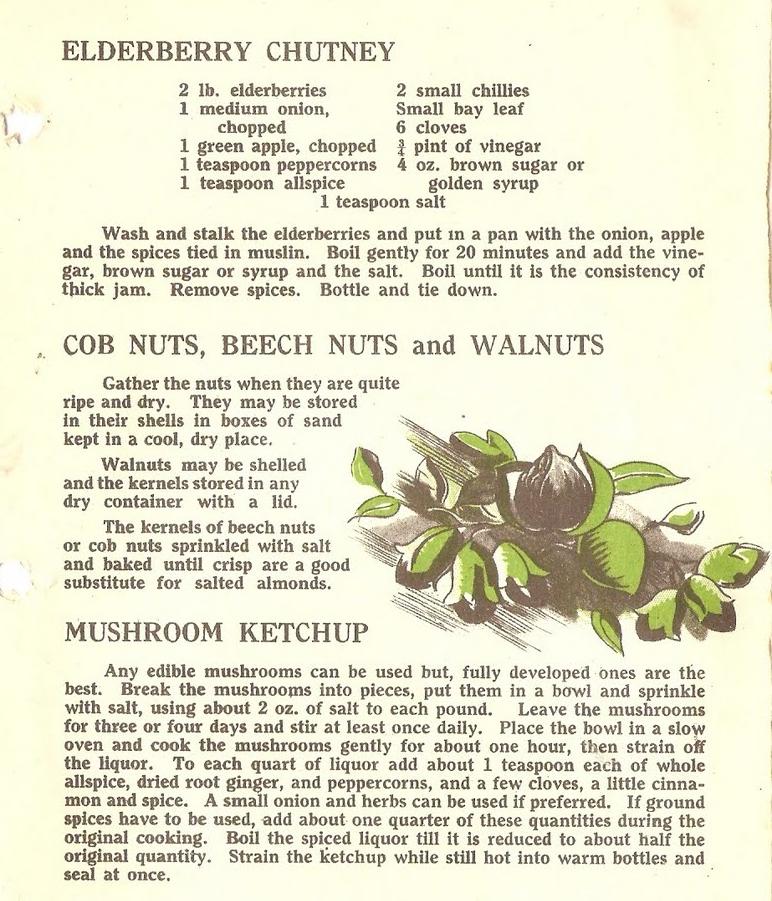
Mushroom Ketchup, 1946
This one is dated July 1946 and was designed to encourage people to gather their own food.
Hedgerow Harvest declared that “there is a wealth of wild foods in our hedgerows and fields for those who are within reach of the countryside” and provided recipes for Elderberry pudding, Blackberry or Elderberry Roly Poly, Blackberry or Elderberry Kissell and Blackberry or Elderberry Tart, along with suggestions for how to make pickles and chutneys, fruit bottling without sugar, how to preserve tomatoes and jam making.

And with the meadows largely still untouched by Corporation tipping there may have been plenty of food just ready for the picking.

Of course Mary Ann might just have made do with her own knowledge and supplemented by the shops on Beech Road.

Pictures; from rom Meta Givern’s Modern Encyclopaedia of Cooking, 1948, Chicago and  the Food Free Advice Service of the Ministry of Food, 1946,  in the collection of Vince Piggott

*The story of house,
http://chorltonhistory.blogspot.co.uk/search/label/The%20story%20of%20a%20house


Saturday, 14 February 2026

One hundred years of one house in Well Hall part 5 living through the Great War

Our house in 2014
The centenary of the Progress Estate has long passed.

Now we can lay claim to about thirty of those 100 years having moved in to 294 Well Hall Road in the middle of 1964 but I gave seldom thought to the history of the house or to the people who occupied it before us.

But now I am drawn to that past and have begun to explore something of what our home would have been like a century ago.*

And because I am deep into researching for a new book on the Great War the events of that year when the Arsenal workers and their families began new lives in Well Hall has special signifigance.

The popular story of how we coped during the four years tends to fasten on the participation of women on the shop floor and in the fields; the impact of Zeppelin raids and the blackout but all too often skips over the huge hike in the cost of living.

As Henry Hyndman the leading socialist pointed out “since the war had begun prices had gone up 22%, so that now the purchasing power of a sovereign was from 13s. 6d to 13s.9d.”**


And this was the context behind the industrial conflicts which rumbled on and which some at the time and since have sought to characterise as greedy workers exploiting a country at war.

The reality was very different as Sam Hague who spoke at a meeting in Manchester was quick to point out, “there never had been a time in the nation’s history when the working classes had so solidly backed the Government.”***

The aims of the committee, 1915
Working hours increased, and under the Defence of the Realm Act 1914 and The Munitions War Act 1915 workers were being prosecuted for absenteeism and striking over wages and conditions.

In Manchester the first prosecutions under the Munitions War Act were held at the Town Hall on Friday July 30 when thirty-two men employed at Craven Bros Ltd Reddish were brought before the Recorder charged with going on strike over wages and working conditions without first submitting the matter to the Board of Trade.

And in response to the rising cost of living the Labour movement set up local emergency war committees and food vigilance committees, which reported to the War Emergency Workers National Committee in London which had come into being on the day war broke out.

The idea of a food vigilance committee seems oddly old fashioned but back in 1915 it was seen by many as an essential way of preventing the  growing practice of adulterating food and the rise in the cost of living.

The London Food Vigilance Committee was a joint body made of the London Joint Committee of Co-operative Societies, the London Trades Council and the London Labour Party.

And cooperating with the Royal Arsenal Co-op in our part of London was Councillor William Barefoot of the Woolwich Labour Party.

These committees set out clear policies on how to manage shortages by insisting that “the Government purchase all essential imported food stuffs, commandeer or control all home grown food products and make effective use of ships and the control of transport facilities” thereby securing both a fair share of what was available and at a controlled price.”****

And a key part of this would be local authorities who should be “power to deal with the distribution of food stuffs and coal, and to establish Municipal Kitchens.”

There will be some who see in this a creeping form of state control but the reality was that war time legislation had already given the authorities sweeping powers but there was a woeful lack of action over the rise in rents, coal and food prices and the lowering of the quality of what was on offer to eat.

The Committees were fully aware that at some point rationing would have to be introduced and it followed therefore that the Co-op and Labour movements should be represented on official committees given that they "had an understanding of the food requirements of the workers.”

All of which brings me back to the Arsenal workers who were beginning to take up residence in their new homes and some of whom will have been actively involved in that committee.

Pictures; our house on Well Hall Road, 2014, courtesy of Chrissie Rose, extracts from documents from The London Food Vigilance Committee, 1915, courtesy of the Labour History Archives & Study Centre,  at the People’s History Museum, Manchester,http://www.phm.org.uk/

*One hundred years of one house in Well Hall,
http://chorltonhistory.blogspot.co.uk/search/label/One%20100%20years%20of%20one%20house%20in%20Well%20Hall   

**Manchester Guardian February 19 1915

*** Free Trade Hall, Manchester February 14, 1915

**** The London Food Vigilance Committee, 1915

Tuesday, 1 November 2022

Left overs ...... not rocket science but a nod to history

Now I never quite knew why my supervisor at the food factory by the Blackwall Tunnel took so strongly against the idea of left overs.

The meal of the day, 1947
It was a chance conversation during a break and I can’t remember how the topic came up or what followed on but I just remember the vehemence of his comments about never touching the cold meat from the Sunday roast.

That was nearly fifty years ago and I have often revisited the conversation and wondered what it said about his upbringing and the degree to which leftovers featured in his diet over the rest of the week.

Not that there was ever much food left over in our house after a family meal.

But I do remember those hand cranked mincer machines which fastened to the side of the table and which mother used to grind up the cold meat.

And for my parents and grandparents there was never any question that you threw anything including food away.  It would all be reused and even the smallest bit would find its way into something.

And the following meal, 1947
For most of my adult life I have been less precious about leftovers.  Food was cheap and somehow reusing yesterday’s bits smacked of being old fashioned and marked you off as a cheap skate.

Today I am less so, a by product of the rising price of food, an acknowledgment that wasting the stuff is wrong and the influence of the Italian side of the family who never adopted the throw away culture.

Rosa and Simone grew up in Naples during and just after the last world war when food was scarce and have never lost that value you place in everything that comes your way.

In their case yesterday’s evening meal will form part of what is served up as a side dish during the following day or slide into the pot for whatever is being made for the evening.

Do it yourself in the hedgerows, 1946
So, we too will now make a big pot of tomato sauce which lasts until it has run out and is served with pasta or pizza dishes and will be the base for soups casseroles and even the odd curry.

And yes more than a few dollops will end up in a soup using the left over vegetables from Sunday’s roast.

None of which is rocket science and of course is the mantra of many popular chefs but I suppose for those of us who came to ignore the obvious it was a reflection on that period of prosperity when new was good and “make do and mend” was an old fashioned idea to be left at the back door with the rest of the discredited bits of the past.

Of course you can over do it and we still do throw some things away, but more because they are the result of impulse buying usually prompted by that “buy two for the price of one” or tantalizing packaging.

Mushroom Ketchup

Neither of which would have existed for my parents or grandparents.  You bought what you needed, never more nor less, and shopped daily if only because in the absence of a freezer or even a fridge anything else was daft.

Added to which there isn’t that much excitement in a brown paper bag which was how most food came home from the shops.


Pictures; from rom Meta Givern’s Modern Encyclopaedia of Cooking, 1948, Chicago and  the Food Free Advice Service of the Ministry of Food, 1946,  in the collection of Vince Piggott

Sunday, 13 November 2022

When the bookmarks travelled to Leicester …. and the food parcel arrived from Canada

It’s the silly story really, so turn away if you don’t enjoy reading daft things.


The bookmarks of course arise from the latest Simpson Topping publication on nothing to do in chorlton Down Beech Road Looking for Chorlton Row, and are the latest clever whizz to share our books with everyone.

And on a whim I sent some of the said book marks to our kids in Leicester, Salford, and Warsaw.

Almost on the same day came the food parcel from one of our Canadian cousins.

We have lots of them, all living in Ontario and in the space of the last decade we have become closer.

It started with Jac, who like me was exploring our family history and has broadened out to include the huge Pember family, plenty of whom played host to our Saul who spent three months travelling in North America.

More recently Heather Marie was here and it is she who sent us a food parcel, of maple syrup and pancake mix from “Jakeman’s, established in 1876”.

It isn’t the first food parcel from Ontario.

Four years ago Chris sent us a box of stuff which like Heather Marie’s have fascinated the family.

All of which got me thinking about food we send and receive.

During the last war and directly afterwards some families would have been sent unrationed food from relatives elsewhere, as would troops on the battlefields of northern France in the Great War.

Which would have been a welcome reminder of home.

It still goes on with us, for when ever Rosa comes over from Milan she brings bits of “stuff” we can’t easily get here from a particular pasta, to oranges from the south and little household gadgets, which remind us from home.

So that is it.

Thank you to the post office staff of three countries and our cousins.

Location, Chorlton, Leicester, Salford, Warsaw, Varese, and Ontario

Pictures, from the collection of Polly Childs and Andrew Simpson, 2022

*A new book on nothing to do in chorlton, https://chorltonhistory.blogspot.com/search/label/A%20new%20book%20on%20doing%20nothing%20in%20Chorlton

**Food parcels, https://chorltonhistory.blogspot.com/search?q=food+parcels


Sunday, 11 February 2024

News from the Ministry of Food.............. July 1946 Hedgerow Harvest

An occasional look at the advice issued by the Ministry of Food in the years directly after the last world war.


Britain continued to ration food and so it made sense for the Government to offer a free advice service on how to plan prepare and cook meals. 

 Here are over the next few days are a selection of the advice issued by the Food Free Advice Service of the Ministry of Food. 

 It is dated July 1946 and was designed to encourage people to gather their own food.


Picture; leaflet from the Food Free Advice Service of the Ministry of Food, from the collection of Vince Piggott

Friday, 16 February 2024

From Seed to Table ………. Stories from our past

Now, most of us will have a shedload of cookbooks which have been collected over the years, some well used and others almost untouched.

And I suppose they say much about their owners offering up insights into the accomplished cook, the occasional cook, and the sucker for the latest in food fashion.

Added to these will be all those books bought on the day after a holiday in the expectation of recreating the culinary pleasures of that “delightful and authentic little back street restaurant only the locals frequent”.

I should know because our kitchen is full of them, while the more favoured, and the more arty the books sit in the dinning room, to be looked at like picture books rather than a guide to making a meal.

Occasionally we have a clear out but that only means they end up in the cellar rather than the charity shop.


Most end up becoming history books, which I read not as a means to a meal but as an insight into how we lived, and what we thought was important.

And so, to F.W.P. Carter’s “The Penguin Book of Food Growing Storing and Cooking” subtitled “From Seed to Table”, which is not the most zippy of titles.

Indeed, I doubt that today it would get past the commissioning stage of the publishing process, but they did things differently in 1941 when the book came out.
Back then the production of home grown food was an essential part of the war effort with the Dig For Victory campaign which encouraged everyone to grow their own food, whether it be on an allotment or a vegetable garden in what had been the lawn or the flower beds.

Speaking in Southport the Minister of Agriculture said “What we do ask and ask insistently is that you shall grow all the vegetables you possibly can.  There are 5, 000,000 gardens and allotments.

If 5,000,000 families would provide themselves with vegetables for eight months of the year, that would be a very notable addition to our war effort,  The NATION needs your gardening skill, skill not only to produce but to plan production, [involving vitamins, variety and storage]”.

And Mr. Carter’s book had the lot, including how to grow a huge variety of vegetables, describing their different qualities, and how to store them.  There were also plenty of diagrams and a detailed description on how to prepare and maintain an allotment.

Nor was he alone.

Penguin books also published Food the Deciding Factor, which was a guide to rationing and food values, along with Hydroponics, Food Without Soil.

Just how popular these books were I have yet to find out, and my copy seems less well used, but I suppose there could be many reasons for that.

It won’t ever make its way to the kitchen, and it sits with all those other “period” history books I have collected over the years and occasionally dip into.

Leaving me just to reflect on those books that did make it into the kitchen and what their fate should be.

Pictures; from “The Penguin Book of Food Growing Storing and Cooking” and few from the kitchen, all of which  have themselves past into history.

Friday, 27 April 2012

What could you have bought on the Row in 1850?


Now I have mixed feelings about supermarkets. Historically they were an important development in the way we shop and the food that is available to us. But of course the impact of huge out of town outlets on local communities, and the demise of the independents raise big questions.

All of which made me reflect on the retail experiences that were available here in the township during the 19th and early 20th centuries.

In 1850 there were just a handful of shops, most in or near the village. But fifty years later almost all the buildings from Wilton down to the green were in place. In 1911 of these 23 shops, 13 were engaged in selling food. And there were more around the green and lots more just the short walk up to and along Barlow Moor Road.

Now in an age before refrigerators this shouldn’t surprise us. People shopped daily because they had to, and if they didn’t make the journey themselves then a servant would or equally likely the shop delivered. Look at any old photograph of Chorlton and somewhere on the road there will be one or more delivery vans, pulled by horses.

Now it is an interesting thought and a challenging one that just possibly this was not such a good thing. Read any account of food outlets in the 19th century and it is to be confronted by stories of adulterated food, tainted meat and underweight produce. The weights and measures man may have been a dreaded figure but if shop keepers could get away with selling their food after it’s sell by date and underweight then some at least would. Nor I think should we mourn the passing of the loose biscuit or of the meat hung out in the open. Surveys done in the mid 19th century pointed to the fact that rural shops were more expensive than their urban counterparts.

It was for all these very reasons that the co-operative movement was started and took such a strong hold in working class areas, and even before the Rochdale Pioneers were setting out their stall the Chartists had set up a co-operative shop in Hulme and other experiments had been floated around the country, something I wrote about yesterday http://chorltonhistory.blogspot.co.uk/2012/04/chorlton-chartist-co-operative-ventures.html.


And it is easy to be seduced by the image of the rural shop. Many here in the township had a short life in the years before 1850. Some I guess were short term expedients to supplement the family income and were terminated when other more gainful means of making money became available. You read of someone who one year described himself as a farmer and another as beer seller before reverting to the land. Others like the Brundrett’s up by Lane End where High Lane and what is now Sandy Lane meet were well established as was the Whittaker family who were selling groceries from the bottom of Beech Road from the mid 19th century and were still there a hundred years later. But even the Brundrett’s grocery store appears to have had a break in trading at one point.

Nor is it necessarily the case that all our food shops sourced locally. Much of the food grown here was produced by market gardeners whose markets were in Manchester and they made the 4½ mile journey almost daily, either delivering the food to Stretford where it was taken by water along the Duke’s Canal or increasingly by wagon.

And it was intensive farming. The diversity of the produce was important where cash crops followed the seasons and were geared to the needs of nearby Manchester. It was reckoned that farmers who sowed the white Lisbon onions in autumn to send to the Manchester markets in spring would have the land cleared in sufficient time to plant potatoes and other vegetables. Many would also have a second crop of onions which would be ready in the summer and might earn £150 per acre.

Moreover farmers like the Higginbotham’s on the green were more likely to sell their surplus milk and dairy products direct rather than to a shop.

So there are still questions to ask about our shops before 1900 and even about the service they delivered in the century that followed. I can remember our own little grocery store which offered one basic cheese, ham that had long ago left the land for some abattoir in the more dingy outskirts of the city and a range of red sugary stuff which the jar described as jam.

As ever history is messy.

Pictures; from the collection of Rita Bishop

This story first appeared in the April edition of the Community Index www.communityindex.co.uk

Friday, 16 July 2021

The blog does food ……. an appeal to the World

 The blog has always done food, ranging from the history of food, to foods across the world and some of our own popular, less popular and downright strange dishes.*


And of course, when ever you look at the history of the subject you turn up so much more, like the two different words for pork, depending on whether you were a Norman conqueror or a defeated English peasant.

Along the way there is the story of adulterated foods, the ongoing history of legislation to protect the quality of what is eaten, and those moments like rationing which throw up a whole heap of things to explore.

While in the 21st century we continue to debate the links between, food, commercialism, and the health of the nation.


But the blog has also just celebrated good food, through the cooking of Italy and in particular the south of the country, to the fads and fashions of what we eat.

Occasionally the stories come from other parts of the world, and here comes the new series, which will last as long as there are people willing to share their dishes and is pretty much an appeal for people to offer up a recipe, with a picture, and a history.  

The history can be a very personal one, or draw on the bigger picture including the time and events surrounding its first use.


So there is the obvious “Scouse”, and haggis and lots more.


I have been sneaky and left a challenge with friends, but that is only to start the ball rolling.

Now I am a vegetarian, but as I never push my own views on the blog, there is no bar to what will be allowed.

So that is it.  You can sign up by leaving a comment here on the blog, or contacting me via Facebook or twitter.  

If you leave your email address, it will be used but never published.  

And all pictures must be your own or are copyright free.

Which just leaves one last addition to the challenge, which you do not have to include, and that is a wine/beer or non alcholic story.

Mine will always be drinking retsina from jam jars, in a small taverna at the bottom of the Acropolis on warm summer's evening.  Long after the food was forgotten that retsina, the jam jars, and the friends I was with has stuck with me.


As has a magical night on the island of Kefalonia , eating, drinking and watching the sun set over the sea with Tina.

Location; the kitchen and the World

Pictures, Risotto alla pescatora, and Easter cakes, 2019, cooked by Rosa, favourites from the USA from Meta Givern’s Modern Encyclopaedia of Cooking, 1948, Chicago, a few cook books from the kitchen, all of which  have themselves past into history, and a night in Kefalonia, 2019, Balzano

*Food, https://chorltonhistory.blogspot.com/search?q=food


Thursday, 8 February 2018

Food parcels from Italy ....... and other places ..... with home thoughts from abroad

Now the box was not strictly speaking a food parcel, more an Italian selection box, and as such should really be described as a hamper.

It was delivered by our old friend Bob Amato last night .

The title on the box translates as Feast of the Holidays and will have been made for the Christmas market.

And that got me thinking about food and food parcels.

Over the years we have had more than our fair share, usually from Italy and containing selections of food which far outstrip anything you can buy here.

And along with theses, our Chris in Canada lightened up a miserable February back in 2015 with a package of “stuff” from Ontario.

And what I like about all these family parcels sent from around the world is that what has been chosen is usually the everyday mix of staple foods, which in turn offers up a fine snap shot of what our relatives eat.

I am too young to remember just what our Canadian family sent over just after the last war when rationing and food shortages resulted in a healthy but meagre diet.

But I do remember one of my uncles bringing back South African butter on his return from a retirement trip which had taken him overland from Cairo to Cape Town in 1960 and a little earlier eating Polish biscuits from the couple who lived upstairs from us.

Even now just the thought of those products takes me right back, as does the first time I encountered that basic sauce made from yogurt, coriander and mint which I was offered in the home of a friend in Ashton-Under-Lyne in the 1970s.

Each of them was in their own way a revelation of the world beyond south east London and later Manchester, and I suppose to today would all be taken for granted.

But not by me, so that just leaves me to say, bring on the food parcels.

Location; pretty much everywhere

Pictures; food parcels, 2013-2018, from the collection of Andrew Simpson

Wednesday, 5 August 2026

“Making do” …… rationing … cooking … and that lost world of 1946

I often return to L.P. Hartley’s novel The Go Between with its story of class, romance and redemption, made more memorable for me by that line from the book, “The past is a different place, they do things differently there”.

The universal and compulsory identity card, 1950
All of which is a lead into a series of reflections on those immediate post war years, when Britain was adjusting to peace but was still surrounded by the effects of those six years of conflict.

It was there in the ruined buildings and bombsites, to the vestiges of wartime control from identity cards, to rationing.

But walking hand in hand with that weariness and the prevailing “make do and mend” there was an optimism which was there in the creation of the Welfare State, The New Look and the Festival of Britain.

And it all seems to come together with a series of information leaflets from the Ministry of Food which were part informative, and part designed to promote heathy eating with the hard realities that food was still in short supply and many necessities as well as luxuries were still rationed.

The leaflets were issued each month during the late 1940s and were compiled into the “’ABC of Cookery’ [which gives] suggestions and methods of cooking and preparing food”.

What's left in the Larder, 1946

They covered every aspect of the sourcing preparing and cooking of meals advocating healthy and nutritious food.  Here could be found “a plan for meals for children”, “Cooking for one” foraging in the countryside and how best to use the fat ration.

At which point there will be those who mutter “nanny state” but it is as well to remember that for many families the war had interrupted family life and in particular the routine of cooking with many civilians eating in office and factory canteens or in subsidised public restaurants while evacuation had ripped many children out of the home.

Hedgerow Harvest, 1946
So, the Ministry of Food’s leaflets aimed to plug the gap of knowledge and in some cases promote what ever food was available.  

One of my favourites was the 1946 “Hedgerow Harvest” issued in the July of that year with the simple message that “there is a wealth of wild foods in our hedgerows and fields for those who are within reach of the countryside [and which] should not be wasted”.

It chimed in with advice from the The British Gas Council with approval of the Ministry of Agriculture focused on “Jam Making & Fruit Bottling”.  Over the years I have done my own experiments in these post war food suggestions including orange curd Pearl Barley Milk Pudding.

And today I have turned to their offer from December 1946 and “What’s left in the Larder” which explored using “Stale Bread” and using up left over fish which could be turned into a curry, using an onion, small carrot, curry powder, and flour to which you added a pint of stock, some vinegar, chutney, two tablespoons of sultanas and the flaked fish.

Using up stuff, 1946


Pearl Barley puddings, 1946
Now whether it was because rice was scare or just a culinary sign of the times, the curry was to be served with mashed potatoes.

But then just under twenty years later and mother regularly made a meat curry with sultanas and served it up with mash.

So looking through the leaflets there is indeed much that echoes that L.P. Hatley observation of the gulf between now then and now.

Of course, the canny cook has never forgotten that there is a place for yesterday’s leftovers in today’s meals, whether it be taking slices of old bread and rubbing them with a mix of garlic, tomatoes and olive oil, or my own teatime fall back which added some end of date salad, the last of the double cream with mushrooms and a newly cooked plate chickpeas, paprika, onions and tomato sauce.

And tonight I will finish off the chickpeas with what ever I can find in the fridge which needs using up.

Location; the kitchen and sometime in the 1940s

Pictures; selections from Ministry of Food leaflets, 1946 and my leftovers, 2026, and an identity card, 1950, from the collection of Andrew Simpson

My left overs, 2026

* "The past is a different place, they do things differently there", The Go Between, L.P. Hatley, 1953

Friday, 24 May 2024

Dandelions, traditional food from Italy and childhood memories


It was after I gave up the fight to eradicate the dandelion from our garden that I remembered we were once served them in a salad in Greece.

Yellow and happy ... the dandelion
Like all casual gardeners the presence of this weed is a badge that I don’t care about the garden and a constant reminder that I should be out there pulling them up.

But they are a source of food and en mass I reckon they do look pretty neat.

Now the best time to harvest the leaves is in early spring when apparently they are “tender and delicious and can be served in salads and sandwiches.”

All of which was a revelation to me, but on reflection I can’t think why that should be.

There are many perfectly edible plants that grow wild.

Tina’s mum can often be found collecting these greens and bringing them home to serve up in a meal.

And when the children were younger Rosa would take them into the woods to collect chestnuts which she would either roast or boil.

In my case all I have left from my own childhood foraging is a memory of eating blackberries when out walking the lanes with my grandfather, although I do also cherish a few late September afternoon collecting from fruit from the side of a canal and making a pie with them.

My old friends John and Margaret would make regular journeys onto the meadows collecting Elderberry flowers to make into home wine.

Hedgerow Harvest, July 1946
I suppose it is a habit that we have lost preferring to buy them rather than collect them.

And I guess is also connected with the distance many of us are from our rural past.  Once it would have been commonplace to pick what could be found in the hedgerows.

But even sixty years ago it was for many a peculiarity so much so that in July 1946 the Ministry of Food issued advice of gathering food from the countryside.

These were still years of food rationing after the war and the Government offered a free advice service on how to plan prepare and cook meals.

Hedgerow Harvest declared that “there is a wealth of wild foods in our hedgerows and fields for those who are within reach of the countryside” and provided recipes for Elderberry pudding, Blackberry or Elderberry Roly Poly, Blackberry or Elderberry Kissell and Blackberry or Elderberry Tart, along with suggestions for how to make pickles and chutneys, fruit bottling without sugar, how to preserve tomatoes and jam making."

All of which takes brings me back to Rosa.  She was born in Naples in 1940 and her early years were set against wartime shortages and a style of cooking which made do of what there was and the skill of making a little go along way.

Rosa's meal for dinner
So there are no little bags of salad in her fridge nor pre packed slices of meat with a long sell by date.  Her food is fresh and what is left over goes into another meal that evening or the following day.

And yes she will still collect the green leaves on her regular walks out of Varese and her children still have fond memories of days out with a basket looking for interesting things to eat.

Now I am fully aware that at this point there should appear a Government Health Warning about being very careful about what you collect.

This I fully endorse given my own total ignorance about what to eat from the hedgerows.

Which I suppose is a sad comment on just how much has been lost.

And equally on that simple fact that despite all I have said those dandelions in the front garden make me feel a little uneasy and I rather think will have to go.

Which has also to be an admission that I have never tried eating dandelion leaves.

But for all those like me who are reluctant gardeners, my botanist friend Dave Bishop has provided me with the perfect reason for inactivity.

In response to the story he posted, "There are at least 100 species Dandelions in the UK and lots of Dandelion look-a-likes. 

They're all good for bees and other pollinating insects. 

As we're in the midst of a mass extinction event - at least as dangerous as climate change - we urgently need to re-think our relationship with our wild flora".

Enough said.

Pictures; from the Food Free Advice Service of the Ministry of Food in the collection of Vince Piggott, dandelions near you and waiting for Rosa from the collection of Andrew Simpson

Thursday, 23 July 2026

Stories from a century and a bit of making what we eat ….....…

 The story of what we eat and what we are sold to eat over the last 126 years has seen regular fads and fashions dominated by diets, “healthy living” options along with the not so healthy, and increasingly dominated by processed foods, global trade and the power of advertising.

Instant food, The Golden Egg, 1966
It is a topic I keep returning to. *

And at 76 I guess like many of my generation I have seen the lot.  From the end of war time rationing and seasonal food, to the abundance and variety on offer, which brings with it a reliance on the quick ready meal and the quest for the new and different.

No more the excitement of the first strawberries or new potatoes of the year, nor the easy and familiar foods of my childhood and that of my parents.

And in the process, we seem ever more distanced from the field and the fun of taking raw ingredients and turning them into something we enjoy and above all knowing exactly what went into the meal.

Green beans slowly cooking in tomato sauce, 2026

At which point it is important to introduce the caveat that this is against the backdrop that we live in a part of the developed world, where famine and food shortages are not at present a reality. 

But some processed foods do creep into my kitchen whether it be cheese or ready-made pastry.  The first in all its rich diversity is something I would miss, while I confess shop bought pastry does make life easier.  But there I think I draw the line.

Yesterday I wrote about “Keep it simple, keep it fresh and use whatever is available”. **

And today I want to develop that theme and in particular the starting point of what is available.

Spicey vegetables, cracked wheat and mint, 2026
It was the TV chef Keith Floyd that happy and at times irreverent man of food who brought it home to me that you don’t start with the cookbook but instead focus on what you see on the market stall or in the supermarket.

Now back in the 1980s I was just beginning to be serious about cooking and on the night before the next meal I would pour over a heap of cookbooks make a choice and carefully record the ingredients dismissing Keith Floyd’s advice.

But the following day I would find that some of those vital parts were not available and others were decidedly sad looking.

By contrast the Floyd approach not only meant you came away with the best that was fresh, but it offered up the challenge of what can I do with a pile of white beans, the freshest of the fresh green beans and the newly arrived on offer Greek halloumi?

And while all the books can offer up well tested ideas there remains no substitute for a big chunk of experimentation guided by that simple of all advice, what if I mix this with that?

Gigantes, with feata cheese, 2026

The Greeks do gigantes which is just white beans cooked slowly in a rich tomato sauce to which I add a bit of paprika dribble with olive oil and eat warm or cold. 

And along the same lines using those freshest of fresh green beans I add a heap of slowly cooking tomatoes with plenty of healthy-looking basil leaves.

Fried halloumi, and salad, 2026
Both can be starters or when combined with some fried halloumi, a portion of rice or cracked wheat you have a wonderful main dish.

And then there is the humble potato which I have been known to cook adding some avocado to create a plate of green mash which will go nicely with salad and spicy roasted cauliflower.

None of them take long to prepare and make.  In the process you know what has got into them and if you do want to add salt, sugar or anything else it’s down to you to judge the quantity.

But I draw the line at tofu and polenta, both of which I have cooked, cooked again and cooked again and despite variations in the method and what I add to the stuff I remain unconvinced.

What all of these meals from gigantes, avocada mash, and green beans have in common is that they don’t take long to make, and you are the arbiter of the quantities of addiatives.  

Added to which most of them cost little to buy, combine and cook.

Pictures; The Golden Egg menu, Andy Robertson, 1966, and stuff I cook and eat, 2026, from the collection of Andrew Simpson

Avocado and potato mash, peas cucumber, sliced tomato and peas, 2026

*Food History, https://chorltonhistory.blogspot.com/search/label/Food%20History

**Stories from a Greek table and that food advice, https://chorltonhistory.blogspot.com/2026/07/stories-from-greek-table-and-that-food.html