Showing posts sorted by relevance for query mrs. pankhurst. Sort by date Show all posts

Wednesday, 19 December 2018

Standing in front of Annie Kenney and Mrs Pankhurst .......

Now, amongst all the press coverage of the unveiling of the statues of Ememeline Pankhurst in Manchester and that of Annie Kenney in Oldham’s Parliament Square, one fact leapt out at me which is that we have had to wait a long time for both.

Mrs Pankhurst, Manchester, 2018
In the case of Mrs Pankhurst, hers is the first statue of a woman to be erected in the city since Queen Victoria statue  was unveiled in 1901 and until relatively recently the role of working class women in the campaign for the vote was largely overlooked.

At best working class women like Annie Kenney, Selina Cooper and Annot Robinson get “walk on parts” and at worst were almost completely ignored.

Many combined their campaigning activities alongside full time work and bringing up young families.

Others were also involved in their trade unions and in the campaigns to improve working conditions and during the Great War arguing for peace.

All of that said, to have two statues unveiled at the same time just eight miles apart commemorating the struggle to achieve the right of women to vote in Parliamentary elections is to be applauded.

Looking towards the Free Trade Hall, 2018
Mrs Pankhurst’s story is well known, and now she is represented by a bronze statue by sculptor Hazel Reeves which stands in St Peter’s Square facing towards the old Free Trade Hall  where some of the first demands for the vote and just a short distance from her home in Nelson Street.

The original idea came from Councillor Andrew Simcock who  launched a campaign in 2015,  to identify a Manchester “woman of significance” who would be remembered by a statute.

Andrew asked for suggestions and Mancunians voted for Mrs Pankhurst.

From there the project took another step forward with the invitation of 19 sculptors to produce a design from which a short list of six was chosen which resulted in the winning design by  Hazel Reeves, and the result was unveiled this week.

With Annie Kenney in Oldham, 2018
And while that event was happening, over in Oldham the statue of Annie Kenney was also unveiled.

Ms Kenny was born in 1879, and started part-time work in a textile mill at the age of 10, before going full time at 13.

She remained at the mill for 15 years, was involved in trade-union activities, furthered her education through self-study and promoted the study of literature among her work colleagues. She was a regular church attender.

One day I hope that there may also be a statue to Annot Robinson, who was born in Scotland in 1874.*


Annot Robinson, circa 1895
She had become active in Scottish politics in the 1890s and by 1895 was working for the Independent Labour Party in Dundee.

After her marriage she settled in Ancoats and became active in the labour movement in Manchester, continuing her work after she and her husband parted.

Subsequently living as a single-parent in an unaccepting age, she remained an active member of the ILP and at different times of the WSPU, the NUWSS and the Women’s Labour League (WLL), Women’s War Interests Committee, Women’s International League for Peace and Freedom, an ebullient speaker and tireless traveller and twice a candidate in local elections.

We shall see.

Location; Manchester and Oldham

Pictures; at the unveiling of Mrs Pankhurst and Annie Kenney's statues, courtesy of Matthew Benham and Annot Rbinson, from ANNOT ROBINSON: A FORGOTTEN MANCHESTER SUFFRAGETTE**

*Annot Robinson, http://chorltonhistory.blogspot.co.uk/search/label/Annot%20Robinson

**ANNOT ROBINSON: A FORGOTTEN MANCHESTER SUFFRAGETTE, Kate Rigby, Manchester Regional History Review, Vol 1 Nu 1 Spring 1987,
http://www.hssr.mmu.ac.uk/mcrh/files/2013/01/mrhr_01i_rigby.pdf


Friday, 15 July 2022

Sharing the Square with Mrs. Pankhurst ............

Now the statue of Emmeline Pankhurst in St Peter’s Square remains a popular one.*

Mrs. Pankhurst, 2022

On any one day there will be someone having their picture taken beside her.

And that is as it should be given her contribution to the campaign for extending the franchise to women.

Equally significant is that she was the first woman in 117 years to be recognised with a statue in a public place in the city since that of Queen Victoria in 1901.

But of course, Mrs. Pankhurst was not alone in the campaign, and we rightly remember Annie Kenney whose statue stands in Oldham’s Parliament Square, and those who died during the struggle.

Annot Robinson, crca 1895
And then there are the less well-known ones like Ada Chew who was active in the Trade Union Movement and the Independent Labour Party and whose name is on the plinth of Millicent Fawcett's statue in Parliament Square, London.

Here in Manchester, there were a host of working class women including Annot Robinson who is less well known but deserves more recognition.**

So perhaps we shall have more statues to those who made that contribution to maintaining the campaign, and perhaps Mrs. Robinson would be a start.***

Location; St Peter’s Square

Picture;  Sharing the Square with Mrs, Pankhurst, 2022, from the collection of Andrew Simpson, and Annot Robinson, from ANNOT ROBINSON: A FORGOTTEN MANCHESTER SUFFRAGETTE***

*Emmeline Pankhurst, https://chorltonhistory.blogspot.com/search?q=mrs.+pankhurst

**Annot Robinson, https://chorltonhistory.blogspot.com/search/label/Annot%20Robinson

***ANNOT ROBINSON: A FORGOTTEN MANCHESTER SUFFRAGETTE, Kate Rigby, Manchester Regional History Review, Vol 1 Nu 1 Spring 1987, http://www.hssr.mmu.ac.uk/mcrh/files/2013/01/mrhr_01i_rigby.pdf


Thursday, 21 July 2016

The first statute to a woman in a century .............. a Manchester “woman of significance”

Now there is something really exciting about the plan to unveil a statute to Emmeline Pankhurst in Manchester.

Cll Simcock & Helen Pankhurst, 2016
The original idea came from Councillor Andrew Simcock who last year launched a campaign to identify a Manchester “woman of significance” who would be remembered by a statute.

Andrew asked for suggestions and from the list Mancunians voted for Mrs Pankhurst.

And this week the project took another step forward with the invitation of 19 sculptors to a launch in the Town Hall which was also attended by Helen Pankhurst who is the great-granddaughter of Emmeline Pankhurst.

Between them the 19 have created statues and busts of an array of people including Sir Alf Ramsay, Prince Charles, LS Lowry, Moss Side peace campaigner Erinma Bell, Captain Mainwaring from Dad’s Army, and my own favourite commemorating Sheffield’s Women of Streel.*

Each sculptor will produce a design from which a short list of six will be chosen, and each design will be auctioned at a fundraising dinner next March.

And it is important to stress that the entire cost of the project will be met by voluntary subscriptions and fund raising activities.

As Andrew has said, “fundraising for the statue now begins in earnest as there will be no public money spent on this project. This is particularly important at a time of public austerity and homeless people on the streets.

I would be delighted to hear from any business or individual who would like to sponsor the short listing competition. **

And Andrew has already done his own cycle ride across the country to raise funds.

All of which is consistent with the way that the City has funded public statues over the last two centuries.

The "19" with aAdrew and Helen
What perhaps makes this one a little different is that it is of a woman of whom there are few in the city and more importantly is about the contribution women made to the City.

The original list offered up some fascinating women from Margaret Aston and Mrs Annot Robinson to of course Mrs Pankhurst.

And in the course of the debates about who to choose people explored the lives and contributions of each woman and reflected on their collective role in the history of the City.

Nor will it stop there because during the course of the fund raising there will be fresh opportunities to swop stories and mount all sorts of projects which will culminate with the unveiling of the finished statue in St
Peter’s Square on International Women’s Day 2019.

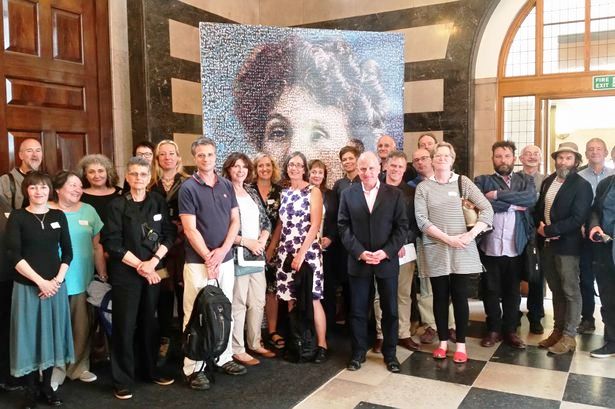
Picture; the nineteen sculptors, Helen Pankhurst and Cllr Andrew Simcock, in front of the Charlotte Newson portrait of Pankhurst in the Town Hall, 2016 courtesy of Andrew Simcock

* Women of Steel ........... the memorial and a chance encounter with Martin Jenkins, https://chorltonhistory.blogspot.co.uk/2016/07/women-of-steel-memorial-and-chance.html

**Cll Andrew Simcock, cllr.a.simcock@manchester.gov.uk

Thursday, 1 December 2022

Free ........ James Fraser ........ and the other Albert Square Four

I wonder what James Fraser and his fellow occupants of Albert Square think about being locked up behind those tall walls in front of the Town Hall for another two years?

Mr. James Frazer, 2022
He shares the space with Prince Albert, John Bright, Oliver Heywood and William Gladstone.

And not for the first time I have pondered on the absence of a woman on a pedestal in the square.

Which I know is a cheap jibe, but none the less a pertinent one.

Still there is that one of Mrs. Pankhurst looking out on St Peter’s Square, which I think is more to a scale of memorial I like.

You can go and stand beside her, or better still position yourself just behind and share her gaze across the Square.

Conversely those grand, worthy, and eminent Victorians look down at you with all that lofty self-esteem and try as I can I don’t often get a good picture of them ……. just a crick in the neck.

Now, I know of course that their imprisonment will finish in 2024 when the final touches are put to the restored Town Hall and the enlarged Albert Square.*

Our Albert, 2018

The project should have been finished a year earlier but as everyone knows a mix of Covid and the inevitable surprises that any restoration throw up have delayed things.

Sharing the square with Mrs. Pankhurst, 2022
Still it won’t be long now before the walls come down and I can wander freely across the square renewing my acquaintanceship with the said five and popping into the Town Hall to see what’s been done.

And by all accounts there has been a lot done, bringing our Town Hall into the 21st century while bringing back much that has been lost, hidden and left a tad neglected.

Location; Albert Square and St Peter’s Square.


Pictures; looking across to Mr. Frazer, 2022, Our Albert 2018, and Mrs Pankhurst, 2022 from the collection of Andrew Simpson 

 *Our Town Hall Project - the transformation,https://www.manchester.gov.uk/info/500354/our_town_hall/7297/our_town_hall_project_-_the_transformation/1


Monday, 8 April 2019

Back in Alex Park demanding …….. “the Parliamentary franchise for women.”

In the early years of the last century many of the bog public meetings held in Alexandra Park were dominated by the demand for votes for women.


Alexandra Park, 1908
The press reported on a series of such rallies from 1908 through to 1912 with speakers ranging from Mrs Emmeline Pankhurst, to Margaret Ashton and Mrs Annot Robinson.

One of the best documented was that held on October 24 1908 with a list of speakers which pretty much covered all the leading lights in the campaign both locally and nationally.*

There had been a public meeting the night before at the Free Trade Hall and on the Saturday the march set off from Albert Square and by degree made its way along Market Street, Deansgate, Peter Street, Oxford Street and then by way of Stretford Road, Upper Jackson Street to Upper Moss Lane and Alexandra Park.

Such was the distance and the expected numbers that the organisers planned for the march to start at 2.30 and enter the park by 4 o’clock.

Nothing had been left to chance. “A robbing room had been provided at 9 Albert Square where a maid will be in attendance between the hours of 1.p.m and 6.p.m., to take charge of hats &coats etc., for those who are walking in academic dress.”

 Emmeline Pankhurst and Emily Wolstenholme, date unknown

On reaching the park there was provision in the shop to store the banners but societies wishing to take their banners in to the park were at liberty to do so with that ever so modern warning the “the Joint Demonstration Committee will not be responsible for their safety in any event.”

Today over a century and a bit since the demonstrators arrived at the park it is possible to create something of what happened.

Annie Briggs, Evelyn Manestra, Lillian Forrester, 1913
The march had been orderly and in the bright sunshine attracted a large audience of spectators and the “walkers acted on the crowd of watchers like a perpetual provoker of argument.  From Albert Square to the Park there were two miles of debaters for an and against the suffrage.  As one hurried one caught queer fragments of speech – ‘....they’ll never get it; If they pay rates, I say it’s only fair ....’ ‘What’ll they do wiv  it.’***

At the entrance to the park the first half of the procession entered by the man gate beside Hulme Lodge, while the second half made its way down Alexandra Road and entered by the side gate.

Both sections then converged on the large expanse of grassland to the north of the lake where there was the choice of those 35 speakers.

These were arranged on ten different platforms each with a theme, and with the help of the organisers map we can stand in that expanse of open space and choose who to listen to.

Platform one was given over to Housing and Health, two was Prison Reform, three Temperance, four Peace, and five Education.  The remaining platforms were devoted to the Protection of Children at number six, Social Ethics at seven, the Poor Law at eight and the remaining two were Labour Legislation at nine and Co-operation at ten.

Some of the people wandered between the platforms while others loyally stayed with their first choice and largest of all was the audience for Mrs Despard speaking from the Social Ethics platform.

I have a sneaking feeling I might have tarried for a while in front of platform number ten to listen to Professor Weis speaking on Peace more because of his involvement with the Cactus House and his support for women’s suffrage.

But despite the plan to keep the platforms far enough away from each other it would have been possible to pick out snatches of other themes.

Speaking on Prison Reform Miss Robertson “showed how great an influence women had had in securing prison reforms,” while Margaret Ashton on the Poor Law platform also spoke on the contribution of women on the boards of guardians [and] claimed the vote so that women may have more influence on the making of the Poor Laws, so that those laws really may be made by the people for the people.”

The speeches lasted just an hour and at the stroke of five announced by the sound of a bugle all ten platforms presented the same resolution to the listeners “calling on the Government to incorporate in their promised Reform Bill a clause granting the Parliamentary franchise to women.”

After which for those who had not yet availed themselves of the opportunity there was tea at the Refreshment rooms, price 4d., 6d., and 9d.

Sadly I have no idea what you got for the different prices but I might just have opted for the economy offer at 4d and spent another penny on one of the scarlet and white badges promoting the cause which were on sale in the park and no doubt also picked up a leaflet or two on the “rights of the women’s just claim to the vote.”

Location; Manchester

Pictures; Alexandra Park, 1908, from the collection of Andrew Simpson, group of Suffragettes including Emmeline Pankhurst and Emily Wolstenholme, date unknown, m08239, and Annie Briggs, Evelyn Manestra, Lillian Forrester, 1913,m08224 courtesy of Manchester Libraries, Information and Archives, Manchester City Council, http://images.manchester.gov.uk/index.php?session=pass

*The 35 speakers included Miss Margaret Ashton, Mrs Despard, Mrs Swanwick, Professor Weiss, and Mr Pollit,

**Women’s Suffrage.  Procession in the Manchester Streets; Manchester Guardian, October 26, 1908

Sunday, 5 January 2025

What if Rin Tin Tin had been born a cat?

You will have to be of a certain age to remember Rin Tin Tin.

Where the North Begins, 1923
He was a star of films radio and TV and his media career stretched from 1923 into the 21st century.

But his first appearances date from the early years of cinema and later transferred to the wireless in the 1930s and on to television from 1954 to 59.

And it is those black and white televisions series that I and many of my contemporise will remember.

My Wikipedia tells me that "Rin Tin Tin (September 1918 – August 10, 1932) was a male German Shepherd born in Flirey, France, who became an international star in motion pictures. 

He was rescued from a World War I battlefield by an American soldier, Lee Duncan, who nicknamed him "Rinty". Duncan trained Rin Tin Tin and obtained silent film work for the dog. 

Rin Tin Tin was an immediate box-office success and went on to appear in 27 Hollywood films, gaining worldwide fame. Along with the earlier canine film star Strongheart, Rin Tin Tin was responsible for greatly increasing the popularity of German Shepherd dogs as family pets. 


The immense profitability of his films contributed to the success of Warner Bros. studios and helped advance the career of Darryl F. Zanuck from screenwriter to producer and studio executive".*

Of course given the longevity of his “run” there were three Rin Tin Tins and later still more stand ins who went under their own names.

Rin Tin Tin, in Frozen River, 1929

But what if Rin Tin Tin had been born a cat?  

I doubt that there would have been many adventure films set in the frozen tundra featuring a ginger cat fighting off bears, and gangs of hoodlums.

It is not so daft a question because it mirrors that equally daft excercise beloved of some historians and journalists ……. What if Hitler hadn’t been born, Maria Antonetta hadn’t liked cake, Genghis Khan had preferred fishing to a career of conquest or Emmeline Pankhurst and her daughters had taken up making balaclavas?

I grant you it is entertaining and may throw light on how events can turn out but to reuse a favourite quote of mine it is as useful as “trying to solve an algebra equation by chewing bubble gum.”**

Not that it stops historians playing the game, and even for a while was part of one GCSE history course where students were asked to speculate on different outcomes to an event.

But for me the trouble with the task is that once you change one bit of the equation all the bits are open to being changed. 

So if Hitler hadn’t been born in the Austro Hungarian Empire in the 1880s but instead in Paris what would the impact of this antisemitic, duff artist with delusions of grandeur have been on European history? 

Or if he been born but the Great War hadn’t occurred how would his destructive passage through the 20th century panned out?

Sneaking up on Mr's Pankhurst, 2022

And how would we remember Emmeline Pankhurst’s contribution if Lloyd George hadn’t calculated that giving the vote to a section of women who were in their 30s and by and large comfortably well off might enhance his election chances in the General Election of 1918. 

Four women campaigning for change, 1905
That election was called in the December just 10 months after The Representation of the People Act 1918 which gave women over the age of 30, and all men over the age of 21, a vote in Parliamentary elections was passed.

Nor should we forget those working class women who in their workplaces and in the Labour Movement advanced the arguments for the Parliamentary enfranchisement of women, but who are in the main left in the shadows. Women like Arnott Robinson from Manchester, Ada Chew, and Annie Kenney.

As Brecht wrote ….. “So many particulars. So many questions”.***

Women demanding change Manchester, 2013
It isn’t that I don’t think the ifs of history shouldn’t be played but just that it ain’t history, and while it can be fun and entertaining as  historical fiction it doesn’t deliver the goods.

So I won’t be looking to wonder how Samantha the cat would have saved the heroine of the 1923 Rin Tin Tin  movie, Where the North Begins, seeing off the dastardly corrupt official and saving the trapper Gabrielle who she loved.

Location; any time

Pictures, Poster for the American film Where the North Begins,1923, and Warner Bros-Lithograph by Otis Lithograph, Cleveland Poster, 1923, Rin Tin Tin from the film Frozen River, 1929, Sneaking up on Mrs Pankhurst, St Peter’s Square, Manchester, 2022, and demanding change, 2013, Manchester from the collection of Andrew Simpson, Suffragettes, 1905, m48441, Annie Briggs, Lillian Forrester and Evelyn Manestra. who attacked pictures in Manchester City Art Gallery in April 1913. m08225, courtesy of Manchester Libraries, Information and Archives, Manchester City Council, http://images.manchester.gov.uk/index.php?session=pass 

*Rin Tin Tin, https://en.wikipedia.org/wiki/Rin_Tin_Tin

**“Worrying about the future is as effective as trying to solve an algebra equation by chewing bubble gum. The real troubles in your life will always be things that never crossed your worried mind.” Sunscreen, Baz Luhrmann, https://www.youtube.com/watch?v=sTJ7AzBIJoI

***A Worker Reads History, Bertolt Brecht, 1947


Sunday, 7 April 2019

Down at Alex Park making the point and demanding change

Now there will be many who remember the Rock Against Racism event Alexandra Park in the July of 1978.

The assembly point was Strangeways and after a short number of speeches the march set off through the city streets to Alexandra Park where perhaps a total 40,000 people listened to the music of Steel Pulse, the Buzzcocks, China Street and the local Moss Side reggae band Exodus.

It was a memorable moment and a very successful one which reaffirmed the multi cultural nature of the city and the need to challenge racism. 

But taking the longer historical view it was only one in a line of similar popular marches and demonstrations which began with Keir Hardie and a rally eighty-five years earlier.

That march had started off at Stevenson Square and by degree had travelled via Portland Street and Oxford Street through to “Stretford Road, Great Jackson Street and the other thoroughfares that led to the park.”*

Back then the right to assemble in any of the city’s parks was still prohibited and it was not until 1897 that the Corporation relented and allowed meetings in four of the parks of which Alexandra Park was the only one in the south of the city.

The campaign to establish that freedom is not really part of our story but as Keir Hardie had made the appeal for the right of assembly and free speech in our park it is worth taking a few minutes to record that the campaign had been won by the actions of the Labour Movement and in particular the Independent Labour Party and the Manchester & Salford Trades and Labour Council.

As support grew large meetings were addressed by people like Mrs Emmeline Pankhurst, and Keir Hardie. 

In 1897 the Corporation accepted the principle which as an editorial in the Manchester Guardian observed was recognition of the “reasonable demand for facilities for public meetings in the parks.”**

What followed were a series of meetings in the park some of which were preceded by marches from the city centre and later during the Great War a number of pro peace gatherings at the park gates.

In 1908 one demonstration had called for the State to provide aid for the blind, and at a meeting in the park “several thousands of people interested in the welfare of the blind gathered [with] the desire to impress upon the public the belief that State aid, not private charity, is necessary to make the life of the blind at all worth living..”***

But the early years of meetings in the park were dominated by the demand for votes for women.

The press reported on a series of such rallies from 1908 through to 1912 with speakers ranging from Mrs Emmeline Pankhurst, to Margaret Ashton and Mrs Annot Robinson.

One of the best documented was that held on October 24 1908 with a list of speakers which pretty much covered all the leading lights in the campaign both locally and nationally. ****

There had been a public meeting the night before at the Free Trade Hall and on the Saturday the march set off from Albert Square and by degree made its way along Market Street, Deansgate, Peter Street, Oxford Street and then by way of Stretford Road, Upper Jackson Street to Upper Moss Lane and Alexandra Park.

Such was the distance and the expected numbers that the organisers planned for the march to start at 2.30 and enter the park by 4 o’clock.

Nothing had been left to chance. “A robbing room had been provided at 9 Albert Square where a maid will be in attendance between the hours of 1.p.m and 6.p.m., to take charge of hats &coats etc., for those who are walking in academic dress.”

On reaching the park there was provision in the shop to store the banners but societies wishing to take their banners in to the park were at liberty to do so with that ever so modern warning the “the Joint Demonstration Committee will not be responsible for their safety in any event.”

Today over a century and a bit since the demonstrators arrived at the park it is possible to create something of what happened.

The march had been orderly and in the bright sunshine attracted a large audience of spectators and the “walkers acted on the crowd of watchers like a perpetual provoker of argument.  From Albert Square to the Park there were two miles of debaters for an and against the suffrage.  As one hurried one caught queer fragments of speech – ‘....they’ll never get it; If they pay rates, I say it’s only fair ....’ ‘What’ll they do wiv  it.’ "*****

At the entrance to the park the first half of the procession entered by the man gate beside Hulme Lodge, while the second half made its way down Alexandra Road and entered by the side gate.

Both sections then converged on the large expanse of grassland to the north of the lake where there was the choice of those 35 speakers.

These were arranged on ten different platforms each with a theme, and with the help of the organisers map we can stand in that expanse of open space and choose who to listen to.
Platform one was given over to Housing and Health, two was Prison Reform, three Temperance, four Peace, and five Education. 

The remaining platforms were devoted to the Protection of Children at number six, Social Ethics at seven, the Poor Law at eight and the remaining two were Labour Legislation at nine and Co-operation at ten.

Location; Alexandra Park

 Pictures; Salford Labour Party banner, 1980, Badge, 1979, Aleandra Park, 1908, from the collection of Andrew Simpson, Women marching with police escort, date unknown, m08238, courtesy of Manchester Libraries, Information and Archives, Manchester City Council, http://images.manchester.gov.uk/index.php?session=pass

*Alexandra Park, Labour Demonstration, Manchester Guardian, May 8 1893

**Editorial article 2, Manchester Guardian, January 4, 189 

***State Aid for the Blind, Demonstration at Alexandra Park, Manchester Guardian, July 27, 1908

****The 35 speakers included Miss Margaret Ashton, Mrs Despard, Mrs Swanwick, Professor Weiss, and Mr Pollit,

****Women’s Suffrage.  Procession in the Manchester Streets; Manchester Guardian, October 26, 1908

Next; the debates on that day in Alexandra Park

Saturday, 27 January 2024

Mrs. Beatrice Annie Bayfield another story from Tony Goulding

This is one of those stories which arise from an unintentional discovery while researching something completely unrelated.


I have recently written of this blog of the pioneering female journalist Madeline Alberta Linford; I have now discovered another, and in a quite remarkable coincidence she also lived on Claude Road in Chorlton-cum-Hardy, Manchester. Although perhaps not as illustrious as her fellow writer, Beatrice still has an interesting and important life story to reveal.

 Mrs. Bayfield was born Beatrice Annie Hodgson in the Hulme district of Manchester during October 1867 to   William Hodgson and Mary Ann (née Dawson). Her father was a Lancaster-born butcher who had, as recorded in the 1871 census, a butcher’s shop at 117, Stretford Road, Hulme, Manchester. The 1881 census record shows the family (1) had moved to 17, Moss Lane West, Stretford, Lancashire. A decade later in the census of 1891, William, by then a widower (2) and working as an "inspector of gas”, was living at 101, Crosscliffe Street, Moss Side, Lancashire with four of his children. Interestingly, while her older sister, Jessie Till, was recorded as a schoolmistress no occupation was entered for Beatrice Annie.

23, Beechwood Avenue, December 2023
An explanation of this is revealed by the Manchester Courier and Lancashire General Advertiser of Thursday 21st September 1893 which advertised the commencement in its Weekly Supplement of an extremely interesting original story entitled “The Mystery of the Mervyns” by Miss Beatrice A. Hodgson - “a young and accomplished local writer”. 

Beatrice was also very active in the Pankhurst's Women’s Franchise League, addressing many meetings around the greater Manchester area and the West Riding of Yorkshire. She was also a member of the Women’s Liberal Association. Both her advocacy of Women’s Suffrage and her Liberal political persuasion would I hazard to suggest have hampered her having further stories published in the chauvinistic and right leaning “Manchester Courier ------”.

Beatrice married Herbert Bayfield a “buyer foreign shippers” in the Chorlton Registration District during the December quarter of 1897. Newly-married the couple settled in Chorlton-cum-Hardy where they remained throughout the next 40+ years. Their first home was number 29, Whalley Avenue (off Sandy Lane), but the 1901 census shows they had moved to another rented property, 23, Beechwood Avenue, further along Sandy Lane. 

With Herbert, however, having a successful career in shipping (3) by 1911 the couple were able to purchase this large house on the edge of the newly developed garden village of Chorltonville, “Fern Lea”, 61, Claude Road. 

61, Claude Road, December 2023
Meanwhile, Beatrice continued in her endeavours promoting the extension of the franchise and women’s causes generally. She began travelling more widely, addressing meetings in Worcester, Coventry, Leamington Spa, Warwickshire and elsewhere. In the afternoon of Wednesday 6th May 1908, she shared a platform with Margaret Ashton (soon to be elected as Manchester’s first woman councillor) at a meeting in Manchester’s Co-operative Hall chaired by Dr. Rhodes, of Didsbury, to discuss a proposal to provide Nursery Training Schools for the city. (4)  At this time Beatrice styled herself as Mrs Hodgson Bayfield.

     Beatrice remained a life-long Liberal. During the first decade of the 20th century, she had toured giving a series of lectures to local Womens Liberal Associations some of which included a lantern slide show.  

In the 1911 census in which she was recorded as a lecturer and journalist her employer is given as The National Reform Union a body with strong links to the Liberal Party. Later in 1929 she stood, unsuccessfully, as the Liberal Party’s candidate in the Manchester (Gorton) constituency in that year’s General Election. She was one of just 61 women candidates (25 Liberal, 28 Labour and 8 Conservative) to stand in this landmark election, the first in the U.K. in which both sexes had an equal franchise. Beatrice continued her writing career alongside her political one. 

Once women had gained equal franchise with men in 1928, she turned more towards how that should be used to improve women’s lives. In the late 1920s and early 1930s she contributed letters and articles to “The Vote” the Organ of the Women’s Freedom League with the: - 

She also wrote for The Manchester City News whose issue of 13th November 1937 reported that she had penned her first play and was going to produce it herself at St. Werburgh’s Hall, Chorlton-cum-Hardy. The two-act play was titled “Neptune and the Lifeboatmen” with the proceeds donated to the National Lifeboat Institution of which Beatrice was the President of its local Ladies Guild.

Mrs. Bayfield was a member of several public bodies. Amongst these were The Manchester Public Assistance Committee and the Board of the Manchester and Salford Co-operative Society. The membership of this latter body caused her some difficulty when she stood in the Liberal cause in the 1929 election for which she sought advice from the editor and owner of The Manchester Guardian, the fellow Liberal C. P. Scott.

Mrs. Beatrice Annie Hodgson Bayfield died of a heart attack at her home on 17th January 1939 aged 71. She was cremated at the Manchester Crematorium on 20th January. Her estate was valued £524-18s-10d 

Pictures: - Mrs Bayfield candidate for Manchester Gorton from The Vote, April 27th courtesy of British Newspaper Archive, and “Objects----” of THE VOTE, from The Newspaper Archive on Find My Past. Others from collection of Tony Goulding.

Notes: -

1) The Hodgson family consisted of Beatrice Annie’s parents, and four siblings an older sister, Jessie Till, 

2) Beatrice’s mother died on 5th November 1884 and was buried in Ardwick Cemetery, Manchester. In the same grave were interred three of her children who died young William Lincoln (died 5/3/1867 aged 11 months) Ernest Dawson (died 1/12/1868 aged 4 years) and Mary Adelaide (died 1/4/1878 aged 10 months).

3) Herbert’s career appears to have involved widespread frequent travel as for both the 1901 and 1911 censuses he is absent from home. He was at home for the 1921 census in which his occupation is recorded as Managing Director of a Shipping Merchants.

4)  As reported in The Manchester Courier--------, the following day. The sub-heading for their story “Utopian Scheme Discussed” was indicative of “The Courier’s” usual stance on such matters.

While writing about this lady I became aware of how few women had featured in my stories for this blog to date. I am glad that this and my recent telling of Madeline Linford’s story have at least addressed this imbalance.


Tuesday, 30 April 2024

Ninety - nine stops ….. heaps of stories …. and a favourite tram destination

The publication of our first book in the new series on The History of Great Manchester By Tram has stirred the pot with plenty of people commenting that it’s a novel way to record the past. *

Arriving at Deansgate Castlefield, 2023

After all there are ninety-nine tram stops across the network and each one will have its own history.

Shudehill after the trams have gone, 2023
And so, Peter and I have decided to explore the entire Metro system, travelling the routes looking for interesting pictures and bits of history.

Peter will paint a picture of the stop and surrounding buildings, and I will find stories about each stop, which will build into a mosaic of tales about Greater Manchester’s past.

And it occurred to me that along the way it would be fun to find out which metro stop comes out as a favourite of those who use them.

I must confess to having several. 

Cornbrook is one because it affords fine views of two canals and the changing landscape as each year more new apartment blocks replace the old industrial brown field sites.

But then Deansgate Castlefield, also has a canal, the old Knott Mill Railway Station and is just a few minutes’ walk away from the city’s own Heritage Park, along with some fine bars and historic pubs.

Sneaking up on Mr's Pankhurst in St Peter's Square, 2022

And both of these stops vie with St Peter’s Square, which has a popular open space from which to take in Central Ref, the Town Hall Extension, the Midland Hotel and Mrs Pankhurst addressing an audience.


In addition, we are close to the Cenotaph, the site of the Peterloo Massacre and that other square which boasts a collection of statues.

Peter is attractedto several but it would be presumptuous of me to reflect on just why Shudehill and New Islington are on his list.

So, that is it.

You can nominate your own selected stop, including a picture and a  few sentences which can be sent to us as a comment via, the blog, social media or an old fashioned postcard.

Busy tram day, Deansgate Castlefield, 2023

Missing the tram from Cornbrook, 2024
Location; Ninety- nine spots in Greater Manchester


Pictures; my tram stops, 2018- 2023, from the collection of Andrew Simpson

*Trafford Bar to East Didsbury, The History of Greater Manchester By Tram, The Stories At The Stops, Andrew Simpson & Peter Topping, 2024.  

The tourists at St Peter's Square, 2018

It is available from Chorlton Bookshop, and from us at www.pubbooks.co.uk, price £4.99

Tuesday, 16 March 2021

On that statue of Mr. Colston …..…and thoughts on Annie Kenney, the Sheffield Women of Steel and Totò

Now I am not precious about statues in public places.

Manchester statues, Sir Robert Peel, Piccadilly, 2018

Augustus, one that survived, Rome, 2008
Most of the ones I pass are of people I have little knowledge of, and belong to a specific time and outlook frozen in the past.

And I am reminded that the Romans were never over bothered about their own great and good, to the point where some statues of dead emperors were melted down for coinage or to start the process of commemorating another live emperor.

Which of course brings me to the current debate on those past public figures connected with our Imperialist past and in particular Britain’s involvement in the slave trade and in slavery.

I have listened carefully to the case against Edward Colston the Bristol slave trader, Robert Milligan who owned two sugar plantations and 526 slaves and Cecil Rhodes, and the arguments against them and others like them are very powerful.

After all, as one Liverpool activist reflected yesterday, we wouldn’t tolerate statues of Adolf Hitler on our streets.

Manchester statues, James Watt, Piccadilly, 2018
But I also paid attention to the comments of those who expressed concern about “air brushing out of history” the exponents of slavery, which in their words runs the danger of actually contributing to a dilution of Britain’s involvement in both the slave trade and slavery.

This was an involvement which permeated many aspects of our economy in ways we might not at first realize, and was central to the economic activity of cities like Bristol, Liverpool and London.

So it is possible to trace the links back from the plantations to the sugar, tobacco and textile industries of Britain, as well as the ship builders who built ships, the bakers and cake makers and of course those who worked in the cotton mills and refineries.

But then Manchester, which directly benefited from the production of cheap cotton grown by slave labour, came out in the late 18th century and organized a petition for the abolition of the trade, and again in the 1860s, supported the war against the Confederacy in the American Civil War.*

All of which makes history messy.  The current campaign to take down the statues of Sir Robert Peel and William Gladstone in Manchester are predicated on their family involvement in slavery and in the case of Gladstone some very iffy comments about why slavery should not be abolished.

Annie Kenney, Oldham, 2018
And yet Peel supported Catholic emancipation, abolished the Corn Laws, argued for Parliamentary reform having at first opposed it, and established the Metropolitan Police Force.

That doesn’t vindicate his earlier position on some issues, only to point out the contradictions in the outlook of those we have come to commemorate, and how some of them moved politically and came to embrace different ideas.

Personally, I think the statues of men, and they are almost always men, who supported and profited from the slave trade have had their day, but perhaps we should retain them with very prominent descriptions of what they did as a reminder of what collectively we did in the past.

Or perhaps they should re-appear in museums with those appropriate descriptions of their activities, and why some individuals or groups in certain communities felt the need to erect a statue in the first place.

Women of Streel, Sheffield, 2016
In that way the mature debate on issues like slavery, and its legacy along with the historic and present-day inequalities experienced by ethnic groups can go on with out celebrating people whose actions are a challenge to the concepts of humanity and equality.

It may be that it is time to evaluate all those public statues of the “great and good”.

This is already underway in cities and towns and perhaps even villages across the country, with calls for local debates on the merits of what stands in our squares and buildings.

Prince Albert, Albert Square, 2020
And that in turn requires some careful balancing of the “good and bad” actions of individuals.

So, Oliver Cromwell has been rightly condemned for his actions in Ireland, but celebrated as an important  factor in the defeat of King Charles and the defence of Parliament, despite his later actions as “Lord Protector”.

Emmeline Pankhurst came out in support of the continued prosecution of the Great War, when fellow women suffrage campaigners argued against it, and Nye Bevan instrumental in the formation of the NHS, opposed calls for Britain to abandon its nuclear deterrent.**

Totò, who makes me laugh, Naples, 2017
Added to which some have had more public recognition than others, so while Mrs Pankhurst is is up there in the text books, the media and of course on plinths, Annie Kenney remains a less well known figure from the campaign for female suffrafge.

Of course, there is also another thought, which is not mine, but my friend Eric who on more than one occasion has pondered on why we need statues of the good and great in public places anyway.

Perhaps such things have had their day, and on every plinth in every city there should just be a piece of artwork, commissioned by the public, displaying the work of everyone from the “renowned" to those of the local art college and community centre.

Or if we must have people, why not a celebration of the men and women history usually ignores like Annot Robinson,  the Sheffield Steel Women,***  or  the actors and comedians who have made us laugh.

Now that’s a thought.

Location; Manchester, Rome, Naples

Pictures; Manchester statues, Sir Robert Peel, James Watt and Prince Albert, 2018/2020, and Totò in Naples, 2017 from the collection of Andrew Simpson, the unveiling of  Annie Kenney's statue in Oldham, courtesy of Matthew Benham, 2018,  Women of Street statute, Sheffield, 2016 courtesy of Sheffield City Council

*Sugar Lane, an industry and a campaign, https://chorltonhistory.blogspot.com/2012/04/sugar-lane-industry-and-campaign.html

**Annot Robinson, https://chorltonhistory.blogspot.com/search/label/Manchester%20Women

***Women of Steel, https://en.wikipedia.org/wiki/Women_of_Steel


Friday, 5 November 2021

“had a very rough time of it” …… letters form Harpurhey ….1916

I am looking at a letter sent by Jack Scott to a Mr. J. J. Clayton in January 1916.


So far, a preliminary search for both has revealed nothing, despite knowing that Mr. Clayton lived in Clacton on Sea.

The letter was sent from B7 Ward, Alfred Street Hospital, Harpurhey and carries the post stamp, “Posted by a Wounded Soldier 2nd Western General Hospital, Manchester”.

Now, the hospital was one of the Manchester schools taken over by the military to care for soldiers recovering from wounds.

In all eight had been requisitioned between the outbreak of the war and 1915 as the casualties’ figures rose.*  

Alfred Street School was the forty-second Municipal school to be built for the City, and the foundation stone was laid by Mrs Pankurst in 1904.

It catered for 1,100 students and cost £18, 850. 

In her address Mrs. Pankhurst praised Manchester Education Committee for the way it was “training up it’s future citizens [and was pleased] that the education of the girls was to be equally considered with that of the boys”. **


But the requisitioning of the eight schools resulted in the loss of 3,897 school places, but would create provision for over 1,000 wounded soldiers***

Just what wounds Jack Scott was recovering from is unclear, but he does write that he “had a very rough time of it and never expected to recover [adding I am one of the lucky ones”.

And in the January of 1916, he in an upbeat mood, that he was soon to be released after a set of tests, one of which had already confirmed that “no germs had been found”.

All of which would hasten his return to the Front and here he expressed a wish not “to go to the East again [but] don’t mind France”.

Location; Manchester

Pictures; letter from Jack Scott to  Mr. J. J. Clayton in January 1916, courtesy of David Harrop

*Central High School for Boys and Girls, Whitworth Street, requestioned 1914, Alfred Street , Harpurhey,  Alma Park, Levenshulme, Grange Street, Bradford, Lilly Lane, Moston, Ducie Avenue, Moseley Road, and Heald Place, Andrew Simpson, Manchester Remembering 1914-18, 2017

**New School at Harpurhey, Manchester Guardian, Oct 17th, 1904

*** Margaret Edwin Sparshot, 2nd General General Hospital, Manchester 1914-1919


Sunday, 10 April 2022

What you do on a sunny Saturday ……… in Manchester

Yesterday was one of those early April days when the weather could go either way.

Dining in at Pizza Express, St James's Building, 2022

The forecast promised sun in the morning and showers in the afternoon which was pretty much how it turned out.

Dining out in the Square, 2022
And of course, given the time of year, the sun couldn’t quite banish the cold.

That said there were enough people in shorts and summer dresses to make you feel that this was one of the days that you just had to get out and walk the walk.

And as the restaurants were getting ready for the mid-day rush, more than a few people chose to eat out in St Peter’s Square, while others gathered for a guided tour of the city, and one women sat patiently by the statue of Mrs Pankhurst, alone with only a suitcase for company.

Meanwhile along Oxford Road the steady procession of people heading into the city centre had to pick their way past an angry man who alternated between shouting abuse and chanting the names of both our local football teams.

Bike park, 2022
But once past this "embarrassment" there were those  interesting buildings to clock, from the terracotta Tootal Broadhurst and Lee Building, the equally magnificent St James's Building to  that former public lavatory which many years ago was converted into a bar.

I have to confess it is a drinking place I have never visited, but have always been amused by the idea of ordering a glass of superior white wine in an old urinal while reflecting that it stands on Great Bridgewater Street which seems a very grand name for what is an indifferent thoroughfare favoured by those who want to leave their bikes in a safe place.

Location; Manchester

Pictures; What you do on a sunny Saturday ……… in Manchester, 2022, from the collection of Andrew Simpson