Showing posts sorted by date for query the together Trust. Sort by relevance Show all posts

Monday, 1 June 2026

Stories of the Great War from Eltham and Woolwich ............. nu 1 the milestone on Shooters Hill

An occasional series reflecting on the impact of the Great War.

Now I have to say I never really knew the story of the war memorial outside Christ Church on Shooters Hill.

I will have passed it countless times, but when you are young war memorials scarcely register especially when there is the promise of an unknown adventure in the woods behind.

But reading it now is to be reminded of the terrible loss of life during the Great War.

The inscription is simple and to the point.

What gives the memorial its added significance is that it is part of an older milestone of which I knew nothing.

And for that knowledge I have Tricia Lesley to thank who unearthed a wonderful history of Woolwich which gives a detailed description of the milestone and the war memorial.

“Originally on the other side of the road, having been placed there by the New Cross Turnpike Trust, the eighth milestone out of London on the Old Dover Road was accidentally fractured by a Borough Council steam roller during road repairs in 1903.

The Dartford plate had been totally destroyed in the collision.

It was thrown aside to be broken up but Vicar Wilson, with authority from the Borough Engineer removed the pieces to the church grounds where they were dowelled together and set up near the church door.


When the church war memorial was being discussed, Col. Bagnold, chairman of the parish war memorial committee, suggested fixing on the eastern side of the stone a plate indicating the distance to Ypres, with the addition of figures telling of the casualties incurred in defending the salient.  

The Director-general of the Ordinance Survey was called and arrived at the figure of 130 miles to the cloth Hall, correct to one-tenth of a mile.

The whole memorial was unveiled by Major General Sir Webb Gillman and dedicated by the Rector of Woolwich in October, 1922."*

All of which leaves me to say I have the book on order, and wish I had the opportunity to repeat the magic adventure in the woods.

Pictures; memorial stone, courtesy of Running Past, @running_past, Shooters Hill, courtesy of Jean Gammons, 1977 and cover of The Woolwich Story 

* The Woolwich Story, 1970, E. F. E. Jefferson.

Friday, 29 May 2026

Lost and forgotten Streets of Manchester ......... nu 69 on Major Street in 1905

Now as ever there is a story behind this picture.

14 Major Street, 1886
We are on Major Street in 1905 and the building is the Boys’ and Girls’ Refuge which was established in 1884.

It was the second shelter opened by the Manchester & Salford Boys’ & Girls’ Refuges offering food and shelter to destitute young people.

The first shelter had been opened by the charity on Quay Street and later relocated to Strangeways but the scale of the problem was such that one refuge was not enough.

That lack of provision was highlighted “in the winter months of 1871 when three boys applied at the Refuge looking for shelter. 

As the home was already full, they had to be turned away. Seeking warmth and shelter and being unable to afford three pence to stay in a lodging house for the night they had wandered up to the brickfields of Cheetham. 

A few days later a newspaper reported on the demise of a young boy who had been burned to death at one of the brick kilns in the neighbourhood. This boy was one of the three who had, had to be turned away much to the consternation of the committee. 

It was this incident that convinced the charity that they needed another building in which to receive any child in need of help, whatever the hour. 


On admittance, date unknown
The result was the Children’s Shelter at 14 Major Street. Open all day and all night children in need of shelter could be brought and receive food and a bed for the night, whilst their individual circumstances were investigated. It ensured that no child requesting aid would ever be turned away again.”*

The story comes from the excellent blog of the Together Trust which describes the work of the Manchester & Salford Boys’ & Girls’ Refuges during the 19th and 20th centuries and is a first stop forthose wanting to trace family members who were cared for by the charity.

I am always impressed by the extent of their archives and the help offered by the archivist to those who want to know more about an ancestor.

Sadly for anyone wanting to stand in front of number 14 Major Street it has long gone.

To be truthful there is very little left of Major Street which runs from Aytoun Street down to Princess Street

Major Street in 1886**
On the corner with Princess Street there is the old Mechanics Institute where the TUC met in 1868, but walk the length of the road today and it  is dominated by two car parks a whole tranche of huge office blocks dating from the end of the last century and the beginning of this one and stuck in the middle is the bus station.

As for number 14 which was on the right hand side just down from Aytoun Street that is now one of those car parks.

At which point I could I suppose regret its passing but it was just a building and the work of the charity still goes and in the fullness of time I hope the archivist will be able to shed some light on what life was like at number 14 Major Street.

Reading back stories from the blog there is much that would help anyone wanting to know about its work and much to set interested descendants on a path of discovery.

All of which leaves me to point you in the direction of that blog and in particular the rest of the story on the opening of number 14.


Pictures; 14 Major Street, 1886 and one of the young people cared for by the Trust courtesy of the Together Trust, http://togethertrustarchive.blogspot.co.uk/p/about-together-trust.html

*The Second Annual Meeting, http://togethertrustarchive.blogspot.co.uk/

**Slater's Directory of Manchester & Salford, 1886. [Part 2: Trades, Institutions, Streets], page 508, 

Tuesday, 26 May 2026

Lost and forgotten streets of Salford ....... nu 37 Francis Street and that children's charity

Now Francis Street which is off Great Ducie Street is hardly likely to lift the heart of the casual tourist or I suspect anyone.

In the back yard off Francis Street, 1873
True there is a hotel on the corner but the rest stretching out to Charter Street and down to New Bridge Street to the south  is a car park.

And the rest is rather unpromising.

Walk along Francis Street as I did a couple of years ago and you come to a dead end having passed what was more open land and a warehouse which was up for sale.

Of course things may have changed and it is on my to do list to visit with a camera which neatly takes me to this photograph.

Part of the Refuges, circa 1882
It was taken in 1873 from the back yard of a children’s charity.

The charity was the  Manchester & Salford Boys’ & Girls’ Refuges which had been established in 1870 to provide a bed and a meal for destitute boys.

The charity quickly extended its work to include girls as well as boys,and  provide more permanent homes offering training for future careers along with holiday homes.

It also campaigned against some of the worst cases of child exploitation taking negligent parents to court and arguing against the practise of employing young children to sell matches on the streets of the twin cities.

And like other children’s charities it became involved in the migration of young people to Canada.

The organisation is now called the Together Trust, and it is still engaged in the primary role of helping young people.

So given how vital their work was then as now I thought I would offer up the detailed plans of their buildings on Francis Street.

The complex was part home and part industrial school but also included a gymnasium and classrooms given over to training for those who were migrated to Canada.

From 1870 till 1939 many organizations engaged in caring for young people migrated some to Canada and later Australia as well as other parts of the old British Empire.

More of the Refuges, circa 1882
The practice has come in for some criticism and also had its critics at the time and the Manchester & Salford charity stopped earlier than most.

That said there were success stories and these are contained in letters and reports held in the Trust’s archives some of which are regularly featured in their blog.*

Added to which the organization is engaged in some exciting work with local schools aimed at extending our understanding of their work both in the past and today.

This also includes help offered to those who may have had relatives in the care of the Trust and want to trace their story.

All of which brings me back to Francis Street where their main building was situated.

Location; Salford

Picture; the yard of the Manchester & Salford Refuges, 1873, courtesy of the Together Trust,  http://togethertrustarchive.blogspot.co.uk/p/about-together-trust.html and details of the buildings from Goads Fire Insurance maps, 1882-1901, courtesy of Digital Archives Association, http://digitalarchives.co.uk/

*Getting down and dusty, the Together Trust, http://togethertrustarchive.blogspot.co.uk/

Saturday, 4 April 2026

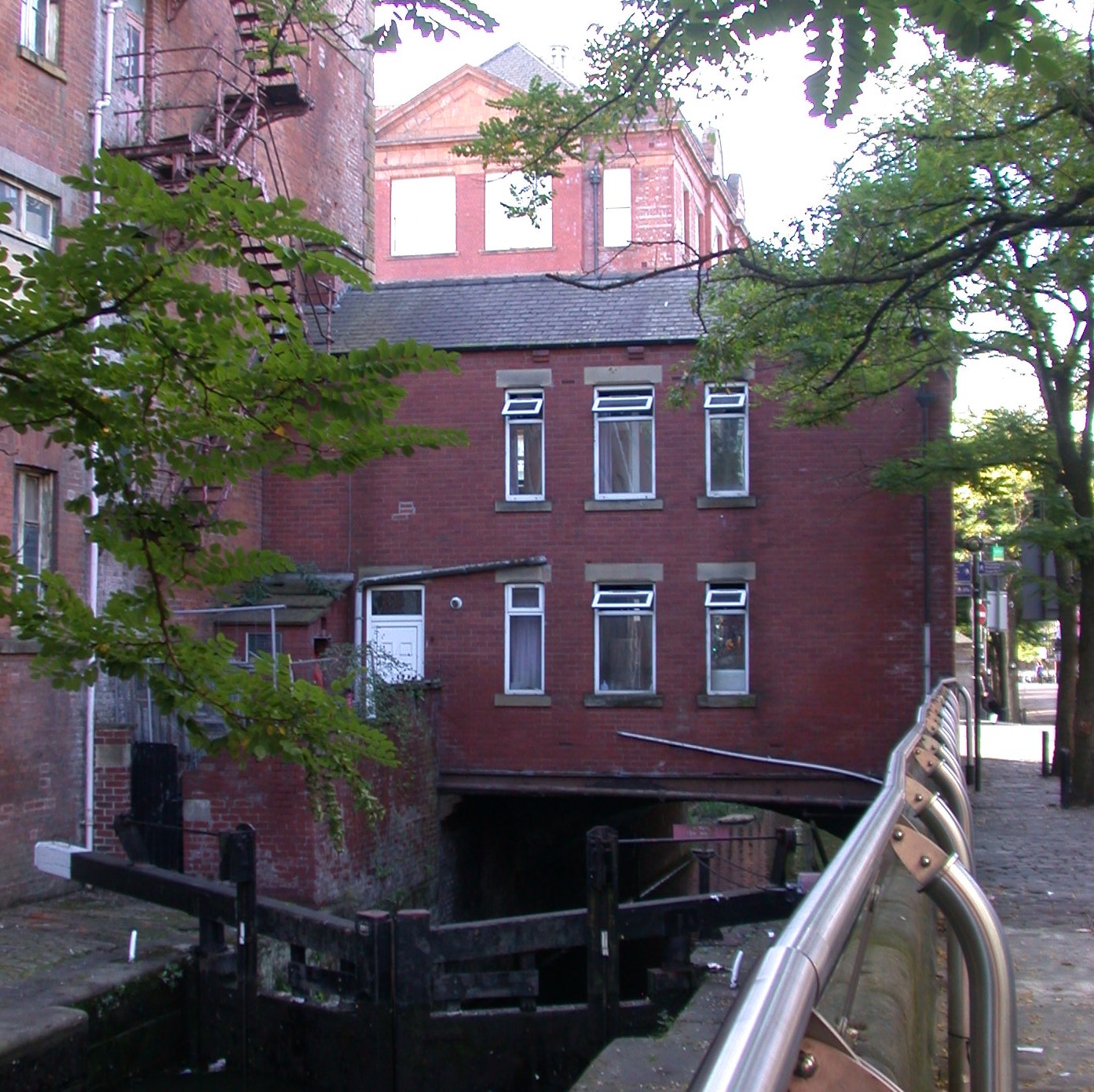
That house over the canal ……….. 41 Chorlton Street

Now, I am reunited with a building that has fascinated me for over 52 years.

The house in 2016

It is the one that stands on Chorlton Street and straddles the Rochdale Canal.

I always assumed it had once been the home of the lockkeeper, and alternated between thoughts of how cool it would be to live there, with the obvious ones of living directly over a stretch of water on a very busy city street.

Back in the early 1970s it seemed to be unoccupied and as the years went by I had less reason to go down that part of Chorlton Street and just forgot about the place.*

But now I see it appears to be occupied again, and after someone recently asked me about it, the fascination has returned, and with it a mystery.

It does not appear on street directories for the 19th or early 20th centuries, and in 1851 is clearly shown as two buildings, one of which is a warehouse and a place of business and the other residential.

The warehouse and house, 1851

That said a Mr. John Holroyd is listed in the Rate Books for 1863 occupying 41 and 43 Chorlton Street in a property owned by the Rochdale Canal Company.  

All of which was confirmed by a street directory for the same year which describes him as “Lock keeper”.

And as every researcher knows once you have a reference in the historical records, it all comes together.

So, the same Rate Books record the property belonging to the Rochdale Canal from 1847 through into the late 19th century but the census returns stubbornly refuse to record who lived in 41 and 43.

Just occasionally there is a break through and from 1871 through to 1895 and I know that Barton Manchester and his family were there.  

A decade earlier he had been working the canal boats as an assistant, and on the night of the census was with William Wignall and Mr. Wignall’s family on a 50 ton “flat” boat moored on the Dukes Canal.

The house, 1955

He married Elizabeth Baron in 1867 and four years later they were settled in the house over the water.  He described himself as as a waterman.  Ten years later is listed as a “Lock keeper” and he and Elizabeth had a young family with the eldest of the four children aged 7 down and the youngest just 1.

And there the family stay, until his death in 1895.  Elizabeth had died in 1890 and both are buried in Philips Park.** He left £502 and a family that were launched on careers which took them away from the waterways.  The eldest was a clerk to a solicitor, and by 1911 was a “Railway Traffic Regulator", while the others were in various skilled occupations.

In time I will search out their lives, but for now I wll close with what little more I know of Mr. Manchester.  I doubt we will find a reference to his birth or any earlier historical records before 1861.

I know that when he married Elizabeth he was illiterate, giving his mark beside the signature of his wife.  

But there is a clue to that earlier life, and that comes from his first name, which is replicated by another “waterman” who in 1861 was plying another canal, working a boat with his father and family.  He too was called Barton, and I wonder if there is any connection with the aqueduct that carried the Duke’s Canal over the river Irwell at Barton -Upon-Irwell.

The house and canal, 2016

Fanciful perhaps, but possible.

Leaving me just book time to explore the lives of Thomas and Mary Holroyd, Willam Diamond, and Alexander Heap all of whom at some point resided in that house over the canal on Chorlton Street.

To which I can now add this from Hayley Flynn, "I thought you might like some info I found on the house on Chorlton Street over the canal. 

I'm writing a little bit about it at the moment and noticed you'd also been curious over the years - love the occupants you tracked down - Barton Manchester! 

This is the recent update I've written in my article: 

It seems that the Canals and Rivers Trust were the owners of the house until it was sold to an individual, Michael Maybin, in the early 2000s. Maybin continued to live in his flat in Hulme, presumably renting the property out. He died in 2019, evidenced by a police appeal to locate his next of kin; since then the house has remained occupied.

When you look on google maps it's after 2019 that the front of the house has physical changes too, which I guess would signal new occupants but I've not found any new documents relating to the owners so maybe it's still part of his estate".

Location, Manchester

Pictures; 41 Chorlton Street, 2016, from the collection of Andrew Simpson,  British Waterways narrow boats, proceeding to Hassall's Warehouse, Ducie Street, leaving Chorlton Street Lock, 1955, m54248, courtesy of Manchester Libraries, Information and Archives, Manchester City Council, http://images.manchester.gov.uk/index.php?session=pass and 41 &43 Chorlton Street, 1851 from Adshead’s map of Manchester 1851 courtesy of Digital Archives Association, http://digitalarchives.co.uk/


*Little David Street, https://chorltonhistory.blogspot.com/2016/10/lost-and-forgotten-streets-of_14.html

**Philips Park Cemetery, Plot FNon Conformist 426 


Thursday, 2 April 2026

In the midst of plenty ........ two children sleeping rough “one under a Salford Railway arch and the other below an old staircase in a Deansgate entry”

It still beggars belief that in a city some called the “second city of the Empire,” which proudly displayed its trade links to the world in its brand new Town Hall and would ambitiously build its own route to the sea children slept rough on the streets,  making a pitiful living selling matches, and shoe laces later in to the night.

First Shelter, Quay Street, 1870
But of course it happened and in response to the stories of children sleeping under a Salford Railway arch and another below an old staircase in a Deansgate entry, the Night Refuge for Homeless Boys opened its doors.

Its full title was “The Boys’ Refuge and Industrial Brigade” and on January 4 1870 if offered a handful of boys found on the streets of the twin cities, a bed and breakfast, before turning them out on to the streets again.

Within a decade the organisers had expanded into a  ranges of activities designed to help young people and a full half century later could point to a whole series of achievements, from rescuing children  off the streets to residential and vocational homes,  seaside holidays, and involvement both in the courts and in legislation to protect young people.

Along the way it also migrated some young people to Canada.

But it began with that one building.

It was on Quay Street off Deansgate and a quarter of century later Mr Shaw one of the prime movers in the shelter reflected on those early days.

“In a dark little room on the ground floor of the house was a living room where meals were served.  A front collar was a living-room by day and a school and band room at night.  The back cellar, described as being dark and damp as a cavern, was made to serve the purpose of a bathroom and lavatory .  

The sleeping accommodation was almost amusingly primitive. 


It took the shape of hammocks hung out round the upper room from strong hooks in the wall, each hammock having two iron legs which fitted into sockets in the floor.    [and] when the boys jumped into bed ‘with a burst’ away went the held fasts and sockets and even a portion of the wall too, and that a dusty heap in the middle of the floor was generally the rest.

Mr Shaw and a group of Boys, 1883
In the year 1870 there were some forty inmates of the Refuge.  Today nearly 500 boys and girls are being cared for and trained within the institution to a life of usefulness, while according to the last report issued in 1894 , not less than 2,595 children come more or less under the influence of the Society and its branches in the course of 12 months.”*

Those involved were motivated by strong religious convictions, but also by that simple and obvious response that not only was the plight of destitute and neglected children and an abomination but “while we leave the little children practically uncared for we shall never want for a fully supply of candidates for our reformatories, workhouses and goals.”

The building had a short life and the organisation relocated to Strangeways but the scale of the problem was such that one refuge was not enough.

That lack of provision was highlighted “in the winter months of 1871 when three boys applied at the Refuge looking for shelter.

Major Street Shelter, 1905
As the home was already full, they had to be turned away. Seeking warmth and shelter and being unable to afford three pence to stay in a lodging house for the night they had wandered up to the brickfields of Cheetham.

A few days later a newspaper reported on the demise of a young boy who had been burned to death at one of the brick kilns in the neighbourhood. This boy was one of the three who had, had to be turned away much to the consternation of the committee.

It was this incident that convinced the charity that they needed another building in which to receive any child in need of help, whatever the hour and this led to the opening of another on Major Street.

"Open all day and all night children in need of shelter could be brought and receive food and a bed for the night, whilst their individual circumstances were investigated. It ensured that no child requesting aid would ever be turned away again.”


Location; Manchester & Salford

Pictures; the first refuge opened in 1870 and a group of young boys from the charity in 1883, and the Major Street Shelter 1905 courtesy of the Together Trust, https://www.togethertrust.org.uk/

* The Boys’ and Girls’ Refuges A quarter of a century’s progress, Manchester Guardian, January 4 1895

**A new book on the Together Trust, https://chorltonhistory.blogspot.co.uk/search/label/A%20new%20book%20on%20the%20Together%20Trust

Wednesday, 26 November 2025

Finding that shop in Bury .... and a bit on youth culture ..... fashion .... and big clothes

This is the story of Chatleys of Bury with as usual a sideways reflection on all things history.

The shop, 2025
So, first Chatleys, Big Menswear Superstore.

And the giveaway is the reference to big which aptly fits me. 

After a bout of series ill health, and a tendency to overeat I have become someone who prowls the internet for clothes to suit a man of very generous proportions but who still wants clothes of style and quality.

I had all but given up and then we found Chatleys.

The staff at Chatleys
The shop is light, large and welcoming, the staff know their stock and assessed my girth, against what I wanted, and the upshot was we came away with two pairs of trousers, two shirts, a tie, a jumper along with socks and underwear.

And most importantly they made me feel at ease, reminding me of that old fashioned approach to retail where the customer has confidence in the staff, and trusts their knowledge and judgement.

The business was established in 1974, and I have a vague memory of visiting their shop in Strangeways, perhaps a decade ago.

All of which set me thinking of when did fashion get limited to clothes of a certain size?

It’s coupled with those other questions to do with why advertising executives, clothe designers and film makers advance youth, and slimness in everything they do.

Dressing like dad, aged 10, 1885
Now, I know that the preoccupation with youth, and the perfect body isn’t new, and are topics which have been discussed for years.

I also know that there has since the 1950s been a lot of money to be made from young people. 

They after all are setting out exploring who they are, and many have an earning capacity as yet freed up from paying a mortgage, buying nappies, finding affordable childcare, and juggling the cost of living, with setting money aside for the future.

Equally the image of an overweight crinkly 70-year-old may not be the perfect match for a romantic film or the face to sell a range of cosmetics, or even a new electric car.

Sadly, we are often relegated in advertising to funeral plans, moving stair chairs and footbaths.

The historian in me is reminded that down the centuries obesity has been limited to a very few, compared with today, and youth culture is but a new preoccupation.

Dressing like mum, aged 13, 1885
Go back to 1900 and while there were adverts aimed at looking young there was less of a market for specifically teenage fashions or clothes that marked you off as different from your mum and dad.  Most of us back then just aspired to wear clothes that looked pretty similar.

And while all through history there have been youth rebellions from Ancient Rome, through to the Middle Ages and onto the Scuttler’s in late 19th century Manchester who wore distinctive clothes and hairstyles, I doubt they were seen as the norm by everyone else.

I could be wrong, and I await Eric of Whalley Range to correct me, but in the meantime I shall close with knowing that my oversized body has somewhere to shop in Bury.

To which I can add that the shop is not far from the tram stop, affording me that other bonus that visits to Chatleys will encompas an adventure by Timmy Tram from Chorlton via Victoria to Bury.

But on the off chance that I choose to stay at home the store has an online alternative. 

Location; Bury

Pictures; A day at Chatleys, 2025, from the collection of Andrew Simpson, and dressing like mum and dad, 1885, courtesy of the Together Trust

Chatleys, Big Menswear Superstore,1A Market Parade, Bury, BL9 0QE, 0161 764 3331- 0161 762 1113, sales@chatleys.co.uk and https://www.chatleys.co.uk/

Saturday, 11 October 2025

Looking deeper into the people who supported a children’s charity ........ Miss Malvey and social reform

Now as I dig deeper into the story of the Manchester children’s charity I have become fascinated by the people who toiled tirelessly to improve the lives of the young people they encountered.*

And in particular have been struck by what motivated them to give up their time and money which in many cases stretched over decades.

The conventional assumption is that for most it was either down to strong religious beliefs or that vague term “humanitarian concerns”.

Neither on their own is very satisfactory as an explanation, and obscures the subtle differences in why people supported the charity.

In most cases it started with that most basic concern that in what many called the second city of the Empire where conspicuous wealth and great commercial success were everywhere to be seen, just yards away children were hawking goods for a pittance and some were sleeping rough while others were in families which had toppled over into real and abject poverty.

The response as ever was mixed but for those who didn’t cross the road the challenge was not just the short term one of “rescue” but the longer and more positive one of offering care and vocational training to enable young people to lift themselves towards a better life.

Of course even the most respectable and hard working were at the mercy of unforeseen events ranging from a trade depression and unemployment to sickness or the death of the breadwinner which could pitch a family into the workhouse.

For some like Olive Christian Malvey that understanding of the reality of working class life appears to be what brought her to the Manchester and Salford Boys’ and Girls’ Refuges.

Until recently she was just a name on one of the charity’s annual reports and a face on a page from one of their publications. **

But I was intrigued by the reference to her as the author of Soul Market “who, in such an intensely practical way has done much for the homeless girl and woman in London.  

The first shelter she provided for this class of needy ones was opened by Her Royal Highness the Duchess of Albany.  Those who have read that striking book ‘The Soul Market’ will know that [she] speaks on the subject from personal experience.”***

The book was one of a number Miss Malvey wrote in the early years of the 20th century and arose from a series of articles she wrote for Pearson’s Magazine about the lives of working class women in one of the poorer parts of London.

Soul Market was published in 1907 and was followed by Baby Toilers, and White Slavery.

All in their way deal with the issues of poverty, and appalling work practices.

Soul Market consisted of twenty chapters ranging from ‘Up and down the Social Ladder – From a Society Crush to the Spike,’ ‘Gliding the Gutter’, ‘In the Sweating Dens of West and East London’, and ‘Women who Work and Babes who Weep.’

There are a number of useful biographies about Miss Malvey of which Olive Christian Malvey: journalist, ‘lecturer, reciter, and social worker’, by Sarah Jackson is particularly informative.****

And for anyone interested in the migration of young people by the charities Miss Malvey struck an interesting position.

During the annual meeting of the Manchester and Salford Boy’s and Girl’s Refuges, she said “She was sorry that so many had to be sent away to Canada.  It would be better if they could have homes and parents in England, but since they had not it was a good thing that that could be sent to such a beautiful wide land as Canada.”****

Some might jib at what still seems an abrogation on the part of a British social reformer to criticise the policy but it fits well with that general view held by some that the migration of young people to Canada was wrong, and when I have delved deeper into her writings we may find confirmation that that was so.

In the meantime, Soul Market, Baby Toilers, and White Slavery are all available as down loads.

Location; Manchester & London


Pictures; Miss Malvey and other scenes from her book Soul Market, 1907 and Miss Malvey in 1912, from the Children’s Haven page 14

*A new book on the Together Trust, https://chorltonhistory.blogspot.co.uk/search/label/A%20new%20book%20on%20the%20Together%20Trust

**The Children’s Haven, April 1912

*** The Children’s Haven, April 1912, page 13

****Olive Christian Malvey: journalist, ‘lecturer, reciter, and social worker’, by Sarah Jackson in particularly informative, http://eastendwomensmuseum.org/olive-christian-malvery-journalist/

**** Saving the Children, Work of the Boys ‘and Girls’ Refuges, Manchester Guardian, April 12 1912

Tuesday, 10 June 2025

What to do with the children ..... British Home Children .... the talk today

  Between 1870 and 1930 100, 000 children were sent to Canada, and placed on farms and in domestic service ….. the youngest were aged just 4 years.

Young people admitted to the Manchester & Salford Boys' & Girls Refuge, undated

Opinions are still bitterly divided as to why they were sent, the morality of the project and the impact on the young people who were migrated.

Emma before admission, undated
In the early years some of the children were those who were found homeless, living on the streets and potentially vulnerable to predators and open to petty criminality.

Others were from families who had fallen into poverty through illness, unemployment or the death of one of the parents and sought help from charities who promised that migration offered a better life and a new start for one or more of the children.

And it was children’s charities, along with the Poor Law Unions who offered the opportunity to participate in the scheme.

Critics pointed out that many were used as cheap labour, were open to all sorts of abuse and in the case of those sent to farms were cast adrift at 16 to fend for themselves.

In the absence of strict supervision some farmers failed to keep the promises they made to adequately feed and clothe the children or ensure they had access to a school.

To these critics the programme was the exploitation of young people who were powerless to protect themselves, an opinion summed up by William Edward Skivington one of the three Socialist Poor Law Guardians on the Chorlton Union in 1905 who wrote, “they were robbed of their childhood and of the opportunity of a sound education .... the emigration of young children for working purposes savoured of a traffic in child labour carried on between agencies in this country and agencies in Canada and children would not be allowed to go from the care of the Guardians to anything like such conditions in this country.”

Leaving for Canada on the steps of Manchester Town Hall, 1897
It was a policy which those engaged in the practice recognised was a cheaper solution to keeping the children in care.

But many of the advocates of the policy genuinely believed they were engaged in giving hope and lifting children from appalling conditions. 

Leonard Shaw of the Manchester and Salford Boys’ and Girls’ Refuges argued that “some [children] would be dragged back to vagrant, drunken and vicious associations …. their only salvation for them was to be placed far away from the baneful environment of their early life … and supplied a colony with one of the other needs – healthy, honest Labour”.

Mr. Shaw was speaking in 1910 of the situation that he had encountered forty years earlier, when destitute children were to be found in many of our cities and towns, and while that scandal had pretty much vanished there were still families who were on the margin of poverty and some who had toppled over.

Application for a BHS boy, 1914
Today the arguments about the policy remain and the battle lines no less tightly drawn. Many who discover they have a family member who was transported are bitter and condemn the practice.

Other’s like me whose great uncle went out in 1914 aged 16 are more nuanced, and as the study of British Home Children finds its way on to University courses, and attracts more writers, the story enters the grey zone.

That said it is a subject which is still not well known.  More so in Canada than in Britain but still a story which deserves better coverage.

So, while there are a growing number of books and sites devoted to British Home Children across Canada, here in Britain the list is small which led me and Tricia Leslie to set up a Facebook site, where stories can be shared and information exchanged all of which will raise awareness of the subject. *


And added to the site I am back again talking to groups about the story which is the lead into my next presentation this coming Tuesday at 1.30 on June 10th to Chorlton Good Neighbours at St Ninians Church on Wilbraham Road.**

And beyond the talk  .... there is Home Children Canada which is "a proactive charity established in 2012, has been dedicated to elevating the profile of the Home Children and preserving their memory. 

Emma after admission, undated
Through diligent efforts, the organization has worked tirelessly to shed light on the historical experiences of the Home Children and to honor their legacy. With a strong commitment to raising awareness and promoting understanding, Home Children Canada strives to ensure that the stories of these children are recognized and respected. 

By honoring their memory, the charity seeks to ensure that the Home Children's contributions and struggles are never forgotten and that their rightful place in history is acknowledged with dignity and compassion".***

Location, June 10th, 1.30, St Ninians Church on Wilbraham Road 

Pictures; Young people admitted to the Manchester & Salford Boys' & Girls' Refuges, undated, Emma before and after admission to the same Charity, undated, party of boys on the steps of Manchester Town Hall about to leave for Canada, 1897, courtesy of the Together Trust, Application for a BHS boy, 1914, British Home Children, poster from the collection of Andrew Simpson

* British Home Children ....... the story from Britain, https://www.facebook.com/groups/1624406061006317

** Chorlton Good Neighbours, https://chorltongoodneighbours.org/ Wilbraham St Ninians Church, Egerton Road South, Manchester M21 0XJ, 0161 881 2925

***Home Children Canada, https://www.britishhomechildren.com/

Wednesday, 4 June 2025

What to do with the children? …… British Home Children …. a story only partly told … the talk June 10th

 Between 1870 and 1930 100, 000 children were sent to Canada, and placed on farms and in domestic service ….. the youngest were aged just 4 years.

Young people admitted to the Manchester & Salford Boys' & Girls Refuge, undated

Opinions are still bitterly divided as to why they were sent, the morality of the project and the impact on the young people who were migrated.

Emma before admission, undated
In the early years some of the children were those who were found homeless, living on the streets and potentially vulnerable to predators and open to petty criminality.

Others were from families who had fallen into poverty through illness, unemployment or the death of one of the parents and sought help from charities who promised that migration offered a better life and a new start for one or more of the children.

And it was children’s charities, along with the Poor Law Unions who offered the opportunity to participate in the scheme.

Critics pointed out that many were used as cheap labour, were open to all sorts of abuse and in the case of those sent to farms were cast adrift at 16 to fend for themselves.

In the absence of strict supervision some farmers failed to keep the promises they made to adequately feed and clothe the children or ensure they had access to a school.

To these critics the programme was the exploitation of young people who were powerless to protect themselves, an opinion summed up by William Edward Skivington one of the three Socialist Poor Law Guardians on the Chorlton Union in 1905 who wrote, “they were robbed of their childhood and of the opportunity of a sound education .... the emigration of young children for working purposes savoured of a traffic in child labour carried on between agencies in this country and agencies in Canada and children would not be allowed to go from the care of the Guardians to anything like such conditions in this country.”

Leaving for Canada on the steps of Manchester Town Hall, 1897
It was a policy which those engaged in the practice recognised was a cheaper solution to keeping the children in care.

But many of the advocates of the policy genuinely believed they were engaged in giving hope and lifting children from appalling conditions. 

Leonard Shaw of the Manchester and Salford Boys’ and Girls’ Refuges argued that “some [children] would be dragged back to vagrant, drunken and vicious associations …. their only salvation for them was to be placed far away from the baneful environment of their early life … and supplied a colony with one of the other needs – healthy, honest Labour”.

Mr. Shaw was speaking in 1910 of the situation that he had encountered forty years earlier, when destitute children were to be found in many of our cities and towns, and while that scandal had pretty much vanished there were still families who were on the margin of poverty and some who had toppled over.

Application for a BHS boy, 1914
Today the arguments about the policy remain and the battle lines no less tightly drawn. Many who discover they have a family member who was transported are bitter and condemn the practice.

Other’s like me whose great uncle went out in 1914 aged 16 are more nuanced, and as the study of British Home Children finds its way on to University courses, and attracts more writers, the story enters the grey zone.

That said it is a subject which is still not well known.  More so in Canada than in Britain but still a story which deserves better coverage.

So, while there are a growing number of books and sites devoted to British Home Children across Canada, here in Britain the list is small which led me and Tricia Leslie to set up a Facebook site, where stories can be shared and information exchanged all of which will raise awareness of the subject. *


And added to the site I am back again talking to groups about the story which is the lead into my next presentation this coming Tuesday at 1.30 on June 10th to Chorlton Good Neighbours at St Ninians Church on Wilbraham Road.**

And beyond the talk  .... there is Home Children Canada which is "a proactive charity established in 2012, has been dedicated to elevating the profile of the Home Children and preserving their memory. 

Emma after admission, undated
Through diligent efforts, the organization has worked tirelessly to shed light on the historical experiences of the Home Children and to honor their legacy. With a strong commitment to raising awareness and promoting understanding, Home Children Canada strives to ensure that the stories of these children are recognized and respected. 

By honoring their memory, the charity seeks to ensure that the Home Children's contributions and struggles are never forgotten and that their rightful place in history is acknowledged with dignity and compassion".***

Location, June 10th, 1.30, St Ninians Church on Wilbraham Road 

Pictures; Young people admitted to the Manchester & Salford Boys' & Girls' Refuges, undated, Emma before and after admission to the same Charity, undated, party of boys on the steps of Manchester Town Hall about to leave for Canada, 1897, courtesy of the Together Trust, Application for a BHS boy, 1914, British Home Children, poster from the collection of Andrew Simpson

* British Home Children ....... the story from Britain, https://www.facebook.com/groups/1624406061006317

** Chorlton Good Neighbours, https://chorltongoodneighbours.org/ Wilbraham St Ninians Church, Egerton Road South, Manchester M21 0XJ, 0161 881 2925

***Home Children Canada, https://www.britishhomechildren.com/

Saturday, 24 May 2025

1883 .......... one year in the work of the Manchester and Salford Children’s charity

Now 1883 was a busy year for our own children’s charity which had been established just thirteen years earlier as a rescue mission to feed and give a bed for the night to destitute boys on the streets of Manchester and Salford.

Outside the Refuge offices, circa 1900
Just over a decade and a bit later it had expanded into a whole range of support activities including homes for both boys and girls, vocational training, seaside holidays, along with campaigning for legislation to protect vulnerable children and intervening in the courts against neglectful and abusive parents.

And the key  to knowing about  the work of the charity, is to start with the annual reports, and at random I have chosen 1883.

It was a busy year but looking at the spread of reports from 1871 through to 1919 it was typical.

And with that in mind I thought it would be useful to focus on that report.*

The first port of call was the newspapers and in particular the Manchester Guardian, and starting next week I shall be delving into the archives.  Like all good research every item begs a whole set of questions which will take me off in all sorts of directions.

But for now it is that year of 1883 and that report.

The report began with the appalling news of the “virtual collapse of old central premises in Strangeways just when the new additional building was almost finished.”

But that hadn’t stopped the completion of extension scheme for Orphan  Girls’ Home Branch or the start of “The Seaside Home for weak, pale faced city children” which had been established at Lytham.

It is easy perhaps to react against the Victorian directness of language but  this and the other summer camps organized by the charity provided children with a holiday by the sea which for many would have been their first.  And some of the 225 children “under our care and training at the Refuge and branch homes” may well have been on one of those trips to the seaside.

The report detailed the gender split, and the number who had had one or both parents still living, and concluded by describing where 118 went onto who didn’t stay in the Refuge.

And that is all for now.

Location Manchester

Picture; courtesy of the Together Trust

* Manchester & Salford Boys’ and Girls’ Refuges, Manchester Guardian, March 12 1884

**The Together Trust, https://www.togethertrust.org.uk/who-we-are


Sunday, 26 January 2025

Remembering ……. Holocaust Memorial Day

 There will be many different ways people will mark Holocaust Memorial Day.

The 8th night of Hanukkah, Kiel, December 12th, 1931

One way will be to light a candle and put it in your window tomorrow evening  you can participate in the UK Ceremony for Holocaust Memorial Day 2024 which will be streamed online  by registering with the Holocaust Memorial Trust online.*

“The Trust encourages remembrance in a world scarred by genocide. We promote and support Holocaust Memorial Day (HMD) – the international day on January 27th  to remember the six million Jews murdered during the Holocaust, alongside the millions of other people killed under Nazi persecution of other groups and in genocides that followed in Cambodia, Rwanda, Bosnia and Darfur.

January 27th marks the anniversary of the liberation of Auschwitz-Birkenau, the largest Nazi death camp.

The Holocaust threatened the fabric of civilisation, and genocide must still be resisted every day. Our world often feels fragile and vulnerable and we cannot be complacent. Even in the UK, prejudice and the language of hatred must be challenged by us all”.**

Chaya Hochrad
And for those who want to explore the human tragedy you can join The I Remember Wall which, “when you join, your name will be randomly matched to a Holocaust victim from Yad Vashem's Central Database of Shoah Victims' Names. 

This unique project allows you to remember a specific victim, learn their name, read their story, and see their picture. You can then share the story of a Holocaust victim with others, as we join together to spread Holocaust awareness on International Holocaust Remembrance Day (January27th). 

Together, we can ensure that the memory of the 6 million Jews murdered during the Holocaust is never forgotten".***

You can join https://hmd.org.uk/=


Pictures, The 8th night of Hanukkah, Kiel,  William Miconnet who wrote, “Rabbi Akiva Boruch Posner lit this menorah on the 8th night of Hanukkah in full view of the Nazi headquarters in Kiel, Germany, 12 December 1931” and Chaya Hochrad  Elaine F. Miller, who added “The young woman on the left was my father’s paternal cousin, Chaya Hochrad.  The National Library of Israel****

* Holocaust Memorial Day Trust, https://hmd.org.uk/

** Holocaust Memorial Day Trust, https://hmd.org.uk/

***I Remember Wall, https://iremember.yadvashem.org/?p=1068&&utm_source=email&utm_medium=newsletter-english&utm_campaign=iremember-2022&utm_content=email-01

****The National Library of Israel, https://web.nli.org.il/sites/nli/english/Pages/default.aspx


Saturday, 16 November 2024

Revealing more of the lives of the poor in Manchester

The project is simple enough and involves a study of the parents whose children were admitted to a children’s charity in the 1870’s and 80’s.

Angel Street, 1900
The charity was the Manchester and Salford Boys’ and Girls’ Refuges which was established in 1870, and is the subject of a book I wrote with their archivist to commemorate the 150th anniversary of the organisation in 2020*.

The admission books show that in that first year the reasons for accepting young people were mixed.  In some cases both parents were dead and in other’s the surviving parent was finding it hard to manage while in a few cases there was evidence of neglect, cruelty and abuse.

Now each admission and the reasons behind it are unique, and to merely lump all the reasons under the general heading of poverty is unhelpful.

Of course long hours of work, seasonal unemployment, coupled with low wages poor housing conditions and an absence of a welfare state were always going to be the main reasons why many families fell apart.

But that is too state the obvious, what I wanted to do was to examine some of those families in more detail and in the process try to bring their lives out of the shadows and better understand the achievements of the charity.

I am well aware the evidence will be fragmentary and in many cases prove a dead end, but like all such projects you never quite know what will turn up.

44 Angel Street, 1897
From the outset even from a distance of almost 150 years there is a need to respect confidentiality which for the time being means that surnames have been omitted.

The starting point was the simple observation that the parents of children admitted to the Refuge in the 1870s and 80’s would have been born in the 1840’s and 50’s when Manchester was still going through the transformation from a pleasant enough small town to what the historian, Asa Briggs described as “the shock city of the Industrial Revolution.”*

Many of these parents may well have grown against a backdrop of poverty, where long term illness, unemployment or the death of a father or mother might plunge them into the Workhouse.

The study is still in its infancy but the research is proving very interesting.  Boy A had been admitted in the March of 1870 and the notes speak of a father who was a drunkard who “ill uses the boy.”

His mother was dead and while I now know her name I have yet to find out when she died.  The father had been born in Ireland and during the 1850s the family had lived in Liverpool, where all three children were born.

Boy A left the Refuge two years later.

Boy B had been born in Spalding, Linconlshire and both his parents were dead.  He too was admitted in 1870 and left the same year.

Angel Street, 1898
Nine years earlier he had been living with his older sister who he seems to have returned to when he left the Refuge.

The records report that he was “making a living from the streets” possibly selling newspapers or matchsticks.

We can track him into the early 20th century living very close to his old home and working as a glass maker and labourer.

In both cases the boy’s parents had migrated to Manchester and one was working as a shoe maker.

I don’t pretend that two cases on their own amount to a picture but they are a start, and the search for parents does seem to be proving successful.

So as they say watch this space.

Location; Manchester

Pictures; Angel Street, 1900, m85543, 44 Angel Street, 1897, m08360,and  44 Angel Street 1898, m00195, S.L.Coulthurst, courtesy of Manchester Libraries, Information and Archives, Manchester City Council, http://images.manchester.gov.uk/index.php?session=pass

*A new book on the Together Trust, https://chorltonhistory.blogspot.co.uk/search/label/A%20new%20book%20on%20the%20Together%20Trust

**Asa Briggs, Victorian Cities, 1963

Friday, 15 November 2024

The stories behind the picture ................... Manchester in the 1870s

Now you know just by looking at the photograph that there is a story here.

And the more you look it is apparent that there will be as many stories as there are people staring back at us.

It starts with those young boys, all in uniform and many holding musical instruments and goes on to the adults.

Their tall hats and beards suggest a date sometime in the 1870s.

Of course we do have to be careful because often the appearance of a person, from their clothes to the style of their hair may reflect the fashions of an early age from which the individual has not moved on from.

Finally there is the banner which is difficult toread but there is enough to suggest a message carrying a high moral tone.

So it might be logical to suppose that this is the youth wing of a religious group and that might takes us to the Salvation Army or the Boys Brigade or any one of a number of others.

The Salvation Army is a candidate in that it was formed in 1865 and just possibly so is the Boy’s Brigade which was established in 1883.

But neither fit the picture.  In the case of the Boys Brigade while the organisation was formed in 1883 in Glasgow it would be a full decade before it took root across the country and I know this is not a group of  Salvation Army, because we are in the back yard of a building belonging to the Manchester & Salford Boys’ and Girl’s Refuges which was established in 1870.

Their original purpose was to rescue destitute children from the streets of Manchester and Salford but expanded into a much wider organisation which owned homes, undertook the vocational training of young people and campaigned for better working conditions for those children engaged in a range of exploited labour.

Alongside these activities the charity was also active in the prosecution of parents who were abusive or neglectful, and offered help to others who through bereavement, ill health or unemployment found it difficult to support their children.

Finally like many other children’s charities they migrated some of those in their care to Canada.

In the case of the Manchester and Salford Boys’ and Girls’ Refuges this part of their work lasted just 34 years from 1872 till 1914 in two short periods from 1872-75 and 1883-1914.

The organisation still exists although it is now the Together Trust,  and is based in Cheadle and it is still engaged in the primary role of helping young people.

For me as a historian leaving aside all their good work it is their archive that fascinates me, which includes the records of those who went through the charity including admission books, letters and profiles and photographs.

And as you would expect the archivist of the Trust is very careful about confidentiality and the rights of individuals to their anonymity even a century and bit on from when they were admitted.

That said she regularly features some of the material in the Trust’s blog.*

And that brings me back neatly to our picture which dates from the 1873 and was taken in the back yard of the charity’s building in Strangeways.
Now this I know because I asked the archivist who for good measure supplied the message on the banner which reads Boy's Refuges, Industrial Home, Francis Street, Strangeways.

The rest as they say is for another time.

Picture; resources at the Together Trust, courtesy of the Together Trust,  http://togethertrustarchive.blogspot.co.uk/p/about-together-trust.html

*Getting down and dusty, the Together Trust, http://togethertrustarchive.blogspot.co.uk/