Thursday, 22 December 2016

A pub book for Christmas .....Manchester Pubs - The Stories Behind The Doors .. available now

Well it’s been a long time in coming but here today is the book that tells the story of 78 iconic Manchester pubs and drinking places.

When we set out to write the book I don’t think that either of us had any idea just what we would uncover about the pubs, the people who ran them and drank in them or about the area they are situated in.

But two years on, and a lot of research, visits to the 78 and conversations with shed loads of people we are proud to announce that it is finished.

The first thirty copies arrived yesterday and within three hours only four were left.and today a pallet load will be delivered at Peter’s house.

Now I could say more but if you have been following the stories on the blog* you will know all about the book, and if not follow this link to the site with all the details of how to buy it.**

“I am” to quote someone else “so excited.”

And if you act quickly it could be a stocking filler or the book to read just after the Queen’s speech.
Enough said.

*Manchester Pubs - The Stories Behind The Doors – City Centre, Peter Topping and Andrew Simpson,
ISBN 978 0 995705 50 0 Price £18.99,

You can order the book at www.pubbooks.co.uk 

The book can also be obtained from  Chorlton Bookshop,  0161 881 6374


Monday, 19 December 2016

One hundred years of one house in Chorlton part 73 ...... on restoring the garden

The continuing story of the house Joe and Mary Ann Scott lived in for over 50 years and the families that have lived here since.*

1974
Now I have no idea just how the garden looked when Joe and Mary Ann lived here or for that matter whether they enjoyed gardening.

But I know that over the last century both the front and back have undergone plenty of changes.

Judging by the picture of Lois taken in 1974 just after Mary Ann had died the front was a mix of border plants and roses.

The cherry tree I suspect will have been planted when the house was new and while we had to cut it down in the 1990s there we have replace it with another tree beside the gate.

The rest as they say has been transformed with a fair degree of regularity since then.

We turfed the front twice in the 1980s, replaced it with a series of bushes and plants and along the way took out the tall privet bushes.

In a way I regret losing the privet which not only shielded us from the gaze of passersby but as all good Victorian gardeners knew absorbed all sorts of pollution.

On the other hand it hid Burglar Bill who twice tried to break in, was a chore to cut and did nothing for the soil.

2012
But I long ago lost my joy of gardening and am no longer happy to spend hours fiddling in the front with weeds and persistent bits of stray long grass, and so Darren has created for us the simple easy to maintain garden lawn.

Gone are the wild array of nasturtiums which took over the garden from spring to autumn along with assorted daffodils, blue bells and Welsh poppies all now replaced by that green carpet.

One day I may find some old photographs pre dating the 1950s of the front garden but for now I can only assume that the Scott’s grew roses.

Darren's van 2016
But at least they didn’t go in for stone and concrete designs which took up number 45 and involved a huge effort to demolish.

Gardens like all things turn on the fashion of the day and I had half thought by turfing we might be returning the garden to its earlier state.

Of this I am no longer so sure but at least I won’t be out there as often.

More so so because the new work was undertaken by Darren Rogerson who did a grand job transforming an overgrown and untidy mess into a neat garden in less than two days.

2016
Many have been the comments in favour of the changes and the finished outcome.  But to see it you will have to wander down Beech Road.

And he came round the following day with four free lavender bushes.

Now that is pretty good.

All of which means we will be using him again and again.

Darren Rogerson, darren-rogerson@hotmail.com  0777022125

Location; Chorlton-cum-Hardy

Pictures; the house over the decades from the collection of Andrew Simpson

*The story of house,

http://chorltonhistory.blogspot.co.uk/search/label/The%20story%20of%20a%20house

Stories behind the book ........ nu 2 the story that escaped

An occasional series on how the book Manchester Pubs was written.*

Now I say it escaped but it was more that it found us after the book had been written.

And it is just one of those things you know will happen.

However much you research a topic, and talk to interested parties there will always be something that comes too late to be included.

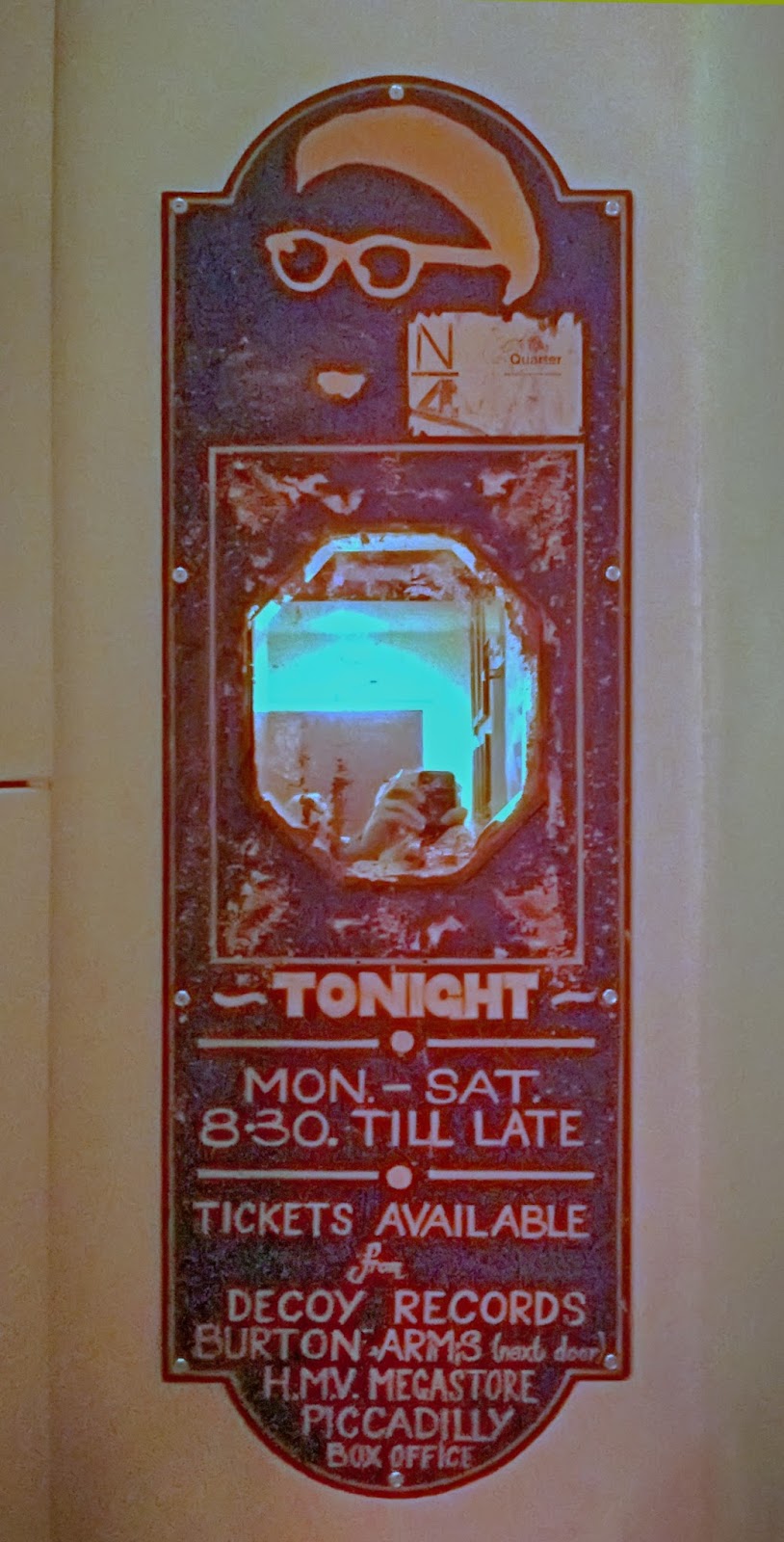
But given that we are self publishing the book, there is no reason why in the second edition this mirror from the Band on the Wall should not find a spot.

Some will say that this was poor planning but not so.  It was more a case or revisiting a favourite one of Peter’s pubs on a night when the music caught his fancy.

And in an interval having bought a round his attention was caught by the mirror.

I could of course at this stage reveal a fascinating interview with Paul Mitchell-Davidson  who features in the book, but as that was a story we included you will have to go off and by Manchester Pubs sold out its first print run in a month and is now available again.**

Picture; the mirror from Band on the Wall, 2016, Peter Topping

*Manchester Pubs - The Stories Behind The Doors – City Centre, Peter Topping and Andrew Simpson,
ISBN 978 0 995705 50 0 Price £18.99,

You can order the book at www.pubbooks.co.uk 

The book can also be obtained from  Chorlton Bookshop,  0161 881 6374

**Paul Mitchell-Davidson,

Sunday, 18 December 2016

One hundred years of one house in Chorlton part 72 ...... noises, smells and redundant fixtures

The continuing story of the house Joe and Mary Ann Scott lived in for over 50 years and the families that have lived here since.*

The M.C.E.W box only replaced in the 1980s
Now there are plenty of old fixtures around the house which Joe and Mary would recognise but which long ago ceased to serve a purpose.

Some like the M.C.E.W box have been replaced with state of the art equipment and now sit on a shelf as a testament to my inability to get rid of all things old.

Added to that is the copper in the cellar used for washing clothes when the house was built a century and a bit ago.

I can’t be sure whether Mary Ann used the thing or whether she relied on a laundry of which there were plenty in Chorlton.

And given the fact that they had a telephone by 1925 and bought a telly in the mid 1950s I rather they would have gone in for a washing machine at some point.

Leaving aside these objects there will be the sounds the house makes.

Of these it will be that early morning noise as the old fire embers are racked through and the ash left to cool before a new fire is laid.

In countless homes across the country and across the last two centuries it will be the sound that many woke up to.

I remember I did, and still think there is something reassuring about the noise.  It is partly that it is a familiar routine which says all is well and all is as it should be, which was more so because I was still in bed and knew that there be another hour before I had to get up.

The copper in the cellar
It was also I suppose a marker that you belonged to a respectable family which took pride in being up and about at the crack of dawn, ready to clean the step, start the laundry on wash day and send the children out clean and ready for school.

And in the small mean terraced houses with their rows of two up and two downs you could hear the fires being racked out in the neighbouring properties.

So woe betide any household where that noise was not well and truly underway by eight at the very latest.

All of which leaves the smells which were another thing.

In the days when most houses had a slope stone and no pipe with a u bend there were those more unpleasant smells, which might vie with those from the moth balls and Flit disinfectant.

Of course Joe and Mary Ann’s house was not one of these and as Joe proudly announced in all his adverts for the houses he built he had embraced all the mod cons, including electric lighting in the garages he built.

But there would be that powerful set of medical smells of which Germalin and TCP were required for all cuts and grazes.

Empty tin of National Dried Milk used for storage
These I could accept and have never lost a liking for but iodine which was yellow and despite it stinging was applied with vigour by Nana, my mother and the school nurse for all non serious accidents.

The yellow arm or leg became a badge of bravery and warning not to be so silly next time.

So as I search through the dark recesses of the cellars I remain amazed at what secrets the house still has to offer.

Joe and Mary Ann did not have that struggle faced by many at the lower end of society where no matter how much soap and  effort were applied a home could not be kept clean or free from infestations and is a salutary thought that in the early 1960s there were still homes where you turned on a light before entering an upstairs room to allow the more horrible things to slide away.

But that wasn't this house and is more properly another story.

Coming soon; mice and the dead bird

Location; Chorlton

Pictures from the collection of Andrew Simpson, and the tin of National Dried milk by Oxfordian Kissuth, Photographer and columnist, Germany and England. And available at WIKIMEDIA Commons,http://commons.wikimedia.org/wiki/User:Oxfordian_Kissuth

*The story of house,
http://chorltonhistory.blogspot.co.uk/search/label/The%20story%20of%20a%20house


A little bit of Christmas 1959 ............... with a thank you to the Eagle Times

Forget the sound of Christmas cards falling on the mat, the smell of warmed mince pies and the battle with choosing the right tree; I know it has all begun when the Eagle Times arrives.

For those of a certain age the Eagle and its companion comics, Girl, Swift and Robin were an essential part of growing up in the 1950s.

And if like me you have never lost the fascination for characters from their pages and still enjoy looking at cut away pictures of aeroplanes, steam locomotive and a London Routemaster then the Eagle Times is special.

It comes out quarterly, has been going for 28 years and is a celebration of that much loved comic.

But it is more than just a nostalgic recreation of a lost childhood which would be fun but with limited appeal.

Instead Eagle tTmes wanders across the 1950s with a mix of articles exploring the artists and writers who contributed to the Eagle and the bigger cultural themes of the decade.

Nor does it stop at 1959 but slips effortlessly forward and backward picking up on the story of the film industry, popular music, and much more.

So less a fanzine and more an insight intothe culture of the time when Dan Dare space hero of the Eagle along with Luck of the Legion and Harris Tweed sorted out the bad guys with stiff upper lip and a concern for decent behaviour.

That said I remain a sucker for the seasonal articles which this edition include ‘Christmas Annuals of the 1960’s’ and the connection between Dan Dare’s rocket ship and Meccano, but all of which begins with the cover adorned with holly, and a shed load of snow.

So there you have it, more than a little bit of Christmas past.

Pictures; cover of Eagle Times, vol 28 no 4 Autumn 2015 and centre page from Christmas Annuals of the 1960’s, Jon Johnson

* Eagle Times, Annual subscription UK £27, overseas £38, and as a start you can visit the site at http://eagle-times.blogspot.co.uk/

Friday, 16 December 2016

A whole lot more about Britain in 1939 has just been revealed ......... new releases from the 1939 Register

Now if you are tracking anyone in the early part of the 20th century you will know that there are pitfalls.

Uncle Roger and mum, 1938
Not least because details from the 1921 census will not be released for another five years, the 1931 census was destroyed in an air raid and there was no census taken in 1941.

All of which makes the 1939 Register pretty important.

It was compiled in late September of that year as part of the country’s response to the outbreak of the war.

The Government had taken the decision a year earlier to compile a National Register that in the event of war would list l the personal details of every civilian in Great Britain and Northern Ireland.

Mum and friend, 1942
The information was used to issue identity cards, organise rationing and  after the war for the National Health Service.

And for anyone looking for an individual or family member from the period the 1939 Register bridges the gap between the 1911 census and the list ones of the middle decades of the century,

But like all such sensitive information the details were subject to concerns over data protection and so when findmypast digitalised the records two years ago they chose to withhold some of the records.

This amounted to about 13 million or 32% of the total list of names, with details of people born less than a century ago and not known to have died before 1991.

The new records went live on November 16.

All of which meant when I went looking for my mum and grandparents I hit a brick wall.

They were there but mum’s entry had been redacted, which is that posh word for blanked out.

Mum, 1949
But now findmypast has matched millions of closed entries to other sources such as death records and has been able confirm that another three million records can now be shown.

And amongst those are mum’s.  In the September of 1939 she was at home and gave her occupation as
Unemployed cashier.  Not much perhaps but helps fill in a bit more of the story.

I know that on leaving school she had worked in a silk factory but had been “let go” when her apprenticeship ended and by 1942 she was in the RAF.  So it is a bit more.

And for that I am pleased.

Pictures; from the collection of Andrew Simpson

*The 1939 Register, findmypast, findmypast.co.uk

Stories behind the Pub book ........ an idea, a shedload of research and some pretty fine paintings

An occasional series on how the book Manchester Pubs was written.

Like all good books especially one to do with pubs it began over a pint and during the discussion on the decline in the number of traditional houses we decided to discover just how many there were left in the city centre.

From there it was just a short hop to Peter proposing to paint each one.

And once you have a painting you have got to have a story, after all our collaboration has always been predicated on that simple idea that he paints the pictures and I tell the stories.

And what a lot there were ranging from murky dealings at the dead of night and colourful characters to events that reflected the history of the city.

Some came from talking to the landlords and the regulars which is always the place to start.

From there I wandered off into the historic records, comparing old maps, with street directories and newspaper accounts and in some cases exploring the lives of those that ran and drank in some of the pubs.

Early on we took the decision to group the pubs into fifteen short walks allowing the reader to better understand the context in which the pub existed.

So as you would expect places like the Northern Quarter which was a densely populated area still has more than its fair share of traditional pubs, while the Oxnoble on Liverpool Road got its name from a type of potato landed at Potato Wharf.

Add caption
And while I was busy delving deep into the past Peter had the task of visiting each pub taking photographs of the interiors and matching these with old pictures from the City’s digital collection of 80,000 images of Manchester.

Of course in the interests of pure research I did on occasion join him on what became adventures in their own right, like the day in the Northern Quarter when we encountered those huge wall paintings which are everywhere.

That in turn led to a “Peter Painting” of the paintings and of course a story.

Next; Mr Thomas 1820 fine bone china replete with the name of his pub, a night to remember at Band on the Wall and the couple from Glasgow and their two friends from Yorkshire.

Painting; montage, of the paintings at the back of Tib Street, near Brightwell walk © 2016 Peter Topping

*Manchester Pubs - The Stories Behind The Doors – City Centre, Peter Topping and Andrew Simpson,
ISBN 978 0 995705 50 0 Price £18.99

We are taking Pre-orders now and hopefully the book will be ready for sale on 20th December 2016 at www.pubbooks.co.uk

The book can also be obtained from  Chorlton Bookshop,  0161 881 6374