Monday, 30 March 2026

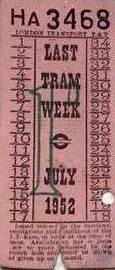
“A single to Well Hall” ...... travelling the tram in the “Last Tram Week”

History comes in many shapes and sizes, from serious books on great events to the humble object which offers up an insight into how we lived.

So I am indebted to Lesley, who on the back of a recent tram story told me that she still had a collection of tram tickets her mum bought during the “Last Tram Week in July 1952”.

Now I always get excited about seeing and especially handling bits of our collective past.

Back in the late 1970s I walked away from the excavations at Viking York with a genuine Viking oyster shell.  The archaeologists had unearthed so many that they were being sold in a barrel for 10p each.

On a more studious note, while writing the book on the Story of Chorlton-cum-Hardy in the early 19th century I used the hand written minutes of the local Poor Law Committee.

The volume began in 1834 and ran through to 1852 and I think apart from the chap who wrote up the minutes and perhaps a few others I will have been the only person to turn the pages in almost 170 years.

So looking at Lesley’s tram tickets is a fascinating link with that last week that London Transport ran trams through the city.

I was just short of my third birthday and though there is a family story that Dad took me down to the New Cross Depot, I have no memory of the event.

But like so many people of my generation, those tall stately trams have a lasting romantic pull and have of course now been resurrected by  by fleets of sleek new trams which have returned to many of our cities.

These are more comfortable, and faster but a bit of me would yearn to hop on one outside the old family home on Well Hall Road and rattle up to the High Street and north into Woolwich.

I can’t, so Lesley’s tickets will have to do.

Leaving me just to reiterate that old observation ...... be careful what you throw away for today’s rubbish will be someone’s priceless piece of history in the future.

Location; Eltham

Pictures; tram tickets from “The Last Tram Week”, July 1952, from the collection of Lesley Ross, 2018
Sunday, 29 March 2026

Glenton Tours …… the coach company that was the luxury motor holiday

Our dad worked for Glenton Tours for over half a century and the story of his part in that company and its part in the modern holiday industry is fascinating.*

Dad and Elizabeth recieving awards, date unknown

It started with an estate agent settling a debt and acquiring five motor coaches which became the core of a business which ran sight seeing tours across Britain and into Europe from 1929.

Elizabeth and Dad, date unknown
The company was in the right place at the right time, as rising disposable income allowed midddle class families the opportunity to go on a new type of coach holiday.

Not that these were run of the mill excursions, but carefully planned tours which lasted for seven, twelve and fourteen days and guaranteed the customers first class hotels, three good meals a day and an itinerary which provided the travellers with all they might want to do about the places of interest.

Added to which there were commentaries which offered up instant historical information along the way.  

These were provided by the driver on home tours and by a courier on the Continental journeys.

Father did both, starting with trips across Britain at the start of the season but slipping in to the Continental tours in late Spring and through to autumn.

Elizabeth, Dad, Frank and unknown courier, date unknown
We still have many of the notebooks and pictures he used for the home tours, and these are now a wonderful insight into the Britain of the 1930s and 40s.

He was pretty there from the start, and so we also have photographs which record the different coaches the company used from the beginning and the differing style of uniforms, from the peaked hat and white long coat to the fitted and style uniforms of the 1950s and 1960s.

And because father kept everything we also have some of the brochures which advertised the individual tours, prices and helpful information.

So from the 1951 brochure came the reassuring comments that “You do not have to bother about luggage, frontier, monetary or language difficulties” and the cost included “the inclusive charge provided for all food and accommodation, the sea crossing and gratuities to hotel staff."

Dad and unknown courier, date unknown
But given that this was soon after the war passengers were informed that “Ration Books are not necessary on any of our tours” but that passengers are advised take "a towel and soap in case some hotels are still unable to supply them.”**

All of which has reignited my interest in the company after receiving a collection of photographs from the grandson of the founder of Glenton Tours.  

Some of the pictures are of a Brighton Coach Rally which I can date to sometime in the late 1950s and early 1960s. 

 In his covering note he  wrote  “If your Father went to Brighton Coach Rallies there is a good chance that there is a picture of him”.

And there are heaps of him, mostly holding trophies he had won for successfully competing against other drivers in demonstrating driving skills before the public.***

Interior of one of the 1950s fleet, date unknown

What makes the pictures even more significant is that in the group pictures I can identify not only Dad but also his fellow Continental driver who was called Frank and who lived very close to us on Queens Road, and one of the couriers who we knew as Elizabeth.

One of the Glenton fleet, date unknown
All of which is a nice Sunday afternoon trip back through the story of Glenton Tours and our dad.

Pictures; Brighton Coach Rally, date unknown, courtesy of Peregrine Smith

*Glenton Tours, https://chorltonhistory.blogspot.com/search/label/Glenton%20Tours

*Motor Coach Holiday Tours, 1951

** UK Coach Rally, https://coachdisplays.co.uk/history/


Memories of the Co-op, a tram journey and a live eel

I am always on the lookout for memories of Eltham and Woolwich before today, and so I was pleased when Jean shared some of her childhood ones.

Now if you are of a certain age you will more than likely remember your Co-op Divi number, this you offered up every time you purchased something from the local store.  There were also those light weight brass and tin tokens.

It always seemed to fall to me to slip down Well Hall Road to the RACS for the odd thing which of course meant remembering the number.  But then they went over to those blue stamps which long ago had their day and now I have a card which I hand over at the till.

But enough of me.  Jean also had those Co-op chores.

"I remember the tin tokens my granny used to get from the Co-op in Welling- she always let my cousin and I sort them all out around Christmas time and then she took us both to the Co-op in Woolwich to exchange them for real money. 


I used to love seeing the little brass things whizzing around that Co-op taking cash from one place to another, I suppose. 

We used to get to Woolwich by Trolley Bus - once and only once she took us on to a Tram, I loved every minute of this but Bryan was sick as a dog so the experience was never repeated.  

She always used to tell us as we got on the Trolley Bus that we would have to leave Woolwich by four o'clock as that was when the knives came out. Amusing this, years ago, but not so funny now in the light of that dreadful killing in Woolwich of that poor soldier recently.  


Thinking of Trams reminds me of a story she told me about my Grandfather (one of Granny Morris's sons and the baby on her lap in the old photo I think I sent you). 

He worked in the Woolwich Arsenal and came home to Welling by Tram. 

He loved eels and often bought some live ones in Beresford Market. One day they fell out of the container straight into a lady's lap!!  

Hysterics all round (I would have died)."

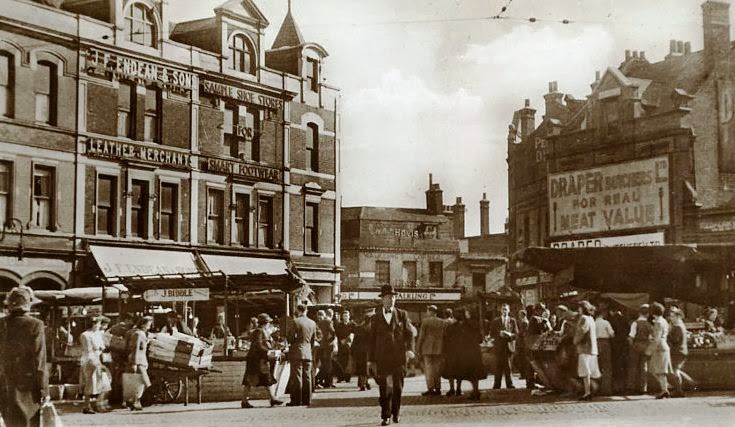
Pictures; number 46 tram, courtesy of the Eltham Society on its way to Woolwich circa 1940s and Beresford Square, in the middle decades of the last century, courtesy of Mark Flynn, http://www.markfynn.com/london-postcards.htm

Don't get me on the subject of wool shops ...........

Now I belong to a generation that was dragged round wool shops as a child.

My mum, her friend and later my sisters all knitted and so the trip to the shop was a regular part of my Saturdays.

It started with the knitting pattern, went on to an endless discussion about the colour of the wool and finished with walking home with loads of the stuff.

Then there was the smell.

Wool shops had a distinctive smell, which was a sort of warm perfume smell which followed you home and stayed where ever mother was knitting.

There was something else about the wool shop which for years I couldn’t quite work out what it was, and then recently it came to me, it was always so very quiet, as if there were secrets about knitting that could only be uttered in a low almost conspiratorial way.

Ours was a traditional wool shop. The wooden shelves which reached to the ceiling were made of a deep dark wood which shone in the sunlight and were heaped high with wool.

 And then there were the wooden and glass counters which today you only see in shops pretending to be old. Through the glass top you could see more wool and all sizes of knitting needles.

So the day Mrs Rogers announced that she was going to try out a knitting machine it was if she had admitted to multiple affairs over the preceding twenty years.

I wouldn’t mind but it wasn’t even that she was going to buy one; all she wanted to do was try it out.

 But that marked her out as a flighty thing who would soon be buying a Christmas cake instead of making one and no doubt had already used custard powder and meat spread.

Nor did the torture of the wool shop stop there. Once home the wool had to be wound into balls, which could be only done using the back of a chair but usually involved me having to stand with my arms outstretched and the wool was pulled from me and went into balls.

So I suppose I chose to ignore the wool shop on Wilmslow Road, and then it had gone.

And in memory of that wool shop and many others I shall leave you with this classic pattern from our Jillian who collects them, in the hope that she will knit me a balaclava.

Location; Wilmslow Road,

Picture; Wilmslow Road, 1967, Courtesy of Manchester Archives+ Town Hall Photographers' Collection, https://www.flickr.com/photos/manchesterarchiveplus/albums/72157684413651581?fbclid=IwAR35NR9v6lzJfkiSsHgHdQyL2CCuQUHuCuVr8xnd403q534MNgY5g1nAZfY
and knitting patterns, 1930-1970 from the collection of Jillian Goldsmith

When Chorlton was in Moss Side

The year is 1978 and the Labour Party is defending its Moss Side seat in a byelection which was occasioned by the death of Frank Hatton who had won the seat for Labour  in February 1974.

George Morton and "team" in Chorlton, 1978
The Labour candidate was George Morton, who had served on both Manchester City Council and the Greater Manchester Council and lived locally.

There were four other candidates, drawn from the Conservative Party, the Liberal Party, and the National Front and the Workers Revolutionary Party, and the election was fought against a backdrop of growing industrial conflict, which has come to be remembered as the “the winter of discontent”.

Added to which the Labour Government had lost its slim majority of three in 1976 and entered a pact with the Liberal Party the following year, which lasted until September 1978.

Here in Moss Side and indeed in Chorlton, George was well received and the outcome of the election was a Labour victory, with George increasing his majority and share of the vote in the General Election which followed in 1979.

And for those who are pondering on the significance of a Moss Side story, that is because Chorlton was in the Moss Side Constituency.

The seat had been created in 1918 and was abolished in 1983 when changes to the Parliamentary boundaries moved Chorlton into Manchester Withington.

For most of its existence it returned a Tory MP, with the Liberals briefly winning the seat in the 1923 General Election only for the Conservatives to win it back a year later.

Campaigning in Moss Side, 1978
By 1929 the Labour Party had over taken the Liberals as the main contender to the Tories and across the next three General Elections achieved between 32% and 41% of the votes cast.

The seat was finally won by Labour in the landslide victory of 1945, when William Griffiths took the seat for Labour with 49% of the vote.

Sadly in Chorlton, Labour had to wait until 1986 for its first election victory, which was followed  a year later when Keith Bradly won Manchester Withington, giving Labour voters the double.

Location; Moss Side and Chorlton

Picture; George Morton campaigning in the by-election in Chorlton and Moss Side in 1978, with fellow MPs, the local organizer and volunteers, from the Lloyd Collection


Saturday, 28 March 2026

Celebrating all things history ….. today at Central Ref

Today was one of those history days in Manchester when the Manchester & Lancashire Family History Society hosted a heap of organizations and individuals all of whom are engaged in making our city’s past more accessible.*

The Lord Mayor & Liverpool and South West Family History Society, 2026 
There were individuals like David Harrop who is a “Postal and Military Historian", representatives from the Greater Manchester Museum of Transport,  Elizabeth Gaskell House, Northwest Film Archive, Manchester Archives, and plenty more, added to which there were a series of talks from the Manchester & Lancashire Family, and the Lancashire Archives History Society.

And along the way I bumped into some old pals, as well as making new acquaintances and discovering a load of regional new historical societies including the Liverpool and South West Family History Society.

Meeting and swapping history stories, 2026


David Harrop, 2026
So, a good day, made better by the appearance of our own Lord Mayor, Cllr Carmine Grimshaw who made his way round the events much to everyone’s pleasure and resisted the temptation to advertise his book of poems, which is available from the book shop in Central Ref for a donation to the Lord Mayor’s charity.**

Now I say he resisted the temptation, but I couldn’t having heard him recite one at Chorlton Arts Festival last year,

Location; Central Ref

Pictures; the Family History Fair March 26th, 2026 from the collection of Andrew Simpson 

Martin Logan and bus ticket machine, 1900

Selection of ticket machines, 1900-1960s


Elizabeth Gaskell House, 2026


The Lord Mayor sharing stories, 2026


* Manchester & Lancashire Family History Society, mlfhs.uk

**Lord Mayor’s Rattlebag of Poems, Cllr. Carmine Grimshaw, Lord Mayor of Manchester 2025-26

And to ensure I don't short change anyone, here is the full list of attendees, Anglo-Scottish FHA (MLFHS stand), Archives+Belle Vue Circus Clown Artist, Pamela Armstrong, Elizabeth Gaskell House, Family and Community Historical Research Society, David Harrop, Postal and Military Historian, Dean Kirby, Local historian - Angel Meadow and Research, Lancashire & Cheshire Antiquarian Society, Lancashire Family History and Heraldry Society, Lancashire Records Office, Liverpool & South West Lancs Family History Society, Manchester and Lancashire Family History Society (MLFHS), Manchester Helpdesk (MLFHS), Manchester, Bolton and Bury Canal Society, Manchester Statistical Society, Museum of Transport, Greater Manchester, North West Film Archive, Oldham & District FHS,  (MLFHS stand), Police Scam Squad, Salford Cemeteries Trust, Swinton & Pendlebury Historical Society, Tameside Local History Centre, Victoria Baths


The Lost Chorlton pictures ......... before the trend

This is Beech Road as it was just forty years ago.

Where today there is a studio, a gallery, and a clothes shop, there was a flower shop which offered a selection of fruit and veg as a side line, an old fashioned hardware store and Dave the Butcher.

Now if you are of a certain age the smell of a hardware shop is a powerful reminder of how we once did things.

The floor was invariably always the bare timbers, and there was that pungent smell of paraffin, and waxed string.

You could buy anything from a small nut and bolt, to sheets of brown wrapping paper and sealing wax.

And had I been on Beech Road a full decade earlier I could have asked Mr Heger, the relative merits of pink paraffin, and just how many nails I would need to fasten down a lose floor board.

That said back then we did have our own photographic shop which traded from what is now Pottery Corner.

So some things haven’t changed.

Location; Chorlton

Picture; Beech Road, 1979 from the collection of Andrew Simpson