Sunday, 2 August 2026

The picture of Annie Magee on Hawthorn Lane and that young Chorlton bandsman

Now if there is a simple lesson about old photographs it’s that you should never take them at face value.

So here is a picture from Peter McLoughlin's collection of family pictures which shows his mother Annie in 1925.

I was drawn to it the first time I saw it and it began the first of series of stories that feature those family albums.

But what I missed or more accurately ignored was the young man standing beside her.

I don’t know who he was or why he posed with young Annie and just assumed he was a young serviceman, but looking again at that uniform it seems far more elaborate and I think it is that of a bandsman and if pushed I think it might well be from our own Brass Band.

And that makes it rather special because there are very few pictures of our brass band which was at the centre of life in Chorlton from the mid 1820s till 1945.

Of course the Stalybridge Band is older and can claim to have marched in to St Peter’s Fields on the day of Peterloo but ours had an almost continuous run until it agreed to wind up after the last world war.

It performed in many of the great and not so great events here in the township and went on to win prizes in brass band competitions.

There are a few accounts of its founding in the 1820s and some more of when it reformed in 1850.

I know the names of some of the men who made up the early bands, along with the prizes they collected during the late 19th century and continue to come across newspaper reports of their activities.

The band neatly reflects the history of the township, starting as a small band whose members made some of their instruments including the drum which once made proved to big to get out of the cottage.

The early band was almost exclusively drawn from Methodists and most made their living from the land.

By the 1890s few of the members still worked the land, most worked in Manchester and most were either newcomers to the township or were first generation.

But so far I guess there are just half a dozen images of the band, some as they marched through Chorlton and one of them at Barlow Hall in 1893 but sadly that’s the lot.

All of which makes this picture of our young bandsmen so interesting and perhaps in time I will discover more about him.


Picture; Annie Magee and that unknown young man, 1925 from the collection of Peter McLoughlin and the Brass Band circa 1920 courtesy of Allan Brown

Walking the Greek iskands .... in the company of Gigantes

The art of cooking for one is pretty much the same as cooking for two or for a family.


Keep it simple, use the best ingredients you can source and have an eye on how the leftovers can used for another meal.

Which brings me to two staple and favourites which are Gigantes and green beans.

Both pretty much cook themselves and just require to be cooked in a tomato sauce.

Now my Wikipedia tells me that Gigantes “is a Greek dish of large white beans baked in a tomato sauce and may be served as a main dish or as a meze”.* 

I first came across them in Greece forty years ago and they remain one of my go to choices when ever I am on the islands.

At home I regularly make them using the humble butter bean which are cooked gently with tomatoes, olive oil, onion and some garlic and a mix of herbs.  

And it makes sense to cook them along with that other dish which use green beans which are made in much the same way as the Gigantes.

Both can be served along side each other with bread and a selection of dips.

I prefer them slightly warm, but they are just as nice when cold.

Variations of both can be found in an arc around the Mediterranean and are essentially peasant food.

Today I ate them with some green leaves, salad and fried potatoes which was a variation on the other day when I made some mashed potatoes, onions and peas.

Leaving me to use what was left of the two in a curry or with some pasta.

Perhaps not exactly how a Greek grandmother or Italian nonna would dish up, but well within that tradition of using up what was in the kitchen.

Location; our kitchen

Pictures; from the kitchen to the plate, 2026 from the collection of Andrew Simpson

*Gigantes plaki, https://en.wikipedia.org/wiki/Gigantes_plaki

The story of a strike and of strikes yet to come, part two .... a Chorlton postcard

On Newton street in July 1911
The Carters came out on strike in Manchester at the beginning of July 1911. 

It was the picture of police escorting a strike breaker which first caught my interest.

But they were not the first or the last during the next few years to withdraw their labour to advance a demand for better pay and conditions.

Early in 1912 the miners had come out following a ballot “in favour of giving notice to establish the principle of a minimum wage for every man and boy working underground,”* and at the beginning of March Manchester Municipal workers voted to follow those of Stalybridge, Salford and Stockport and strike for higher pay.

You can get a sense of the mounting conflict from the newspapers of the period. The Manchester Guardian was quick to comment on the concerns over coal stocks in the Greater Manchester area just weeks after the miners had come out, and carried reports that in Nottingham the bakers and painters were about to go on strike while in Manchester there was serious disruption to the rail network.

Leonard's fears
And here in Chorlton on the day the Guardian reported that 60% of trains from one Manchester railway station had been “knocked off” Leonard wrote to a friend of his worries about his mother’s illness and that “all our staff intend to come out on strike this weekend.”

Now it may never be possible to discover the business that he ran or what happened on Friday March 15th when the strike was due to start, but I shall endeavour to try.

He was “busy making arrangements to fill their places” and thought that “this Coal crisis ..... is a terrible affair.” 

All of which rather eclipsed his pleasure that at the Parliamentary bye-election earlier in the year “our man got in (Good old Blue) turned a liberal majority from over 2,000 to a conservative one of 500, great excitement.”

It is a fascinating glimpse on how people here in Chorlton looked out on the mounting political and industrial unrest and sadly represents the only comment we have so far.

As it was the strikes rumbled on through the year, but more about them tomorrow.

Picture; detail of a postcard sent on March 12th 1912 from the Lloyd collection, detail from the Carter's strike, courtesy of the Greater Manchester Police Museum

*Balllot paper issued by the Miner’s Federation of Great Britain, January 1912


Posters from the Past ........... no 17 ......... Woolwich .......Walking The River

Now the project is simple, take an image of a building we all love and turn it into the style of poster which was popular in the middle decades of the last century.*

And because so many of us have fond memories of the foot tunnels under the Thames, here is our take on how Woolwich Borough Council might have marketed the trip.

Location;Woolwich

Painting; Woolwich Foot Tunnel, © 2018 Peter Topping,  Paintings from Pictures, from a photograph by Neil Simpson, 2016

Web: www.paintingsfrompictures.co.uk 

*Posters from the Past, https://chorltonhistory.blogspot.co.uk/search/label/Posters%20from%20the%20Past

Saturday, 1 August 2026

The Tale at Eltham …….

Now I really wish I knew just what the “Tale at Eltham" was, but alas it is lost.


Nor I suspect did anyone know just what had gone on in Eltham in the October of 1917 when this picture postcard was sent to Miss Goddard of Sussex.

I can tell you that it was sent at 2.30 in the afternoon, but can’t make out from where it was posted.

Nor can I really be sure that the sender or Miss Goddard had any connection with Eltham, which leave me wondering if it had been the two “young things” that caught the attention of Eliza who sent it.

But then these picture postcards were standard fare, with the company merely over printing different destinations to attract local audiences.

Some where in the collection I have another with a different place name.

The message on the back is difficult to read but hints a at a boat trip and an admonishment that Miss Goddard hadn’t written recently.

So that is it, a little bit of 1917 which might or might not have a connection with Eltham.

Location; Suffolk and maybe Eltham

Picture; The Tale at Eltham, 1917, from the collection of David Harrop


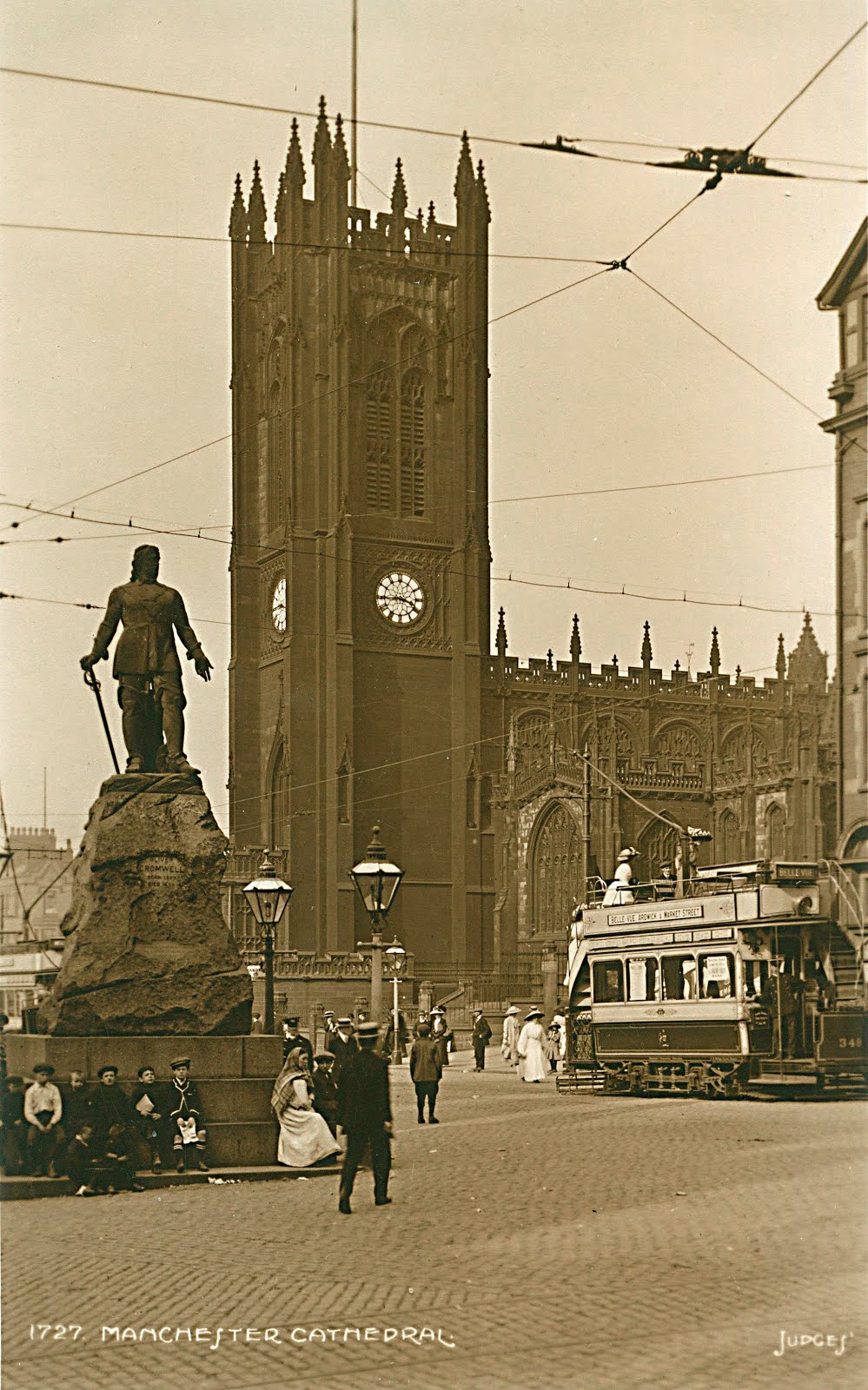
The woman in a shawl at the foot of Oliver Cromwell in the summer of 1914


It’s the last of my Judge postcards. 

Like the others in the series which Fred Judge took in the summer of 1914 it has much going for it not least because it isn’t the standard view.

Instead we have the statue of Oliver Cromwell matched by the Cathedral behind and balanced by the building to our extreme right.

But for me it is also the figures he has captured sitting on the steps.

There is the mixed group of boys including one in school uniform and beside him what might be a paper seller and the others, two of whom are engaged in a game.

And there is the woman in the shawl not at all interested in the camera deep in thought or perhaps listening to the chap next to her.

She is interesting because you rarely see women in shawls in post cards of the period.

They were there in the city and were often the subject of pictures taken on the poorer streets.

She makes a fitting contrast to the more elegant woman with their fine hats and expensive looking clothes off in the distance.

I wish I knew more about her, or for that matter the group standing by the tram, which is heading up to Market Street.

I can’t be sure but I rather think it is a Sunday sometime in the summer, partly because this is from the same series of pictures Fred Judge took around Manchester and may well be the next after the one on Cross Street.

In his photograph of Albert Square from Cross Street the time is just before three in the afternoon and here beside Oliver Cromwell the Cathedral clock is just coming up to a quarter to four.

Which was just enough time for him to stroll down and set up here.
The crowd by and large are oblivious to his presence and just get on with the day, some no doubt heading on to Bell Vue which is the final destination of our tram.


Picture; from the collection of V & G Harris

In celebration of Chorlton People ….. at our Library ... in August

I am enjoying the library’s current series of exhibitions under the broad title of “Works of Art By Local People”.


And starting in August their latest exhibition show cases the work of Peter Topping who is an artist, author, poet and now song writer. *


All of which he combines in this presentation which has the lot.

Now, I could paraphrase the content, but where would the fun be in doing that when you can go along and see it all for yourself?

So, I will just share some of the display panels which will be the enticement to go down to the library and view the full exhibition which also highlights his workshops on how he writes his songs which are designed to be a collective experience.

Leaving me to add a mangled version of that well known song, If you go down to the library today, You're sure of a big surprise. **.

And because I am in the mood and can I will finish with that panel celebrating my literary and artistic partnership with Mr. Topping.

It began around 2012 and in that decade and half has brought forth sixteen books, umpteen exhibitions, three street installations including the popular History Walk murals as well as talks and walks.


All of which is a lead into that wonderful film Casablanca, made in 1942 and set in Vichy controlled north Africa, full of sinister Nazi officers, Free French resistance fighters, a lost love affair and some memorable catchphrases.

Of which one of my favourites is uttered by Rick Blaine to the corrupt but slightly endearing Police chief Captain Louise Renault.  It comes at the end of the film, when the nasty Nazi officer is shot dead, and the resistance leader, Victor Laszlo, leaves Casablanca with his wife Isla Lund who was also Rick’s long-lost love.  With nothing left Captain Renault and Rick face an uncertain future and resolve to head to a “Free French Garrison over at Brazzaville”, leaving Rick to say "Louis, I think this is the beginning of a beautiful friendship".

And that has pretty much characterised that Simpson Topping partnership.

*From Poems to Musical Poems, Peter Topping, Chorlton Library, through August 2026

** Teddy Bears' Picnic,  melody written in 1907 by American composer John Walter Bratton, and lyrics added in 1932 by Irish songwriter Jimmy Kennedy

***Casablanca, 1942