Thursday, 11 January 2018

City Shapes

This is one of the pictures Andy took a few days ago while wandering around Castlefield.

Having done Water Street and Liverpool Road he went looking for another of those iconic buildings which may soon be demolished and took this one which I very much like.

Location; Manchester

Picture; City Shapes, 2018 from the collection of Andy Robertson

Location; Manchester

Picture, looking down Deansgate, 2018 from the collection of Andy Robertson

REMEMBERING THE EMPLOYEES OF MANCHESTER CORPORATION TRAMWAY ..... JANUARY 1918 by Martin Logan

The Great War has now gone into a fourth year.

When war was declared in 1914 thousands upon thousands of young men flocked to the colours so as not to miss any of the action. Why? Because they believed that it would be all over by Christmas and so wanted to be part of this Great Venture. Little did they realise what lay in store for them on the Western Front.

As the war dragged into 1918 with no end in sight the death toll amongst MCT employees would continue to rise.

Amongst the many that would die on the western Front, January 1918 would see just one Tramways employee being killed.

William Maguire was a labourer with the Manchester Tramways Department.

He enlisted as Private 6852 with the King’s Own Royal Lancaster Regiment.

However in the course of the war he was later transferred to 863 Area Employment Company Labour Corps as Private 404883.

He was the son of Patrick and Teresa Maguire and the husband of Mary Jane Maguire of 20 Beswick Street Manchester. On the 8th January 1918, exactly one hundred years ago he was killed. He was 35 years of age.

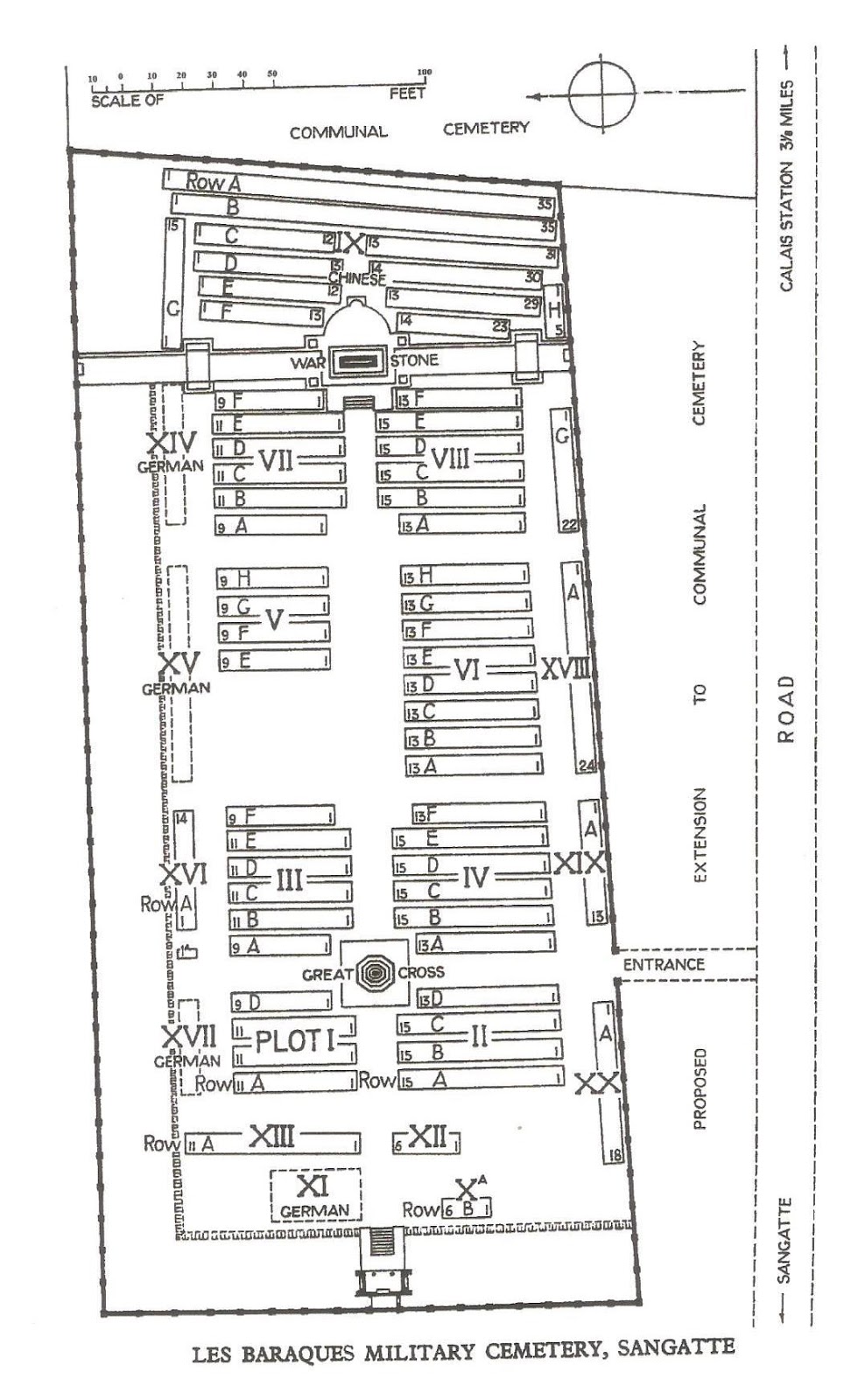
He is buried at Les Baraques Military Cemetery, Sangatte Pas de Calais in grave ref: II.C.6 near the Great Cross.

At the base of the headstone is the following inscription from his family: “ETERNAL REST GIVE TO HIM O LORD MAY HE REST IN PEACE AMEN”

The cemetery is located on the western side of Calais just off the D940, the road to Sangatte.

In April 1915, No.6 Base Supply Depot was started at Calais to help relieve the pressure on Boulogne and to provide a base nearer to the front than Havre or Rouen.

The base remained open until the last Commonwealth forces left France in March 1921. The 30th, 35th and 38th General Hospitals, No.9 British Red Cross Hospital and No.10 Canadian Stationary Hospital were also stationed in the town providing about 2,500 beds.

For three years, Commonwealth burials were made in Calais Southern Cemetery, but it later became necessary to start a new site and in September 1917, the first burials took place at Les Baraques.

The cemetery continued in use until 1921.
The cemetery now contains 1,303 Commonwealth burials of the First World War, together with more than 250 war graves of other nationalities, all but 2 of them German.

The cemetery also contains seven Second World War burials.

The cemetery was designed by Sir Herbert Baker.

Compared to the larger WW1 Cemeteries or Memorials like Tyne Cot, Thiepval and the Menin Gate, Les Baraques is small and probably rarely visited by British people as they arrive in Calais.

However this cemetery is just as important to me as they are, as it holds the grave of a Manchester Tramways employee. Please Remember Him.

If you have info on William Maguire  or anyone else on the MCT Memorial Plaque please contact me at martin.logan@btinternet.com or by mobile 07985490124

LEST WE FORGET

Martin Logan © 2018

Pictures; the name off the plaque is from Martin Logan, the scroll is from CWGC web site, the photo, plan, and info are from CWGC site and other WW1 sites

Wednesday, 10 January 2018

A BHC story ............ after migration stopped

Now quite understandably the study of British Home Children takes a different path after the migration of young people to Canada stopped in the 1930s.

The Children's Village, Cheadle, 1920s
It was to continue in a slightly different form for another forty years as children continued to be sent to Australia, and nor was there closure for those sent to Canada who after they left the farms and domestic service lived full and productive lives in their adopted country.

Their lives continue to be explored by descendants and historians.

Indeed in the last decade and a bit BHC has become a serious area for historical research which can only be for the good of all of us.

But I am increasingly interested in what happened here in Britain after migration stopped and in particular how young people “who missed the boat” experienced the world of charitable care.

Belmont in Cheadle, 1920
And here it has to be said that for every child who was migrated, many more stayed in Britain in the care of the Poor Law Unions or children’s charities.

Some spent a relatively short time in an institution, waiting on family circumstances to improve while others remained, seeing out their childhood in homes and orphanages.

At which point I have to own up and say that my interest is in part to do with the new book I am working on with the archivist of the Together Trust which has been commissioned to mark the charity’s 150th anniversary in 2020.*

Promotional material, date unknown
The charity began in 1870 with the purpose of offering a bed for the night to destitute young boys found on the streets of Manchester and Salford, and within a decade had expanded into a wide range of activities to do with young people who were in need of care.

The form of care that was provided changed with the century, and so what in 1870 was immediate and pretty much a reaction to a crisis on the streets, over time evolved into a more interventionist approach which saw the charity campaign for the regulation of child labour along with prosecuting neglectful and abusive parents and the provision in the homes for vocational training for both boys and girls.

They stopped the migration of young people at the outbreak of the Great War and in 1920 changed direction with a move out of the inner cities to a green field site and the establishment of a “children’s village”.

The creation of the Welfare State and the growing involvement of local authorities in the care of young people further changed the role of the charity with by the beginning of this century more emphasis on working with families as well as children.

All of which makes the story of the charity less an account of one organization and more a comment on how society has and continues to evolve its approach to those who at one stage of their life need help.

Promotional material, date unknown
And in the course of the research the Trust has made available a set of oral histories from the 1930s onwards which give a fascinating insight into what it was like to be in the children’s village in Cheadle.

The first dating from 1937 will be from children who just twenty years earlier could have been bound for Canada, and whose contemporaries from other parts of the country might well have had siblings who were sent over.

They record the minutia of living in a home, from the routines, to the small acts of childish rebellion, the memorable moments like the lighting of the Christmas tree and the bitter sweet memories of life in care, which in the case of the first I have read were positive.

There are plenty more to read and I have to say I am looking forward to the task, partly because it is always fascinating reading about other people but also because it takes the story down a different path.

Pictures; courtesy of the Together Trust, http://togethertrustarchive.blogspot.co.uk/p/about-together-trust.html

*A new book on the Together Trust, https://chorltonhistory.blogspot.co.uk/search/label/A%20new%20book%20on%20the%20Together%20Trust

The Great War ......... how we remember it ......... a century on

It is the way of popular history that the way some of it is driven rests on anniversaries and this has certainly been how the media and some historians have approached the Great War.

Manchester Remembering 1914-18
At which point I cannot hide from that simple observation that I have fallen in behind the rest.

The blog regularly marks the centenary of events from that conflict, and last year I published Manchester Remembering 1914-18, which drew on the collection of David Harrop.

Now there is nothing wrong with visiting the past through anniversaries, it is of course a powerful way of delivering history, offering an instant link to an event long gone and allows people to reflect on the differences between that day and its modern counterpart.

But go back into the past and I suspect many great anniversaries were at best marked by a personal reflection or quickly faded as those involved died and the significance of the event was lost in the sweep of history.

So a full century after Agincourt I bet few pondered on that day of battle, and if it did surface it will have been appropriated by the publicity machine of the time to rekindle a wave of patriotism.

At the book launch of Manchester Remembering 1914-18, Central Ref, 2017
All that said, anniversaries are as they say here to stay, and that brings me to the two for today.

It will soon be a year since the publication of Manchester Remembering 1914-18, which had its launch in early February of last year in Central Ref.

I will always be grateful to David for providing the core of the material I used from his collection and the advice he gave at the time, and his continued interest in the blog which often sets him off looking for memorabilia which he knows I will want to write about.

And that I have to say includes material from south east London where I was born and grew up, to Chorlton where I live now.  There are as I tell David always stories, and many of them will feature in his major exhibition also at Central Ref later in the year to mark the anniversary of the Armistice.

Southport, 2014
So over the next brace of weeks I shall be returning to old stories about the book and new ones about David’s exhibition, leaving me only to mention his permanent exhibition featuring some of his collection at the Remembrance Lodge in Southern Cemetery and the many other temporary ones he puts on at the request of Art Galleries and local history groups.

Location; The Great War

Pictures; the book launch of Manchester Remembering 1914-18, 2017 courtesy of ALTO•VISUAL and David’s  exhibition in Southport, 2014 from the collection of David Harrop.

The City’s changing skyline

Now I am not alone in wondering whether the new developments down beyond Deansgate add anything to the city.

When the building makes you feel insignificant, then perhaps there is something wrong with the building.

Location; Manchester


Picture, looking down Deansgate, 2018 from the collection of Andy Robertson

Tuesday, 9 January 2018

Of cranes and towers and street furniture ..... the city at dusk

What more is there to say?

Location; Manchester


Picture; Dusk across the city, 2018, from the collection of Andy Robertson

The loss of Oddest

I was saddened to hear that Oddest on Wilbraham Road has closed.

As ever, the social media sites were quick to home in on its closure, beginning with questions about why it was not open, followed by speculation on what might replace it, along with the inevitable  tranche of stories and memories of the place.

What seemed to be missing from the chatter was any appreciation of what its closure meant to the staff who worked, there and at the two other outlets in the Northern Quarter.

And it was left to the Evening News to record that 40 jobs have gone, which is a tragedy in any one’s books.*

There will be more than a few of the uncharitable sort who argue that this is evidence of there being too many bars in Chorlton and call again for a return of the traditional retail outlets.

Sadly in an age of on line shopping, giant supermarkets and the Trafford Centre, the demand for the small independent green grocer, grocer and shoe shop are not high on most peoples’ shopping list.

And that in turn leaves many High Streets chasing a mix of charity shops, niche businesses and bars to fill the void.

The same uncharitable voices may also dismiss my response as nothing more than self interest, given that late last year I co-produced a book on Chorlton’s pubs and bars with the Manchester artist Peter Topping.

Since its publication there have been a few bars which have changed their name, one that was going to but didn’t, another which closed as we were writing the book and the opening of Zitano, that excellent pizza restaurant on Beech Road.

What is more remarkable is that most of the establishments are open and appear to be flourishing, which may say something about Chorlton.

And that brings me back to Oddest which opened in 2009, had a complete refurbishment five years later and always seemed busy when I passed.

Those in the know, or perhaps think they are in the know, may offer up an explanation for its demise, based on the steady decline in the pub trade which may now be biting into the bar business.

But such speculation I will leave to them, who may in their endless pontificating give some thought to the staff of Oddest, the Odd Bar and The Blue Pig which together formed the chain.

Location; Chorlton & Manchester

Painting; Oddest,  © 2017 Peter Topping

Web: www.paintingsfrompictures.co.uk

Facebook: Paintings from Pictures https://www.facebook.com/paintingsfrompictures

*Odd bar, Oddest and The Blue Pig have closed down - leaving dozens of staff jobless, Beth Abbit, Manchester Evening News, January 5, 2018, http://www.manchestereveningnews.co.uk/news/greater-manchester-news/odd-bar-oddest-blue-pig-14118281