Wednesday, 20 March 2024

Coming soon ….. The Streets of Chorlton

The Simpson & Topping partnership are working on a new series of books which will explore the stories behind the doors of some of our most loved places.


And along the way will challenge that widely held belief that there are no streets in Chorlton which is an idea that regularly floats across social media and pops up in the odd pub quiz.

To be fair the last “street” disappeared over a century and a bit ago, but they did exist, can be found in the historical records and were once well known.

Names like Chorlton Row, Lloyd Street, Cross Street, Back Lane and House Yard Road have long since vanished from living memory but along with Pitt Brow and Lane End they were places where people lived.
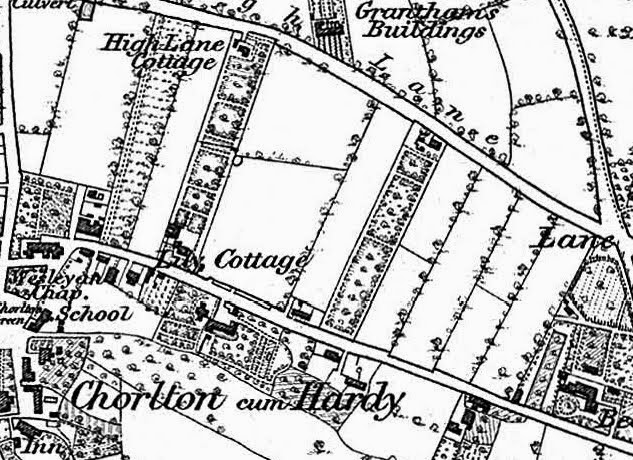
Chorlton Row [Beech Road] 1854
So, the series will start with the ever-popular Beech Road which for centuries was just a twisty turny rural lane connecting Chorlton Green with Barlow Moor Lane.

Had you walked it in say 1850 you could have marvelled at the few posh houses along its path, caught a glimpse of old Mr. Gratrix in his farm house, chatted with Mrs Sutton in the garden of her thatched wattle and daub cottage and stayed to gaze at the blacksmith engaged in the magic of heating and hammering.

Throw in a pint in the Traveller’s Rest which was a modest beer shop almost facing the village green and you pretty much had the lot.

Andrew has begun writing the stories behind the doors and Peter is busy sourcing previously unknown old pictures as well as painting a few new ones.

If you think your road, lane, close or avenue has a story do let us know.

Location; Chorlton

Picture; Peter’s painting based on a photograph of Beech Road, from the early 20th century, Chorlton Row, 1854, from the OS map of Lancashire, 1854, courtesy of Digital Archives Association, http://digitalarchives.co.uk/

“It’s good to talk”* …….. today at the Tea Hive

It is a truth universally acknowledged, that we all like to chat whether it’s over the phone, across a pub table or on a park bench with a friend.**

The 18th century had its coffee shops, the 19th its chop houses and the last century its Milk Bars.

Go back far enough into the past and I bet you could find a couple of Romans discussing gladiator fights and the best fish sauce to take home to mother, or the children of Noah on the different sorts of rain.

All of which is an introduction to a new project today at the Tea Hive on Manchester Road.  It is centred on that simple idea that we all like to chat.

It is part of a nationwide scheme called Chatty CafĂ©, which Jessica Mayne says offers “a friendly safe space for anyone who wants to leave their troubles at the door and have a natter with approachable people. Even if it’s just to drop by with a quick hello!

Order a drink, scan Teahive and you will see me, Jess, the host - bright yellow cards laden our table. Anyone at a bit of a loss, wanting a chin wag or even just a little listen to others or a board game. Stay as little or long as you like. It’s good to talk. pop on by!”

And sometimes the fun is in just taking time out to meet up face to face with someone, who isn’t on a social media platform, doesn’t have to rush off, or wants to sell something.

So that is it ….. today at the Tea Hive on Manchester Road between 1 and 3.

Painting: The Tea Hive © 2019. Peter Topping, Paintings from Pictures, https://paintingsfrompictures.co.uk/

*BT advertising campaign, 1994

** with apologies to Jane Austen


Tuesday, 19 March 2024

Piccadilly Gardens ....... the early years nu 2 trenches in Piccadilly

Looking across to the site of the MRI sometime after 1911
Now Piccadilly Gardens continues to excite a wealth of feelings from those who miss the old sunken gardens and have no love for that concrete slab to those who dwell on the seedy last days of the old park and point out that in these cost cutting days the present space is pretty low maintenance.

Of course before 1914 there were no gardens just the site of the Royal Infirmary which when it was demolished left a debate on what to do with the site.

It took a few years before the Corporation decided that this was a perfect place for a park in one of the busiest parts of the city.

This much I knew but what I didn’t know was that in the June of 1917 according to the Manchester Evening News the Red Cross “found a practical use for the old Infirmary site in Piccadilly ....[turning] it into a miniature sector of the Western Front.

Manchester Evening News, June 1917
The front line trenches and their equipment are said to be perfect in every detail.  There are grim touches of realism here and there, - like the torn and tattered heap of clothing nearthe terrible barbed wire entanglements to represent a dead Boche.  Some rare and valuable war relics may also be seen, including some fine specimens of enemy guns.

With infinite labour the trench diggers who were the convalescent soldiers from Heaton Park, have passed right through the heavy masonry and substantial brickwork of the old Infirmary foundations.”

There is no record of what the "convalescent soldiers from Heaton Park" thought of the task and I have yet to dig deeper to discover what the public made of the “miniature sector of the Western Front” in the heart of the city.

But once they had explored the trenches they could go on to visit the adjoining museum which “was wonderfully interesting.”

All of which just begs the question of why the display was produced.

Given that it had been produced by the Special Effects Committee of the East Lancashire branch of the Red Cross I suspect that along with its propaganda value it was linked to the organisation’s campaign for volunteers and funds.

I do know that Heaton Park had had its on set of trenches which were open to the public and no doubt so did other parts of the country.

Pictures; the site of the Infirmary, date unknown from the collection of Rita Bishop and Trenches in Piccadilly ............ a New Use for the Old Infirmary Site June 1917,  the Manchester Evening News from Sally Dervan

Monday, 18 March 2024

“a true representation of the present state of Manchester” …… September 1907

This representation of Manchester I like.

And I guess it is the one countless people have had of our city stretching back to the time when the first smoky factory chimneys rose from the ground and helped coin that description of Manchester as the “shock city of the Industrial Revolution”.*

Certainly it chimed with an H. R., who wrote "I hereby present to you Sept 14. 07 with a true representation of the present state of M/C, as it is presented to our eyes, by night.  

Isn’t it really Beautiful?  Doesn’t it look a healthy place to live in?”

He/she was writing to a Mrs. McKeilty in Ballynahinch which my Wikipedia tells me is "is small town. On Census day (27 March 2011) there were 5,703 people living in Ballynahinch (2,326 households), accounting for 0.31% of the Northern Ireland total and representing an increase of 6.3% on the Census 2001 figure of 5,363."**

Which I rather think would make it smaller than Gorton where H.R. was living in 1907 at 28 Jackson Street.

Reading the rest of the message I think he/she was from Ballynahinch and so the contrast with Manchester must have been very striking.

The card was published by the The Cynicus Publishing Company of Fife and  was established by Martin Anderson, who according to one source was “better known by his pseudonym Cynicus, was a Scottish artist, political illustrator and publisher”.***

His early working life involved producing illustrations for a variety of publications, before setting up in his own business in London in 1891, and from there setting up a postcard company publishing his own designs in 1902.

After a promising start his business like many suffered from a fall in the popularity of such picture postcard and the company went into liquidation with his stocks of prints and original work were sold for a fraction of their real worth.

A further attempt at a similar business also met with failure when the market for seaside picture postcards declined with the outbreak of the Great War.

Mr. Martin produced a series of anti-war posters and cards, which got him into trouble with the authorities. 

“In 1924 his Edinburgh shop was destroyed by fire, everything inside it was lost, and he did not have the funds to repair and restock it. 

He retired to his castle-like mansion in Balmullo to live in increasing poverty. A final edition of The Satires of Cynicus was published in 1926.”***

He died in 1932, and was buried in an unmarked grave, without a tombstone, and the final indignity was that his home was extensively vandalised after his death.

Leaving me just to say I am a great fan of his work which I have written about on the blog.****

Location; Manchester in 1907

Picture; Lovely Manchester, 19907, from the collection of David Harrop

*Briggs Asa, Victorian Cities, 1968

** Ballynahinch, https://en.wikipedia.org/wiki/Ballynahinch,_County_Down

*** Cynicus, Wikipedia, https://en.wikipedia.org/wiki/Cynicus

****The Last Car from Woolwich ..... Manchester .... Rouken Glen and pretty much everywhere ……. the story with a sad ending, https://chorltonhistory.blogspot.com/2021/07/the-last-car-from-woolwich-manchester.html


Sunday, 17 March 2024

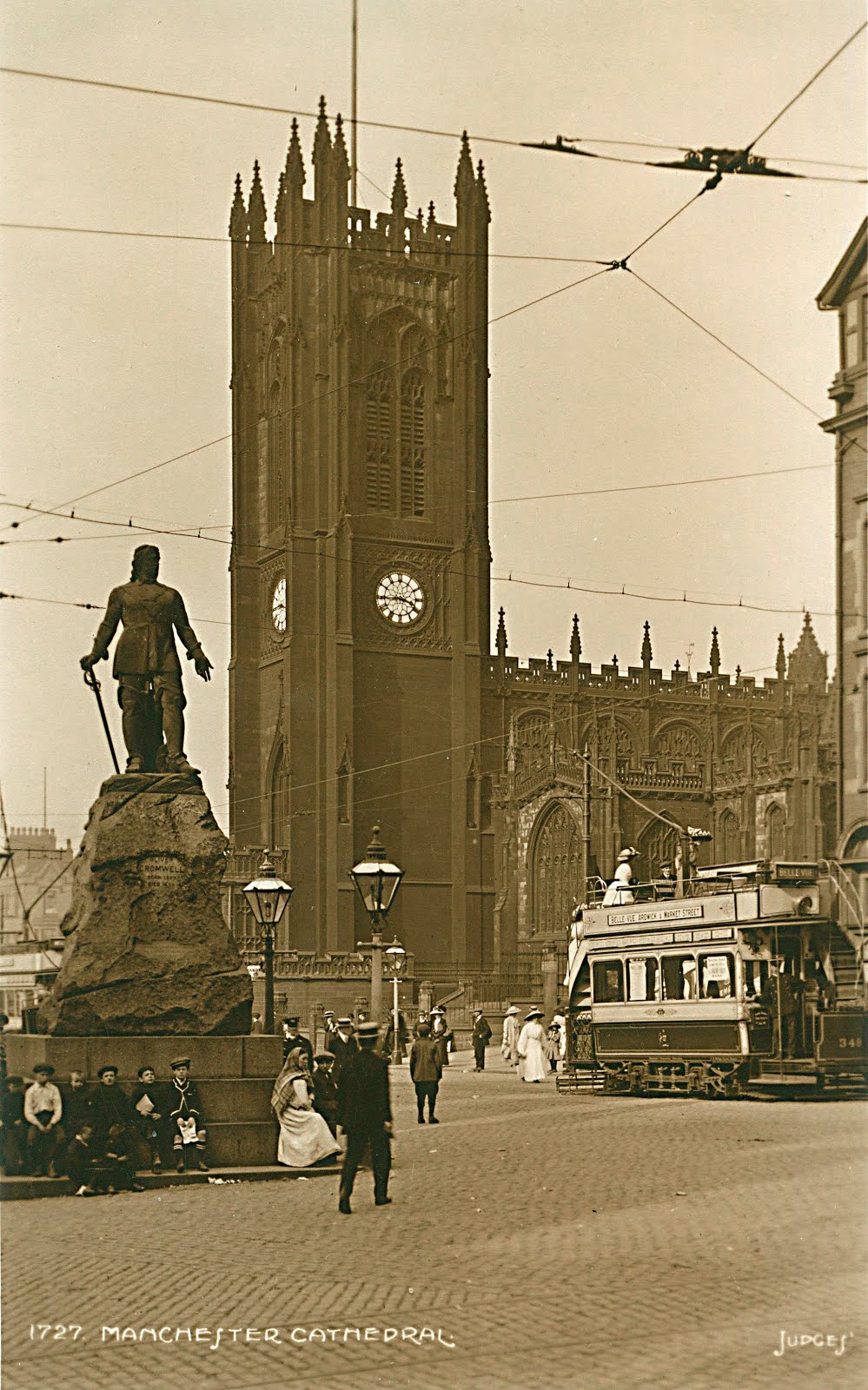
The woman in a shawl at the foot of Oliver Cromwell in the summer of 1914


It’s the last of my Judge postcards. 

Like the others in the series which Fred Judge took in the summer of 1914 it has much going for it not least because it isn’t the standard view.

Instead we have the statue of Oliver Cromwell matched by the Cathedral behind and balanced by the building to our extreme right.

But for me it is also the figures he has captured sitting on the steps.

There is the mixed group of boys including one in school uniform and beside him what might be a paper seller and the others, two of whom are engaged in a game.

And there is the woman in the shawl not at all interested in the camera deep in thought or perhaps listening to the chap next to her.

She is interesting because you rarely see women in shawls in post cards of the period.

They were there in the city and were often the subject of pictures taken on the poorer streets.

She makes a fitting contrast to the more elegant woman with their fine hats and expensive looking clothes off in the distance.

I wish I knew more about her, or for that matter the group standing by the tram, which is heading up to Market Street.

I can’t be sure but I rather think it is a Sunday sometime in the summer, partly because this is from the same series of pictures Fred Judge took around Manchester and may well be the next after the one on Cross Street.

In his photograph of Albert Square from Cross Street the time is just before three in the afternoon and here beside Oliver Cromwell the Cathedral clock is just coming up to a quarter to four.

Which was just enough time for him to stroll down and set up here.
The crowd by and large are oblivious to his presence and just get on with the day, some no doubt heading on to Bell Vue which is the final destination of our tram.


Picture; from the collection of V & G Harris

Saturday, 16 March 2024

In St Ann’s Square with the Rotary Photo Company …… sometime in the early 20th century

Now if you wanted proof that St Ann’s Square has always been a busy and fussy place, the evidence is here in this picture postcard.

I don’t have a date, but I am guessing we are sometime in the early 20th century, and a bit of detective work using the names of the shops and street directories will get close to when the picture was taken.

Everyone will pick up on some different bit of the picture, from the line of taxis and the cabby’s hut, to the throng of people parading through the square and that female cyclist.

And then there is another story around the company who published the picture postcard.

I had causally thought that Rotary Photo, EC were a Manchester firm, but not so.

According to that excellent site, Graces Guide to British Industrial History, they were a London business with offices at 23 Moorfields London, with works at West Drayton.

They were established in 1901, as The Rotary Photographic Co and “was a huge publisher of real photo postcards. 

One of their unique novelty postcards was a 1¾ inch x 5½ inch (4.4cm x 13.9cm) photo series of bookmark cards. Most seem to have been posted in the 1903-04 period".

Later in the century they amalgamated with other photographic companies and were still in business in 1947.

Location; St Ann’s Square

Picture; St Ann’s Square, date unknown, courtesy of Steve

*Graces Guide to British Industrial History, https://www.gracesguide.co.uk/Rotary_Photographic_Co

Painting Well Hall and Eltham ....... nu 2 the Greyhound

An occasional series featuring buildings and places I like and painted by Peter Topping.

I always remember this as the Greyhound and it will have been one of the first pubs I went into when I was old enough and so I asked Peter to paint it using a photograph taken by Chrissy Rose.

Peter and I have been working together on projects for almost a decade including two books and an 80 meter installation along with various smaller displays and plenty of commissions.

And next time I am home I might book to eat in the restaurant.

Location; Eltham, London


Painting; Ye old Greyhound © 2015 Peter Topping from a photograph by Chrissy Rose 2014

Web: www.paintingsfrompictures.co.uk

Facebook: Paintings from Pictures https://www.facebook.com/paintingsfrompictures