Saturday, 22 August 2026

Lost and forgotten streets of Manchester nu 39 ............. the mystery of the moving street

Now this entrance looks as if it should go somewhere and back in 1851 it did.

What should be Back Spear Street, 2016
This is Back Spear Street which is off Spear Street.

Spear Street  is one of those streets that connects Hilton Street to Great Ancoats Street.

It is narrower than Oldham and Lever Streets which run parallel but it still offers up some interesting sights including a few of those new wall painting which are everywhere in the Northern Quarter.

And it has a mystery in that Back South Street seems to have moved.

On the 1849 and 51 maps it is directly opposite Faraday Street and contained seventeen properties along its length which ran off Spear Street and then took a right to run parallel with its name sake.

In time I will go looking for its residents, and that search might also reveal why what is now called Back Spear Street starts a little further north and still has an echo of that dog leg set up.

Back Spear Street, 2016
I must admit that at first this did confound me but Goads Fire Insurance map and the current street plan place it closer to Warwick Street than it was.

I don’t have an answer and I suspect the search might not prove doing.

So instead having featured the entrance to the old Back Spear Street and its rival I shall close with the building that stands beside our earlier one.

In 1851 this spot was listed as livery stables, from where a Mr William White ran a coach business.

Almost thirty years later it was the site of a glass manufacturer and by 1903 was specializing in the manufacture of millinery products.

The building beside the old street entrance, 2016
I can’t date our building and so it will have to be a trawl of the rate books but it does post date 1851 and having been at the mercy of the fly poster it does now have one of those Northern Quarter paintings.

And that just leaves me with the mystery because if you follow the directories over the years Back Spear Street seems to where I first found it but that conflicts with our maps.

All very strange.

Which just leaves someone to come up with the answer.

Location; Manchester

Pictures, Spear Street up and down its length, 2016 from the collection of Andrew Simpson

Walking Well Hall ......... past the station and then the climb up to the High Street

Now anyone who walked up to the High Street from anywhere along Well Hall Road may well have wondered about these houses.

I was always fascinated by how high and set back they were from the road and was always particularly intrigued by the one with high wall and brick entrance.

And I remember the time when one of the occupants excavated all that land in front of their house to create a car space which must have been in the late 60s or early 70s.

In time someone will post on the history of these properties.

Tricia’s picture, she thinks, dates from the 1930s and certainly the tram lines  will date it to before the end of the 1940s.

When I regularly walked Well Hall from our house just beyond the roundabout which will have been thirty or so year after the picture was taken little had changed.

And I still remember the school friend who lived on the opposite side of the road.

She was called Deboarah, was a year below me at Crown Woods and went off to train as a teacher.  Alas our paths never crossed again.

Many others remember those houses.  My friend Jean thought they were posh while Lesley like me passed them many times on foot.

For me it was the return journey back from the High Street, which was just that better with its view down the slope to the station and then that steady rise away in the distance that took in the Odeon and the woods.

So thank you Tricia for posting the pictures.

Memories are made of these.

Location; Eltham

Pictures; Well Hall Road, circa 1930s, courtesy of Tricia Leslie

From green fields to gas works, the Reverend William Birley’s change of parish in 1859


In 1859 the Reverend William Birley had left Chorlton where he had been for seventeen years exchanging the small rural living for one in the  in the heart of Salford.  

This was St Stephens* and it was surrounded by rows of terraced housing which hid smaller houses and dark courts as well as the gas works, timber yards, iron works and cotton factories .

To the west and north the area was cut off by the river and to the east by the railway.

The contrast between the two places could hardly be starker.  During the day there was the noise from the countless factories, mills and foundries, while at night the clunk of shunting railway wagons and the whistle of steam locomotives carried over the roof tops.  Added to this was the all pervading smell from the gas works and the ever present pall of smoke from countless domestic fires and factory chimneys. **

But this was just the outward appearances of a hard and grim parish.  In the area bordering the church most were engaged in manual occupations.    Many of these were best described as pauper trades,

“for the wages can never enable a man to rear a family in independence.  Street sweepers, night soil men and policemen, handloom weavers and cotton dyers, hawkers, strikers in foundries, minders of planning and drilling machines, railway porters and the whole range of labourers, ....their wages varying from 12 to 18s [60p-80p] per week.  Deduct from this highest sum of 2s 6d for rent and how can a man keep and clothe himself, wife and four or five children on the remainder?”***      

These were also physically demanding jobs which could be dangerous.

Nothing perhaps prepared the casual visitor to the scene in the gas works as the men cleared the coke from the ovens and transported the red hot material on hand waggons, or the noise, dust and repetitive labour of the spinning room of a mill.
Perhaps it was the wish to bring a message of religious hope to such a place which motivated William Birley.

After all the income at St Stephens’s was £145 a year which was just £42 more than he had received in income from St Clements’ in the township.****    His sense of duty had also led him to sit as a Poor Law Guardian while still living in the township and later became an Inspector of schools for the county.*****

He was comfortably well off having described himself as of independent means at the 1841 census, held shares in a number of railway companies and was a director of at least two companies.  

He chose to live some distance from his parishioners in Leaf Square.  This was a pleasant and elegant spot separated from Greengate and St Stephen’s by a double loop of the river, and further isolated by the Manchester, Bolton and Bury Canal, and the Lancashire and Yorkshire Railway.

Looking out from his windows he had an uninterrupted view of the delightfully laid out square, and across open land to the river and Peel Park beyond.  Only the railway and canal could be said to act as mild blots on what was otherwise a fine vista.

Moreover his neighbours were drawn from the same genteel class.  They included a property owner, retired solicitor, fellow cleric, an iron merchant and those on independent means.      As would be expected all had a variety of servants, housekeepers, cooks and governess’s to ease their comfortable lives.

True there were nearby examples of industry in the form of cotton and flax mills, a dye works and brewery but these were surrounded by open land and houses with large gardens.   Even the rope walks which were some distance away between the square and the railway could not have been said to distract from what was a pleasant place.

St Stephen’s, it has to be said was more impressive than our own church in the township.  It was made of plain brick, dated from 1794 and was reckoned by contemporary observers to be comfortably fitted, containing three galleries and an organ.   All of which made it bigger than ours and with its tall classical tower and two floors it stood out from the village church William had previously preached in.***

But then it was set in the middle of Salford, with a timber yard running alongside the graveyard and a  foundry at the back of the church.   Just across the road towered the gasworks and a little further away was the rope works.

There is more on William Birley, the book. The Story of Chorlton-cum-Hardy, http://chorltonhistory.blogspot.co.uk/2011/11/the-story-of-chorlton-cum-hardy.html

Pictures; St Clements Chorlton-cum-Hardy, from the OS map of Lancashire, 1841-53, and St Stephens in Salford & Leaf Square, from the OS map of Manchester & Salford, 1844-49, courtesy of Digital Archives, http://www.digitalarchives.co.uk/

*Duffield, H. G., The Strangers Guide to Manchester 1850, 29, , The church was demolished in 1962 and the site is now a small park between Trinity Way and St Stephens Street.

**In the 1861 census these comprised the enumeration districts of numbers 7, 8, 9 , and 10, where the occupations included labourers, warehouseman, textile workers, foundry workers, laundresses, and porters

*** Watts, John, The Facts of the Cotton Famine, Simpkin, Marshall & Co, Manchester 1866, page 99, Google edition page 120

****Lewis, Samuel, A Topographical Dictionary of England, S Lewis & Co Vol 1& 3 1840

*****He held shares in the Birkenhead, Lancashire and Cheshire Junction Railway and the Fleetwood, Preston and West Riding Junction Railway [Preston Guardian December 24 1846], and  was a director of the Socttish Amicable Life Assurance Society [Manchester Times Saturday February 17 149], and the Manchester and London Life Assurance and Loan Association [Manchester Times Saturday March 12 1853],

Friday, 21 August 2026

Poverty…. gas masks ….. going to the flicks …. and a night in Chorlton ….. stories from Madeline Alberta Linford

Madeline Alberta Linford was by any measure a remarkable woman.

Madeline Alberta Linford, 1921
At just 22 in 1917 she was writing for the Manchester Guardian, at 27 she had reported on the famine and typhus outbreak in Poland followed by on-the-spot reporting from Austria, and Germany.

In the same year she was chosen to create to create a page "aimed at the intelligent woman", defined by C. P. Scott  as discussing issues such as "domestic economy, labour-saving, dress, household prices, and the care of children".*

And she remained the only woman journalist on the Manchester Guardian till 1944.

During the war she was also night picture editor, combining it with voluntary war work.

She “wrote a biography of Mary Wollstonecraft, published in 1924, and five novels: Broken Bridges (1923), The Roadside Fire (1924), A Home and Children (1926) Bread and Honey (1928) and Out of the Window (1930)”.* 

To all of this she also championed other women writers.

I first came across Ms Linford when Tony Goulding wrote about her life for the blog back in 2023.** 

It is a comprehensive account of her life and particularly her time in Chorlton on Claude Road and Wilbraham Road and is an excellent starting point.

My interest was reignited after a chance conversation with Cllr Mathew Bentham whose friend now lives in her old house in Chorltonville.

August 1917
As you do, I went looking for her articles in the Manchester Guardian. 

Alas her stories on Poland, Germany and Austria have yet to turn up, but there were plenty of articles spanning her years as a critic reviewing plays, and films as well as those reporting on contemporary issues.

Reading them for the first time over a century since they were produced, they offer up a fascinating insight into Britain during the early and middle decades of the last century.

And there were some surprises, not least that in 1917 both here and in Hollywood films were being made in colour.

Her review of Annabel’s Romance in the August of 1917 at the Deansgate Picture House begins with that simple observation that “A coloured film is still rare” **, while five years later she playfully remarked that the colour effects in A Study in Scarlet made “Faces as expressionless as though a sponge had wiped the life out of them”.****

Deansgate Picture House, 1928

But for me it is her articles on hospitals, shopping and the impact of the war which bring the 1920s and 30 bouncing into life.

December 1922
Like the piece on the Manchester Babies’ Hospital in Burnage Lane, written in 1922 which is both informative and written with style.

She visited in late December when “the hospital is in party dress [with] its Christmas decorations which are simple and consist of silvered twigs latticed across windows with robins perching on them, trails of pink almond blossom, and bright ballons tugging at their strings.”*****

But this is 1922, in that time before the NHS when poverty is the main reason why the fifty-bed hospital is full and why “the fifty cots could be filled over and over again”.

“All of them are suffering in some way or another from malnutrition.  They come from the most destitute homes in Manchester where their poor little bodies have been the victims of ignorance, poverty and in a few tragic cases, of actual neglect … where all the good things of life are short”.

Manchester Babies’ Hospital, 1962
“Children of six months weighing only six pounds; newborn babies whose weight barely reaches three pounds. 

The wards are full of them, lying with terrible apathy in their cots, their faces wizened and furrowed like those of the very aged, and their waxen fingers as helpless as broken ones. Anyone who since the war has visited the infant welfare centres of Berlin or Vienna will find the tragedies all over again in this Manchester hospital.”

And because rickets marches with poverty “the conservatory has been turned into a semi-open-air ward for rickets”.

Equally telling is the admission of just how much money is needed to maintain and advance the care. So, while “The Babies’ Hospital is full of plans for the future and a laundry is now being built and X-ray department is one of the great needs [with] it is hoped an extension to enable another twenty babies to have their shire of skill and kindness but for these schemes as well as the ordinary everyday running of the hospital money is badly needed”.

It is a powerful piece of reporting which comes with the style of an accomplished writer and so she begins by locating the hospital in a “big old house of the type of successful businessmen built for their families half a century ago. One can imagine it furnished in mahogany and rep with steel engravings of ‘Pilate’s Wife’s Dream hanging in the hall and camellias cherished in the conservatory”.

That same playful way of writing is evident in a series of articles she wrote in the run up to the first war time Christmas of 1939.

Set against the novelty and danger of going out in the blackout, and the surprise that the shops almost had a prewar feel about them the ever-present conflict is not far away and includes a delightful and humorous take on what the fashionable woman looks for in a bag to contain her gas mask.

July 1947
And along with all the serious and the not so serious comes a review of our own “Chorlton Repertory Theatre Group which has been an enlivening feature of Chorlton-cum-Hardy and the neighbouring suburbs”.

Written in in the summer of 1947 it reviews the group’s “choice of plays, performed in the Public Hall ranging from Shakespeare to Noel Coward and to farces which had caught the fancy of West End audiences” and focused on “The Letter” by W. Somerset Maugham.

It is a well balanced and I think affectionate report and offers up the names of some of the actors.  These include Harry Littlewood, Gloria Foster, Arthur Spreckley, the producer, and James Lovell who “designed and painted the excellent sets” which might be another story. 

One to read, 2024
But for now, I will just leave you with a suggestion to read a review by Quentin Outram of a selection of Ms Linford’s writing “M.A.L” The Journalism and Writing of Madeline Alberta Linford" edited by Michael Herbert and published in 2024

Pictures; Portrait of Madeline from the Guardian’s photograph of its 1921 editorial staff researched by Tony Goulding, Manchester Babies’ Hospital in Burnage Lane, m15731, 1962 courtesy of Manchester Libraries, Information and Archives, Manchester City Council, http://images.manchester.gov.uk/index.php?session=pass Deansgate Picture House, from Kinematograph Year Book, 1928

Further reading; Outram, Quentin, The Journalism and Writing of Madeline Alberta Linford, Society for the Study of Labour History January 3rd 2023, https://sslh.org.uk/2025/01/03/the-journalism-and-writing-of-madeline-alberta-linford/

Herbert Michael,[ed] “M.A.L” The Journalism and Writing of Madeline Alberta Linford, self-published through Lulu.com and available Society for the Study of Labour History, https://sslh.org.uk/

* Madeline Alberta Linford, https://en.wikipedia.org/wiki/Madeline_Linford

**Madeline Alberta Linford .... another story from Tony Goulding, https://chorltonhistory.blogspot.com/2023/12/madeline-alberta-linford-another-story.html

***A Coloured film at Deansgate Picture House, Manchester Guardian, August 21st, 1917

****A Study in Scarlet, Manchester Guardian, February 24th 1922

*****A Hospital of Cots, The Sick Babies of Manchester, Manchester Guardian, December 29th, 1922

******Chorlton Theatre Group, Manchester Guardian, July 30th, 1947


Touching our history 18th century silver from the old parish church


It is for me one of the most exciting things about crawling around in the past and it is when you get to touch something you have written about.

It is as if the very act of holding it in your hands links you to every other person who has ever picked it up.

Now over the course of the last few years I have come across many documents, pictures and things which came my way as I wrote the book*.

And as I promised to run stories about how the book was written this seemed a good moment to start.

The first is  the silver tankard donated to the church in the 1730's and used and seen by congregations in the old parish church until well into the 20th century.

The second is the minute book of the meetings which ran the township during the 19th century.

They cover the period 1839 through to the 1850s and document who was appointed as the officers including the constable, those responsible for the highways and assessing the rates as well as decisions on how our money should be spent.  There in the handwriting of Edward Smith are the names of the men who sat in the old school house on the green and carried out the business of local government.

I suppose it is a little daft but each time I use the book I am conscious that perhaps only three or four other people have turned its pages since it was written 160 years ago which is a great shame because here are the voices of the committee trying to grapple with the mundane and the deadly serious.

In 1850, James Higginbotham argued that because the services of the constable had not been called on during the year before “there should be no Constable returned for appointment this year.”  

And when the decision was repeated in 1853 it was as James White said because “the Township is sufficiently protected by the County Constabulary that there be no special constables returned.” It was a decision which must have sat uncomfortably with many who reflected that the previous decades had been marked by all manner of crimes and disturbances.

And only went to underline the serious loss of money from the Committees' own accounts just two years earlier.


* The Story of Chorlton-Cum-Hardy
http://chorltonhistory.blogspot.co.uk/search/label/A%20new%20book%20for%20Chorlton

Picture; of the tankard from the collection of Andrew Simpson, 2011


At the opening of the Well Hall Odeon, May 20th 1936

Now it would be a full 28 years after the Well Odeon was open that I first saw a film there.

And of course I have no idea what the film was or for that matter almost any of the pictures I went on to see at the place.

But it was a regular haunt made more so because I had the job of taking my sisters there on a Saturday morning.

Of all the picture houses I have been in there, was something special about the Odeon.

It started with that unique box office in the centre of the foyer, that thick carpet, the decor and of course the smell.

Put them all together and you felt that this was somewhere special, a place not only to be entertained but a place where for a few hours the daily routines along with the niggles of the day could be forgotten.

And these picture houses were designed for just that purpose.  Plenty of homes back in 1936 were still austere places little in the way of luxury and by comparison drab and dim and cold.

But the Well Hall Odeon radiated style from that tall glass and tiled tower to the sweep of the entrance roof.

And it was big. It dwarfed the houses that surrounded it stretched back and was only really challenged by the church opposite.

So I am really pleased that Chrissie shared the souvenir programme with me.

Location; Well Hall, Eltham, London

Picture; souvenir booklet of the opening of the Well Hall Odeon, 1936 courtesy of Chrissie Rose

Thursday, 20 August 2026

Lost stories from Chorlton’s graveyard ………

 I am looking at a picture of our own parish graveyard sometime in the late 1970s and it records a scene which has long gone.

When the gravestones were numerous. 1979
Many of the gravestones would be removed during the make over which turned a neglected and forlorn spot into a pleasant recreational area.

In total there had once been 361 monuments to those who had been buried in the graveyard, but only a few survived the rest are lost to us.

And that of course is a terrible loss, both for the descendants of those who were interred here and also to the historian wanting to uncover Chorlton’s past.

Because here had been buried the people of plenty, along with the less wealthy, ranging from farmers, tradesmen to the families of farm labourers.

The Stopford family, 1979

The earliest recorded burials date from the mid-1700s with the possibility there may have been some from the previous century.

We do have the parish burial records along with an inventory made in 1975 of the 361 gravestones, but that will never be the same as standing in front of them and reading not just the names but also the messages that were left.

The Isherwood family, 1979
Like that of William Barlow Stopford who “fell asleep in Jesus” aged just 23, who was buried with his father who was 31 when he died and William’s brother Frank who died on November 14th just 19 months old. 

Sadly, their gravestone is one of the missing ones, along with that of the Isherwood family, whose gravestone records the names of six, two of whom died at 8 and 14 months.

In time I will go looking for their stories but for now all I have are pictures of their gravestones and the locations of where the two sat.  The Stopford’s rested just east of the lych gate and was the first you would encounter on entering the graveyard while the Isherwood plot was one of six graves that rested against the south wall of the church.

I wish I had taken more on what must have been a spring day in 1979, but soe far I have only turned up the two images amongst the 1500 or negatives which I am slowly digitalizing.

There may be more but at present that is it.

Location; the parish graveyard

Pictures; lost scenes from our parish graveyard, 1979, from the collection of Andrew Simpson


Stories from my pasta bowl ……

Once every two decades I have a clear out of the books on the shelves.

Of course, there are some I will never part with because they were inherited from my parents or given as gifts from someone special, and like the scratches on an LP they are books which instantly take me back to a girl friend or a significant moment.

And then there are the cookbooks of which I have plenty. 

Most have been acquired after holidays with the fruitless attempt to replicate a dish but are more about recreating a night when good food mixed with interesting company and made for a magic night.

We have all had them and most of mine were in southern Italy or one of the Greek islands.  

The food was simple but delicious and the house wine came in anything from a rustic jug or on one memorable occasion at the foot of the Acropolis in a recycled glass bottle that had once held orange juice.

The best of these cookbooks come with stories which can be anything from the history of the dish to the region they came from, or just the people who cooked them.

What most of the recipes have in common is that they are simple and are really just a rehash of what is available and will change depending on what is in the garden or in the market that day.


And so long ago I stopped being precious about recipes and just went with what I found in the larder or the fridge or what was in season and on sale.

Not rocket science I know but worth restating.

So yesterday I tossed some pasta with a light tomato sauce, a bit of cauliflower and a handful of olives, while the day before it was pasta and peas with a splash of olive oil and pecorino.

And tonight I might cook up some mushrooms and garlic in cream or green beans and tomatoes with fresh basil, only leaving the serious decision as to whether to accompany them with rice, pasta or something else.

Alas I cannot dredge up any stories of encountering a Sicilian peasant or Greek farmer who offered up the secrets of these dishes.

Mine were made up and while they owe something  to heaps of dishes I have eaten across Italy and the islands, they were just made up.

But then always being an inquisitive chap and willing to talk to those in the know, I was always prepared to ask about the meals we were served.

And that led on quiet evenings to the invite into the kitchens and my favourite dishes in preparation.


So on one eventful night I shared the individual secrets of the chef on how she made green beans and Gigantes. 

We were in a small taverna on  Kefalonia looking out on the sea on the night that the news broke of the death of the late Queen.

As that news  filtered out on countless mobile phones my own memorable revelation paled against the bigger story.

But I came away with the knowledge of how to make two of my favourites dishes and a bonus account of how our chef served up grilled halloumi during a power cut amidst a thunderstorm. 


Pictures; cook books from the kitchen, and dishes I have made, 2026, from the collection of Andrew Simpson


Visions of the future .... Orangery Lane, Eltham as it might have been

Now I have always been fascinated by how planners have thought the future might turn out.  


So here are two views of Orangery Lane as it was in the early 1970s and how it might have been.


Pictures; from A Future for Eltham Centre, Greenwich Borough Council, 1975

Joseph Johnson, radical, farmer and almost a Didsbury Radical

The Peterloo Massacre still has the power to shock and ranks alongside the Sharpville Massacre in South Africa in 1960 and the Kent State killings in Ohio in 1970 as a moment when peaceful demonstrations were met with the full ferocity of State power.*

And it is of Peterloo I want to think about today and in particular the part played by Joseph Johnson, one time radical who lived in Northenden and whose political past gave rise to a potato being called the “radical.”

Now as many of you know I am searching for our radical past here in Chorlton, not out of a nostalgic wish make the place politically correct but because it seems to me that there would have been people here with views that ran directly opposite to those of the establishment and the wealthy.

There is evidence that there were people from both Stretford and Urmston present at Peterloo, and this shouldn’t surprise us either.  Both were places where there were significant numbers of weavers and these were a group who had become radicalised as their industry went into decline.  So according to one source 151 of those wounded at Peterloo were weavers, which represents 50% of all casualties whose occupations are known.**  And we had some weavers.

So it is not beyond the bounds of possibility that we made a contribution to that 80,000 strong crowd, but that is where at present we have to leave it, with just a maybe.

His home in 1905
That does still leave me with Joseph Johnson, who was on the platform in St Peter’s Field, during the Peterloo Massacre and was arrested for “assembling with unlawful banners at an unlawful meeting for the purpose of inciting discontent,”  found guilty, and on his release in 1821 settled in Northenden.

He was born in Manchester which some sources narrow down to Didsbury in 1791 and became a successful brush maker.

A strong supporter of universal suffrage and annual parliaments, Johnson joined the Manchester Hampden Club formed by John Knight. In 1818 Johnson helped John Knight, James Wroe and John Saxton to start the radical newspaper, the Manchester Observer. Within twelve months the Manchester Observer was selling 4,000 copies a week. Although it started as a local paper, by 1819 it was sold in most of the large towns and cities in Britain. Henry Hunt called the Manchester Observer "the only newspaper in England that I know, fairly and honestly devoted to such reform as would give the people their whole rights."

In March 1819 Joseph Johnson, John Knight and James Wroe formed the Patriotic Union Society. Johnson was appointed secretary of the organisation and Wroe became treasurer. The main objective of the Patriotic Union Society was to obtain parliamentary reform and during the summer of 1819 it was to hold a meeting here in Manchester at St Peter’s Field.  The rest as we know was a tragic outcome, and one which in its way was no less awful for Johnson.  For after being imprisoned his wife fell ill and died and he was refused permission to attend the funeral. ***

On his release he settled in
Northenden and we can track him in the village from 1841 through till his death in 1872.  During that time he gave his occupation variously as brush maker and later land proprietor and it will be as such that he planted potatoes which became known as “radicals” 

A fact that might have been lost to us had not another radical who described his visit to Chorlton in the June of 1847.  This was Alexander Somerville who having crossed over the Mersey recorded that

‘My companion said-“It was in this way; it was a sort of potato introduced here by Mr Johnson of Northern; and as he was a radical, they called the ‘tatoes radicals too.  Don’t you remember the song that used to be sung?  ‘God Bless Hunt and Johnson, and all who take their part;’ that was the Mr. Johnson, now of Northern, a very good gentleman he is who brought this very good kind of potato here which they call radical.”’

Which should really be the end of the story but I shall close with his will.  On his death he left £2000 and was described as “gentleman.”  I wonder if he would have approved of the description.

Pictures: Courtesy of Manchester Libraries, Information and Archives, Manchester City Council Peterloo, 1819, m77801, Ravenswood home of Joseph Johnson, 1905, m36100, Veterans of Peterloo 1884, m07594

*On an August day in 1819, anything between 60,000 and 80,000 men, women and children had assembled in St Peter’s Field to listen to the case for reforming the representation of Parliament.  Just before 2 in the afternoon a unit of Cavalry charged into the crowd with their sabres.  The deaths resulting from that charge have never been exactly established but sources claimed between 11 and 15 people were killed and up to 700 injured.  At Sharpeville in March 1960, after a day of demonstrations, the South African police opened fire on the demonstrators, killing 69 people. At Kent State University in Ohio, four students were shot and nine wounded by the National Guard during a peaceful protest at US involvement in the Vietnam War.

**Bush, Michael, The Casualties of Peterloo, 2005

*** http://www.spartacus.schoolnet.co.uk/PRjohnson.htm


Wednesday, 19 August 2026

The grim side to some of our Manchester pubs

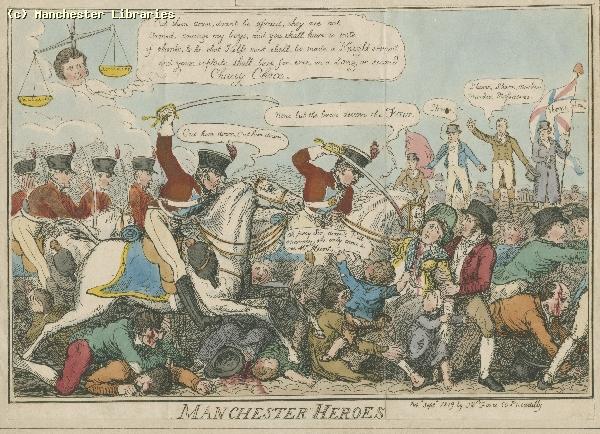
Now I am back with Peterloo and the dastardly actions of the Manchester Yeomanry who on August 16th, 1819, charged a peaceful crowd in St Peter’s Fields, leaving many dead and wounded.

The Manchester Yeomanry in action, 1819
And over the last few days I have been exploring* the background of the 101 men listed in the Northern Star as participating in the outrage.**

We can track the occupations of 87 of them, and they represent a cross section of the population, with over a third drawn from the “people of plenty”, another 29% who made their living as publicans and shopkeepers, which left the rest as a mix of skilled, and manual workers, with the odd surprises which include a “Professor of Dance” and a quack doctor.

But today I am interested in the nine publicans.  They were William Bowker of the King's Head at 4 Old Shambles, John Beeston who ran the Windsor Castle in Salford, and later took over the George at 47 Deansgate, and William Benson of the Fox at 1 Jackson’s Row.

The Briton's Protection, 2016 as seen in the book
To these three we can add Mr. Burgess of the Hen & Chicken on 163 Deansgate, Parker Horsefield of the Briton’s Protection on Waterloo Street by Great Bridgewater Street, Edward Hall of the Blue Cap at 80 Greengate, Jacob Chadderton who offered up beer and cheer at the Wool Pack in Pendleton, John Reid of the Globe, Gartside Street and Samuel Lees of the Crown and Thistle, 9 Half Street, Manchester.

Of these I am pretty sure that only one of the nine pubs still in business is the Briton’s Protection, but some will have lasted longer than others.

So, while the Blue Cap on Greengate had vanished by 1850, the Windsor Castle on New Windsor in Salford was still there thirty-one years after Peterloo.

The Windsor Castle Salford, 1850
Had I come across this bit of information back in 2016, it might well have been included in our book on city centre Manchester Pubs, that said as the book is only about ones you can visit today that would have limited the inclusion of the Manchester Yeomanry landlords to just the Briton’s Protection.

That said, I see no reason why I shouldn’t pursue the remaining eight, starting with the Fox on the corner of Deansgate and Jackson’s Row which was still selling happiness or sadness in 1844, but now sits under Onward Building.

So in the fullness of time we  shall see just what can be found out about the two Salford pubs and their landlords, followed up by the more  Manchester landlords and their pubs.

The Fox, Jacksons Row, 1844
Location; Manchester and Salford

Pictures; "Manchester Heroes", Peterloo, print from etching by unknown artist, published by S W Fores, 1819, m07587, courtesy of Manchester Libraries, Information and Archives, Manchester City Council, http://images.manchester.gov.uk/index.php?session=pass, New Windsor, Salter’s Street Directory, 1850,  The Fox Inn, Jackson’s Row, 1844, from the OS for Manchester & Salford, 1844, courtesy of Digital Archives Association, http://digitalarchives.co.uk/


*The Manchester Yeomanry, https://chorltonhistory.blogspot.com/2019/08/exploring-butchers-of-peterloo-101-men.html

**The Northern Star, Chartist newspaper, August 20th 1842

*** Manchester Pubs- The Stories Behind the Doors, Centre Centre along with  our two companion volumes,  Manchester Pubs- The Stories Behind the Doors, Chorlton-cum-Hardy, and  Manchester Pubs- The Stories Behind the Doors are available from www.pubbooks.co.uk and Chorlton Books

Snaps of Chorlton nu 16 .............. on Beech Road with Mrs England just 52 years ago

Now I can’t be exactly sure of when Mrs England posed on Beech Road for this photograph but it will be sometime before 1974.

And it is a scene I will have missed by just a few years, because while I remember Threshers, the old frontage of Ettchel's and Richardson’s it is the absence of Ivy Court opposite the Rec which fastens the date to sometime before 1974.

Look closely and just beyond the car on the right is the outline of the farmhouse which was demolished to make way for Ivy Court.

There will be plenty of people who still remember Mr and Mrs Riley who lived there in the 1960s and there will even be some who remember being sent for milk from the dairy.

My old friend Marjorie had the regular job of going across the road from the family home on Provis and had more than a few stories of the place.

But the farm stretched back into the 18th century and was farmed from the 1760s by the Renshaw family and later the Bailey’s who were still there at the beginning of the last century.

By the time they left for Park Brow Farm at the bottom of Sandy Lane Beech Road was pretty much as it was in this picture and there was a degree of continuity.

There has always been a news agents on the corner of what is now Beech Road and Chequers, and its companion premises has always been a fish and chip shop.

That said the rest of the parade of shops up to Wilton dates from later in the century while the Thresher frontage was changed sometime after Mason and Burrows departed the building.

So there you have it a little of the history of Beech Road at a time before now, and yes I will conclude with that obvious observation that there ain’t many cars to be seen.

And there I will leave it with just a big thank you to Paul England who allowed me to share another of his family photographs.

Picture; Beech Road sometime before 1974, from the collection of Paul England

Of town plans and visions of a future that never quite happened, Eltham in the 1970s and Manchester in 1945.


Cover of A Future for Eltham Town Centre, 1975
Nothing dates as much as those planning booklets issued by the Council as part of a brave new consultation process.

Of course at the time they look bold innovative and exciting, but go back to them 30 or 40 years later and many of them frankly just look embarrassing.

In most cases the plans never came to anything, or they didn’t work or worse still they did but time has over taken them and a new plan is called for.

But in their way they are as much a history book and a comment on past times as any learned piece of original research.

All of which was prompted by A Future for Eltham Town Centre, which fell through dad’s door sometime in 1975.  It was produced by Greenwich Borough Council and invited residents to “make your views known to the Council.”

Back of A Future for Eltham Town Centre
Like all such documents it rehearsed the problems, speculated on how these might develop and offered possible solutions.

As ever “increased trade has brought pedestrian/ traffic conflict and parking pressures and a growing interest by multiple chain stores accompanied by a reduction in the smaller family business.”*

Added to this were issues of parking, demand for more office space, a need to accommodate more community services, while recognising that it was desirable "to promote the provision of residential development, some small service industry and some open space within Eltham town centre.”

It is a litany of concerns which could apply to many urban areas and no doubt our own planners in the town hall wrestled with similar issues here in Chorlton.

And like everywhere many of the opportunities for change were constrained by the amount of space, lack of money and other priorities.

But the planners did their best offering ideas to retain and plant more trees and improve the green spaces on the north side of Eltham High Street and suggesting a multi story car park down Orangery Lane as well as developing the reservoir.

Plan for the top of wel Hall Road
My own favourite was the idea of a small Town Park “on the disused part of Eltham Cemetery and a community centre beside the parish church, which would involve moving the public lavatories “when an opportunity occurs.”

Like so many planning ideas it would seem that the opportunity never did occur.

But I think I may be a little unfair on the planners given the constraints they faced.

So how much more of a problem was it for the town planners here in Manchester in the closing stages of the last world war?  They too were well aware of what they could do, but at the same time were galvanised by the issues of a tired looking city where many of the inner city  residential areas were no longer fit for purpose and some of the commercial areas showed the effect of haphazard development during the past century.

Trinty a new station for Manchester,  1945, from the Manchester Plan
Of course what they had in their favour was the wide open spaces which had been made by enemy action and a will shared by both politicians and planners to do something decent for the city.

Theirs was a bold plan which envisaged broad new avenues, People’s Places and rationalization of work, traffic and leisure along with new social housing.

The 1945 Plan for Manchester fitted an optimistic age fired by that post war belief that this time things had to be made to better.

Each time I go back to it I still get excited but do have to admit that I am pleased that not all of it came to pass, for while the slums would have been banished, new pleasant public places would have replaced the twisting dark courts and alleys, we would also have lost many fine Victorian buildings.

The People's Place, All Saints, 1945, from the Manchester Plan
Some still went under the commercial projects of the late 1950s and 60s but many more have survived.

The 1945 plan no less than the consultation document for Eltham in 1975 may not have gone the wayt he planners wanted but they do take me back to another time.


*A Future for Eltham Town Centre
** The 1945 Plan for Manchester, http://chorltonhistory.blogspot.co.uk/search/label/The%201945%20Plan%20for%20Manchester

Pictures; from A Future for Eltham Town Centre, Greenwich Borough Council, Planning Department, 1975, The 1945 plan for Manchester, Manchester Corporation, 1945


Tuesday, 18 August 2026

Trams across Warsaw

I like trams.  


And that affection stretches from the old tall and stately looking Corporation trams which for over half a century trundled across our towns and cities to their modern sleek counterparts.

Here in Britain, we did away with trams and instead embraced the motor-driven bus and that hybrid which was the trolley bus.

But many European cities and towns retained their trams and while the ravages of the last world war destroyed the cars and the rail network when peace returned the authorities turned back to them.  

In some cases, investment was slow but today they are an essential part of the transport scene.

All of which is a lead in to my visit to Warsaw and my opportunity to explore its fleet of red and yellow trams.


My Wikipedia
tells me that "The Warsaw tram network is a 146.2-kilometer (90.8 mi) tram system serving a third of Warsaw, Poland, and serving half the city's population. 

It operates with 726 cars and is the second-largest system in the country. 

There are about 25 regular lines, forming a part of the city's integrated public transport system organized by the Warsaw Transport Authority. 

Since 1994, the system has been operated by the municipally owned company Tramwaje Warszawskie sp. z.o.o.*

Now I can well believe that there 726 cars travelling the 25 lines, because where ever we were in the city we encountered them with our Josh happily opting to use them in preference to taxis.

That said he did take the occasional bus but preferred the trams.

At which point I could write about the history of the service which began in 1866, and which had its ups and downs, with low investment, it’s almost total destruction during the war, and the ill advised post war policy of relying on oil from the Soviet Union to power a fleet of buses so that Polish coal could be exported for hard currency and not used to generate electricity.


Even after the collapse of communism, investment was slow and it was not till 2005 that real money was spent to purchase new rolling stock and modernize the system.

Happily, today the trams whiz across the city.

Location; Warsaw

Pictures; Warsaw trams, 2026, from the collection of Andrew Simpson

*Trams in Warsaw, https://en.wikipedia.org/wiki/Trams_in_Warsaw


A history of Chorlton in just 20 objects number 20, a tram and the railway line that is 132 years old


Concluding the story of Chorlton in just a paragraph. They are in no particular order, and have been selected purely at random.

For my last object I have selected what must be the newest and one that takes our story into the 21st century.  It is a painting by Peter Topping of a metro tram near the station at Chorlton, and I think it is appropriate for many reasons.  The extension of the metro service brings back into use the old railway line.  When it was opened in  1880 it was a significant contribution to the development of the township making it possible to work in the city but commute home in just fifteen minutes to a pleasant enough place on the edge of open countryside.  So here there is continuity with the past but also the promise of things to come. And the painting is part of a new venture where Peter paints pictures of contemporary Chorlton and I tell stories of its past.  It works well enough and many of these can be read on the blog at  http://chorltonhistory.blogspot.co.uk/search/label/Chorlton%20artist%20Peter%20Topping%20in%20collaboration%20with%20Andrew%20Simpson and Peter’s full collection is available to see at http://www.gladtobe.in/

Pictures; ©Peter Topping 2011 www.paintingsfrompictures.co.uk