Thursday, 23 June 2016

The story of Private John William Ingham of the CEF and a thank you to all those in Canada who helped in the research

Now the story of John William Ingham of the 46th Battalion of the Canadian Expeditionary Force has taken yet another unexpected twist.*

The family grave of Mr & Mrs Ingham
He enlisted in 1916 was wounded at Vimy Ridge the following year and was buried in Southern Cemetery in south Manchester.

But he had died of his wounds in Sheffield at the Wharncliffe War Hospital and was brought back to Manchester because his wife lived in Longsight.

The Wharncliffe War Hospital was established in April 1915 from what had formerly been the South Yorkshire Asylum. 37,000 patients were to pass through the hospital during the war, and over 200 are commemorated on its Roll of Honour.

And there is an entry for John William Ingham, which I came across on that excellent site Wharncliffe War Hospital.**

What I was not prepared for was when I followed the link I came across his gravestone which is in Southern Cemetery and sits away from those of his comrades in the CEF.

I have Dean Hill and Stuart Reeves to thank for the image and it does help take the story a little further.**

I now know from the research by Linda Wisking and Melisa Dolan that he settled in Canada in 1910 giving his previous occupation as a “carter” and his intended one as “farmer.”

That said I am puzzled by the 1916 census which has him and all those on the page as living on Front Street, Yorkton, Saskatchewan. But I am sure someone in Canada will be able to shed light on my confusion.

Southern Cemetery, 2014
And this co-operation is what has made possible the story and points to the willingness of people to follow up leads and dig deep into the records.

It would seem that Private Irving had also been regarded by the authorities as a valuable asset given that his papers are stamped “British Bonus Allowed” which was commission paid by the Canadian government's Immigration Branch to steamship booking agents in the United Kingdom for each suitable immigrant who purchased a ticket to sail to Canada.”***

Not that the immigrants saw the bonus.

Detail of the Irving family gravestone
.But at least I have cleared up why he enlisted in the CEF and did not return to volunteer for the British armed forces because by the April of 1916 he was a Canadian national.

There is still the issue of why his family did not join him but perhaps they would have had not the war intervened.

Location; Southern Cemetery, and Saskatchewan

Picture; the grave of Private Ingham © Dean Hill and Stuart Reeves and Southern Cemetery from the collection of Andrew Simpson

* Looking for more British Home Children in Southern Cemetery, https://chorltonhistory.blogspot.co.uk/2016/06/looking-for-more-british-home-children.html

**Wharncliffe War Hospital, http://www.wharncliffewarhospital.co.uk/Wharncliffe6.html

*** Terminology and Abbreviations, Library and Archives Canada, http://www.bac-lac.gc.ca/eng/discover/immigration/Pages/terminology-abbreviations.aspx

Now here is a bit of a detective story for anyone in Whalley Range

Angela emailed me just now to ask “I wonder if your blog could appeal for anyone who can remember where the Quakers met in Whalley Range? 

Alexandra Park, 2014
According to Harold Wilde they met in Alexandra Park- not just at the gates, but in a building.  

It might be a house near St Bedes called something like ‘Edinburgh Court’ or ‘Edinburgh.’ 

There must be someone who remembers the place.”

Harold Wilde was a peace campaigner and conscientious objector during the Great War and refers to meetings he attended in his diary.*

The 1911 directory lists the Friends Meeting Houses on Mount Street, Albert Square, Langworthy Road, Pendleton and the Adult Schools at Byrom Street, Deansgate, Ainsworth Street in Gorton and Pendleton and Didsbury.

But Whalley Range fails to get a mention.  Nor could I find a reference to ‘Edinburgh Court’ or ‘Edinburgh’on Alex Road South.

So there for the moment it rests, but I bet as Angela says there will be someone out there who knows.
Failing that it will have to be the old fashioned way of the sleuth and a visit to the Friends’ Meeting House and Central Ref.

Location; somewhere in Whalley Range

Picture; Alexandra Park, 2014 from the collection of Andrew Simpson

* "my life will be spent in fighting the Christian fight against Militarism in England.”......... stories behind the book nu 19, https://chorltonhistory.blogspot.co.uk/2016/04/my-life-will-be-spent-in-fighting.html

Wednesday, 22 June 2016

Looking for more British Home Children in Southern Cemetery

Now here is a mystery to which at present I don’t have answer.  I had gone looking foe more British Home Children amongst the men of the Canadian Expeditionary Force buried in Southern Cemetery.

It is on going project in advance of Canada Day.

And I thought I might have found a third when I found a reference to Manchester as the place of birth of John Wiliam Ingham of the 46th Battalion.

He was wounded at Vimy Ridge in the May of 1917 and was buried in Southern Cemetery in south Manchester.

Private Ingham had enlisted on April 27 1916 in Yorkton Saskatchewan giving his occupation as a dairyman and he was 43 years of age.

What is slightly odd is that he died in Sheffield on the other side of the Pennines and was buried here in Manchester which is 71 kilometres way.

The explanation is simple enough, his wife, Mrs Ann Ingham was living at 5 Glebe Street off Stockport Road in the Longsight area of Manchester.

But that just begs another question which is why would he be in Canada and she over here?  I could understand how a much younger man might leave to start a new life and then send for his family when he was settled, but Mr Ingham was no spring chicken.

I know that in 1901 he was in Manchester with his wife and daughter and was a “milk dealer and chop keeper” running his own business and that they were married in or around 1899.

This would fit because their eldest daughter Annie was eleven in 1911.

So instead I shall leave it at that.

Someone from Canada will be able to access the shipping records and census returns which might shed light on the story.

In the meantime he is the third of those of the CEF buried in Southern Cemetery I have researched two of whom were British Home Children.

The aim will be to uncover something about each of the 31 in advance of July 1 and the special Remembrance service to which the High Commissioner for Canada will be in attendance.

Location; Southern Cemetery

Picture; pictures of Southern Cemetery from the collection of Andrew Simpson

Stories from Canada of a Manchester boy and the Great War

I always enjoy the stories which appear on the Together Trust’s blog which explores the archives held by the organisation which from 1870 cared and campaigned for some of our most vulnerable young people.

Henry
Today’s post is the second to focus on the Great War.

“The charity’s roll of honour extends to over 400 men and includes committee members and officers in charge as well as refuge lads. 33 never made it back.”

Of these 400 men, 58 were from youngsters who had been migrated to Canada and fought in Canadian Expeditionary Force.

“This is in comparison to 55 in the Manchester Regiment.
It is apparent that many of those who were migrated across to Canada in childhood, voluntarily enlisted to fight for the country they were born into.

This perhaps speaks volume of the strong connections many Home Children still felt for England.

So today we tell the story of one of those men who emigrated across to Canada and fought in World War One.

Henry was admitted to the Central Refuge on Francis Street in 1906 aged 10. He was brought across to us by the Reverend Alfred Cook of the Salford Central Mission after his father passed away, leaving him and his 3 siblings as orphans.

The following year Henry set sail for Belleville, Canada where he was placed with a farming family. Here he was taught how to milk the cows, harvest the fields and enjoyed a strong relationship with the family he lived with.

Henry's letter
In 1913 letters from him received by the charity speak of his desire to continue his education at Belleville High School after passing his entrance exams.

After working hard to pay his fees he eventually gained a free scholarship and studied law.”

And for the rest you will just have to follow the link and read the Trust’s blog.

But that is not entirely the end, because Henry’s story mirrored that of my great uncle who also made that journey from a disadvantaged home to Canada and like Henry followed the Colours back to Britain. 

And reading his letter reminds me of one of great uncle Roger’s letters which was also written to the charity which sent him and follows Henry’s almost word for word.

Nor will I be alone in finding echoes in the story which I suspect will make it a welcome addition to the contribution made by British Home Children to the Great War.


Pictures; from the collection of the Together Trust

A thank you ................ to everyone who makes the blog work

Now the blog has been going since November 2011.

I could wax lyrical about the numbers who read it, the countries where it is read and the fact that there is only one continent where it isn’t browsed but I won't.

Instead it is more about all the people who have helped make it a bit of a success.

They range from Andy Robertson who must be unique in his persistence in recording the changes to the buildings and places around Greater Manchester to David Harrop whose vast collection of memorabilia from the Great War medals to Blitz gas masks and Victorian pillar boxes is always at the disposal of the blog.

Added to these are a whole shedload of contributors, some like Tony Goulding who now writes regularly for the blog and Tricia Lesley who is always at hand to do research from that part of London where I grew up and rolls through to the occasional story or picture from lots of people.

Of these I would just like to thank Sally, Bill Jones and Bill Sumner, Neil, David from Rochdale who once lived in Chorlton and offered up scary stories of Chorlton Brick works and so many more.

Not forgetting of course Peter Topping whose paintings continue to provide an alternative to the photograph.

And because I now am firmly based in the North I rely so heavily on Ryan Ginn and our Colin and Chrissy as well as Jean and Larissa to send me pictures of Eltham and other bits of London.

Not that I shall leave out all my Canadian friends from British Home Children and a lot more from New Zealaand who continue to show that co-operation and a love of research helps us all.

To them and to lots more a thank you.

All of which just leaves me with Andy’s picture of the Opera House in Manchester and Ryan's crane taken on a very early trip to work.

Pictures; Quay Street Manchester2016, from the collection of Andy Robertson and London from Ryan Ginn

Another story from Tony Goulding .......... Chorlton-cum-Hardy and the Somme July 1916

The Thiepval Memorial to the Somme Fallen
The 1st. July, 1916 is widely known as the first day of The Battle of the Somme, the bloodiest day in history of the British Army, when approaching 60,000 were recorded as killed or wounded. Less appreciated, perhaps, is that the fight for the same objectives ground on for the rest of the month of July and beyond, indeed not until the foul weather and the onset of winter in November was their respite in the carnage. (1)

The still embryonic community of Chorlton-cum-Hardy like everywhere else suffered greatly from the loss of many of its young men.

While researching these men a ”story within a story” was revealed. Many of these casualties came from the large number who had volunteered into the so-called “Pals” battalions formed in the previous year.

Whilst, most of these battalions were made up of recruits from the same geographical area some were drawn from the same trade or profession.

School Sign 1973
A significant number of the recruits from the suburbs of South Manchester came from middle-class homes, and had attended the local Public/Grammar schools- William Hulme’s, Manchester Grammar, and St. Bede’s College.

The 20th Battalion the Royal Fusiliers, raised in the Manchester area, was one of the “Public School Battalions” and included many of the sons of the middle-class homes in Chorlton-cum-Hardy.

Just before the dawn of what promised to be a fine, sunny summers day, 20th July 1916 at 3-25 a.m. this unit was ordered to take part in the attack on the strongly defended German position of High Wood Nr. Longueval on the Somme.

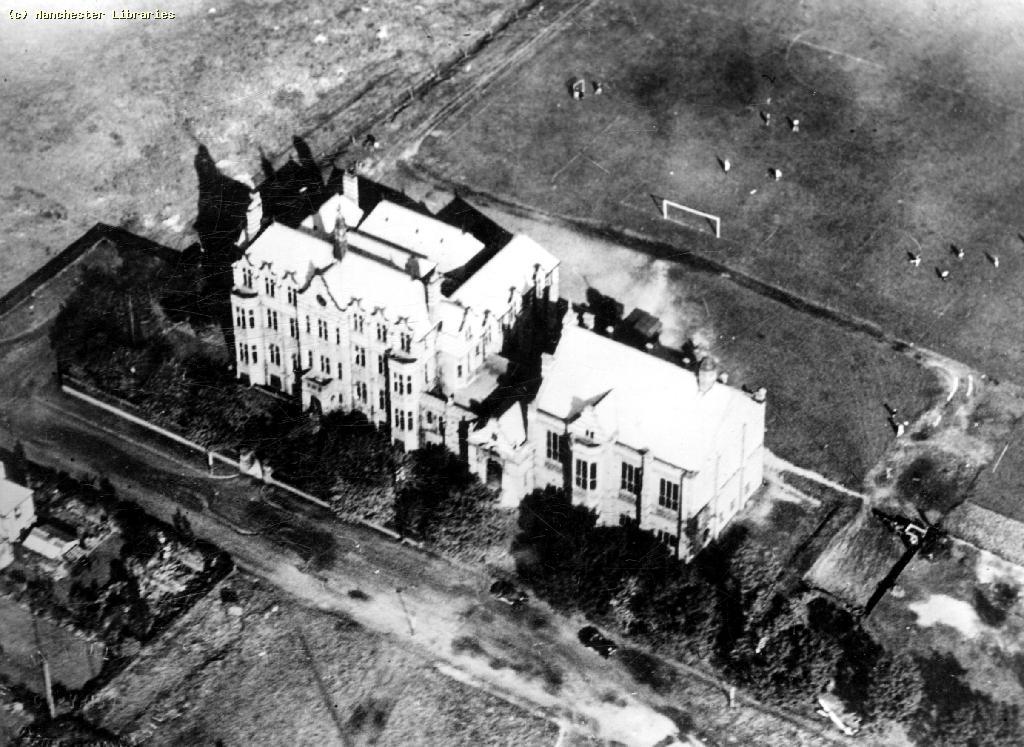
Aerial view of William Hulmes G. S. 1920
The resultant losses suffered by this battalion in the ensuing battle were terrific.

Of an initial strength of around 1100 men at least 140 were reported as killed in action that fateful day, with a similar number injured and perhaps a hundred recorded as missing.

The official War Diary kept at the time lists by name 16 officers and puts the number of other ranks at 375 casualties. In addition there had been 30 or so casualties on the battalion’s march to the front line the previous day.

Map of German defensive lines around High Wood, July 1916
These stark figures would be further supplemented by more recorded deaths, either “in action” or “of wounds” during the days immediately following. In consequence by the end of July 1916 the 20th Royal Fusiliers had suffered the loss of over half of the men on its roll-call at the start of the month.
     
At least five of these soldiers had a Chorlton-cum-Hardy connection no doubt bringing a general cloud of sadness to the area which was mirrored across the other suburban communities of the greater Manchester area and Lancashire as a whole.

A battalion of Royal Fusiliers going up into action, probably later in the war
Pte. Alan Joures Knudsen:
Born in 1894, in Withington to a Danish father, Justin Anton a shipping agent and his South Shields born wife Jennie (née. Joures), Alan was raised in Lytham-St Annes.

His father’s business was conducted in Manchester and sometime after the 1911 census the family home was “Thornlea” on Edge Lane, Chorlton-cum-Hardy. Prior to hostilities Alan was developing a career with the textile merchants – Hiltermann Brothers of 56, Whitworth Street, Manchester.

Sgt. Alexander Ross:
Alexander was born, to Henry and Martha in 1893, in Northampton where his father was a “Sergeant Major of volunteers”. In 1911 he was living with two of his aunties at 15, Birch Hall Lane, Longsight, at which time he is recorded as being a student. (2)

A record of Alexander’s death gives his place of residence as being Chorlton-cum-Hardy but I haven’t yet been able to ascertain the precise address.

Caterpillar Cemetery
Pte: Leslie Wilton Ball:
At the time of the 1911 census Leslie Wilton Ball lived at 51, Claude Road with his parents Wilton William and Helena Maud (née. Kent); he being their only child. His father was a salesman for a calico printer and his mother was the daughter of a prominent Manchester jeweller, Thomas Kent.

Leslie’s mother and father were married in St. Clements’s, Chorlton-cum-Hardy on 15th September, 1892 and he was baptised, in the same church, on 17th June, 1895. He’d been born on 22nd May at 12, Cranbourne Road.

Trones Wood   8-14 July 1916
Erne Shorrocks:
Ernest was born, on 12th March, 1875, in Rhodes, Nr. Middleton, Lancashire, but spent his childhood in South Manchester initially in Moss Side but later at 47, Keppel Road.

He was the third of the four children of James Henry, a cashier in a Manchester warehouse, and Lucy Ann (née. Hood) was a pupil at William Hulme’s Grammar School and went on to study at the University of Manchester (3) at which he gained  an M.Sc. (first class honours) in Chemistry in 1900.
Ernest then had a successful career in education filling a series of teaching positions at a number of prestigious schools whilst also doing a further years study at London University.

He began at his old school; William Hulme’s and in 1914 was at Taunton Grammar School from where he enlisted in the September of that year. Whilst in Somerset he appeared in that county’s cricket XI

His family continued to live in the Chorlton-cum-Hardy area at 17, St. Clements’s Road.

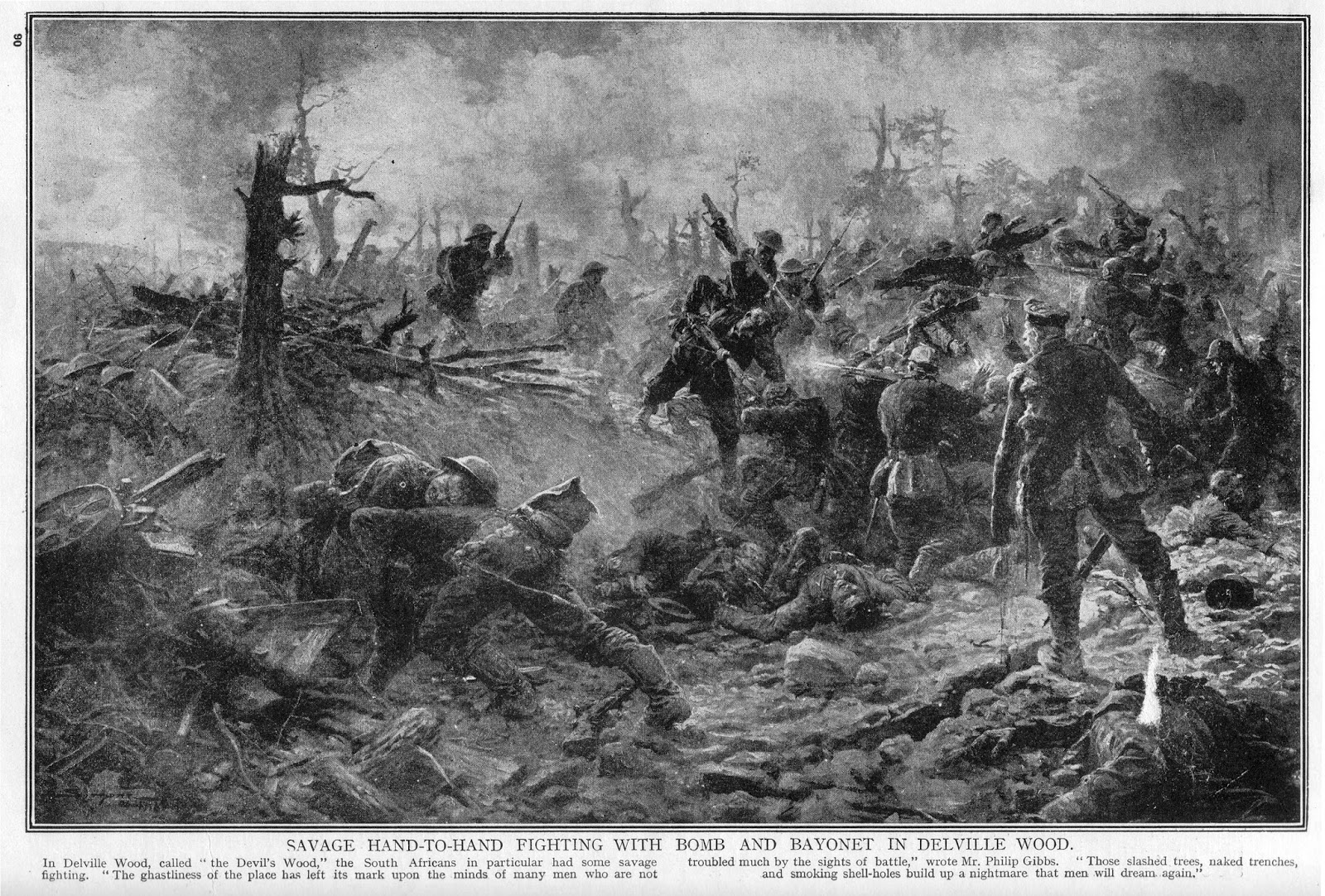
Delville Wood 14-19 July 1916
Pte. Frank Hardman:
This soldier was born in Gorton, in 1895, where he lived for a time on Church Lane with his parents Isaac, a clerk to a cotton yarn agent, and his wife Margaret (née Hardy). The family had moved by 1911 to 9, Keppel Road with young Frank being recorded as a commercial clerk.


Another soldier of 20th Royal Fusiliers, who died that day, although only loosely connected to South Manchester, is perhaps worth a mention in passing.

Pte. Nissim Lisbona:
Nissim is one of just four names on a memorial in the Synagogue of The Manchester Congregation of Spanish and Portuguese Jews on Queenstown Road, West Didsbury.

He was a qualified barrister and an ex-student of both Manchester Grammar School and Manchester University. He obtained a second class honours M.A. in English in 1906.

He was born and lived in the Cheetham /Cheetham Hill area of North Manchester in 1882. His parents were Moses, a cotton goods shipping agent born in Syria, and his wife, Mazal, also from Syria.

Total devastation of the area this was the main street of Longueval
Nissim is another soldier buried in Caterpillar Valley cemetery

Finally, in passing, there is a matter for some thought. There were five so called “University/Public School Battalions”, four forming part of Royal Fusiliers and one belonging to the Middlesex Regiment.

Initially they were officially encouraged, perhaps with the aim of showing to the country as a whole that the upper and middle classes were ready to share in the general sacrifice.

However, by the spring of 1916, due to the huge losses already suffered, there was a general shortage of officers in the wider army. Consequently the existence of these five units of  “officer material” became something of an embarrassment and their rank and file members were encouraged (not to say pressured) into applying to become officers for dispersal around the rest of the army In April 1916, three of the Royal Fusiliers Public School Battalions were disbanded leaving just the 20th operational.

This unit would then largely have comprised of those men who had resisted, against the wishes of the War Office, the call to train as officers; the remnant of the 20th battalion being augmented by men of a similar feeling from the other three battalions.

 It was maybe only a “fortune of war” and unfortunate, though convenient for the authorities that the 20th Battalion suffered such heavy casualties shortly afterwards.

©Tony Goulding 2016-06-21

Pictures; the Thiepval Memorial to the Somme Fallen, C.W.G.,School Sign 1973 D. Scholes, M38580,
Aerial view of William Hulmes G. S. 1920,Imperial Aerial photographic Co.,M67839, courtesy of Manchester Libraries, Information and Archives, Manchester City Council, http://images.manchester.gov.uk/index.php?session=pass Map of German defensive lines around High Wood, July 1916 by “The Times”, A battalion of Royal Fusiliers going up into action, probably later in the war, taken by Tom Aitken http:/digital.nfs.uk/74549002 (12) n 390, Caterpillar Valley cemetery, CWGC site, fighting in adjacent areas of the Somme Battlefield, Trones Wood, 8-14 July 1916, Delville Wood 14-19 July 1916, Total devastation of the area this was the main street of Longueval (Daily Mail Official War Photograph

Notes:

1) November 18th is usually cited as being the final day of the battle.
2) There are strong indicators that this was at Manchester Central High School which includes an “Alexander Ross” on its memorial roll. Also one of his aunties, on the 1911 census, was a “superintendant of a municipal school of domestic economy”
3) Ernest was able to do this with the aid of a scholarships awarded him by Lancashire County Council,  a science award he won in 1892 was worth £60-00 p a year for 3 years and one of just eight such awards that year.


Shapes and sizes ........... the day Andy Robertson wandered into Salford nu 5

Now here is another scene I like just because of the shapes that are left from the bits of t buildings that have been demolished along with a few that haven't.

Location; Salford

Picture; a Salford skyline 2014, from the collection of Andrew Simpson