Sunday, 6 August 2017

At Victoria Station ............... today and everyday ....... remembering the Great War

I am pleased at the way the authorities have imaginatively treated the archway at Victoria Station through which thousands of men passed on their way to the battlefields of the Great War.

For years the arch stood slightly neglected, first with a set of closed doors and later if I remember correctly a small gate.

And on busy commuter days I doubt that many people gave much time to the plaque commemorating the “MEMORY OF THE MANY THOUSANDS OF MEN WHO PASSED THROUGH THIS DOOR TO THE GREAT WAR 1914-1919 AND OF THOSE WHO DID NOT RETURN."

Not having been in Victoria Station for a while I had no idea at what had been done to the arch and I have my old friend David Harrop to thank for taking the pictures and posting them on his facebook sites.

And I have to agree with his comment on how “nice a way these memorials are looked after.”

Added to which the simple glass wall listing the battlefields and the casualties restores the significance of the entrance.


Pictures; Victoria Station, 2015 courtesy of David Harrop

Friday, 4 August 2017

The Odeon ....... one last stubborn stand

Now as everyone knows Andy has been recording the demolition of the Odeon here in the city centre.

And for quite a few weeks we have been debating when the end would finally come.

But not just yet.

Location; Manchester


Picture; the Odeon, lunchtime August 3 2017 from the collection of Andy Robertson

Good evening and welcome back to the Trevor

Now everyone I know has been posting pictures of the outside of the Trevor and pretty good the pub looks.

But these may be the first of the inside of the Trev to come out into the morning sunlight.

There is of course a perfectly good explanation for that because until yesterday the place had been closed for refurbishment which has included knocking through the two bars and adding some new furniture and a lick of paint.

And I like it.

I first crossed the threshold in the mid 70s when Stan Mona and Christine ran the place, and Ann and Jack along with the Judo crowd were in most nights.

It remained our local into the 1980s and even if I was on my own there was always a shed load of people to talk to from Telecom Eddie and Jean the Post to Scotch Ken and many more.

Back then I don't recall a beer garden, and it was just the "yard."

A place Stan and Mona stored the bits of the pub which after doing a useful job never got into the cellar.

I suspect there may have been the odd rickety chair, a spare darts board left soaking in a tub of water and other things.

I did try to get into the beer garden last night bu it wasn't to be.

Ann however did and she told me that they had "popped in last night, thought it was lovely.  We sat outside because of the strong smell of glue but that's understandable because of all the new upholstery, cracking outside area."

And she shared a picture which is equally happy to share again here on the blog.


All of which is a roundabout way to say I was back in the company of Peter his wife and friends to introduce the pub to the new book on Chorlton pubs and bars.

We were made very much at home y Phil the manager and the staff,

And the rest as they was a couple of bottles of Peroni, some fine conversation including a chat to Janice from Morrisons and the sale of eight books.

Enough said .............. more to come.

Location; Chorlton


Picture; the inside of the Trevor from the old vault, 2017 from the collection of Andrew Simpson and the beer garden 2017, courtesy of Susan Bowie

*A new book on the pubs and bars of Chorlton, https://chorltonhistory.blogspot.co.uk/search/label/A%20new%20book%20on%20Chorlton%20Pubs%20and%20bars

Thursday, 3 August 2017

Calling out the troops to the Lancashire coal fields ........ 1912

The years before the Great War were a time of major industrial confrontation and saw some of the bitterest clashes between employers and the Government on one side and organised labour on the other.

A squadron of the 16th Lancers at Leigh, April 1912
During 1911 there were strikes in the south Wales coal fields, and trouble in Liverpool which began with a sailors strike and spread across the city involving other industries.

And while the miners lost, the workers in Liverpool were mostly successful and pointed the way forward for other workers in other industries around the country.

There was a growing feeling that industrial action would deliver a better life for working people.

Royal Fusiliers at Fletcher and Burrows Chesters Pit, Atherton, April 1912
And the agitation even spread to the schools. In over sixty cities and towns children came out as well.

The number of working days lost because of strikes climbed as did the number of trade union members, and in Parliament Churchill, the Home Secretary was often preoccupied with questions on the industrial unrest.

All of this was against a backdrop of wage cuts, poor working conditions, and rapid inflation. Between 1889 and 1910 the cost of food rose by 10 per cent and the cost of coal by 18 per cent.

The life expectancy for working men was just 50 years of age and 54 for women, five per cent of children aged between 10 and 14 were already at work and the richest one percent held 70 percent of the wealth.

4th Battalion Royal City of London Fusiliers at Leigh, April 1912
Here in Manchester in the summer of 1911 the carter’s came out on strike and there were other strikes by the engineers and in the dock workers.

The following year there was a national coal strike aimed at securing a minimum wage.  It began in Derbyshire spread across the country and lasted for 37 days.

Troops were dispatched to the coal fields and the dispute finally ended with the Liberal Government passing the Coal Mines (Minimum Wage) Act.*

Location; 1912

Pictures; from the Manchester Weekly Times, April 12, 1912

*"to provide a Minimum Wage in the case of workmen employed underground in Coal Mines" from the debate on the bill, which can be read at HC Deb 19 March 1912 vol 35 cc1723-93, http://hansard.millbanksystems.com/commons/1912/mar/19/goal-mines-minimum-wage-bill


What were the 3rd Battalion of the Manchester Pals doing at Alex Park in the September of 1914? ........... stories behind the book nu 10

An occasional series on the stories behind the new book on Manchester and the Great War.*

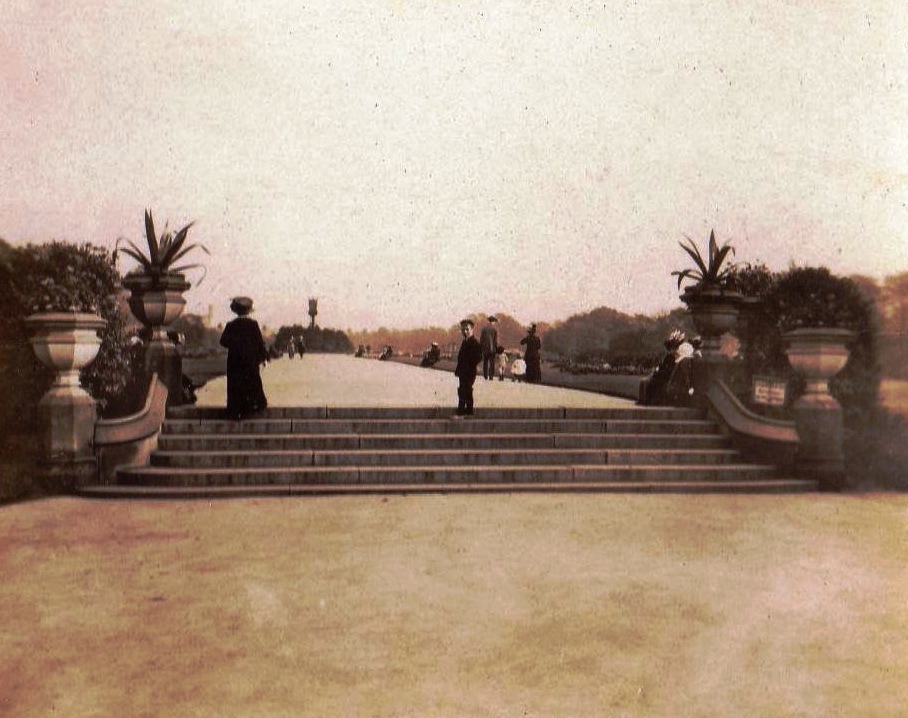
The entrance to Alexandra Park, 1907
Now this is one of those stories that started off full of promise with just a chance that I would uncover a lost part of the Park’s history.

The 3rd Battalion were one of the eight Pals’ Battalions raised in the first few months of the Great War.

The authorities had not quite been prepared for the rush of recruits.

The first two battalions had been raised in a matter of days and by the time the 3rd and 4th were complete there were still no where to put them.

So while the first and second fairly quickly moved to a tent city at Heaton Park, the 3rd was accommodated at White City and the 4th were billeted at home.

And that brings me to the 3rd Battalion and Alexandra Park.

The definitive book on the Manchester Pals* describes how the battalion had been recruited in just three days between Saturday September 5 and Monday the 7th but “unlike the first two companion battalions [it was] initially trained at White City, a sports and racing stadium in the Old Trafford area, and accommodated  there in hastily  erected and draughty constructions.  Before those huts at the White City became available this battalion’s parades were undertaken in the City Hall with route marches to and from Alexandra Park.”**

Heaton Park, 1914
As late as September 26 the Manchester Guardian reported that “the recruiting authorities have in mind the undoubted convenience of being able to billet the men on themselves, in which case they would be in the same position as the men who were recently posted to reserve, though of course their full time would be required in training.”***

Which nicely brings us back to those route marches to Alexandra Park.

I have to confess I had misread the original newspaper entries and made the assumption that they had camped out in the park but no evidence has come forward to support this and so I can only assume that on arriving at the park gates and after a suitable rest they marched away to White City where they were still to be found two month later.

Pictures; entrance to Alexandra Park, circa 1907 courtesy of Ann Love, and Heaton Park, 1914 from the collection of David Harrop

*Manchester and the Great War, Andrew Simpson, was published in 2017, http://chorltonhistory.blogspot.co.uk/search/label/A%20new%20book%20on%20Manchester%20and%20the%20Great%20War

**Manchester Pals A History of the two Manchester Brigades, Michael Stedman, 1994

***ibid, page 25

****City Battalion and Winter Quarters, Manchester Guardian, September 24 1914

Wednesday, 2 August 2017

That new book on the history of the Progress Estate ......... a must to have

Well my copy arrived today and it looks to be all that I expected it to be.

There are chapters on the origin of the estate along with an explanation of the idea behind the Garden Suburb and the story of how the Progress developed over the last century and a bit.

There are plenty of illustrations including two familiar ones of Manchester cellar dwellings in the 1840s, which have a special resonance given this is my adopted city.

And there is plenty more from some very interesting set of tables on everything from the development of London’s suburbs to the numbers of residents on the estate.

I especially like the inclusion of diagrams and plans showing houses on the Progress and comparing them with similar garden suburbs.

But one of the real attractions has to be the descriptions of the roads around the estate and the origins of their names.

What’s more there is a comprehensive bibliography and index making it perfect for anyone wanting to follow up on the subject.

That said I do think Mr Billinghurst’s book has got the lot.

The cover price of £13.95 includes free delivery by second-class mail to addresses in the UK.

However, each household on the Estate may buy one copy for £10 and people living elsewhere in SE9 may do so for £12.

To order, either write to theprogressestate@gmail.com stating your name, address and phone number or call or text 07962 877389 to provide the same information.

Location; Well Hall, Eltham

Picture; cover The Origins and Evolution of the Progress Estate

*The Origins and Evolution of the Progress Estate, Keith Billinghurst, 2017

**Progress Estate Residents' Association, http://progressestate.blogspot.co.uk/

Tuesday, 1 August 2017

“The Appeal Tribunal have decided that the appeal be dismissed” ....... February 28 1917

The Appeal Tribunal was one of the many held regularly across the country during the Great War to determine whether a conscripted man had a case to be exempted from call up.

"the appeal be dismissed"... 1917
Now I have written in detail about these tribunals in Manchester Remembering 1914-18.*

“There are many detailed accounts of tribunal hearings ranging from press reports to the memoirs of those who appeared before them.  

Writing in 1920 John Graham whose book remains a good history of the movement wrote that 'there was little uniformity in the practice of the Tribunals.  The Local Tribunal in Liverpool was hopelessly tyrannical, the one in Manchester was judicial and reasonable.' 


Often in response to a prepared statement outlining his opposition on religious or humanitarian  grounds questioning revolved around the simple question of what would the objector do if faced with a German invasion and worse still an attack on his own family.

In many cases the members of the tribunals were both abrupt and unsympathetic to arguments of principle and quite scathing and dismissive in their comments.  In response to the arguments of one objector the Chairman of the Manchester Appeals Tribunal commented “it is ..... [about] doing your duty.  It is your duty to take part in the defence of your country and the public law of Europe.”

But not all the appeals were from conscientious objectors.  Employers also appeared on behalf of employees who they judged were essential to their business and along with these were individuals making out a personal case.”**

Travel pass, 1917
Now I don’t yet know the grounds upon which Albert Edward Dawson made his appeal or why it was turned down, but the Tribunal having dismissed the appeal  instructed him to “report on April 30 1917” and by July he was in Egypt.

The letter containing the news along with a number of travel passes giving permission for Private Dawson to travel to Alexandria by train have just been acquired by David Harrop who supplied much of the memorabilia that features in the book.

As yet Private Dawson still sits in the shadows.  I know he served in the Army Service Corps and was awarded the Allied Military Medal and Victory Medal.

Tonge Street, 1894
It is likely that he was born in 1899 and spent some of his early years at 16 Tong Street in Ancoats which was a four roomed property which long ago vanished although for the very interested it is possible to stand on the spot by turning off Merril Street on to Frost Street and gazing across the open ground.

Back in 1911 number 16 along with the other residential properties didn’t even warrant a mention in the street directory and the compilers recording only the presence of the Holt Town Ragged School and Mission Church.

Private Dawson’s father was Robert H Dawson who in 1901 was a “general carter.”

And that is pretty much it for now, but I remain very confident that we will uncover more about Private Dawson but for now will be happy to look at the original documents which David will be exhibiting along with other memorabilia at the book launch for Manchester Remembering 1914-18 which will be at Central Ref on Saturday February 18 between 1 and 4.30pm.

Pictures; documents relating to Private Dawson, 1917 from the collection of David Harrop, detail showing Tonge Street, Ardwick, 1994 from the OS map of South Lancashire, courtesy of Digital Archives Association, http://digitalarchives.co.uk/


Manchester Remembering 1914-18 by Andrew Simpson was published by the History Press in February 2017

Order now from the History Press, http://www.thehistorypress.co.uk/publication/great-war-britain-manchester-remembering-1914-18/9780750978965/ or Chorlton Book Shop,info@chorltonbookshop.co.uk 0161 881 6374

*A new book on Manchester and the Great War http://chorltonhistory.blogspot.co.uk/search/label/A%20new%20book%20on%20Manchester%20and%20the%20Great%20War

**ibid, Manchester Remembering 1914-18 page 81