Monday, 14 June 2021

When prejudice stalks Chorlton and ignores the historical reality

It is that time of year when yet again someone posts a question about Chorlton, which the prejudiced and ill-informed leap on.

From the 1851 census of Chorlton-cum-Hardy

So, the post was about Chorlton and culture, and sure enough we got a heap of answers, some of which repeated that old idea that today the area is full of people who were not born here. 

I suppose some were attempts at being funny and at best displayed a degree of ignorance, and at worst slide into prejudice.

The easy response is either to say nothing or to reply with “so what”.

But, it comes up so often that it is worth exploring the assertion, and pointing out that Chorlton has always seen a lot of people from elsewhere coming to live here.

In 1851, the census records that there were 760 people here in the township.  Discounting ten whose places of birth are undecipherable, 346 were born in Chorlton-cum-Hardy, and 404 from elsewhere.

Now the elsewhere did contain some pretty local places, like Withington, Didsbury and Stretford, and a bit further away in Hulme, Manchester and Salford.

But there were a fair few from Yorkshire, Cheshire, Warwickshire, the Home Counties and Scotland.

The Chorlton Brass Band, 1893, 

All of which meant that walking the lanes of the village and surrounding hamlets, there would have been a mix of accents.

The answer partly lies in the practice of employing servants from outside Chorlton, there by reducing the possibility that the secrets of “the family” would become known in the homes of the locals.

Thirty years later and the housing boom of the 1880s, which lasted into the next century, brought a range of people from all over Britain, whose occupations were far removed from farming.

And there are plenty of examples.

The Chorlton Brass band dated back to the 1820s, but by 1893, the majority were either born elsewhere, or first generation.

Joe Scott who built many of the smaller houses in Chorlton during the early decades of the 20th century may have been born here, but his father who was a plasterer moved up from London to benefit from that housing boom.


And in the 1830s, the Holt’s escaped city centre Manchester to settle in their fine house on the corner of Barlow Moor Road, and what is now Beech Road, and after their death, their place by one of their children.

All very different from the assertion that “Chorlton culture is real people who left and outsiders who moved here because of trends and the beegees then claimed it as their own” or that "Original Chorlton people were great it’s all the new people that have turned into what it is now, old Chorlton was great”.

Added to which for almost a century we referred to the Old Chorlton and New Chorlton, or the Old and New Village, to distinguish those who lived in the old rural centre around the village green and Beech Road, and those in the new developments which occupied the area around Barlow Moor Road and Wilbraham Road.

To which I would just point out that in the early 19th century original Chorlton people engaged in bull baiting, dog and badger fights, and the public humiliation of residents whose partner had left them, and others who the moral populace thought had offended the common good.

Still, why let history get in the way of a good rant?

And if any one wants further evidence, there is the book The Story of Chorlon-cum-Hardy, which is a study of the township in the first half of the 19th century, or if that is too much like a conspiracy theory why not go back to the census returns and read what the residents of Chorlton themselves said.

Pictures; Chorlton Brass Band, 1893, from the Lloyd Collection

*The Story of Chorlton-cum-Hardy, Andrew Simpson, 2012


A Country Park ……. a big bit of history …….. and the village of Compstall

The village of Compstall, between Marple and Romiley might well have once been called a one-man town.

Expanses of water ....... 2021

In the 1820s according to one source a chunk of the surrounding land was part of the Andrew’s estate incorporating a mine, a cotton mill and a lake.

“Mr. George Andrew originally built the mill and made the artificial lake, and built houses along with a church and school for the work force who were employed in his mill”*.

Compstall, 1900

And like so many one-man towns, many of the streets were named after the family, including Andrew Street, George Street, Montague Street and Thomas Street, and the pub the Andrew’s Arms, which I think was a late addition.  

To which can be added the Compstall Print Works, which was part of the family empire.  

In 1850, the Manchester Guardian reported that a division of the family assets had led to the dissolving of the partnership “between George Andrew, the elder Thomas Andrew, George Andrew the younger , and Charles Andrew, as calico printer, cotton spinners and manufacturers and carried on at Compstall, and at Manchester, under the firm of ‘George Andrew and Sons’ was dissolved by mutual consent.  The manufacturing establishment will in future be carried on by Messrs. George Andrew, senior, and Charles Andrew, and the printing establishment by Mr. Georg e Andrew, the younger.”**

Twisty walks

George Andrew had been born in 1799, and died in 1854 and was buried in Compstall Church.  

On the 1851 census he described himself as “Justice of the Peace, Cotton Manufacturer, employing 472 Males and 598 Females.”

His father had died in 1821, and George then began a major expansion of the textile business, which involved the construction of the North Mill between 1839 and 1847, and the enlargement of the mill office. The Albert Mill and a range of riverside buildings, including the mechanics shop were extended followed before the business was sold off in the 1890s.***

For those wanting more, there are a series of family and business documents which are listed by the Marple Local History Society.****

I don’t suppose I would have come across Mr. Andrew, ofr Compstall had we not taken ourselves off to Etherow Country Park, on Sunday, and as you do I became interested in the place.

The park was created in 1868, and was one of England’s first country parks, which now attracts over a quarter million visitors a year.

More water

It is situated in the Etherow-Goyt Valley, and is the start of The Goyt Way, which is a 10 mile walk to Whaley Bridge.

The River Etherow flows through the park which is the source for the lakes and was originally used as a reservoir to power the water wheels for the mill. 

Now, none of this will be a surprise to the residents of Stockport, or Compstall, but I am confident that there will be plenty for whom Mr. Andrew, his family business and the Park will be a revaltion.

Location; Compstall

Pictures; the Etherow Country Park, 2021, from the collection of Andrew Simpson, and Compstall in 1900, from the OS Map of Cheshire, 1900, courtesy of Digital Archives, Association, http://www.digitalarchives.co.uk/

*HISTORY OF ETHEROW COUNTRY PARK; https://www.etherowcountrypark.co.uk/

**Manchester Guardian, September 21st, 1850

***Compstall, https://en.wikipedia.org/wiki/Compstall

***COMPSTALL MILL / ANDREW FAMILY, Marple Local History Society Archives,http://www.marplelocalhistorysociety.org.uk/archives/collections/show/104

****Compstall, https://en.wikipedia.org/wiki/Compstall

A library in your garden ……………

Now, I say in your garden but  over the last few years I have come across these little popup libraries, outside shops, beside car parks, and pretty much anywhere, where lots of people pass.


This one is in Chorlton, and is part of the  Little Free Library.*

And as you do I went looking for more information and as ever Wikipedia had the lot.  “The  Little Free Library is a nonprofit organization that promotes neighborhood book exchanges, usually in the form of a public bookcase. 

More than 90,000 public book exchanges are registered with the organization and branded as Little Free Libraries. 


Through Little Free Libraries, present in 91 countries, millions of books are exchanged each year, with the aim of increasing access to books for readers of all ages and backgrounds. The Little Free Library nonprofit organization is based in Hudson, Wisconsin, United States”.
**

There is more, but I have a policy of never representing other people’s research, so you fill have to follow the link to get the full story.

The purists will quibble and say that they are not true libraries, which offer a host of other resources, but that is to mis the point that anything which advances reading and a love of books has a part to play.  After all I am of an age to remember those private libraries which for a small fee lent books.  Ours in New Cross was in a bookshop, but many were part of newsagents. And they were always a supplenet to those eager to read.

Mother went to our public library twice a week and also used the one on Queens Road.

Location; Chorlton

Picture,  the Little Free Library, 2021, from the collection of Andrew Simpson

*Little Free Library, https://littlefreelibrary.org/

**Little Free Library, https://en.wikipedia.org/wiki/Little_Free_Library, https://en.wikipedia.org/wiki/Little_Free_Library

Sunday, 13 June 2021

One hundred years of one house in Chorlton …. part 121 ....... at the cutting edge of kitchen appliances

The continuing story of the house Joe and Mary Ann Scott lived in for over 50 years and the families that have lived here since. *


Now I can be fairly confident that the Scott’s had one of these in their kitchen.

Long before the Kenwood mixer, the electric blender, and several other modern kitchen tools, the humble mincer took pride of place.

This one belongs to my friend Christianna Franck, who sent over the picture, adding “Look what I picked up for a fiver in a charity shop”.

Ours which did the business in both the house in Peckham and later Well Hall in Eltham, was lost a long time ago, although dad was till using it to make his forced meat balls every Christmas well into the 1990s.

I had thought production of this simple tool had ceased decades ago.  But not so, because they are a neat way to mince food.  The device is study, washes easily, and just clamps to the side of a table.  

Of course, this will present a problem in many kitchens whose work surfaces do not admit to having a device clamped on to them.

But when I was growing up the kitchen table was the work surface, which was perfect to attach the mincer.

And in a time of “waste not”, the mincer could process the remains of the Sunday joint offering up heaps of meals based on the humble minced meat.


Which was always preferable to the shop bought variety which cost 2/6d for a pound of raw meat.

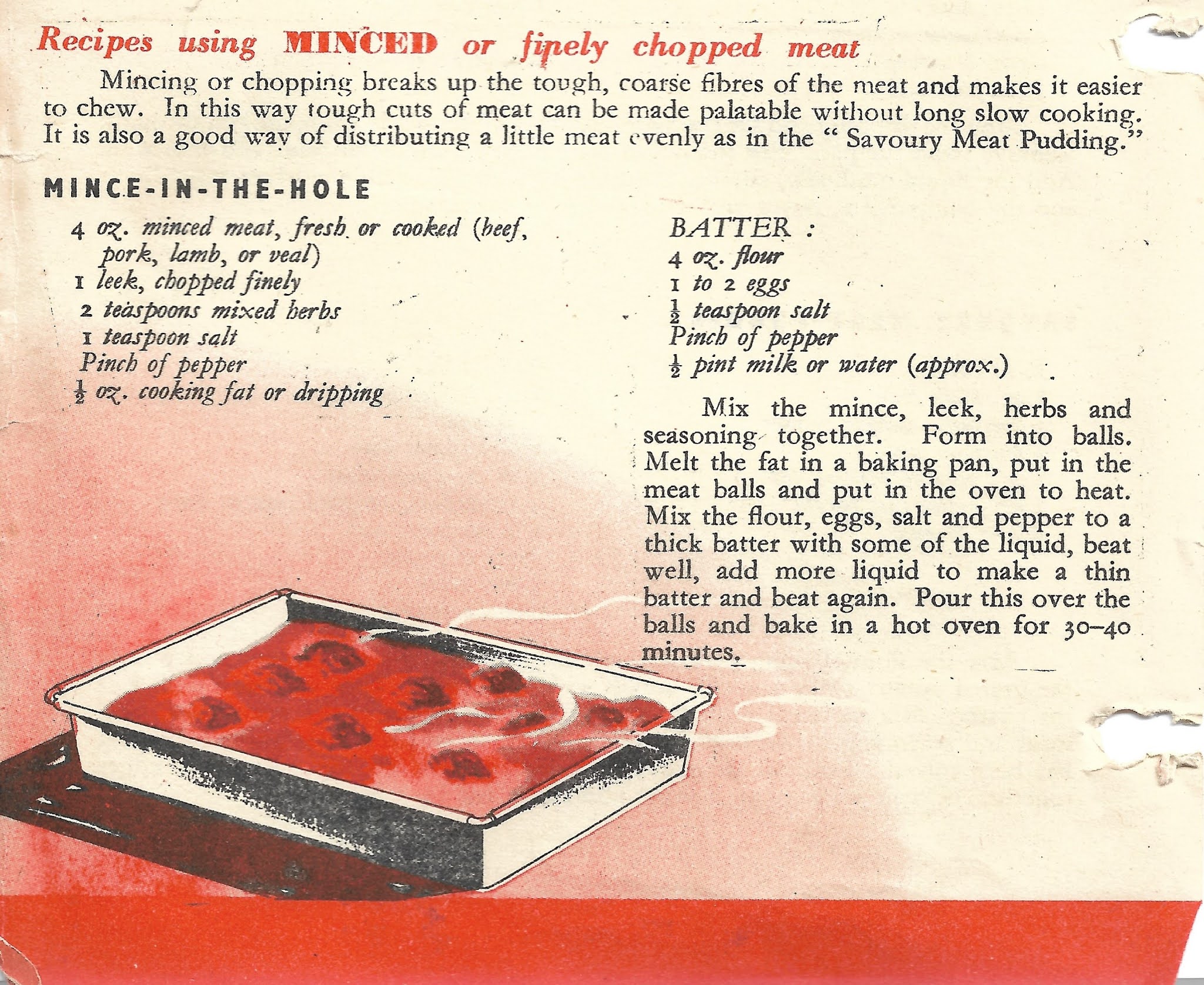
All of which leaves me to include a recipe from The Ministry of Food from 1946, which I guess would have been about the time Mary Ann used her mincer.  

The same leaflet also offered Hamburgers, Hamburgers in Brown Sauce and Savoury Meat Pudding, .... so more than a few meals to enliven that post war period when rationing and shortages were part of everyday life.

Picture, the mincer, 2021, from the collection of Christianna Franck, and Mince in the Hole, 1946.**

*The story of a house, https://chorltonhistory.blogspot.co.uk/search/label/The%20story%20of%20a%20house

**Mince in the Hole, from Making the most of Meat, Ministry of Food Cookery Leaflet, Number 16, October 1946, from the collection of Mrs. Piggott

Who were these unknown men of the Great War?

This is another of those pictures whose story I doubt I will ever know.

It is from the collection of David Harrop, and is undated and comes with no clue as to where it was taken.

Now there will be somebody out there who can help.

The men are wearing spurs and bandoliers which suggest they were a cavalry unit or from the Royal Artillery.

There may also be something in the design of the train carriages which I think varied from railway company to railway company.

So find which company and we may be able to identify a location.

The original photograph was in a poor state but with the help of David’s friend Bernard we have a clearer image and so it would be nice to know more about these men and their eventual destination.

Picture; unknown unit of British soldiers, sometime during the Great War somewhere in Britain, courtesy of David Harrop

Saturday, 12 June 2021

The bottle …… the stillman ..... and a mystery

Like all good stories this one began with the discovery of some treasure by Declan Maguire.

The bottle, 2021

The treasure was an old glass bottle which he told me  “is green tinted and very thick, and written in raised glass is the names ‘Thomas Edge Trade Mark T E Thomas Edge Registered Manchester’, and  on the back, ‘Redfern Bros. Bottle Makers Barnsley’. 

Strange what you can find just a few inches down. I wonder how long it’s been since that bottle last saw daylight, perhaps dropped into and during some long ago bit of building work”.


The bottle is undated, but I know that Redfern Brothers were engaged in the business of bottle manufacture from 1862, until they sold out to a Swedish company in 1967.  

And we can limit that near century down to sometime between when they started and when they moved out of Barnsley in 1946.*

Which still leaves a heap of time, but here Thomas Edge steps into the story, and reduces that chasm of time to just 25 years.  

In 1891 he described himself as a Stillman and Dye Worker, a decade later he had become a “Foreman in a Chemical works” and by 1903 was listed in the directories as a stillman, and that suggests by then he may have struck out on his own.

How he raised the capital to purchase the bottles and distilling equipment is an intriguing question, but I know he died in 1936, leaving just £127 to his niece.

All of which offers up a timeline for our bottle of something like 33 years.

Not much I know, but so far it’s the best we can do.

So instead, given that history is messy the story takes a few twists.  

Thomas was born in 1862, married Annie in 1885, and they settled in Blackburn Street in Hulme that year, and were still there in 1914.  Just how successful he was and what he put into that green bottle is as yet unknown to me.

8 Blackburn Street marked in red, 1894 home to Mr. and Mrs. Edge

But it does suggest we have a man who the Victorians would have approved of, and a man who had taken to heart the writings of Samuel Smiles in Self Help, and had raised himself “to social eminence and even wealth”.**

Of course, I might just have got this last bit wrong.  His business career may have been short, and carried out on the edge of impending disaster.

And so there is a lot more research to do, including why he left his money to his niece who in 1936 was 73 years old and not his married daughter.

I can think of answers but that would be unhistorical with out the research, so research I shall, leaving me just marvel at what can come out of the ground, long after they were discarded.

Location; Chorlton

Pictures; the bottles, 2021, from the collection of Declan Maguire, and Blackburn Street, 1894, close to Chorlton Road, from the OS map of South Lancashire, 1894, courtesy of Digital Archives, Association, http://www.digitalarchives.co.uk/

* Redfern Brothers https://sha.org/bottle/pdffiles/RedfearnBros.pdf

**Samuel Smiles


From Finland ........ with a story

Now, all too often old family photographs have lost the story that gives them a purpose.

Usually it is simply that there are no names on the back, the date has been omitted and there is no reference to where the picture was taken.

All of which means that within two and certainly three generations the people and the event has been lost forever, and the picture runs the risk of being thrown away.

But not so with this one.

It was sent to me by Andy Robertson who wrote “I am sending this picture because I think you may like it. It is of Percy Albert Sharples (1857-1915) and family in their house in Tampere, Finland.

My wife's great great great grandfather was John Sharples (1814-1876).  He was an overlooker in a mill around Ashton/Stalybridge in 1841. 

Between 1844 and 1847 he, his wife Mary and young family migrated to Tampere, Finland where he became the weaving and spinning master at the rather impressive Finlayson mill.  I suspect he probably ran the show on the shop floor.

John and his growing family remained in Finland but rather surprisingly by 1861 his two eldest surviving sons Solomon my wife's great great grandfather who was born in 1837 and Arthur born five years later were back in Manchester living with family members. 

By 1871 the third son John Edwin who had been born in 1849 was also back in Manchester, leaving the fourth surviving son Percy Albert 1857) and the Sharples’ three daughters in Finland.”

It is a remarkable story and points to the willingness of people to migrate to follow work and better their position.

Usually we assume the migrations were to the Americas, Australasia or Africa while places closer to home were ignored.

But given that countries across the mainland of Europe were also going through their own industrial revolutions, it made perfect sense for Mr Sharples to settle in Finland, leaving me only to wonder if he was invited or went off his own volition.

The picture is also a fine introduction into furniture and fittings of a home middle class home in Finland at the beginning of the 20th century.

I particularly like the ornate design of the piece of furniture behind them along with the wall paper.

But I could't leave the story without returning to John Sharples and his wife who had worked in the mills of Lancashire and settled for a new life in Finland.

I don't have a date but here are pictures of both John and his wife which will have been taken in Finland.
Location; Finland

Picture; in Finland circa 1905 from the collection of Andy Robertson