Wednesday, 20 July 2022

The Titanic ……. Chorlton library …. a smelly stream and Mr Hastings ……… tales from the new book

 Today our new book, arrived from the printers. 

It is the second in the series “nothing to do in chorlton” and this one  is called "Martlege Lost and Found".

The first book has proved a runaway success, and so we been asked to repeat the format.*

The idea is that simple one where we choose six locations for you to sit, do nothing while we will tell stories of what went on at each of the six spots.

Tales which include the role of the Titanic in the history of Chorlton Library, a forgotten property developer, and the tale of a much-polluted stream, not forgetting a chunk of our lost industrial history as well as the magnificent Chorlton Ice Rink.

Like all our nothing books Martlege Lost and Found is divided into six short chapters which if you so choose can be “walked” with suitable stops to take in the views and the stories.

And to make it even easier we have made the book pocket size, selling it for the modest sum of £5, and is available from www.pubbooks.co.uk and Chorlton bookshop.

Arrived today
Location; from the former Four Banks, to the library and beyond

Picture; cover of nothing to do in chorlton, Martlege Lost and Found, 2022, and newly arrived today

The book, nothing to do in chorlton, Martlege Lost and Found by Andrew Simpson & Peter Topping, costs £5, is available from Chorlton Bookshop or us at  www.pubbooks.co.uk  

*nothing to do in chorlton, https://chorltonhistory.blogspot.com/search/label/A%20new%20book%20on%20doing%20nothing%20in%20Chorlton

Painting Well Hall and Eltham ....... nu 5 Eltham Church

An occasional series featuring buildings and places I like and painted by Peter Topping.

Now our parish church is one of those landmarks in Eltham with history.*

Long before Burton’s became McDonald’s it was one of the places I would arrange to meet friends.

Unlike the Eltham Grill and Wimpy’s it was free to wait there usually in the entrance which offered fine views up the High Street and down Well Hall and Court Roads.

And in a pre mobile age you had to be clear of the time and place with a back up destination if for any reason you had to move on.

The old tram sheds a little further down Well Hall Road were a good alternative as was the entrance to the Library otherwise it was in front of the post office.

But Eltham Church was always that first choice which is why I like Peter’s painting.

Location; Eltham, London

Painting; Eltham Church, © 2015 Peter Topping from a photograph circa early 19th century.

Web: www.paintingsfrompictures.co.uk

Facebook: Paintings from Pictures https://www.facebook.com/paintingsfrompictures

*Eltham Church, http://chorltonhistory.blogspot.co.uk/search/label/Eltham%20Church

Tuesday, 19 July 2022

Silly history …… where would I have been in 1851?

Of course it is a silly question, given that 1851 is now over 170 years ago.

In the Holt's garden, 2022

But if I had  been standing just a few yards back from the sign I would have been in the garden of the Holt family.*

They had made their money from making wooden engraving blocks for calico printing and one of their factories stood on the site of the Beetham Tower.

They were a well-off family with a fine town house in St Johns Street, off Deansgate, owned a portfolio of properties in the surrounding streets around Castlefield and were minor landowners here in Chorlton.

Looking at the Holt's house from Beech Road,1907
From their upstairs windows they commanded a clear view of their fields stretching east from Barlow Moor Road down to towards St Werburghs Road.

And so in 1851 I would have been in their garden close to the eastern wall which ran along Barlow Moor Road, down High Lane, before cutting across towards Beech Road, and then back up Beech Road to the lodge house facing the main road.

Here they had lived since the 1830s, and would remain until the early 20th century, when after the death of the last “Manchester” Holt, the estate was sold off, to enterprising developers.

One of which was Manchester Corporation, which bought a chunk of the garden, demolished the trees and wall and extended Barlow Moor Road, adding the tram terminus.

Location; Chorlton

Picture in the former garden of the Holt family, 2022, from the collection of Andrew Simpson, and  Beech House once called Beech Cottage, 1907, m17645, courtesy of Manchester Libraries, Information and Archives, Manchester City Council, http://images.manchester.gov.uk/index.php?session=pass11

*The Holt family, https://chorltonhistory.blogspot.com/search?q=holt+family

Three actors …….. Dessies’s Place ….. and a pub ….. abroad in Cadishead

This is one of those stories for which you can make your own history.

I am confident that the three are Marilyn Munroe, John Wayne and Humphrey Bogart, allowing the keen film enthusiast to trawl the life stories of each, and follow up with identifying the movies which featured these poses.

And maybe even discovering where each of the figures came from.* 

My bet is the old Granada Studios Tour where you could sit in an American Dinner and stand beside an authentic yellow taxicab.

But for those interested in an alternative challenge, the building was once The Royal Arms which offers up a study of this former pub.

Either way I am thinking Andy Robertson’s pictures are a good start.

And leaves me to reflect on that alternative title "Three actors in search of a film".

Location; Cadishead

Picture; Looking for Hollywood legends in Cadishead, 2022, from the collection of Andy Robertson

*Hellfighters, John Wayne, 1968, The Seven Year Itch, Marilyn Munroe, 1955, Casablanca, Humphrey  Bogart, 1942


Monday, 18 July 2022

Just what can you buy on Market Street? …….

Now for me the fun of Market Street is less the big shops and more the pop-up salesmen.


And in that respect, it is no different than it was in the 19th century when match sellers, shoe shine boys, newspaper vendors and hot food salesmen worked their pitch.


Location; Market Street


Picture; Just what can you buy on Market Street, 2022, from the collection of Andrew Simpson, and Manchester street sellers by H.E.Tidmarsh, from Manchester Old and New William Arthur Shaw, 1894  

Sunday, 17 July 2022

Gooldens Buildings in New Islington ………. Lost and now redicovered

Now this is one of the best views across to what was Gooldens Buildings, which stood just a short distance from Great Ancoats Street and faced the Ashton Canal.

Looking towards Gooldens Buildings, 2022

If I wanted to be entirely accurate the buildings were just a little past the lock keepers gate house heading east to the main road.

Sod’s Law dictated that I wasn’t looking for them when I wandered around New Islington on Monday, and the exact spot was occupied by builders on a break, the odd parent with a push chair and heaps of passers-by, making taking pictures a bit difficult.*

Gooldens Buildings, 1851
Nor had I heard of the eight properties which made up “Gooldens Buildings”, but as you do having decided to investigate what the area was like in the mid-19th century they seemed a perfect starting point.

Three of the eight were back to backs and the remainder seem to have had a backyard.  

They formed a rough L shape with the larger houses fronting the canal and the smaller ones running off at right angles, beyond which there were more houses and one of those closed courts of 13 back-to-back one up one down properties looking onto Booth’s Court, where sunlight and fresh air struggled to penetrate.

Gooldens Buildings started as a row of houses but appear to have given its name to the stretch of thoroughfare along side the canal up to Great Ancoats Street.  So long after the original houses had vanished or were converted into retail and industrial use, the name Gooldens Buildings remain.

By the 1920s some of the site had become a collection of warehouses and a factory and later still in 1953 the footprint is the same.  Tantalizingly there is only one picture of the street dated 1962 showing the corner of Gooldens Buildings and Great Ancoats Street with a hint of one of the warehouses.

The canal close to Gooldens Buildings, 2022
The first reference to the eight properties of Gooldens Buildings, dates from 1833 and the last from 1890.  These come from the Rate Books and offer up the names of various owners and residence over those 57 years.

As to exactly when they were constructed is still in doubt, but I think it will be sometime after 1819 because they do not appear on Johnson’s map of that year.

All of which leads me to burrow down into their history and explore who called them home.

The census returns show that in the spring of 1851 there were 49 people living in the row, whose ages ranged from the newly born to 76, with 42% below the age of 21.

Most were born in Manchester with a few from Cheshire, one from Yorkshire and one from Hertfordshire.

Their occupations were pretty much what we might expect of an area bounded by two canals and surrounded by textile factories.

Gooldens Buildings, 1962
The largest grew worked in a variety of jobs to do with the manufacture of cotton, four described themselves as “Canal Boat” men, and the remainder consisted of a Stone Mason, two Hawkers, a salesman, charwoman, launderess, along with a carter, “"and a house servant.

Their rents ranged from 2/9d to 4/9d, when an average wage might be £1.**

In time I will pursue the life stories of the 49 including tracking them across the city using the Rate Books and census returns, and possibly the street directories, although I doubt any would have been deemed worthy enough to have featured in the lists of residents of Manchester in the mid 19th century.

The promise of more residents, Gooldens Buildings, 2022
For now, I will reflect that Gooldens Buildings and the surrounding area will have had a density of living only matched again in the 21st century as New Islington continues to be developed as an attractive part of the inner city.

But unlike today with its mix of waterside attraction, a park and interesting bars and restaurants I think this bit of the city would have been less desirable in 1851.

During the day the noise from the textile mills, and foundries and the ever present danger the two canals presented to young children  Made New Islington a less attractive place to live.

Location; New Islington

Pictures; walking New Islington, 2022, from the collection of Andrew Simpson, and in 1851 from Adshead’s map of Manchester, Digital Archives Association, http://www.digitalarchives.co.uk/ and Goolden's Buildings, T Brooks,1962,m11279,courtesy of Manchester Libraries, Information and Archives, Manchester City Council, http://images.manchester.gov.uk/index.php?session=pass

*New Islington, https://chorltonhistory.blogspot.com/search/label/New%20Islington

**2/9d was two shillings and 9 pennies.  There were twenty shillings to a £ and 12 pennies made up a shilling.  Converting these sums to post decimal currency has little meaning and perhaps matching earnings with rents makes more sense, although there are comparison historical sites out there.

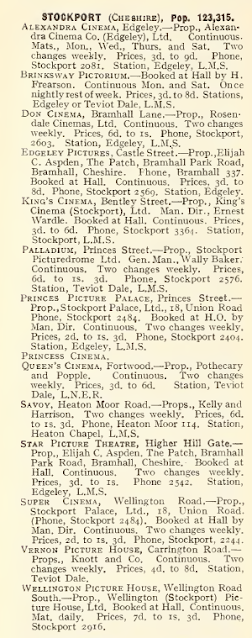
The Stockport 13 …….. going to the flicks in 1929

It is 1929, and had I lived in Stockport I would have had a choice of 13 picture houses to visit, which was not bad for a population of 123, 315.

The Stockport 13, 1929

But then this was the age of cinema, when for a comparative small amount of money, you could sit in a warm “picture palace” and get lost in lavish musicals, romantic comedies, and exciting adventures starring the hot throbs of the period.

And I am reminded of this long lost bit of recent history by Andy Robertson’s photograph of the Wellington Picture House.

According to that excellent site of lost cinemas, it opened on July 11th 1921 with Hay Foxhall in ‘Only a Mill Girl’. 

“The corner entrance has a dome, which was originally topped by a cupola. Seating in the auditorium was provided in stalls and circle levels. 

The proscenium was 28 feet wide. The Wellington Picture House also contained a 13-table billiard hall and a café.

Independently operated, it was last operated by the Essoldo Cinemas chain who took over in 1948. Bingo was introduced for one day a week in 1961, and the Wellington Cinema was closed on 31st August 1963 with Hayley Mills in “Pollyanna”.

It was converted into a full time Essoldo Bingo Club, later becoming a Ladbrokes Bingo Club, and finally a Walkers Bingo Club. In recent years it has become a Riley’s snooker hall, which closed in 2012.

Local campaigners are trying to raise £500 to have a Blue Plaque placed on the building. 

It was still vacant and abandoned in the summer of 2021”*

And that is it, although I may go back and visit some of the cinemas from 1929

The Wellington Picture House, 2021

Location; Stockport


Pictures; list of Stockport cinemas, 1929 from the Kinematograph Year Book 1929, and the Wellington Picture House, Stockport, 2021, from the collection of Andy Robertson

* cinema Treasures, http://cinematreasures.org/theaters/36714